
Mass Effect: Andromeda Collector's Edition Guide Introduction
Milky Way Species
In the Mass Effect universe, the Milky Way is home to numerous sapient and technologically advanced lifeforms. However, only a few of these species are represented in the Andromeda Initiative’s ambitious voyage.
While Mass Effect: Andromeda takes place in an entirely new and unexplored galaxy, the story focuses on the journey of the following sentient Milky Way species. (Although other Milky Way species such as the quarians and hanar may be involved with the Initiative, they have yet to arrive at the Heleus Cluster.)
Human

Physiology: When compared to the other Citadel sentient species, humans are: physically stronger than salarians, slightly less dexterous than asari, and when in optimal shape, they can overpower a turian. The average turian and the average human are usually evenly matched in terms of physical combat. Most krogan dwarf the average human.
Unlike the asari, humans are not born with biotic abilities, but roughly one in ten human infants exposed to element zero (the material involved in manipulating mass effect fields) can potentially develop an aptitude in biotics later in life. Additionally, exposure to “eezo” carries a significant health risk.
Humans can live to up to 150 years in optimal conditions, and since they’re relatively new to advanced medical technology, the average human life span is expected to increase considerably.
Notable Historic Events: Humans were the latest of the sapient species to discover mass effect travel technology. In 2149, Charon, one of Pluto’s moons, was revealed to be an ancient and awesome device—a mass relay. Probes that were sent in to investigate the Charon Relay curiously vanished upon entry. Of course, the only definitive way to determine the relay’s destination was to send people through it.
A team of ambitious Alliance members, led by Jon Grissom, volunteered to take the risk and make the leap into the relay. The endeavor led them 36 light-years away from their origin, to a system called Arcturus. Alec Ryder (human Pathfinder of the Andromeda Initiative), was a crewmember of this task force, making it the first of his major contributions as a pioneer of humanity.
Years later, humanity (not realizing there was a galactic community beyond Arcturus) runs into trouble as they unknowingly break the Citadel law of activating disabled relays put in place as a defensive measure against hostile invaders like the rachni.
The turians, peacekeepers of Citadel space, detect the relay activation and respond aggressively. They view their act of aggression as justifiable punishment upon the humans. The human fleet retaliates, lashing out with a surprisingly effective counterattack, successfully destroying several turian ships. This escalates the conflict into a war with many battles taking place on the human colony, Shanxi.
Although Shanxi is occupied by turian forces, it’s eventually liberated by the Second Fleet. To prevent further bloodshed and an intergalactic species war, the Citadel Council intervenes before the turians can launch another attack.
Impressed by the Alliance’s decision-making capabilities and adaptations to their aggressors, the Citadel Council mediates a truce. This marks a major milestone for humanity as they learn of an established intergalactic governing body. However, high tensions persist between the two species, with activist groups forming in both camps. Around this time, an eventually significant turian named Saren develops a particular hatred for humans.
Prominent Humans in the Mass Effect Universe: Commander Shepard, Miranda Lawson, David Anderson, Alec Ryder, Scott and Sara Ryder, Liam Kosta, Cora Harper
Asari
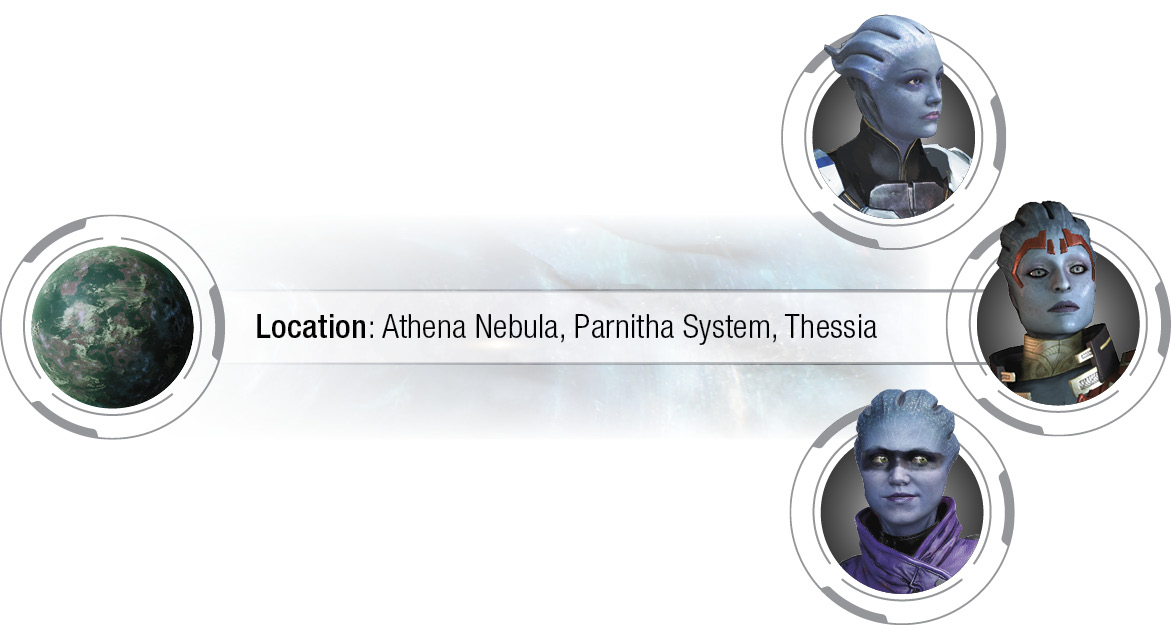
Physiology: Out of all of the known sapient species, asari are the most comparable to humans. The two species share several commonalities, including five like-sized fingers on each hand. Their comparable physical dimensions allow them to share clothing and armor. While the asari are a mono-gender species, their voices and physical features strongly resemble those of a human female and they’re usually referred to with feminine nouns.
Aside from physique, asari are wildly different from humans (and most other species) in terms of cellular regeneration and sexual reproduction. With a much lower cellular decay rate, asari can naturally live for over 1,000 years. However, the most fascinating aspect of asari biology is their reproduction process—a process referred to as “melding.”
Even though they only have a single gender, asari still require a partner for the melding process (they’re not asexual). Melding always produces an asari offspring, since no DNA from the partner is taken. Instead, -the asari virtually synchronizes her nervous system with her partner’s, proceeding to map and instill the partner’s desirable traits onto her offspring.
All asari are born with biotic capabilities that can be unlocked and developed later in their lives.
Notable Historic Events: The asari were one of the first Milky Way species to develop interstellar travel and, in 500 BCE, they became the first modern species to discover t the Citadel—humanity’s first encounter with the council doesn’t occur for another 2,700 years.
Thanks to their long life spans, the asari naturally have long-lasting and powerful influences over other species, culturally and intellectually. By welcoming advanced species into their community, the asari are confident that they can inevitably instill their beliefs and ideals into other cultures.
During the Reaper War in 2186 CE (Mass Effect 3), it’s revealed that the Athame Doctrine (an asari religion) was actually a myth invented by the Protheans. The religion was designed to support asari beliefs that they were gifted with natural abilities by a goddess, when in reality, they were culturally nurtured by the Protheans for generations. The asari government refused to disclose this information until they were forced to during the Reaper assault.
Prominent Asari in the Mass Effect Universe: Liara T’Soni, Samara, Aria T’Loak, Pelessaria “Peebee” B’Sayle, Lexi T’Perro
Turian

Physiology: Turians are a relatively slender, raptor-like species, with distinct and intimidating “spiky” features, including mandibles and talons. They’re typically taller than average specimens of other species, with the average adult being over six feet tall. Turian vocal cords produce a noticeable “phasing” effect (as if they have more than one pair of vocal cords).
As their appearances suggest, turians are carnivorous, naturally possessing anatomic tools for flaying, tearing, and chewing flesh. Interestingly, the turian digestive system has been compared to those of the birds on Earth, unable to process food that other humanoids can digest.
A typical turian life span is comparable to that of a human.
Notable Historic Events: Turian civilization spans over 15,000 years (over twice that of humanity). They fought in the Krogan Rebellions and the First Contact War: These are only two examples. The turians are peacekeepers.
With the help of interstellar travel, turian colonies quickly developed across the galaxy, distancing themselves from the Turian Hierarchy (their governing body) and becoming tribal. The inevitable civil war that sparked between these distant and isolated tribes lasted for several years, eventually culminating in a peaceful resolution as the Turian Hierarchy intervened and forced the rogue colonies’ allegiance.
Years later, during the Krogan Rebellions, the turians deployed a salarian-made biological weapon known as the genophage, a bioweapon designed to target and cripple krogan reproduction. As the bioweapon’s name suggests, its destructive effects nearly caused krogan extinction.
Prominent Turians in the Mass Effect Universe: Garrus Vakarian, Saren Arterius, Vetra Nyx
Krogan

Physiology: Contrasting turian evolution, krogan physiology evolved toward protection against predators, with wide-set eyes that allow for a much wider field of view and improved threat detection. Krogan adults generally reach over seven feet in height. While they aren’t as agile as asari and humans due to their thick and heavy hides, they’re extremely durable and near invulnerable to laceration. Thick hides mean heavier specimens—krogan weight can range from roughly 300 to 800 pounds. While wearing their battle armor, certain individuals can weigh over a ton.
Krogan “blood rage” isn’t just a colloquial term for a livid krogan in battle. It’s a genuine, trigger-able genetic condition present in all modern krogan. In the harsh environment of a self-inflicted nuclear winter, krogan with blood rage found it easier to fight for survival.
During a krogan’s blood rage, they lose the concept of pain but also lose all rational thought. Although they become a torrent of undying fury during the madness, it can result in their deferred death as they succumb to their unfelt wounds.
Another interesting component to krogan biology is their organ redundancy (a sort of backup system). For instance, krogan have two hearts in case one fails. Interestingly, male krogan have four testicles, so when a krogan uses the term “quad,” they’re referring to their testicular fortitude.
Notable Historic Events: Unsurprisingly, modern krogan aren’t as concerned with science as they are with combat. However, archeological excavations reveal that ancient krogan culture contrasted this militaristic characteristic. On their home world of Tuchanka, the ancient krogan were once a society with proclivities in art, architecture, technology, and culture. Evidence also shows that these krogan ancestors worked toward advancements in seismic-resistant architecture—presumably designed to protect against and coexist with thresher maws instead of simply trying to eliminate them.
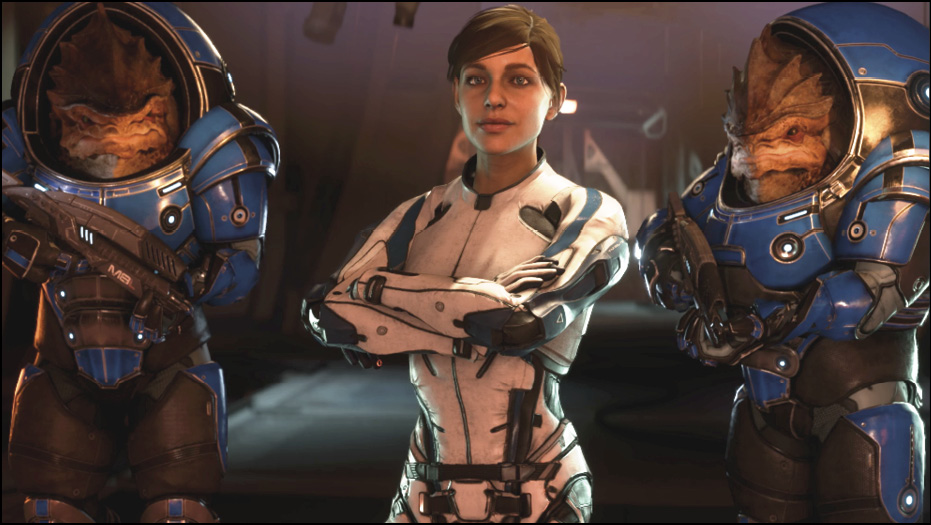
These ancient krogan became vulnerable to their industrial advancements. In conjunction with their naturally high birth rates, their newfound ease of survivability resulted in overpopulation. Hence, conflict over limited resources arose as the population aggressively continued to expand throughout Tuchanka. Eventually, the war for resources escalated into a globally decimating nuclear ecocide. Tuchanka was transformed into a radioactive hellscape, and the krogan were sent back to a proverbial stone age.
During a seemingly unwinnable war with the rachni (a hostile insect-like species), the Citadel salarians came up with an ingenious plan involving the now-primitive krogan in order to defeat the rachni. Since reaching the heart of the rachni hive was impossible for the fragile Citadel species, the salarians recruited the krogan by elevating them out of their primitive state. The krogan were given advanced salarian tech and transported off of the desolate wasteland that they once called “home.”
The plan worked to perfection. Krogan resilience afforded them the ability to withstand the extreme environment of Suen, the rachni home world. The battle-hardened warriors successfully pursued and exterminated the rachni queens, resulting in the insectoids’ extinction.
Although the krogan are celebrated for their contributions, they would later become victims to salarian ingenuity and the turians’ militant and callous ways.
Prominent Krogan in the Mass Effect Universe: Urdnot Wrex, Patriarch, Nakmor Drack, Nakmor Kesh
Salarian
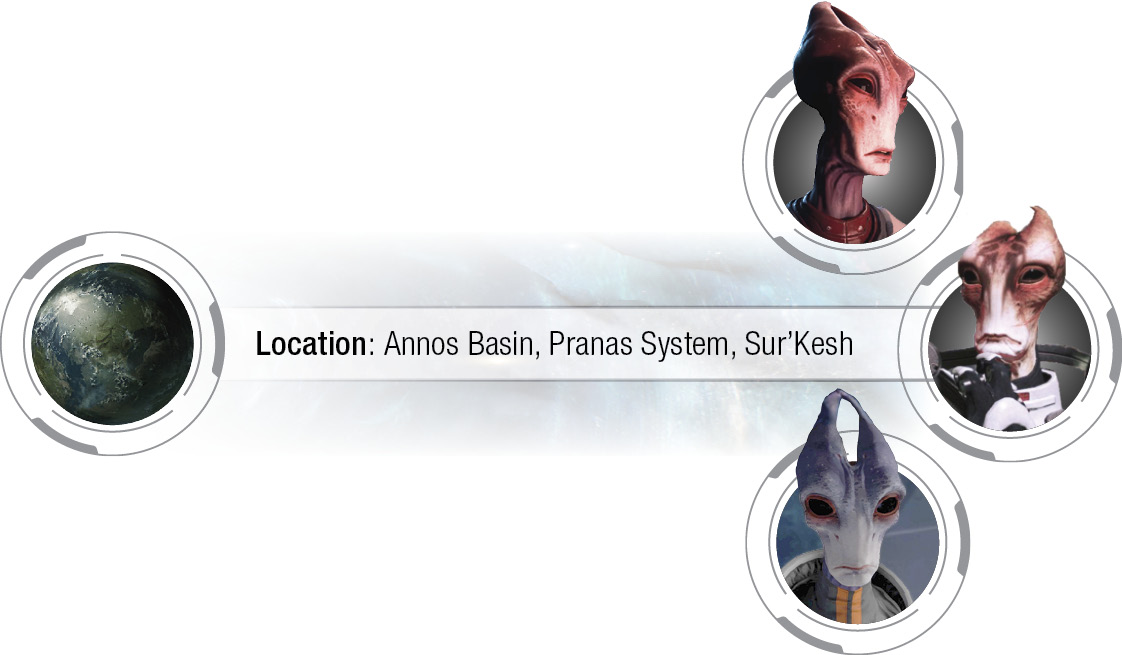
Physiology: Unlike the krogan and turians with their intimidating animalistic features, the salarians appear unassuming; they’re thin amphibian bipeds with modest horns protruding directly from the tops of their distinctly divided skulls. Salarians have exceptionally large eyes, which are covered by a thin membrane, and they noticeably blink with their lower eyelids (as opposed to how humans close their upper eyelids).
Salarians have eidetic memory, and talented individuals are able to hone and improve on this. Additionally, they have a relatively high metabolic rate that is easily noticed from their hyperactive speech and mannerisms. Unfortunately, their metabolic rate also means that they have shorter life spans than the average intelligent lifeform, with a life expectancy of around forty years.
As amphibians, salarians are an egg-laying species. Gender of their offspring is determined by the haplodiploidy system—unfertilized eggs develop into male (haploid) salarians, and fertilized eggs result in hatching females (diploid).
Notable Historic Events: According to the last living Prothean, salarians were a once-primitive species, classified by the Protheans as simply “lizard people.” Fifty thousand years later, they would independently develop sufficient technology to traverse the stars and colonize three interstellar settlements.
Salarians are brilliant operation strategists as evidenced by their contribution to the eradication of the rachni species during the Rachni War. The salarians devised and flawlessly executed a plan to both elevate the entire krogan species out of their cultural depression and to then convince those krogan to finish off the rachni.
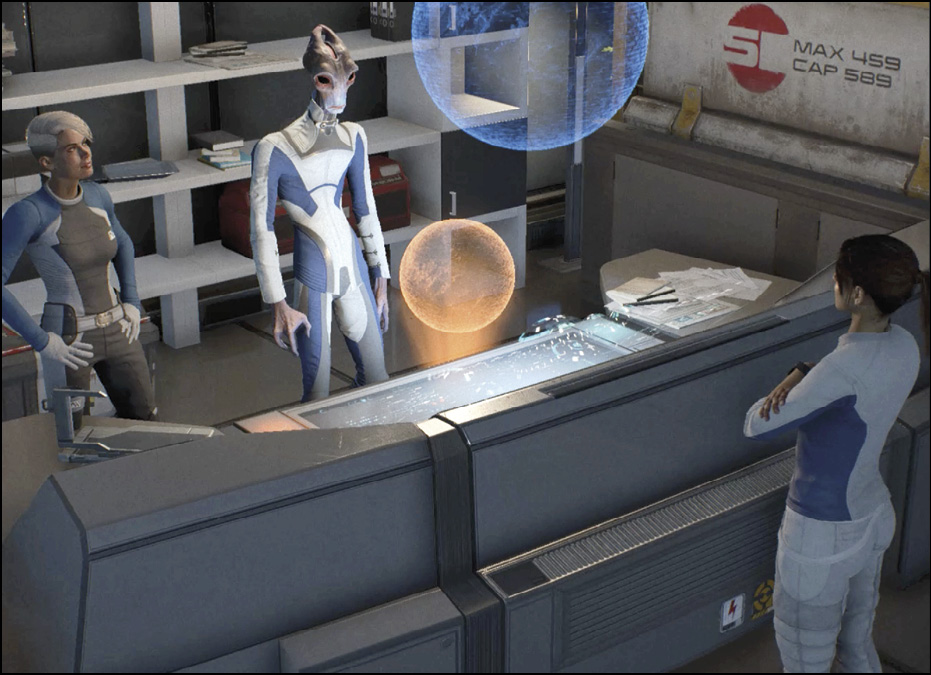
The salarians realized defending against the rachni was a futile endeavor, and the only way to defeat them was to cut off the head of the hive: the queens. The problem lay in the rachni’s home world and lair; the environment was dangerously toxic to most lifeforms—except the krogan, thanks to their adaptation to extreme conditions and resilient protective hides. The krogan penetrated the rachni lair, hunting down and successfully eliminating the queens. A once-dispirited krogan species suddenly became war heroes and glorious defenders of the Citadel species.
As a counter-measure against aggressive krogan expansion, the salarians developed the genophage.
Prominent Salarians in the Mass Effect Universe: Mordin Solus, Major Kirrahe, Kallo Jath, Jarun Tann