
Mass Effect: Andromeda Collector's Edition Guide Developer Interviews and Concept Art
Joanna Erbach (Technical Artist)
Joanna Erbach Senior Technical Artist
FAVORITE MOVIE?
Paprika (Satoshi Kon)
FAVORITE ALL-TIME GAME?
Neverwinter Nights
FAVORITE BOOK?
Fire in the Mist by Holly Lisle
BIGGEST HOBBY?
Painting, writing fiction, and creating worlds. I’m working on a series of tarot digital paintings based on the setting for a joint writing project with my partner.
SECRET?
Dark chocolate peppermint bark.
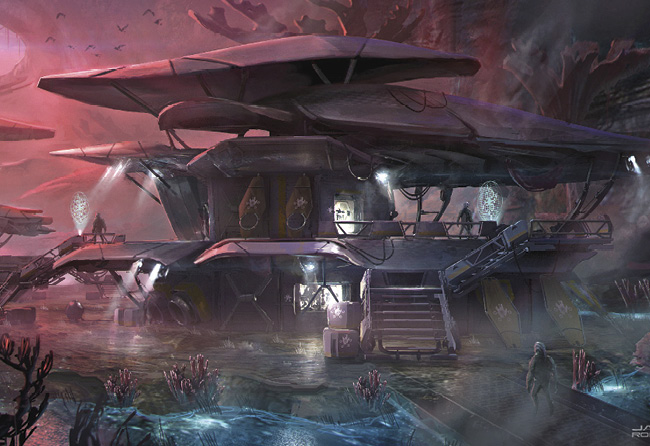
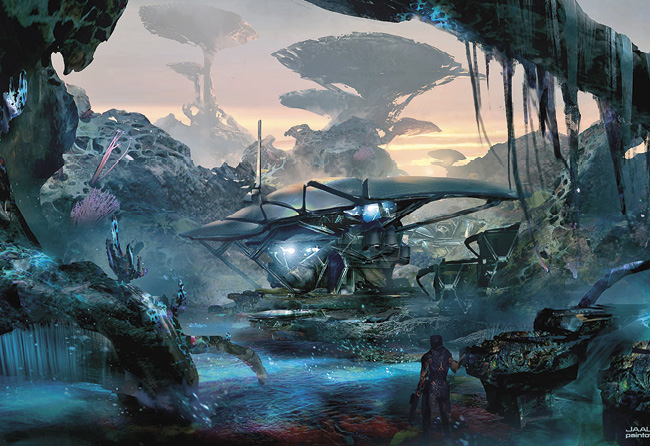
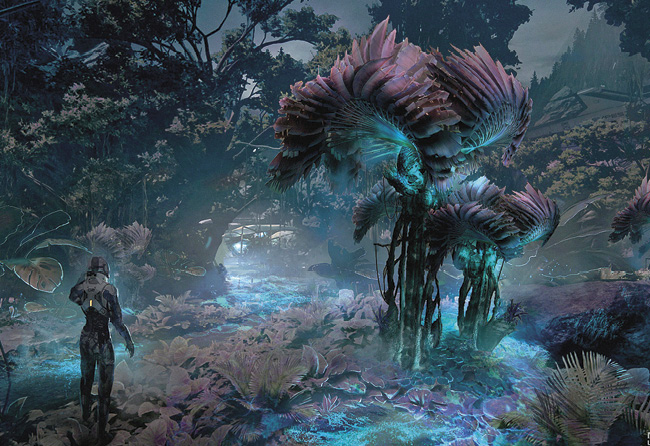

HOW DID YOU FIRST BECOME INTERESTED IN A CAREER IN VIDEO GAMES?
It’s Robyn Miller’s fault. When I was about 10, my father showed me an article about the production of Myst. I read that Miller got to design his own worlds, all the fantastical architecture and landscapes, then write the stories behind it. My parents bought me Virtus Walkthrough, an early 3D design program, and UltraPaint, a Mac image editing program. Virtus was so primitive it didn’t even have textures. Still, I loved it. This was what I wanted to do with my life.
HOW LONG HAVE YOU BEEN ON THE TEAM?
Mass Effect: Andromeda is my first game with BioWare. I’m proud to be here.
GIVE THE READER AN IDEA ABOUT YOUR DAY-TO-DAY TASKS.
I work with lighting, world maps, and procedural tools. On a given day, I might load one of our levels, select the parts that should appear on the map, and run the Houdini tool I created to process that geometry into a map. I work with the level artists to solve their lighting problems. They might send me a place where certain rocks appear black, or all the furniture appears brighter than the walls, and I’ll debug the problem. I also help prototype our HDR color grading—that’s a final pass after each frame is rendered to give it film-quality color on everyday monitors and high-end HDR screens.
WHAT WAS YOUR FAVORITE ASPECT ABOUT THE PROJECT?
Seeing the evolution in the art and level design as we worked. Some of the worlds look very different in the final game than they did in our early builds. I remember trying to navigate the Nomad through some narrow canyons on a desert world before the driving controls were finalized. One time, we had an animation bug that made the wheels seem to fold up into the cab of the vehicle and it skimmed across the sand like a stone skipping on water. The lighting evolved as well. One morning, I discovered that the color of the sun was completely different or there was an orange haze over everything. Each time it would look a little better.
WHAT WAS YOUR TRICKIEST TASK AND HOW DID YOU SOLVE IT?
Probably the hardest thing was hooking up Houdini to the Frostbite engine to create procedural tools without dev resources or real-time feedback. I had to create tools that were simple enough to be used by an artist who’d never touched Houdini without changing the code of the engine. Technical constraints prevented real-time feedback like immediately seeing the generated geometry update once I moved a proxy object in the Frostbite engine. So I had to create the fabled “Do it!” button and make sure it ran fast enough to avoid frustration from the designers.
WHAT ARE YOU MOST PROUD OF CONCERNING THE GAME?
The world maps, especially the ones for our uncharted planets. They use voxels, so unusual rock features like arches and overhangs can be portrayed correctly. I worked with art direction and another technical artist to tweak the holographic look to perfection.
HOW HAS THE TEAM CREATED THE LOOK AND FEEL IN MASS EFFECT: ANDROMEDA?
The team spent a lot of time studying and recording unusual things in the real world to inspire the alien lifeforms of Andromeda. Some of the level artists traveled to Iceland to capture source material of volcanic rocks. Odd plants and animals inspired the artists while designing alien foliage.
WHAT DESIGN LENGTHS HAVE THE TEAM GONE TO IN CREATING THE SHIP?
We worked hard to get the right lighting on the Tempest. The ambiance needed to change in real time as the Tempest travels from planet to planet, and the lights on the ship needed to dim and brighten for certain cutscenes like the romantic encounters. However, dynamic lighting has a high performance cost, so we created a combination of static and dynamic lights, depending on the room.
WHAT TYPES OF CHOICES WENT INTO CREATING THE WORLDS AND LOCATIONS OF MASS EFFECT: ANDROMEDA?
It’s all about balancing how much fun the game is to play, how big we can make it, and how good it looks. If one of those is neglected, we end up with a worse result. We have a limited number of artists, so part of my job is to create tools that help them work more efficiently. If we can automate the most annoying parts of asset creation and level design, it frees them up to concentrate on the parts of the game that really matter.
WHAT ARE SOME OF THE CHALLENGES IN DESIGNING THE FUTURISTIC LANDSCAPE FOR A GAME LIKE THIS?
Gameplay balance requires that the player be well-matched against most of the aliens they meet, and that the final challenges feel epic enough to be worth pursuing. Even in a universe where alien races have far more advanced technology than humans, the story needs to focus on the aspects that the player can affect. The same goes for alien species with different life spans from humans—the psychology of their characters must be similar enough to the player to form a meaningful bond. It helps that there is a lot of trade and ideas exchanged among the primary races, which lets them develop conventions of communication and common architectural standards. Andromeda technology hasn’t been designed with humans in mind, so the scale of buildings and doorways does not match the human physique.