
The Elder Scrolls Online: Morrowind Guide Adventuring Across Tamriel Items of Note and Interest
Crafting Materials
Alchemy
CRAFT: Potions, Poisons
Solvents
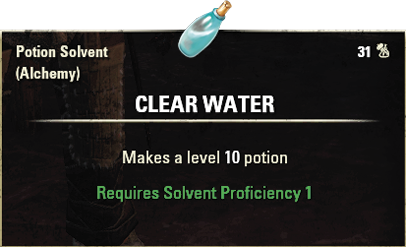
Solvents serve as the base when formulating potions and poisons at an Alchemy Station. Look for Water Skins and Pure Water spots in bodies of water to find Potion Solvents, while various enemies, such as Ogres and Trolls, drop Poison Solvents. As you progress through higher-level zones, the solvents found create more potent products, though you must upgrade your Solvent Proficiency Alchemy Passive Ability to use the higher solvents. Note that the solvents you find are based on your current level and Solvent Proficiency.
Reagents
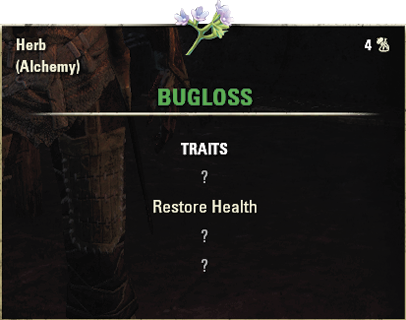
Two or three reagents are added to a solvent to create potions and poisons. Each reagent has four traits that decide the effects of the mixture, but when first found, none are known. Use a reagent straight from the Inventory screen for a chance to learn a trait. Create a successful formula to learn that trait for all reagents used. Note that if all reagents used do not share a common trait, the formula fails and the items are lost.
Beetle Scuttle, Butterfly Wing, Fleshfly Larva, Mudcrab Chitin, Scrib Jelly, Spider Egg, and Torchbug Thorax are dropped by small creatures. The rest can be found growing in the wild.
Blacksmithing
CRAFT: Metal Weapons, Heavy Armor
Ores and Ingots
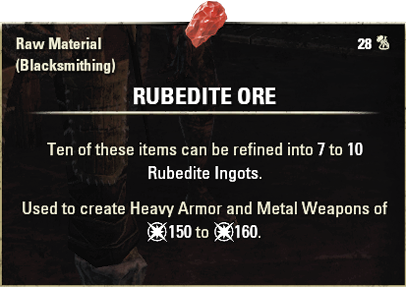
Blacksmithing allows the player to create metal weapons and heavy armor at Blacksmithing Stations. Mine ore nodes found throughout Tamriel and use the station to refine 10 ores into the matching ingots, which are then used in the production of the metal equipment. Your rank in the Metalworking Passive Ability and current level determine the type of ore available for mining and crafting.
Tempers
When improving heavy armor or metal weapons at a Blacksmithing Station, add tempers to improve the quality. Using one temper gives a small chance to successfully improve the item with the risk of losing the item if unsuccessful. Add tempers to improve the chances up to a 100% chance. Ranking up the Temper Expertise passive also improves your chances.
Clothing
CRAFT: Light Armor, Medium Armor
Clothing Materials
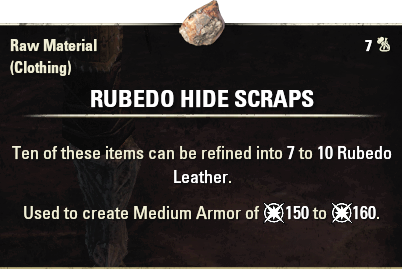
Collect raw materials and use a Clothing Station to refine them. Light armor raw materials, such as cloth, is found by harvesting plants, while medium armor raw materials, such as leather, are looted from certain monsters and critters. Then use the station to create light and medium armor pieces. Separate materials are used for light and medium armor. Your rank in the Clothing Tailoring Passive Ability and current level determine the type of material available for picking and crafting.
Tannins
When improving light or medium armor at a Clothing Station, tannins are added to improve the quality. Using one tannin gives a small chance to successfully improve the item with the risk of losing the item if unsuccessful. Add tannins to improve the chances up to a 100% chance. Ranking up the Tannin Expertise passive also improves your chances.
Enchanting
CRAFT: Glyphs
Runestones
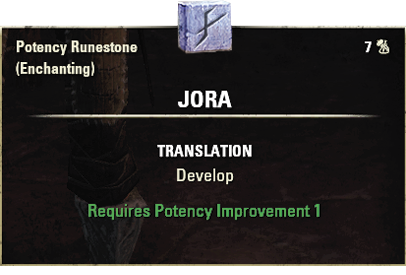
Chisel Potency, Essence, and Aspect Runestones out of rock Runestones scattered around Tamriel. Look for the red glow to light the way. Take the Runestones to an Enchanting Table, where they can be combined to create armor, jewelry, and weapon glyphs, which can be used to enchant your gear.
Start with a Potency Runestone to decide the equipment level and whether the glyph is additive or subtractive. An Essence Runestone decides the effect of the glyph. The Aspect Runestone gives the glyph its quality.
Provisioning
CRAFT: Food, Drink
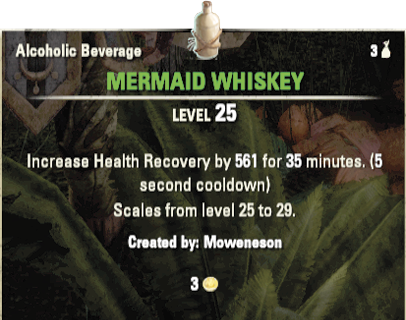
The Provisioning crafting skill allows the player to create food and drinks. Food increases Maximum Health, Stamina, and/or Magicka, while drinks increase recovery of the three. Provisions are created at Cooking Fires, which can be found in and outside of town.
Recipes
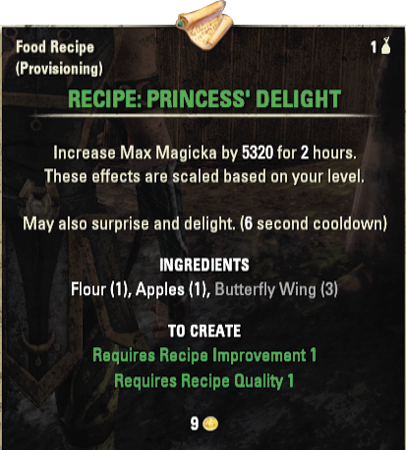
A recipe, purchased from Merchants or found around town, must be learned before it can be crafted at a Cooking Fire. Use the recipe to learn it, and then head to a fire with the required ingredient(s). Learning and crafting food and drinks adds Experience to the Provisioning skill line.
Upgrading the Recipe Quality Passive Ability allows for higher-quality recipes to be created, while Recipe Improvement decides the level of recipes that can be created.
Woodworking
CRAFT: Bows, Staves, Shields
Wood
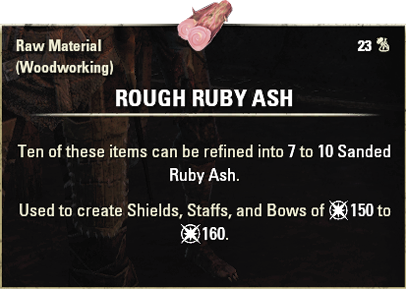
Collect woods in the wild, such as maple and ash, and refine it at a Woodworking Station. Use the station to create bows, staves, and shields with the refined woods. Your rank in the Woodworking Passive Ability and current level determine the type of material available for picking and crafting.
Resins
When improving bows, staves, and shields at a Woodworking Station, resins are added to improve the quality. Using one resin gives a small chance to successfully improve the item with the risk of losing the item if unsuccessful. Add resins to improve the chances up to a 100% chance. Ranking up the Resin Expertise passive also improves your chances.
Materials
CRAFT: Blacksmithing, Clothing, Woodworking
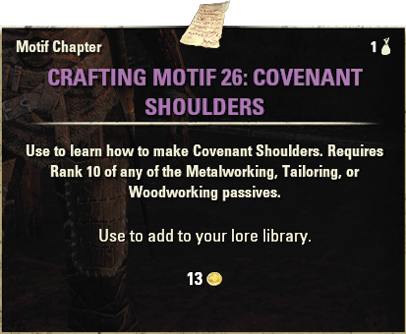
When creating apparel or a weapon at a Blacksmithing, Clothing, or Woodworking Station, a style must be selected to create the equipment in that fashion. Each requires knowledge of that style gained by using the appropriate Motif Book and the corresponding style material. The initial 10 materials may be purchased at Blacksmiths, Carpenters, Clothiers, and Stylemasters for 15G each.
Use a Motif Book to learn a new crafting style. Many styles requires a specific rank in any of the metalworking, tailoring, or woodworking Passive Abilities.
Raw materials may be found for select styles that must be refined at a crafting station into the desired style material. For example, Coarse Chalk is refined into Fine Chalk, Dwemer Scraps become a Dwemer Frame, and Malachite Shards turn into Malachite.
Glass Style
Ten Glass Style Motif Fragments and a Merethic Restorative Resin, available from Mystic Merchants, are required to create a random Glass Style Motif Chapter. The fragments are extremely rare rewards from high-end writs.
Trait Items
CRAFTING SKILL: Blacksmithing, Clothing, Woodworking
Armor Trait Items
| Trait | Item | Trait Item Name | Effect |
|---|---|---|---|
| Divines |

|
Sapphire | Increases Mundus Stone effects |
| Impenetrable |

|
Diamond | Increases Critical Resistance, and this item takes less durability damage |
| Infused |

|
Bloodstone | Increases armor enchantment effect |
| Nirnhoned |

|
Fortified Nirncrux | Increases Physical and Spell Resistance |
| Prosperous |

|
Garnet | Increases gold gained from looting enemies |
| Reinforced |

|
Sardonyx | Increases this item’s armor |
| Sturdy |

|
Quartz | Reduces block cost |
| Training |

|
Emerald | Increases Experience gained from kills |
| Well-Fitted |

|
Almandine | Reduces cost of sprinting and dodge rolling |
Weapon Trait Items
| Trait | Item | Trait Item Name | Effect |
|---|---|---|---|
| Charged |

|
Amethyst | Increases chance to apply status effects |
| Defending |

|
Turquoise | Increases Physical and Spell Resistance |
| Decisive |

|
Citrine | Chance to gain additional Ultimate when Ultimate gained |
| Infused |

|
Jade | Increases weapon enchantment effect and reduces enchantment cooldown |
| Nirnhoned |

|
Potent Nirncrux | Increases damage of this weapon |
| Powered |

|
Chysolite | Increases healing done |
| Precise |

|
Ruby | Increases Weapon and Spell Critical values |
| Sharpened |

|
Fire Opal | Increases Physical and Spell Penetration |
| Training |

|
Carnelian | Increases Experience gained from kills |
Weapons, armor, and jewelry are not only improved with an enchantment; a trait can be added for another effect. Traits often come “pre-loaded” on dropped and purchased gear, but can also be applied at Blacksmithing, Clothing, and Woodworking Stations. Just as with enchanting, only one trait can be used per item.
Similar to adding a style, traits require a specific trait item and the knowledge to apply that trait. Each type of weapon and armor has a set of traits that must be researched at the appropriate station.
Things to remember when researching new traits:
- Researching a trait requires a weapon or piece of armor with that trait
- Only one item can be researched at a time per discipline, unless the appropriate Passive Ability is upgraded
- Researching is done separately for each type of weapon and armor
- The item is destroyed when researched
- Researching a trait takes a set amount of time to complete
- Each discipline has a Passive Ability that reduces research times and allows for more items to be researched at once
| Discipline | Passive Ability |
|---|---|
| Blacksmithing | Metallurgy |
| Clothing | Stitching |
| Woodworking | Carpentry |