
Elder Scrolls V: Skyrim Special Edition Guide Training Training Part 3: Adventuring Across Skyrim
Holds of Skyrim
The Holds of Skyrim
Skyrim is divided into nine separate Holds: Haafingar, Hjaalmarch, the Pale, Winterhold Hold, the Reach, Whiterun Hold, Eastmarch, Falkreath Hold, and the Rift. Each of these Holds has a distinct atmosphere to it, from the Autumnal Forest of the Rift, to the Tundra Plains of Whiterun Hold, to the ragged and rugged Northern Coast of the Pale. You can’t see the borders of these Holds on your world map, but we show them in this guide’s maps. Wherever possible, cartographers have used rivers, roads, and treacherous mountains to separate Holds so it’s easier to find a location in this guide.
Each Hold has a capital city: Solitude, Morthal, Dawnstar, Winterhold, Markarth, Whiterun, Windhelm, Falkreath, and Riften. These are the nine shields (crests) that you can see on your world map. While most Holds contain smaller towns and settlements as well, the capital is always the most important and highly populated location within the Hold and is among the safest places to be (unless it’s under siege during the Civil War, of course).
Habitations
A city, town, or dwelling populated with citizens who are almost always neutral, if not civil and friendly, toward you.
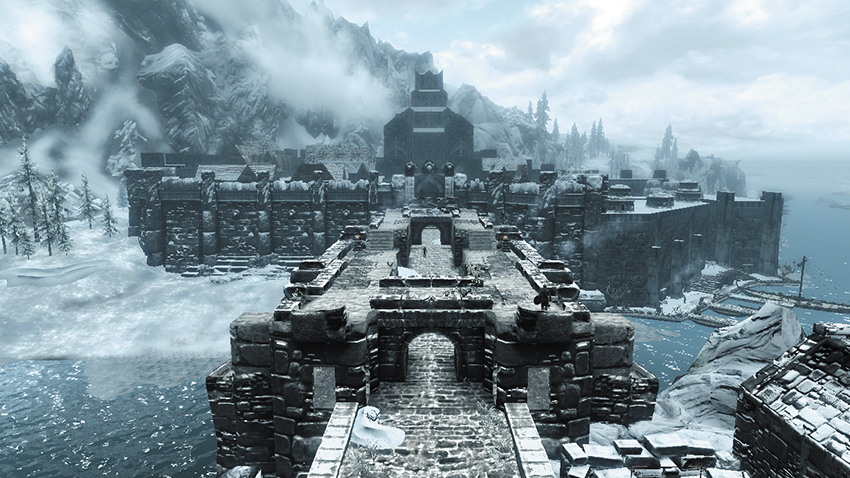
Habitations range in size from a small group of Khajiit Caravaneers to the rugged majesty of Solitude, the sprawling capital of Haafingar Hold. Here, you’re likely to find citizens in need of help (or at least a Favor or two) or who have rumors to share, tasks to accomplish, quests to start, and interactions that test your social skills more than your skill at arms. The major types of habitations are listed in this guide’s Atlas.
Dungeons
A location populated with hostile people or creatures that typically attack you on sight.
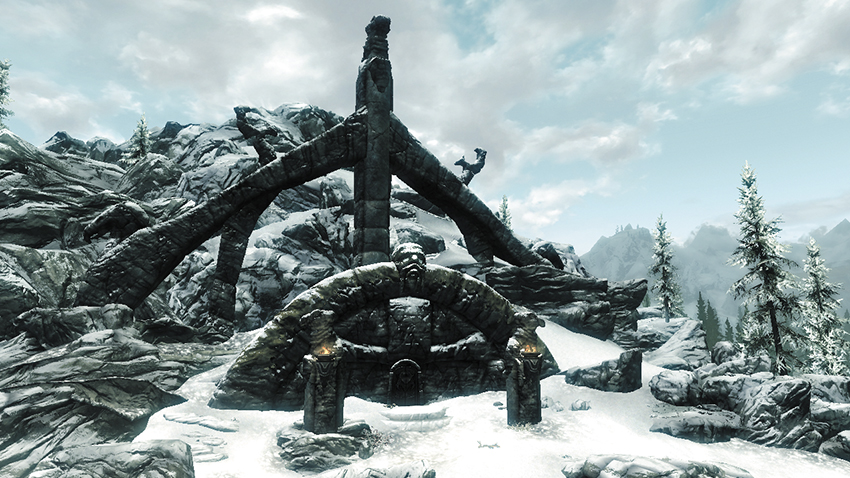
A “dungeon” is a place where you will find exploration and combat. It is an all-encompassing term for a location with usually no friendly faces, a place where you encounter wild animals, brigands, or worse. When you fully explore a dungeon, you typically leave with a reward that makes the harrowing trek worth your time and sanity. Dungeons vary widely in size, from small caves to massive, multistoried ruins. Most have a high-level foe you most defeat (a “boss”), and some even have their own small quests. Others are woven into the larger quests that dominate your adventure.
When you clear a dungeon—that is, explore it and defeat all of the major foes within—your map typically marks it as “cleared.” Some locations cannot be cleared, and others can be cleared only under special circumstances.
Most dungeons will repopulate over time. This can happen in as little as a week for a location you left midway through and may not happen for a month or more (if ever) for a dungeon you have cleared. Note that your map will not indicate when a location has repopulated (once cleared, always cleared), so be careful—you may find enemies where you least expect them.
Other Locations
There are also many minor locations and encounters not flagged on your in-game world map, but all of them are listed on this guide’s map. These are Secondary Locations, usually small shrines, lost treasure chests, tiny campsites, dragon burial mounds, or other odd occurrences that you can stumble upon. There are also World Encounters, small events that occur randomly. This could be anything from a fox chasing some chickens, to a challenge from an Orc, to a Khajiit with a penchant for being economical with the truth....
Mapping and Movement
The realm of Skyrim is vast and foreboding and at times almost overwhelming—there are over 350 Primary Locations to discover! Although you can go where you want, do what you want, and see what you want, it is worth considering the following plans to explore a location more logically:
Plan 1—The Base Camp: Use a location you’ve cleared out or a location you know is safe (such as Riverwood) as a base camp until you’re familiar with your surroundings. Learn how far a new location is from this safe place.
Plan 2—The Landmarks: Look for landmarks when you travel. No matter where you are in Skyrim, you should be able to spin around slowly and spot two familiar landmarks to get your bearings. This is easier in some Holds (such as Whiterun, with its capital and the towering Throat of the World mountain) and more difficult in others (such as the craggy Reach). However, once you know the locations around a big landmark, you can investigate other locations close to it without becoming lost. Also use smaller landmarks such as roadside shrines, bridges, or signposts to remember where you’ve been.
Plan 3—Roads and Paths: You may be tempted to charge off into the wilderness, and this is perfectly fine. But to efficiently discover everything in the area of a Hold, it is worth using the network of roads (cobblestones, with signposts) and pathways (tracks, goat trails, and even foot-tracked snow). These almost always lead you close or directly to a Primary Location. Follow the roads to make a circular trek around a Hold, then return and methodically search areas off this beaten track.
Plan 4—Your Destination Marker: If you select an empty spot on the world map, you can place your own destination marker there. This is extremely useful when used in conjunction with this guide’s Atlas, as there are close to 200 Secondary Locations, which don’t show up on your world map! Simply gauge where a Secondary Location is by comparing the world map to the guide map, place the marker, and head there.
Plan 5—Use the Atlas: This guide has a sizable section revealing every location in Skyrim. Reference the locations and maps in that giant chapter to help you on your way.