
Elder Scrolls V: Skyrim Special Edition Guide Training Training Part 2: Combat, Development, and Crafting
Enchanting
Enchanting
Arcane Enchanting: An Overview
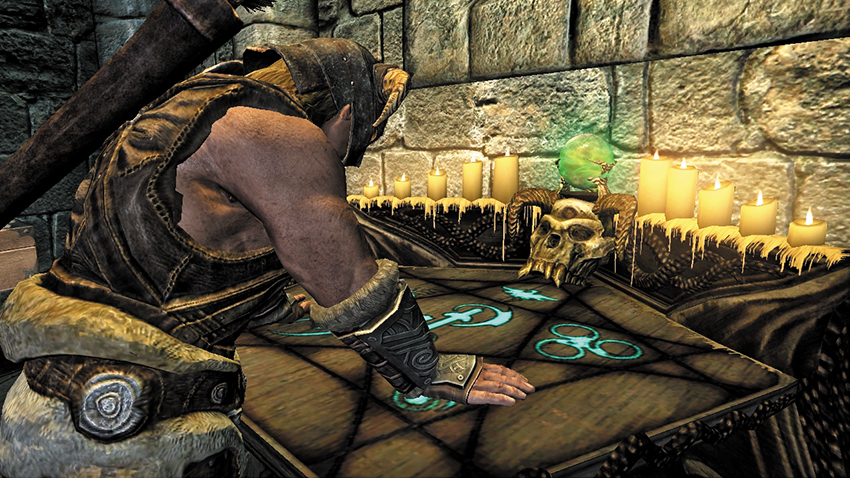
With an Arcane Enchanter, items are both ruined and reborn as new and more powerful objects.
Enchanting requires you to make short-term sacrifices for long-term rewards. The important (and sometimes difficult) choices you make throughout this process determine what items you can create and how powerful they will be. In short, enchanting is the art of imbuing an item with magical enchantments powered by soul energy. However, this is done at the expense of other enchanted items. To enchant an item, you need:
- An enchantment. Before you can imbue an item with an enchantment, you must first learn that enchantment by disenchanting an item with the same base effect.
- A filled Soul Gem. While you can find filled Soul Gems in the world, you can also create them by using an empty Soul Gem and the Soul Trap spell (Conjuration) or a weapon enchanted with the Soul Trap enchantment.
- An unenchanted item. These are easy to find, though you may wish to smith your own in order to have a ready supply of items to enchant.
- The Arcane Enchanter: To enchant an item, you will also need to use an Arcane Enchanter. If you plan to focus on enchanting, locate an Arcane Enchanter you can return to quickly and easily and make a point of visiting it often. Two locations close to your starting point of Helgen are Anise’s Cabin, across the river from Riverwood, and Farengar’s study in Whiterun’s palace of Dragonsreach. Later on, you may want to purchase a house with an Arcane Enchanter.
Disenchanting Items
The only way to learn new enchantments is to disenchant an existing enchanted item. The disenchanting process destroys the original item and teaches you the item’s base enchantment—that is, its fundamental ability (e.g., Fortify Health), not its specific value (e.g., Fortify Health 50). Once you learn an enchantment, you can apply it to as many other items as you wish.
Early on, disenchanting may be a difficult, even painful decision. Enchanted items are both useful and extremely valuable, while the enchantment you learn does nothing in and of itself. You should definitely use enchanted items you find, rather than rush to disenchant them all. But when you outgrow an item or find something you aren’t interested in, consider disenchanting it instead of selling it—you’re making an investment in your future.
It is important to remember that you learn only the base (or general) enchantment and not the specific enchantment that appears on the item. Because of this, disenchanting a more valuable item doesn’t give you a better enchantment, as these examples show:
The conclusion? That to start with, at least, it is better to destroy a low-value item rather than a high-value one, especially if you want to use or sell the higher-value item.
However, there is one advantage to disenchanting more expensive items: disenchanting helps increase your Enchanting skill, and your skill will increase faster when you disenchant a high-value item than when you disenchant a lower-value one.
If you plan to focus on enchanting, disenchant enchanted items early and often, as soon as they’re no longer of use to you, to quickly build your repertoire of effects. If you’re coming to enchanting at a later level (20+), you may want to disenchant higher-valued items to help your skill advance more quickly. You can only learn each base enchantment once, so don’t expect to disenchant your way to 100.
Soul Gems
Acquiring Soul Gems
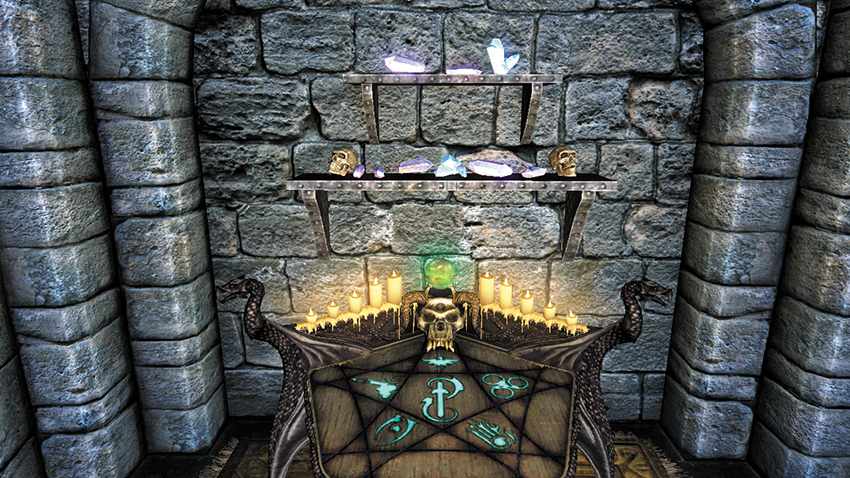
A collection of Soul Gems, just ready to be gathered up and filled.
You can acquire Soul Gems in a number of ways:
- Purchasing filled Soul Gems: You can buy filled Soul Gems from merchants. However, this is an extremely expensive proposition, as a filled gem is three to four times more expensive than a comparable empty one.
- Purchasing empty Soul Gems: If you need to buy a Soul Gem, you’re better off purchasing an empty one and filling it yourself. Although this takes a little more work, the savings can help you break even (or even turn a profit) on the item you enchant.
- Finding Soul Gems: An even better option is to find (or steal) the Soul Gems you need:
- Any Dwarven city, warlock den, vampire lair, or Nordic ruin will usually have Soul Gems lying around. Enemies in these areas (especially Dwarven Automatons) often carry Soul Gems as well.
- There are several areas in the College of Winterhold where you can simply take Soul Gems for free.
- Or you can steal them from other mages, such as the Court Wizards or the mages of the College.
Filling Soul Gems
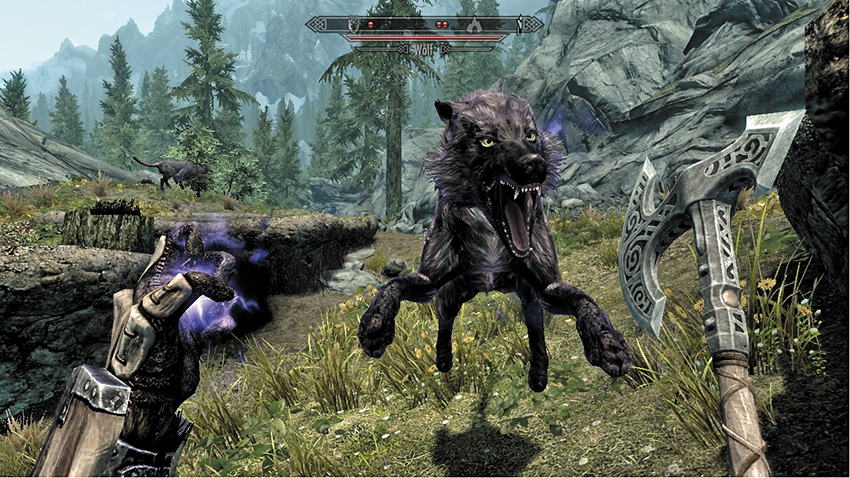
A successful Soul Trap captures a wild animal’s essence for your arcane antics.
In order to trap a creature’s soul in an empty Soul Gem, you will need either:
- The Soul Trap Spell: Cast this spell on a creature and kill it before the spell wears off to snare its soul. If you plan to focus on enchanting, purchase this spell from Farengar, the Court Wizard of Whiterun, as soon as possible.
- A Soul Trap Enchantment: If casting Soul Trap becomes a nuisance, look for a weapon with the Soul Trap enchantment imbued in it. Then all you need to do is slay the creature using the weapon to capture its soul. You can obviously enchant a weapon for this purpose, as well as find one.
Chaos Enchantments
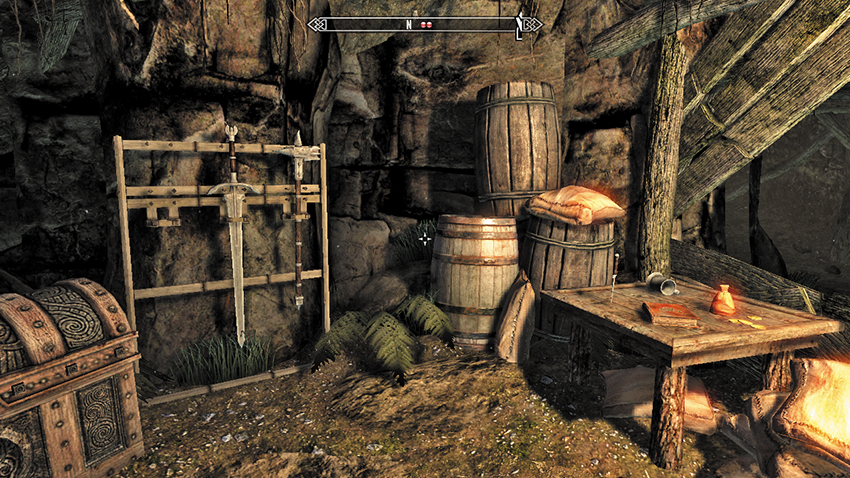
This selection of weaponry looks good enough to try your enchanting on.
Unenchanted weapons and armor can be obtained in one of three ways:
- By purchasing them: This is obviously the fastest and most straightforward option, as most merchants have a wide variety of unenchanted items for sale. However, if you hope to turn a profit with your enchanting, you’ll need a high Speech skill (in order to barter the prices down), or the merchant’s cut (both when you buy the original item and then sell the enchanted version of it back to them) will leave you with a loss, not a profit.
- By finding them: This is a much better plan. Simply grab them while on your travels.
- By smithing them: True artisans should consider smithing their own weapons and armor (on a forge), enchanting them, improving them (on a grindstone or workbench), and then selling them for incredible profits. If you’re not motivated by money, smithing also allows you to create and enchant exactly the item you want.
Enchanting
Enchanting a Weapon
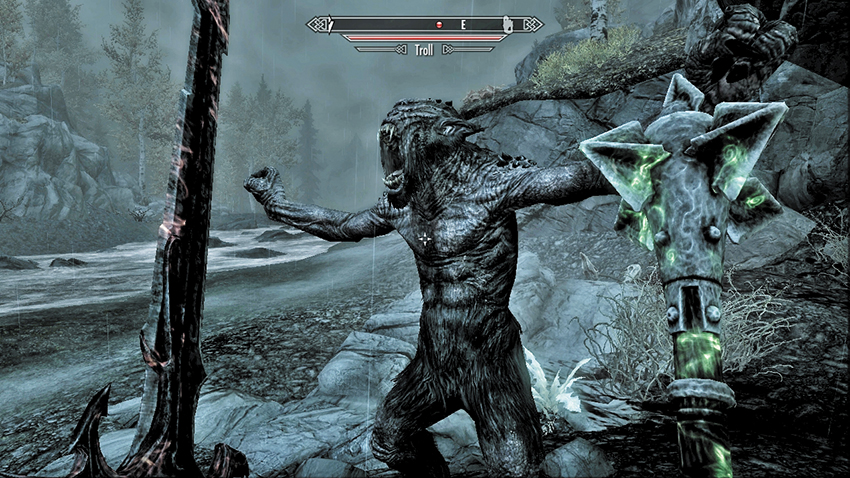
The tell-tale glow of an enchanted weapon, made stronger by a professional imbuer!
Now that your preparations are complete, journey to any Arcane Enchanter with the items you wish to enchant in your inventory. Select the weapon and the Soul Gem first, and then pick the enchantment. This is important, because the type of Soul Gem you use has a huge impact on the next decision you must make: how strong to make the enchantment. Remember, enchanting is all about choices!
Enchanted Weapons and Charges
All enchanted weapons have charges. These represent the amount of soul energy that remains within the weapon. When all of an item’s charges are expended, the weapon’s enchantment ceases to function (and it essentially becomes a “normal” or unenchanted weapon) until you recharge it.
Think of this as a formula: Charge Capacity ÷ Enchantment Cost = Charges.
Charge Capacity: The item’s capacity is determined by the strength of the soul used during the enchanting process. For example, a Grand Soul Gem containing a Grand Soul has a greater capacity than a Petty Soul Gem containing a Petty Soul. Note that capacity is determined by the soul, not the gem—a Grand Soul Gem containing a Petty Soul is no better than a Petty Soul Gem with that soul.
Enchantment Cost: The item’s Enchantment Cost depends on three factors:
- Inherent strength. Some enchantments are simply more powerful (and thus more expensive) than others.
- Selected strength. When you select a weapon enchantment, you can use the slider to choose how powerful to make the enchantment. The stronger you make it, the higher the cost and the fewer total uses you can get from the item.
- Your Enchanting skill. The higher your skill, the lower the cost and the more total uses you can get from the item.
- The soul and your Enchanting skill also determine the maximum strength of the enchantment you can apply to the item.
- The right balance: This choice is entirely up to you—experiment and see what works best for your play style. If you keep a large supply of Soul Gems on hand, recharging a weapon frequently may not be much of an issue. If you don’t, or keep forgetting to recharge your weapon, a weaker but longer-lasting enchantment may work out better.
Recharging Weapons
To recharge an enchanted weapon, you need a partially or completely depleted weapon and a filled Soul Gem. Select the weapon in your inventory, pick Recharge, and then select the Soul Gem you want to use.
Enchanting Armor
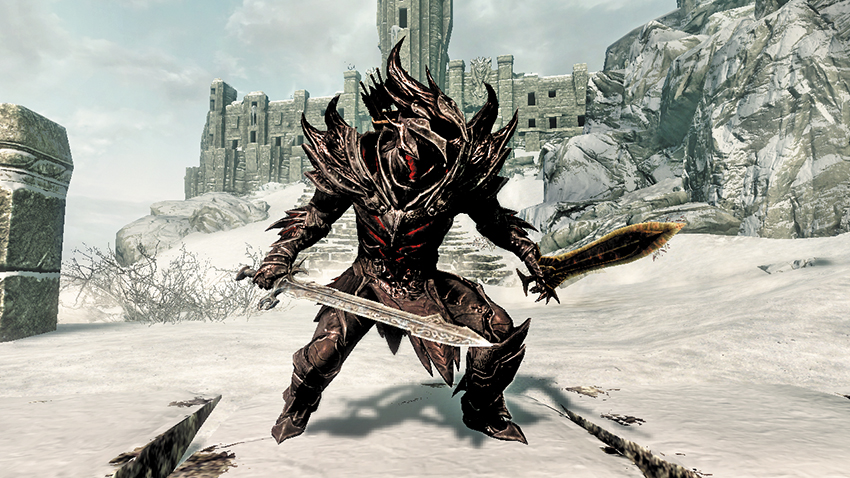
Crafting a set of armor and enchanting it gives you the very best in outfits.
To enchant a piece of armor, visit an Arcane Enchanter with the items in your inventory. Always choose the armor piece first, then the enchantment, and then the soul gem. Enchantment Restrictions: Not all armor enchantments can be applied to all pieces of armor. Sometimes, these restrictions are logical. Muffle (quiet movement) can only be placed on boots. Waterbreathing can be placed on helmets but never boots. But other restrictions are more complex and less obvious. Fortunately, the armor enchantment chart in the Inventory chapter has all the details.
Enchanted Armor Strength: Once you’ve selected a piece of armor and an enchantment you want to apply to it, you still need to choose a Soul Gem. Unlike enchanted weapons, enchanted armor does not have charges: The armor grants you a constant bonus as long as you wear it. Instead, the soul’s capacity, in combination with your Enchanting skill, determines the strength of the enchantment you can create. In effect, your skill allows you to squeeze more power from a given Soul Gem.
General Advice
- If you want to make money with enchanting, find or make most of the components yourself. Otherwise, the merchant’s markup on the item and Soul Gem will wipe out the additional value you create by adding the enchantment.
- Your character level and the item you are enchanting have no effect on the strength of the enchantment. You can infuse the same enchantment into an Iron Helm as into a Daedric Helm.
- All armor enchantments stack, so a cuirass and gauntlets that both increase your Heavy Armor skill by +10% will together give you a bonus of +20%. Stacking is especially powerful with Elemental Resistance enchantments (to Fire, Frost, or Shock): keep a few items on hand and equip them as appropriate if a dragon attacks. Note that there is a limit to this—at most, you can have an 85% Resistance to Magic, Fire, Frost, or Shock damage. Beyond that point, any further bonuses are wasted.
- If you wield two weapons, don’t forget to enchant them with complementary enchantments! Two Fire, Frost, or Shock damage enchantments are great for causing maximum damage, or combine Absorb Health and Absorb Stamina enchantments to sustain you in a long battle.
- Disenchant junk. If you don’t need the gold, it pays to disenchant any cheap enchanted items you find so you can take advantage of their effects later on. If an enchanted item has outlived its usefulness and been drained of charges, instead of recharging it, you may want to disenchant it, learn its effect, and apply that effect to another item instead.
- Get Soul Trap. The Soul Trap spell is critical to enchanting and worth picking up as soon as possible if you plan to focus on this skill. Provided you have the Soul Gems, Soul Trap everything you can so you have filled gems to power and recharge your items.
- Combine both smithing and enchanting to get the maximum benefit from both skills; craft and enchant incredibly powerful weapons and armor to enhance your style of play.
 Chaos Enchantments
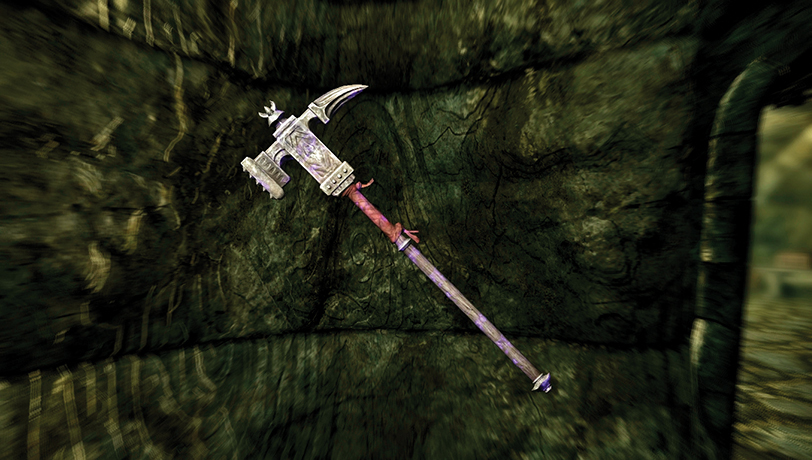
There is a new weapon enchantment available in Dragonborn: the Chaos enchantment. When a weapon is imbued with such an enchantment, it inflicts a random mixture of Fire or Frost or Shock damage. Each element has a 50% chance of happening on each hit. So it’s possible to get no extra damage, only one element, two elements, or even all three elements adding to damage. Regardless of which elements are generated, the enchantment power goes down by the same amount.
Staff Enchanting
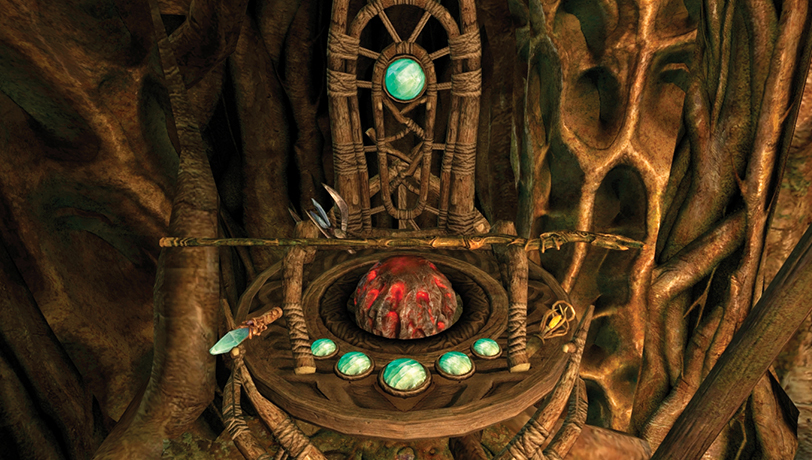
Dragonborn adds the ability to enchant (create) your own staffs. You can only attempt staff enchanting at the Staff Enchanting workbench in Tel Mithryn (shown in the previous picture). This workbench is located in a locked room that becomes accessible after you complete Solstheim Side Quest: Reluctant Steward. The key that accesses the room with the Staff Enchanter is part of your reward for the quest.
In order to create a staff, you will need:
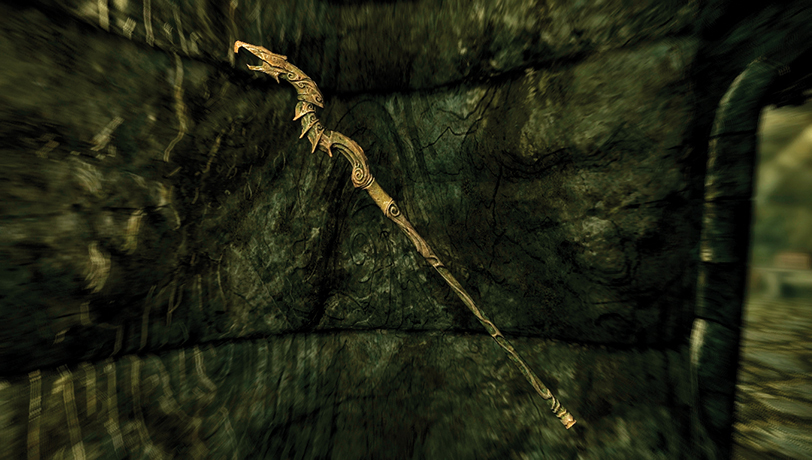
- An unenchanted staff of the correct type. You must purchase this from Neloth. Unenchanted staffs cannot be crafted or found as treasure.
- One or more Heart Stones. You must mine or find these yourself—you can’t buy them. They are found in deposits across the ash-filled parts of Solstheim.
- To know the spell you want to place into the staff. For example, you can only create a Staff of Thunderbolts if you already know the Thunderbolt spell.
Creating a staff works like forging an item—you just select the item you want to create and select “Craft.” Your Enchanting skill has no effect on the result. However, creating staffs will increase your Enchanting skill based on the value of the staff you create.