
Elder Scrolls V: Skyrim Special Edition Guide Training Training Part 2: Combat, Development, and Crafting
Crafting
Alchemy
Alchemic Experimentation: An Overview
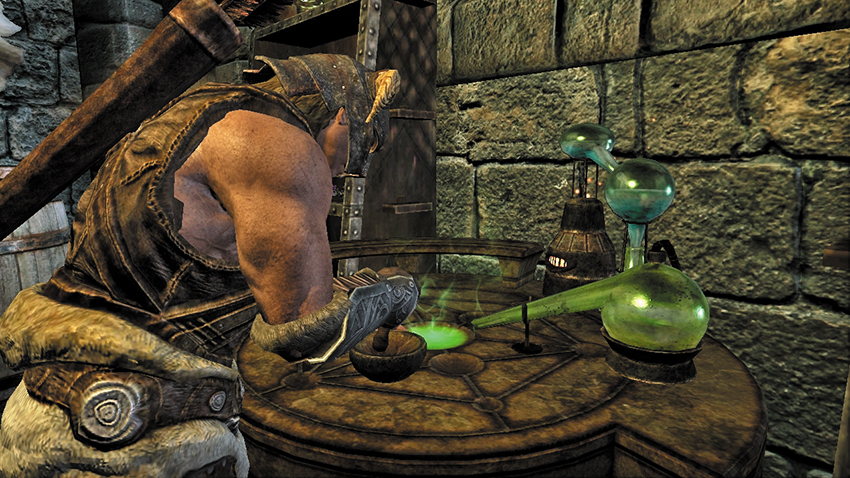
With an Alchemy Lab, combinations of ingredients become great elixirs or potent poisons.
Alchemy is the craft of combining ingredients to create beneficial potions or debilitating poisons. The key to mastering this art is experimentation: When you smith or enchant an item, you already know what the end result of what the crafting process is going to be; the recipes or combinations of materials are clearly laid out in advance. Not so with alchemy; you often have no idea what you’re making, and discovering a powerful new potion or effect is a thrill unto itself.
In short: The process of alchemy involves foraging for ingredients, learning their effects, and then experimenting by combining them with other ingredients to make potions and poisons.
Foraging for Ingredients
The Foraging Process
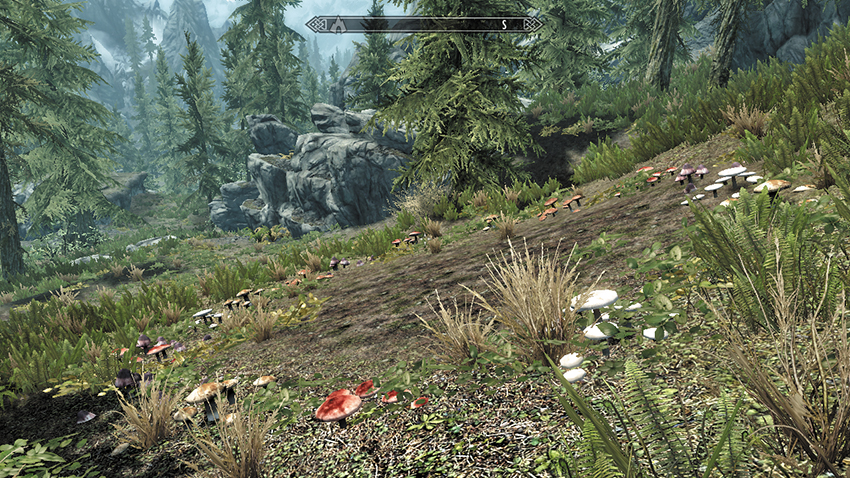
Living off the land is more than just farming crops: Scour Skyrim for ingredients.
The realm of Skyrim is filled with dozens of unique ingredients, which can be categorized into three major groups: those that are grown (such as flowers, mushrooms, and crops), those that are alive (such as dragonflies or butterflies), and those taken from an enemy’s corpse (such as Falmer Ears, Hagraven Feathers, or Troll Fat). All of these are stored in the Ingredients menu in your inventory.
Learning Ingredient Effects
Once you’ve collected one or more ingredients, you can study it in your inventory. Notice that under its weight and value, there are four effects—the ingredient’s alchemic properties—which are all initially “unknown.” Your ongoing task is to learn what all four of these effects are. Until you do, your initial attempts at crafting potions can be a little hit or miss.
Ingredient digestion: The easiest way to learn the properties of an ingredient is to eat it! This always reveals the first effect, and depending on your Alchemy perks, it may reveal more. The advantage of eating ingredients is that you always receive the first property; it always works. The downside is that for rare items, you’ll have to consume the item for no directly beneficial effect.
Experimental potions: Or you can learn an ingredient’s properties by attempting to craft a potion with the ingredient. Constant use of a particular ingredient will gradually allow you to learn its effects and discover good combinations with other ingredients.
Crib sheets: Or you can consult this guide, which helpfully lists the four alchemic properties for every ingredient in Skyrim.
Crafting Potions
In order to craft potions, you must use an Alchemy Lab. If you plan to focus on alchemy, you’ll want to find an Alchemy Lab that you can access quickly and return to it frequently. Near the start of your adventure, one good location is the Alchemy Lab inside the Sleeping Giant Inn in Riverwood. Later on, you may want to purchase a house for convenient access to your own Alchemy Lab and plenty of storage space for ingredients.
Selecting ingredients: Step up to the Alchemy Lab, pick two distinct ingredients (you cannot combine two identical ingredients), and mix them together. You can optionally add a third ingredient if you wish (and want to further experiment).
Experimental potions: If you don’t know what effects the ingredients share, the Alchemy Lab will caution you that the result is a “Potion of Unknown Effect,” but you can still try it.
When you combine ingredients, the Alchemy Lab checks the complete list of the two (or three) ingredients’ effects. If none of those effects match, the crafting fails. If there is one or more match, it succeeds.
Failure: If there were no matches, you receive nothing and use up the ingredients, but still receive a small Alchemy skill improvement. The Alchemy Lab remembers that the combination failed and grays it out, indicating you don’t need to try it again.
Success: If there was a match, the resulting potion or poison has all of the effects that matched, in a much more potent form than simply eating one of the ingredients would have given you. Most of the time, you receive an item with only one effect, but you may end up with two, three, or even four matches.
Potion or poison? The resulting mixture is classified as a potion if its primary effect is beneficial; it’s a poison if its primary effect is harmful. You can have potions with lesser negative effects and poisons with lesser positive effects, although these aren’t usually worth making more than once during experimentation. The Purity perk allows you to remove these side effects from your mixtures, creating wholly positive potions and negative poisons.
Effect reference: The Alchemy Lab menu handles all the bookkeeping for you—it knows which ingredients you have, which effects you’ve learned, and which combinations you’ve tried before without success. Based on this information, it even recommends ingredients that you know you can combine to produce a specific result, like “Restore Health.” While these recommendations are great for quickly creating just the potion you need, don’t forget to experiment to continue learning new effects.
Advanced Alchemy
Alchemy Skill and Potion Creation
Your Alchemy skill improves the effectiveness of the potions and poisons you craft:
- If an effect has only a magnitude (e.g., Restore 50 Health), your skill increases it.
- If an effect has only a duration (e.g., Invisibility for 30 seconds), your skill extends it.
- If an effect has both a magnitude and a duration, only one of the two values will increase, never both. For potions and poisons that affect regeneration rate, the duration increases; for everything else, the magnitude increases.
In addition to your raw skill, the perks in the Alchemy tree dramatically increase the effectiveness of potions you craft. Because of the number of factors that can affect the potency of these potions, exact statistics are not listed in this guide. Consult the exact values in the Alchemy Lab to see what you can create given your current skill and perks. Your Alchemy skill increases when:
- You learn a new effect for an ingredient.
- You successfully craft a potion.
- You attempt to craft a potion but fail (a very small increase).
Three-Ingredient Potions
Potions with three ingredients are more likely to succeed (with 12 effects between them, there’s a greater chance of at least one match). However, they are also more likely to produce results with multiple effects...which may or may not be a good thing. You might end up with an excellent potion that has three or even four positive effects—or one that has a bizarre mix of positive and negative properties. These can still be helpful when trying to learn ingredient effects as quickly as possible, but you may not be able to get much use out of the resulting potion.
Alchemic Recipes and Combinations
Novice Recipes
If you’re just starting out on your adventure, here are a few good recipes to try:
Health Potions
| Potion Effect | Ingredient #1 | Ingredient #2† |
|---|---|---|
| Restore Health | Blue Mountain Flower | Butterfly Wing |
| Fortify Health | Giant’s Toe | Hanging Moss |
| Regenerate Health | Juniper Berries | Nordic Barnacle |
Magicka Potions
| Potion Effect | Ingredient #1 | Ingredient #2† |
|---|---|---|
| Restore Magicka | Creep Cluster | Red Mountain Flower |
| Fortify Magicka | Red Mountain Flower | Tundra Cotton |
| Regenerate Magicka | Garlic | Salt Pile |
Stamina Potions
| Potion Effect | Ingredient #1 | Ingredient #2† |
|---|---|---|
| Damage Health (Weak) | Falmer Ear | Imp Stool |
| Damage Health (Strong) | Falmer Ear | River Betty |
| Damage Magicka | Butterfly Wing | Hanging Moss |
| Paralysis | Canis Root | Imp Stool |
Resistance Potions
| Potion Effect | Ingredient #1 | Ingredient #2† |
|---|---|---|
| Resist Fire | Fly Amanita | Snowberries |
| Resist Frost | Snowberries | Thistle Branch |
| Resist Shock | Glowdust | Snowberries |
Utility Potions
| Potion Effect | Ingredient #1 | Ingredient #2† |
|---|---|---|
| Restore Stamina | Pine Thrush Egg | Purple Mountain Flower |
| Fortify Stamina | Garlic | Lavender |
| Regenerate Stamina | Bee | Mora Tapinella |
Poisons
| Potion Effect | Ingredient #1 | Ingredient #2† |
|---|---|---|
| Invisibility | Chaurus Eggs | Nirnroot |
| Waterbreathing | Chicken’s Egg | Nordic Barnacle |
Advanced Recipes
At higher levels, once you have a wider range of ingredients at your disposal, you can begin to construct potions with more and more complex effects. Here are just a few examples:
Two-Effect Potions
| Potion Effect | Ingredient #1 | Ingredient #2 | Ingredient #3† |
|---|---|---|---|
| Regen Magicka, Resist Frost, Resist Fire, Restore Magicka | Fire Salts | Moon Sugar | Snowberries |
| Invisibility, Regen Health, Fortify Light Armor, Cure Disease | Hawk Feathers | Luna Moth Wing | Vampire Dust |
Three-Effect Potions
| Potion Effect | Ingredient #1 | Ingredient #2 | Ingredient #3† |
|---|---|---|---|
| Fortify Heavy Armor, Fortify Block, Resist Frost | Briar Heart | Slaughterfish Scales | Thistle Branch |
| Fortify One-handed, Fortify Sneak, Fortify Light Armor | Beehive Husk | Hawk Feathers | Rock Warbler Egg |
| Fortify Magicka, Fortify Destruction, Restore Magicka | Briar Heart | Ectoplasm | Glowdust |
| Regen Magicka, Fortify Magicka, Restore Magicka | Briar Heart | Jazbay Grapes | Moon Sugar |
Four-Effect Potions
| Potion Effect | Ingredient #1 | Ingredient #2 | Ingredient #3† |
|---|---|---|---|
| Restore Health and Fortify Health | Blue Mountain Flower | Wheat | None |
| Invisibility and Regen Health | Luna Moth Wing | Vampire Dust | None |
| Paralysis and Damage Health | Canis Root | Imp Stool | River Betty |