
Borderlands 2 Game of the Year Guide Marcus' Munitions Monthly
Gunder Construction
Several factors influence the guns you’ll find. The first is the base level of the area you’re in, which is set for that playthrough the first time you enter a region. If you first set foot in a region at level 16, from then on anytime you return there you’ll find enemies, missions, and loot roughly balanced with that in mind, along the level 14-18 range, centered around level 16. That becomes less useful if you’re gathering a lot of XP in more recently discovered areas and are now, say, level 25. Now, looking for loot in the older area becomes less appealing because it’s very unlikely to compete with even common drops at your new level, just because of the delta in experience. Much of the game’s content is balanced this way, comparing aspects relative to one another rather than in absolute terms. Apart from the level around which the gear is based, the gear’s rarity grade and the parts it’s built from modulate the finished product.
Post-Scarcity Pandora: On Rarity
At a glance, the first indicator of loot quality is the rarity grade, which can be ascertained just by looking at the glow emanating from the weapon. The rarity color will also infuse the stat card with a new look. Note that there’s still a spectrum of quality possible within the same rarity grade, so a superlative example of a green (uncommon rarity) gun might perform better than a low-spectrum example of an equivalent blue (rare rarity) piece.
White: Common
Run of the mill, commonly available, cheap, lacking in quality and polish. These are all ways to describe weapons and equipment of a white rarity grade. They do not come equipped with sights or accessories, and no weapon except Maliwan will feature elemental effects. You’ll find white rarity items all over the place, even in skag piles.
Green: Uncommon
Now things get a little more interesting. Green items are uncommon, made with finer parts. Better actual gun components can be found on green rarity weapons versus their white rarity counterparts, so you’ll see better barrels and magazines on many of the guns. Green rarity weapons CAN come equipped with a sight to improve optics, various accessories to enhance aspects of performance (and influence the title of the gun), and even added elemental effects to grant a more pointed purpose to the weapon. However, that doesn’t mean green weapons WILL have those pieces added; it just starts to become possible at this rarity level.
Blue: Rare
Now we’re getting somewhere. You’ll always, always want to go out of your way to inspect items of a blue rarity or better. At the very least, even if you don’t want to use them, they’re likely to be worth selling or trading to a friend. With the blue rarity grade, component quality takes another leap, and blue rarity weapons may be equipped with a sight, an accessory, and even an elemental power much like green rarity weapons. Again, they might not have any of those things—but they CAN, and the added parts are more likely than with green rarity weapons.
Some blue rarity items are mission rewards, or unique drops off of certain enemies. Starting with blue rarity items, look out for red descriptive text on the item card. These weapons are unique in all of Pandora and will not show up among the normal multitudes of procedurally generated munitions. Don’t write these items off without a decent trial run; they’re sporting all sorts of abilities not documented expressly in the menu, running the gamut from awesome to absurd. The drop rate for enemies who carry unique blue (or purple) rarity items is 1-in-3.
Purple: Very rare
Now we’re cooking with gas. Right? Purple drops are quite rare indeed. One might even say they’re very rare. The highest quality pieces in a manufacturer’s wheelhouse go into crafting these fine killing machines. Weapons of a purple rarity WILL be outfitted with a scope and also with an accessory that greatly boosts an aspect of performance, while probably altering the name of the gun. There’s also a good chance the purple weapon will come equipped with an added elemental effect, though it’s not guaranteed.
That is, unless you’ve stumbled upon an experimental version of a very rare weapon, enabled by its manufacturer to run Eridian tech… these purple variants are similar to very rare weapons from the same manufacturer, except that they ALWAYS produce an elemental effect. Furthermore, the weapons themselves come equipped with enormous magazines thanks to energy-based projectiles instead of lead-based, and finally, you might have noticed the strange alien barrel? Those things are sort of a giveaway.
So if it’s purple, it’s worth checking out. This is doubly true if it’s a unique purple rarity weapon sporting red descriptive text, or if it’s an alien-derived version of that weapon.
Orange: Legendary
Now we’re just simply on fire! Orange grade weapons and equipment are spoken of in mythic terms, with so few Vault Hunters having actually survived long enough on Pandora to even glimpse an orange drop on the battlefield before them.
Not only are the highest quality components used in the construction of orange grade items, but one-of-a-kind parts are used, granting unique behavior to legendary weapons. These unique properties can be obvious, like a sniper rifle that fires a distant and tight shotgun pellet spread, or subtle, like the guns that spew shots in an interesting spread, which might leave a particular pattern blasted as pockmarks into a wall.
Magenta
| Gun type | BANDIT | DAHL | HYPERION | MALIWAN | TEDIORE | VLADOF |
|---|---|---|---|---|---|---|
|
Assault Rifle |
BlASSter |
Blaster |
— |
— |
— |
Blaster |
|
Pistol |
Spiker / Dart |
Spiker / Dart |
Spiker / Dart |
Spiker / Dart |
Spiker / Dart |
Spiker / Dart |
|
Rocket Launcher |
PRAZMA CANON |
— |
— |
PBFG |
Launcher |
Topneaa |
|
Shotgun |
Blashter |
— |
Splatgun |
— |
Splatgun |
— |
|
SMG |
Plasma Caster |
Plasma Caster |
Plasma Caster |
Plasma Caster |
Plasma Caster |
— |
|
Sniper Rifle |
— |
Railer |
Hybridfication |
Railer |
— |
Moloko |
The Gunsmith’s Toolkit: On Components
A gun’s performance is determined by its pieces, and each gun has the same general breakdown of part types. You don’t have any control over the build of a particular gun—not over the brand and quality of the barrel, nor the type and severity of the added elemental effect, nor any aftermarket accessories and their supplemental effects. But knowing how the guns come together can help you appraise guns at a glance and also get more information and pleasure out of viewing the guns as they perform and on the Inspect portion of the Inventory menu.
Note that, when looking at weapons, what you see is what you get—no matter where the gun is. Whether on the ground waiting to be picked up, in your hands, in an enemy’s hands, on the Inspect screen—if you see a shotgun with a quad barrel and a drum magazine, then it’s simply a shotgun with four barrels and a big-ass magazine, the better to rapidly fire four shells with. If you see a scope on the shotgun, then it’s going to have a scope; a bayonet, then a melee damage bonus. What you see is what you get.
Each gun manufacturer makes several gun types, and each gun type possesses several levels of quality and different pools of components. Some manufacturers share certain components, and any given gun might come equipped with, say, the grip of a different company. The shared components, such as some multi-barrels for assault rifles, operate differently for different manufacturers. A Dahl assault rifle isn’t going to perform like a Bandit assault rifle, for example, even if they share components in some places.
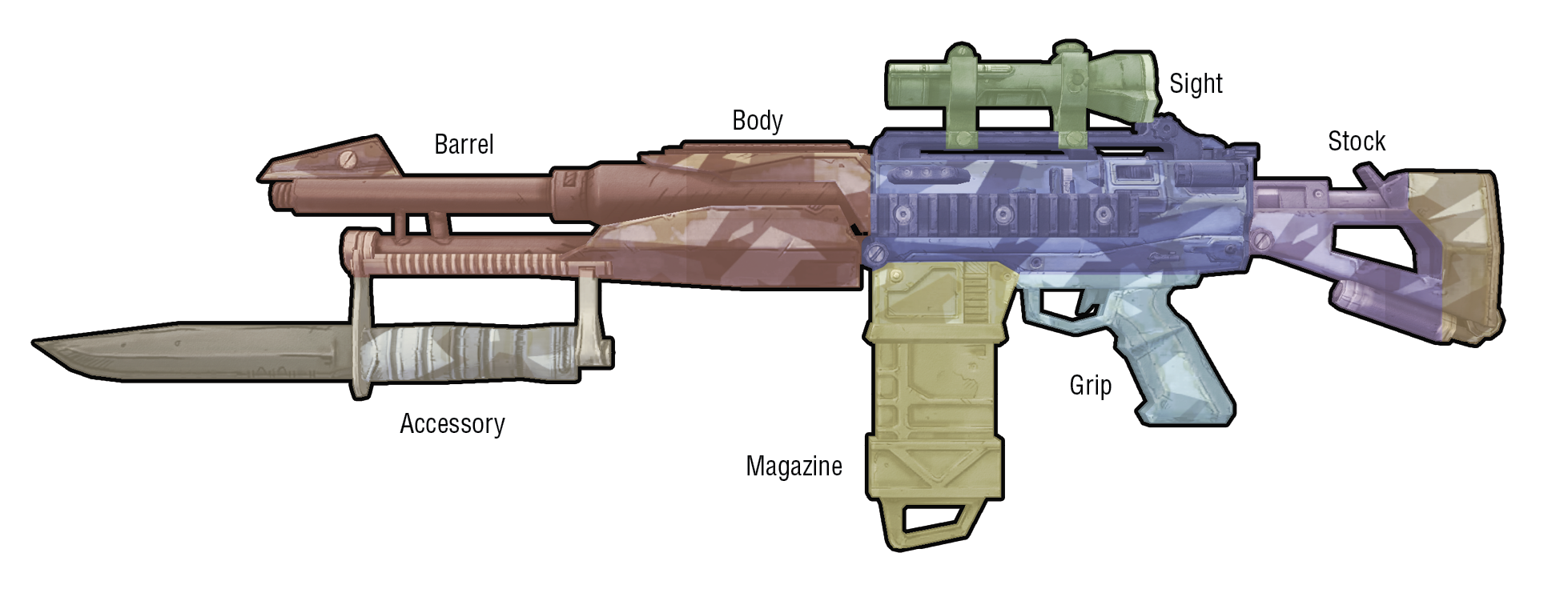
- Body: The base of the gun, this piece determines the main manufacturer of the gun and consequently its most fundamental characteristics. It sets the stage for the overall level of quality and finish the gun will have.
- Grip: As you might imagine, this is where the operator handles the firearm.
- Barrel: This is the part that the projectile travels through. Determines much of overall performance—long-barreled for accuracy? Multi-barreled for extra projectiles? An ultra-rare, experimental alien barrel, derived from ancient Eridian tech?
- Sight: White rarity weapons won’t have sights besides the iron sights innate to the gun’s body and barrel. Rarer weapons can have special optics attached to provide targeting assistance while zooming. Exceedingly rare weapons will always have sights, unless they don’t have them by design.
- Stock: Not present on every weapon, a stock helps with stability and recoil.
- Elemental Capacitor: Maliwan is the manufacturer with elemental tech on lockdown, and when you see elemental power in non-Maliwan guns, it’s because of Maliwan components inside them. These parts provide the drive to imbue the weapon’s bullets with Fire, Shock, Corrosion, or Slag. This is the same slot into which Torque’s gyrojet rocket technology can be fitted, as well, producing an explosive, rather than elemental, firearm. A weapon that lacks this component altogether simply fires normal bullets.
- Accessories: The possibility of optional supplements or aftermarket accessories showing up on uncommon weapons adds a lot to the variability of Pandora’s unspeakably vast arsenal. Accessories include foregrips for stability, bayonets to enhance melee damage, and other attachments that can alter various things. Orange and purple rarity weapons are guaranteed to have an accessory attached, and other non-white rarity weapons might.
- Material Quality: The material grade is the overall finish and quality of the aggregate. A gun identical to another in every way except in being made of better material results in, surprise, a better-performing, better-looking gun with better stats. This value is naturally higher with weapons of increasing rarity.