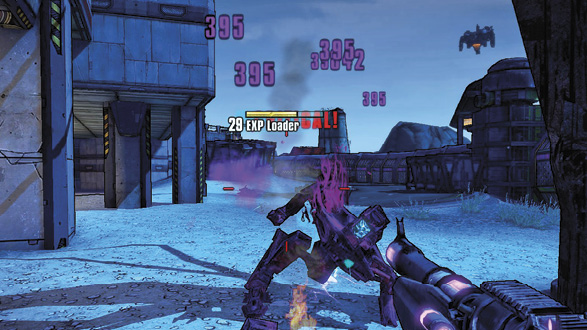
Borderlands 2 Game of the Year Guide Bestiary
Fauna
Dens
Wildlife and humanoids tend to congregate around what can be thought of as dens, or areas of interest. These dens will also often be named places of discovery, as it so happens. From afawvr, you’ll see enemies leisurely patrolling their den; while you’re merely in sight of the den and the enemies within, nothing will happen; not until you come near or provoke them from afar will the enemies of the den be alerted to your presence. Once they’re alert they’ll attack and perhaps give chase, unless you beat quite a distant retreat and leave the area altogether. If you defeat every enemy, the den will repopulate after 25 minutes, or after you leave the region entirely and return (by using a loading screen).
Moonshot barrages
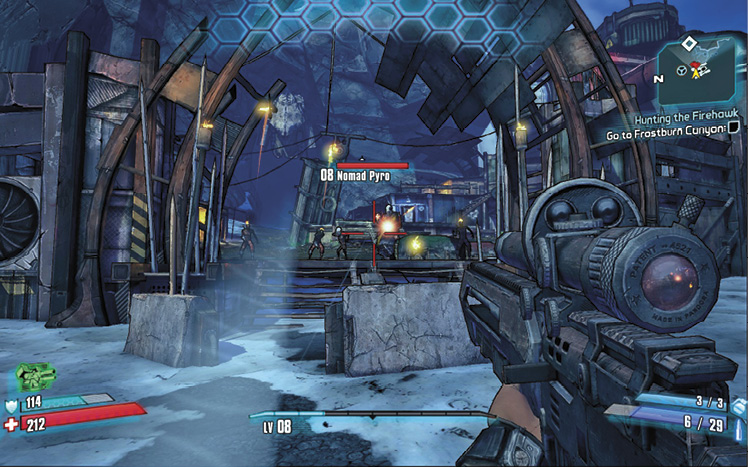
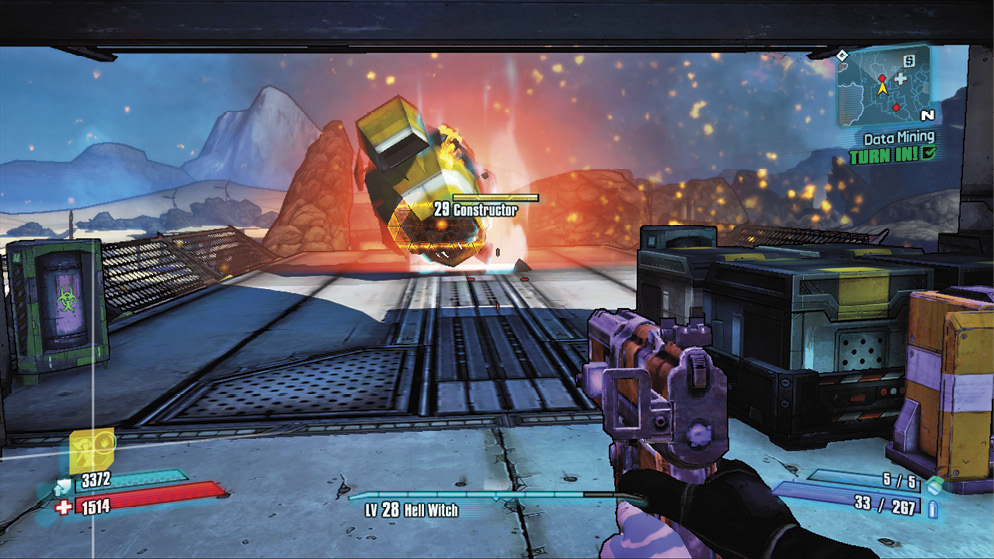
The Hyperion space station that dominates your view of the sky anytime you’re outdoors is capable of shooting reinforcements down with pinpoint accuracy, right to the intended target (which is almost always you). Apart from dropping off loader reinforcements from orbit, this allows the remote deployment of Constructor Bots to immediately boost Hyperion presence anywhere on Pandora.
Constructor Bots
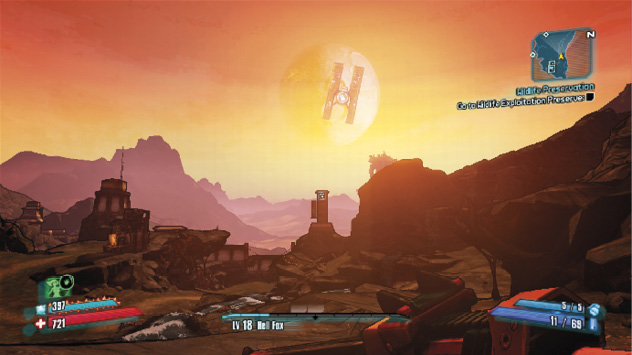
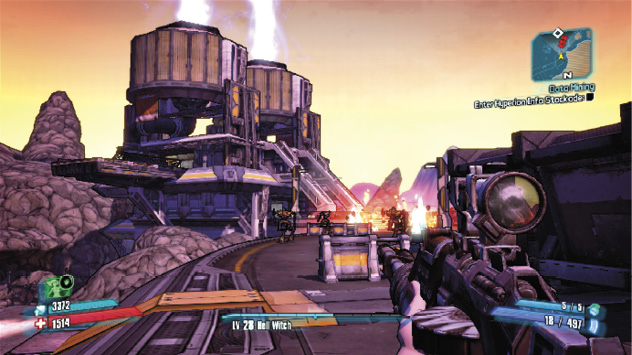
These robot behemoths are mobile combat construction yards, designed to take a position and hold it with or without support—given time, a Constructor builds its own support. Constructors will deploy a surveyor to provide repair support, then they will begin digistructing loader units on the spot… nail the Constructor with Critical Hits in the red sensor eye during this process to interrupt the digistructing process. Constructors are also themselves outfitted with powerful weapons, and are virtually immune to status effects and grenade damage. (Though as armored targets they still take bonus impact damage from Corrosive sources.)
Enemy Species, Family, and Allegiance
Each enemy represents a species within a family. Various species within a family are friendly among themselves, but generally not friendly with other families. If a marauder aims at you but misses and disturbs a bullymong den with the whizzing bullet, the bullymongs will be alerted and go after him! It’s not uncommon to see battles in progress between Pandoran wildlife and encroaching elements of civilization. For example, you may come upon bandits fighting spiderants, or loaders fighting threshers. They aren’t friends to one another any more than they are friends with you. You can use this to your advantage, allowing warring factions of foes to wear themselves out, while you pick away at them all from the sidelines.
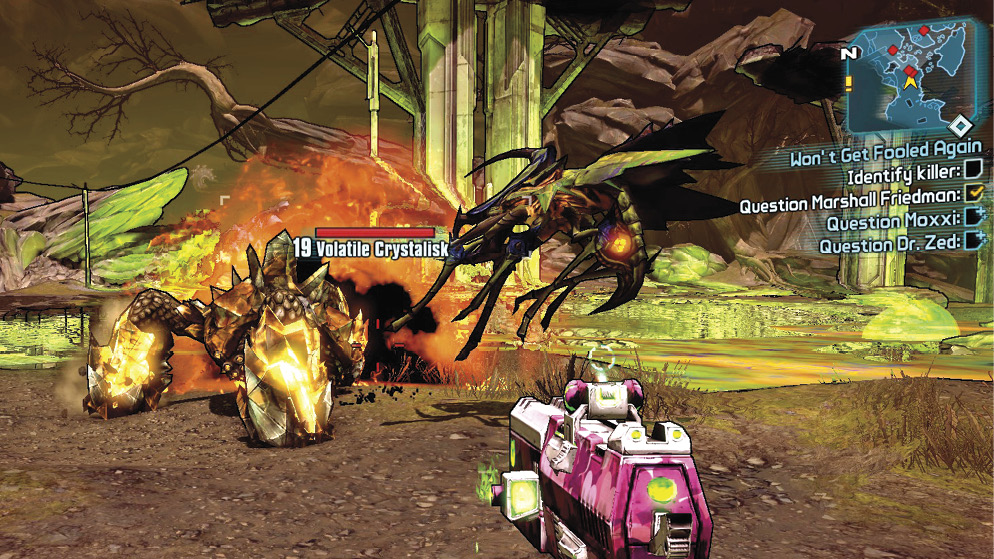
Infighting enemies do your work for you.
Some enemy families work together despite being different—occasionally allegiance runs deeper than blood. Hyperion troops and Hyperion loaders naturally work together, for example. Goliaths are also friendly with other humanoid enemies… until their little security caps get knocked off. Then they aren’t friendly with anyone. Maya’s Motion tree capstone skill Thoughtlock changes her Action Skill into one that confuses the target, switching their allegiance over to the side of the Vault Hunters! Does having a Super Badass Loader on your side sound appealing?
Enemy Grade
Just as your weapons have a rarity, so too do enemies have a sort of grade. Most are merely categorized as peons, run-of-the-mill adversaries, a dime a dozen, always the bridesmaids but never the brides (add your own clichés here). Consider these your commons or whites/greens.
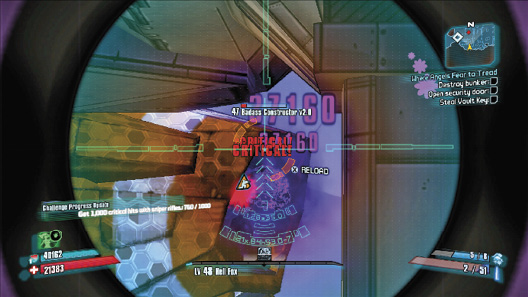
But some enemies are rougher, tougher, and fit for the moniker Badass—a title that signifies amplified abilities, health, and damage, as well as better loot upon death. Badasses are sort of like your rare items, your blues/purples, except the part where those things don’t try to kill you, and Badass enemies do.
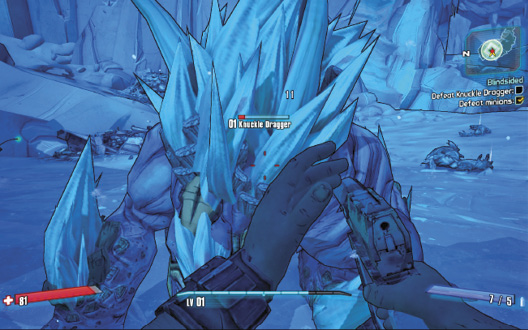
Bosses are, of course, considered Badasses.
For global purposes of damage and health multipliers strictly affected by the playthrough mode (Normal or True Vault Hunter) and the number of players (one through four), there are two grades of enemies: Peon, and Badass. That’s it.
Animal v
Maneuvering
A monster’s first priority in the wild is to ask: how do I get in the best position to murder a Vault Hunter? If it can get there safely, it will. Many enemies must simply run, like humanoids or skags. Some enemies can leap or even fly great distances, like bullymongs, varkids, and loaders.
While approaching or moving about, most enemies are intelligent and aware enough to perform at least nominal dodging, such as trying to leap away from a grenade or roll sideways out from in front of the path of oncoming projectiles.
Burrowers transit from position to position in the womb of the earth, where surface dwellers cannot follow. Cloakers are virtually undetectable to the naked eye when their device is functioning.
Attacking
Enemies will attack when they’re in position to do so. Up close this will usually be with a charging attack, a melee swipe, an area-of-effect pound, or a leaping pounce. From further away it’s typically an axe toss, or gunfire, or beam, or some other type of ranged attack.
Taking Cover
Lithe humanoids that engage in gunplay with you are also apt to take cover, if it’s available. Not big, bulky brutes like nomads, but more agile foes like marauders. Enemies can stretch to shoot out from above of cover, or off to either side. They can be flushed out with grenades, and with mortar-like projectiles, if you’re lucky enough to find a gun outfitted with them. (Later on: Axton can flush anything out of cover by deploying a Longbow Mag-Lock Sabre Turret. Or how about two of them, with Gemini?)
Teamwork
Nomads are heavy brutes who hold authority within bandit and marauder clans; if a nomad calls for aid, the lesser scum pay attention. A nomad may summon all his mates to charge, or take cover, or to throw grenades together—that last one is pretty important! Listen carefully and you’ll hear the nomads shouting orders.
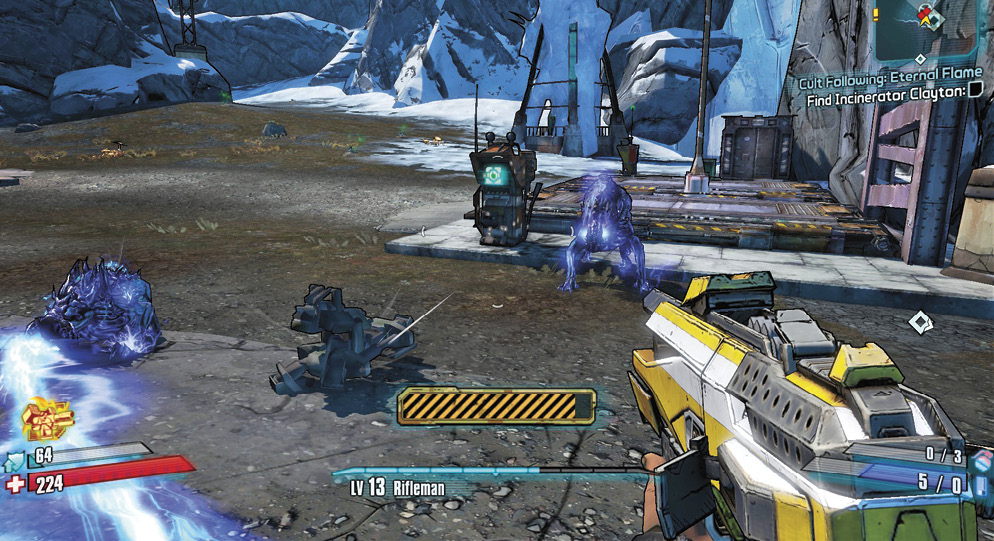
Similarly, spiderants can command lesser of their same species, though you won’t understand the noises they make as commands. Badass elemental skags can also imbue lesser skags around them with the same element.
Retreating
Some enemies will actually try to retreat, either when the tide is turning against their allies, or when they’re injured and ailing. Your charity for these cases should be measured; if they somehow heal on the sidelines, they’ll only return to try to kill you again.
Injuries
When a creature is especially low on life, it will exhibit obvious signs of exhaustion and distress. Usually, beasts are relatively easy to finish off at this point; the hard work of the hunt is mostly done, since they’re so stripped of offensive and defensive ability by then. In a nasty firefight you might even use this to your advantage, leaving low life enemies injured, but still alive. If there are other difficult enemies in the vicintiy, the diminished threat of the dying enemies is worth having around for the easy Second Wind they’ll score a Vault Hunter who goes down.