
The Witcher 3: Wild Hunt The Complete Edition Guide Training
Armorers And Blacksmiths
It is important to understand that Geralt himself isn’t skilled in the arts of armorsmithing or blacksmithing; he can only repair the equipment he wears or wields (or he can get others to repair equipment for him). For improvements and creating new combat items, he must rely on the numerous smiths scattered across the Northern Realms. There are two kinds of smith, and both offer specialized services. Armorers can craft, sell, and repair armor. Blacksmiths are focused on weapons. Remember though, that both smiths usually have both armor and weapons for sale, and can repair both armor and weaponry. But only Armorers can craft new armor, and only Blacksmiths can craft new weapons.
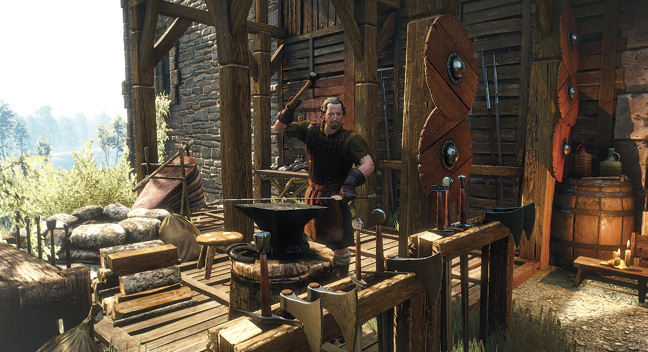
Almost all Armorers and Blacksmiths have two levels of talent; either Amateur or Journeyman. Amateur smiths can craft the most basic of items. Journeyman smiths can craft more impressive equipment. In addition, a single Armorer and a single Blacksmith offer skilled services at the fabled Master level (these are listed below): Remember, not all Armorers and Blacksmiths are equal. Many can work on a specific quality of gear and diagrams, so you need to be mindful of a smith’s competence level. If they don’t have the necessary experience, they won’t be able to work with a crafting diagram you found. Also note that if a village is missing a smith, it is likely they have been kidnapped, and are a Person in Distress, caged nearby and waiting to be rescued by you.
 Crafting: Armorers And Blacksmiths

Finding Crafting Diagrams
In order to craft new or improved equipment, you must have a specific Crafting Diagram in your possession. While certain Merchants have these for sale, the majority of the highest-quality diagrams are found during quests, especially the Witcher Gear Scavenger Hunt. Random Crafting Diagrams are also found on corpses and looted from chests. A full list of vendors who sell Crafting Diagrams, and their competence level (Amateur, Journeyman, or Master) can be found in the Merchants Appendix.
Finding Crafting Materials
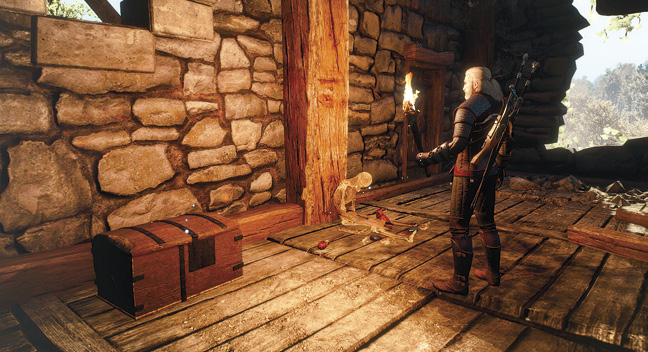
In addition to needing a Crafting Diagram to construct a new piece of armor or weapon, a smith also requires a number of material components to work together into the finished product. These materials are scattered throughout the Northern Realms, and are gathered in a number of ways.
- Crafting: Some materials you find are known as Crafting Components, and a smith can craft them into a new material you need for a more intricate item. For example, Assassin’s Boots require Cured Leather (1) as one of the materials. Check your Inventory for Leather Scraps you may have acquired on your adventure; four units of Leather Scraps can be crafted into one Cured Leather component. Crafting Components are usually rough metal ores, string and thread, timber, or other base materials.
- Dismantling: One of the options each smith has is to dismantle items you are carrying in your inventory. Simply select the item, pay the smith, and reduce the item to its base components to be subsequently combined into new equipment. Before you do this, check the price you pay for dismantling compared to that of simply purchasing the base components, or simply selling the item instead; it might be a better investment.
- Loot: Pilfer from abandoned houses, dungeons, hostile locations, and even areas where friendly peasants live, as long as the receptacle isn’t guarded.
- Purchase: If you have the funds, you can visit any Merchant (but primarily Armorers and Blacksmiths have what you need), look through their wares, and buy the necessary material. This is a much more expensive option.
Master Crafting Diagrams And Gear
Under normal circumstances, the ultimate in armor and weaponry is available when you find Crafting Diagrams that require Master level smiths to craft. These are the very best armor sets and swords you can obtain. For this to happen, you must visit the shop of the previously-listed armorers and smiths who offer equipment of the highest quality. However, some have an involved quest to complete first:
Yoana (Master Armorer): Visit Yoana, over at Crow’s Perch in Velen, and complete Secondary Quest: Master Armorers. Afterward, her shop and services become available.
Eibhear Hattori (Master Blacksmith): Visit Hattori over at his Dumpling Shop in Novigrad City, and complete Secondary Quest: Of Swords and Dumplings. Afterward, his shop and services become available.
 Beauclair Master Armorer and Master Blacksmith: You are fortunate that the Master Armorer, and Trentin the Master Blacksmith, are both open for business in the city of Beauclair (Toussaint), south of The Gran’place Signpost. Their shops and services are immediately available.
 Master Armorer and Blacksmith: Visit the Ofieri Runewright at Upper Mill (Gustfields), and complete Hearts of Stone: Secondary Quest: Enchanting (all three requests for money). For each amount of funding you give him, he can craft Amateur, Journeyman, and finally Master level armor and weapons, acting as both Armorer and Blacksmith.
Grandmaster Armorer and Blacksmith: Visit Lazare Lafargue at his Beauclair shop. It is immediately open and he can craft master-level armor and weapons immediately. For Grandmaster armor (which is only relevant to Witcher gear), the Witcher Gear Scavenger Hunts for Toussaint must be completed. Afterward, Grandmaster armor and weapons for Feline, Griffin, Ursine, Wolven, and Manticore School equipment can be crafted!
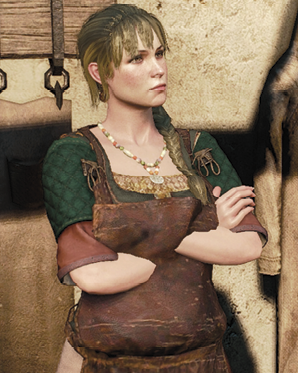
Yoana (Master Armorer): The real power behind the throne over at Fergus’ armory in Crow’s Perch, Yoana is the only Master Armorer in the Northern Realms.
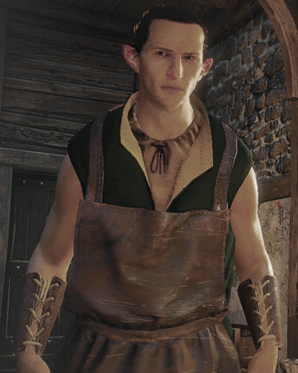
Eibhear Hattori (Master Blacksmith): The elven master blacksmith makes a delicious dumpling as well as crafting Master-level weaponry.
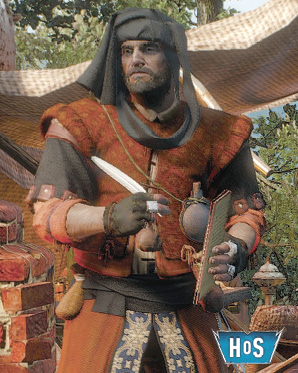
Runewright: If you pay him everything he requests, the Ofieri Runewright, over at Upper Mill acts as a Master Armorer and Blacksmith!
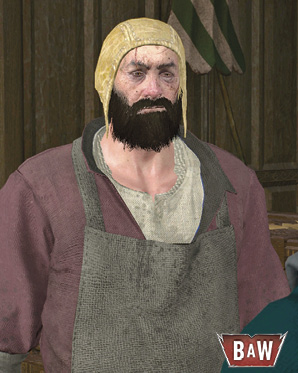
Master Armorer: Seek out the armorer in the city of Beauclair, who can craft Master-level protection for you.
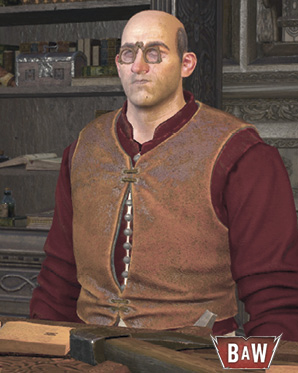
Trentin Master Blacksmith: The blacksmith of Beauclair is also able to craft Master-level weaponry for you.
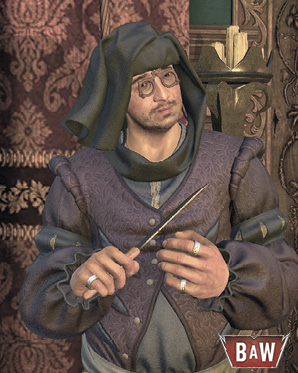
Lazare Lafargue (Grandmaster Armorer and Blacksmith): Visit this fellow’s shop in Beauclair, close to the armorer and blacksmith, and seek the very best armorer and blacksmith of all! He can craft master-level armor and weapons, as well as the fabled Grandmaster Witcher gear!
Crafting > Crafting
This Armorer and Blacksmith menu allows you to craft the following diagrams: Boots, Chest Armor, Crafting Components, Crossbows, Gauntlets (Gloves), Junk, Silver Swords, Steel Swords, Trousers, and Upgrades.
Crafting > Repair
This Armorer and Blacksmith menu allows you to pay to have your equipment repaired. Single items, or every damaged item you own (at once), can be repaired, if you have the funds. This is also a quick way to see your damaged items in one place.
Crafting > Remove Upgrades
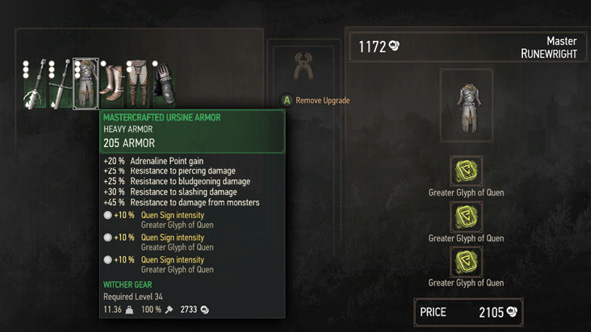
This Armorer and Blacksmith menu enables you to remove any upgrade (glyphs for armor and runestones for weapons) that you may have augmented a piece of equipment with. Check the section on Upgrades for a list of the different (and recommended) Glyphs and Runestones. Only you can add these augmentations to your equipment. Only a smith can remove them (and the glyphs and runestones are destroyed in the process). Do this when you wish to change the benefits of a glyph or runestone, or you find a better quality glyph or runestone.
Crafting > Dismantle
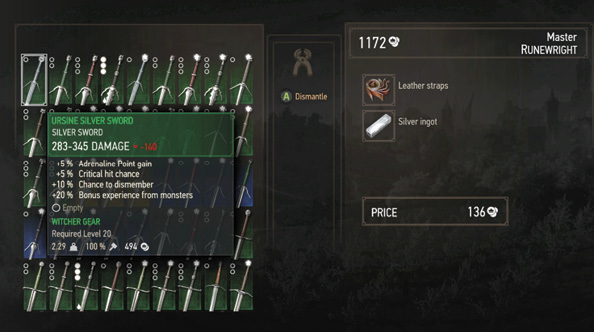
As previously discussed, an Armorer or Blacksmith can dismantle a number of your equipment types into base materials so you can recreate other (and hopefully better) equipment. Use this menu to see the components that are created, too. The following item types can be dismantled (at either smith): Witcher Gear, Armor, Swords, Upgrades, Tools, Junk, Crafting Components, Alchemy Ingredients, and Food and Drink.
Dismantling is an incredibly useful function of all smiths; you’ll get nowhere with Crafting if you try to buy all the materials yourself. It is best to salvage what you can from equipment left behind by fallen foes, or from older weapons that are no longer of use to you, or from junk acquired during your travels.
If you visit the Duchy of Toussaint, and uncover a hidden Alchemy Laboratory under the Corvo Bianco Vineyard as part of Blood and Wine Secondary Quest: No Place Like Home, you can dismantle items for free!
Repairing Items: Durability
Swords dull, armor bends and breaks. As each item wears down, it loses value and becomes less effective. Hiring a properly skilled smith to repair the item can fully restore its durability. Remember that Armorers and Blacksmiths can repair every single damaged piece of armor and weaponry with one choice, if you have the funds: Simply ask to see their wares, back out of the Shop to the Crafting > Repair menu, and choose “Repair All”. Additionally, armor and weapon repair kits can be purchased or crafted to help maintain gear in the field.
Some armorers and blacksmiths also have Armorer Tables and Grindstones that provide time-limited bonuses to armor and weapon damage respectively, when used.
The Importance Of Maintenance
Pay attention to the condition of your equipment! Deteriorated swords strike for considerably less damage, while low durability armor does not protect Geralt as well as maintained armor. A smith can fully restore a piece of equipment, and it is possible to use a repair kit to restore items in the field.
Armorers Tables And Grindstones
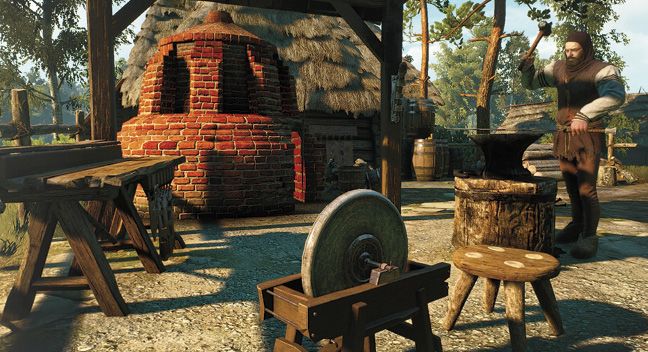
Armorers Tables (also known as Workbenches) and Grindstones (also known as Whetstones or Sharpening Stones) can be found next to some smiths or in villages. You can use these to provide temporary boosts to your equipment’s effectiveness (armor is enhanced at a table, and weapons are enhanced at grindstones). Both are indicated on your maps once you pass near them. This is where to go to get a boost before a tough fight.
Do It Yourself: Armor And Weapon Repair Kits
A well-used sword gradually deteriorates and the damage inflicted lessens. Armor employed in battle gradually weakens and damage resistance lessens. This is your combat equipment’s Durability rating, and is the most important statistic after its combat potential. By visiting an Amateur, Journeyman, or Master Armorer or Blacksmith, you can Repair any of your combat items. But why not do it yourself?
Repair Kits (Armor and Weapon varieties) are accessible at any time once you buy one, as it is part of your Inventory. It is weighty though, so you may wish to return to a Stash and keep your Repair Kits there (or on Roach). Simply highlight the Repair Kit you wish to use, then the armor or weapon you wish to repair, and repair it. The quality of the Repair Kit influences the percentage amount you can add to your Durability. Amateur (15%), Journeyman (40%), and Master (90%) repair kits are available.