
The Witcher 3: Wild Hunt The Complete Edition Guide Gwent
Basics Of Gwent
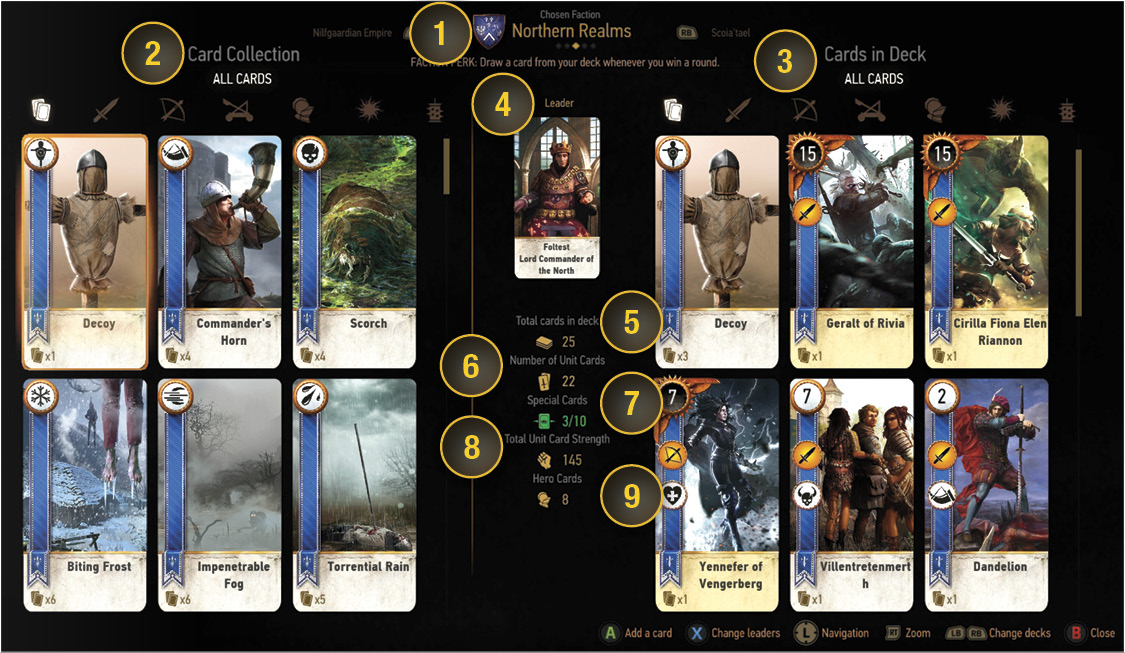
You begin your adventure with a meager collection of mainly Northern Realms Gwent cards (and a small, but reasonable, Skellige Clans deck if you’re starting the Blood and Wine Expansion). To excel at this game, you must collect many more cards, so you can build a deck suitable to challenge every player in the realm. Access your Gwent Deck from the Main (left vertical) Menu. It is here that you can inspect all five Faction decks, individual cards, and prepare decks before a match. This deck-building is also possible just before a match starts, after your wager. Here, you can inspect the following:
The Basics Of The Gwent Menu
 Deck faction.
Scroll through the five Factions and choose the one you wish to build a deck with. When you commence your adventure, you only have enough cards for a Northern Realms deck (and Skellige Clans deck if Blood and Wine Expansion is active). The ultimate goal is to create a variety of strong decks for each faction.
Deck faction.
Scroll through the five Factions and choose the one you wish to build a deck with. When you commence your adventure, you only have enough cards for a Northern Realms deck (and Skellige Clans deck if Blood and Wine Expansion is active). The ultimate goal is to create a variety of strong decks for each faction.
 Card Collection: Look through all of your cards in the deck faction you have highlighted. You can sort them by Unit type (Close Combat, Ranged, and Siege), as well as by Hero, Weather, and Special type.
 Cards in Deck: You have the same sorting ability when you place cards from your collection into a deck you are building. This area showcases the cards you have access to during a match, so place all the ones you want to use, and none of the ones you don’t!
 Leader: Press “Change Leaders” to swap between the Leader cards you have for this Faction. You can collect up to five, except for Skellige Clans, which has two.. Base the deck you are creating around the Leader’s ability.
 Total Cards in Deck: This is the total number of every card type you can place in your deck (your total unit, Hero, Weather, and special cards). Aside from number limits on Special cards, there is no upper limit, but the deck maxes out when you’ve placed all your Neutral and Unit cards and have nothing left. However, this is far too big a deck to be effective, so pair down cards to ones you really want to use.
 Number of Unit cards: This counts the number of Close Combat, Ranged, Siege, and Hero units in your deck. You must have 22 of these cards, and they can be from your faction or neutral cards. The maximum number of cards is only limited by your collection of unit cards that are neutral or for the faction you’re building a deck with. But again, the most effective Gwent players try to keep their card total down to around 22-24 Unit cards.
 Special cards: This counts the number of Weather and special cards you place in your deck. There is no minimum (you don’t have to use any of these cards), but you can’t have more than ten special cards in a deck. Usually, professional players tend to limit these cards to only 1-6, depending on tactics.
 Total Unit Card Strength: This is the only strength points value for all the cards with an actual strength (not special or Weather cards) that are in your deck. Remember that certain cards (like Spies) have strength that counts towards an enemy’s total, and not your own, while other units (like those with Tight Bond ability) have a much higher strength when placed together. Although the bigger the number, the stronger the army, but in all actuality, the best decks follow this mantra: The bigger the number (excluding Spies) with as small a deck as possible. This means you should be creating decks where your deck minimum of 22 cards gives you a Total Card Strength of around 150-165 points.
 Hero Cards: This shows how many Neutral and Faction Heroes exist within your deck. Heroes aren’t affected by Special cards (whether the effects are good or bad), so they are a little more “stable” to employ.
The Basics Of A Gwent Card
When you’re examining a Gwent card, it’s worth learning what different aspects of the card mean. Here, the Scoia’Tael Hero Isengrim Faoiltiarna shows his mettle. Here’s how the information is imparted:
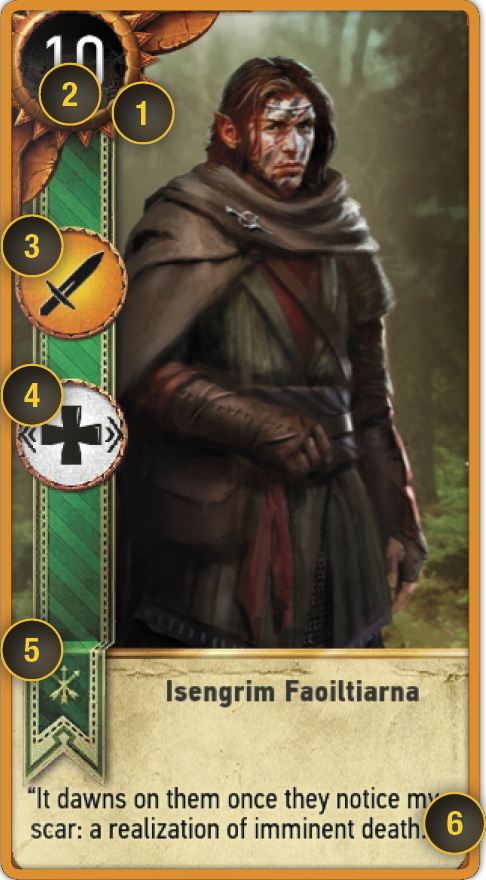
 Hero Sunburst: If the card is a Hero (and Isengrim Faoiltiarna is), an extra orange sunburst and flourish appears in the top left corner. A regular unit card does not have this.
 Unit Strength (Power or Value) or Icon: For Unit cards, the strength points are shown here (in this case, 10). The maximum strength a card can give you is 15, and the least is 0. For Special cards, the icon of that card (such as a sun icon for Clear Weather) is seen instead.
 Unit Row: This weapon indicates which row the unit fights in. Isengrim, and all Close Combat units, have a sword icon. Ranged units have a bow. Agile units have a sword and a bow. Siege units have a catapult icon.
 Ability: Aside from Hero and Agile abilities, if your unit has a special ability, it is flagged in icon form here. Isengrim Faoiltiarna’s ability—aside from being difficult to spell—is a Morale Boost.
 Faction banner: A banner scroll fills the left side of the card, and is color-coded to the faction, along with the faction’s insignia at the bottom. Isengrim is part of the Scoia’Tael faction.
 Notes: The name of the unit is shown (which is important as some units increase their power when placed with units of the same name), along with a quote to delight you.
Card Abilitites: A Quick Look
Each ability a card might possess receives a thorough tactical inspection later in this chapter. But to begin with, here’s a list of all possible card abilities:
 Combat: Close Combat: This unit fights on the Close Combat row.
 Combat: Ranged: This unit fights on the Ranged row.
 Combat: Siege: This unit fights on the Siege row.
 Agile: This unit has the flexibility to be placed on either the Close Combat or Ranged rows.
 Berserker: This unit changes into a much stronger version of itself if a Mardroeme is played before or after it.
 Commander’s Horn: This appears as a non-unit Neutral card (place on any row), or as a character’s ability (affects only the row the character is played on). It doubles the strength of all unit cards in that row. Limit to 1 per row.
 Decoy: This non-unit Neutral card allows you to swap it with a card on the battlefield to return it to your hand.
 Hero: This unit is immune to any special effects or abilities.
 Medic: After playing this card, choose one card from the discard pile and play it instantly (no Heroes or Special cards).
 Morale Boost: Adds +1 to all units in the row (excluding itself).
 Mardroeme: This appears as a non-unit Skellige card (place on any row), or as a character’s ability (affects only the row the character is played on). It triggers transformation of all Berserker Cards on the same row.
 Muster: Find any cards with the same name in your deck and play them instantly.
 Scorch (Specific Row or All Rows): Destroy enemy’s strongest unit in a specific row, if the combined strength of all his or her units is 10 or more. “Scorch” and “Clan Dimom Pirate” cards affect the whole battlefield. “Scorch (Specific Row)” cards (which are all “character” cards, beside the Clan Dimom Pirate) affect only one row.
 Spy: Place on your opponent’s battlefield and draw 2 cards from your deck.
 Tight Bond: Placing this unit next to a card with the same name will double the strength of both cards.
 Weather: Biting Frost: This appears as a non-unit Neutral card. It sets the strength of all Close Combat cards to 1 for both players.
 Weather: Impenetrable Fog: This appears as a non-unit Neutral card. It sets the strength of all Ranged cards to 1 for both players.
 Weather: Torrential Rain: This appears as a non-unit Neutral card. It sets the strength of all Siege cards to 1 for both players.
 Weather: Skellige Storm: This appears as a non-unit Skellige card. It sets the strength of all Ranged and Siege cards to 1 for both players.
 Weather: Clear Weather: This appears as a non-unit Neutral card. It removes any current weather effects across the entire battlefield.
 Neutral Cards

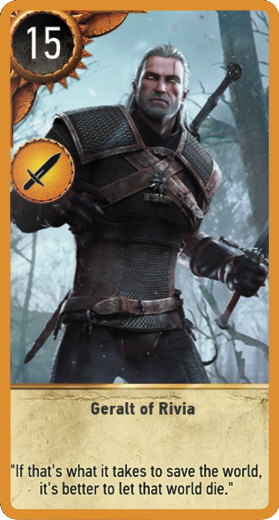
There are a number of cards that feature both Hero and non-Hero unit cards that do not belong to a specific faction. These Neutral cards include Geralt of Rivia, Cirilla, Yennefer of Vengerberg, and even Gaunter O’Dimm. They fill the roles of various Unit types and some have special abilities to further improve other cards on the battlefield. They do not care which faction they are used by, and are sometimes added so a deck without a particular ability can utilize one held by a neutral card.
For example, a Gwent player is creating a Monster deck, but has no medic (as all Monster faction cards don’t have this ability). However, Yennefer of Vengerberg does have a Medic ability, so she is added to the deck.


 Unit Cards


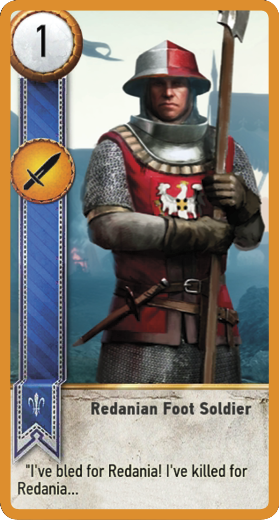
Unit Cards constitute your primary means of earning strength points in a Gwent game. There are three types of Unit Cards to place on the combat rows of your battlefield: Close Combat (shown), Ranged, and Siege. Some of these cards possess special abilities that enhance the Strength of other cards on the battlefield, and can allow for dramatic reversals in the middle of a bout. Just what all these abilities are, and how to use them, is explained later into this chapter.
Leader Cards
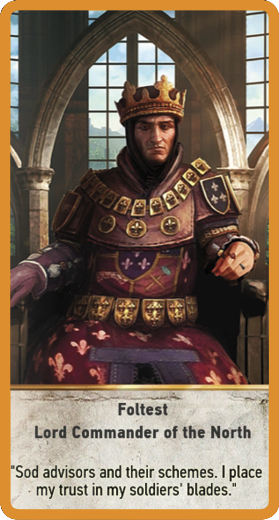
Each of the five deck types in Gwent has a Leader Card (selected before a bout), the commander of the forces represented by that deck. These special cards have abilities that can be invoked during a player’s turn, once per match. Used correctly, a Leader Card can cause dramatic comebacks, so it is important to understand what your Leader Card can do and then use that ability accordingly. There are a variety of Leader Cards for each Faction; all aspects of the Leader or Leaders in question. These variants (that are separate cards collected throughout your adventure) can be earned, found, or purchased, and each has a unique special ability. Consult the in-depth section next for more pertinent information on Leader Cards.
 Hero Cards

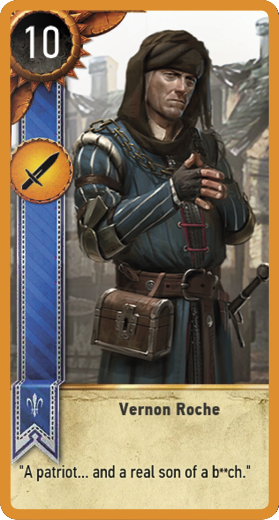
Heroes are unique to each deck. These special individuals are related to the factions represented by the five Gwent deck types. Heroes are immune to abilities, which makes them very useful in situations where the rest of your card draw is being stymied in some way by Special or Weather cards. In general, Hero Cards are far more powerful than standard unit cards. However, they have a drawback; any abilities your other cards may have which could be deemed positive, such as the Medic’s ability to bring a discard card back to battle, do not work on Heroes.
 Special Cards

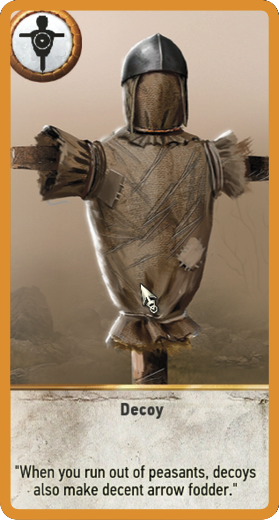
Special Cards are different. They offer no strength point amount. They offer a single, specific advantage when played, and are designed to be utilized when the abilities of your unit cards. There are four non-Weather special cards to learn to use:
- Decoy: These swap with a card on your battlefield, returning it to your hand, enabling you to retrieve a card you don’t wish to utilize, but wish to keep.
- Commander’s Horn: This doubles the strength of all unit cards in a row. They are placed in the “horn section”, on the left side of the battlefield. Only one Horn can be placed in a row, so a maximum of three Horns can be used (one in each of your three rows). The fancy fop Dandelion and the Skellige bard Draig Bon-Dhu also have this ability.
- Scorch: This slays the strongest card(s) on the battlefield, whether it is your card or your opponent’s card. Careful strategy is needed here as Scorch seeks out the highest non-Hero card value, and torches it into the discard pile and then follows it there. Three unit (or “character”) cards have a variation of this Scorch ability too (Villentretenmerth, Toad, and Schirru).
- Mardroeme: This triggers transformation of all Young Berserker, and Berserker Cards on the same row; changing into ravenous Vildkaarls with a much higher strength value. As Berserker cards are specific to the Skellige Clans deck, the Mardroeme only becomes useful when utilized with this faction. The Skelliger Druid Ermion also has this ability.
Remember that Hero cards are not affected by Decoy, Commander’s Horn, Scorch, or Mardroeme cards.
 Weather Cards

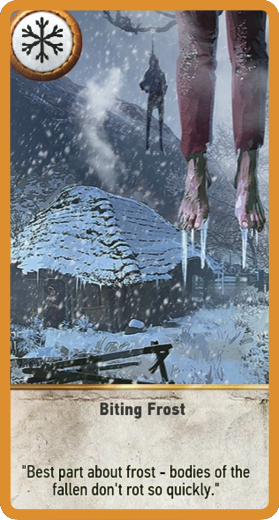
Weather cards are a subset of Special cards. Each deck type has access to Weather cards, which give you additional ways to respond to plays made by an opponent. Four inclement Weather Cards can cripple the strength points of all cards in a given row or rows on the battlefield, reducing all the strength in both your and your opponent’s row to 1 (excluding Hero cards). Playing them requires some forethought, as this can wildly affect the Strength totals for both sides. There’s also a fifth Weather Card, Clear Weather, that clears all other Weather Cards in play. This can completely negate a stratagem relying on Weather cards.
- Biting Frost affects Close Combat cards.
- Impenetrable Fog affects Ranged cards.
- Torrential Rain affects Siege cards.
- Skellige Storm affects Ranged and Siege cards.
All Weather cards should be played with care, as they can ruin your own strategy, as well as your opponent’s! Remember that just as you can play a Weather-clearing card, so too can your opponent.
Becoming A True Gwentleman: General Gwent Tips
Before this chapter expands on the tactics of a Gwent game to mind-bending proportions, it is worth learning a few general tips to aid you in your initial competitions:
- Play Cautiously: You draw only 10 cards from your customized deck at the start of a match. Outside of any special abilities that allow you to draw more cards from the deck, that’s it! Don’t blow all of your best cards too early in a match; you must win two rounds with those 10 cards!
- Pass if you must, and pass wisely: You can choose to pass a turn for any number of reasons. If your opponent’s cards feel too overwhelming for that round, if you feel that they might be over extending their cards and playing too strong in an early round, if you’re confident they cannot counter your hand, etc. Just remember that passing a turn is not automatically forfeiting a match! It is just as much a part of your strategy as playing a card at the right time. Again, remember that you have only 10 cards to work with across potentially three rounds of Gwent, but so does your opponent!
- Weather Cards are a double-edged sword: Weather Cards can dampen the effects of cards for both players. Knowing this, if you intend to use a Weather Card, wait until it looks like your opponent is favoring a row that your Weather can affect, then try to strengthen combat rows that aren’t going to suffer the Weather effect.
- Acquire new Gwent cards at your earliest convenience: The deck you begin with might be capable of beating your earliest competition, but if you want to defeat all comers, including the special opponents holding onto the rarest cards in the world, you must form a much better deck. You can buy new cards as early as the Inn at White Orchard during the prologue, where you first learn how to play Gwent.
- Integrate powerful new cards into your deck as soon as you get them: Decks do not make themselves. You need to add the cards to your deck for them to be of any use.
- Minimize your deck size: The more cards you have in a deck, the less chance you have of drawing the specific ones you want. Craft your decks to be as lean as possible, ensuring a good spread of Unit, Special, Neutral, and Hero Cards to cover your bases. It’s just as important to cull weaker cards or those that don’t fit the strategy to which you’re tailoring the deck.
- Challenge Gwent players met during quests: Some quests involve larger events where Geralt may encounter Gwent players while he takes on other important tasks. If you have an interest in collecting all the cards, challenge them as soon as possible. You may not get another chance, and this can cost you some rare and powerful cards! This guide has identified quests where Geralt encounters Gwent opponents in the Quest section of this guide.
- You can win (random) cards by beating merchants, crafters, traders, and innkeepers you meet. All are stationary and linked to a settlement. You only receive one card from them when you beat them for the first time; if you want a second (random) card, you must find another player.
- You can win unique cards by playing different individuals as part of Gwent-related quests, or during specific events and on-Gwent related quests. Watch out! It’s possible to miss out on some of these cards entirely, so be sure to play any important tournament players or acquaintances you encounter over the course of your adventure.
- You’re able to purchase Gwent cards from vendors. These are usually in taverns or inns throughout the realm. Various curio merchants in Novigrad may also offer a selection of cards; usually between four and five.