
The Witcher 3: Wild Hunt The Complete Edition Guide Appendices and Compendiums Bestiary
Hybrids
Hybrids come in various shapes and sizes, but one of the key defining traits of these monsters is that they mix physical aspects of other creatures. A perverted merging of man and bird of prey could describe a Harpy, while a Griffin could be likened to an eagle mixed with a tomcat.
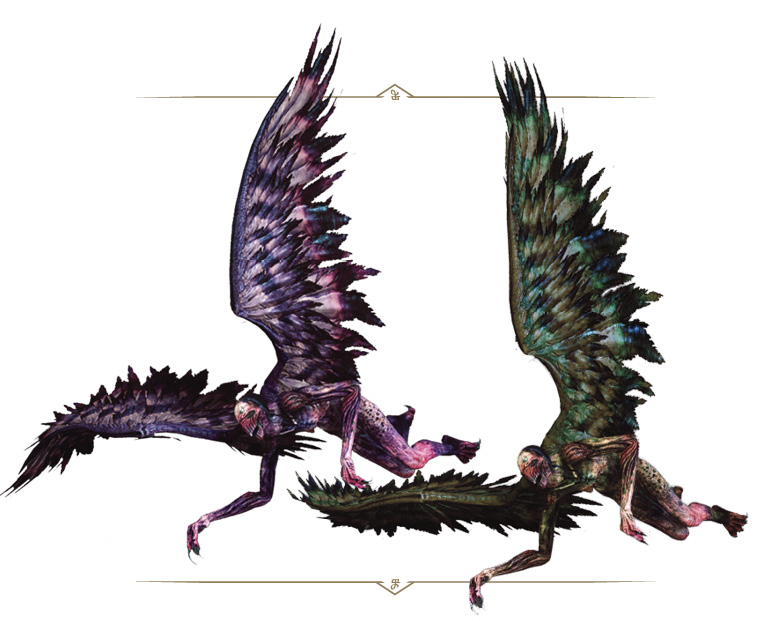
ERYNIAS & HARPIES
Erynia Danger Alert

Frequency

Harpies Danger Alert

Frequency

It is hard to say what is most repulsive about Harpies and their cousins: their hideous appearance, the overwhelming stench of rot and bird excrement that clings to them, or their bloodcurdling screech.
|
Loot (Erynia): Erynia Eye, Infused Shard |
|
Loot (Harpy): Harpy feathers, Harpy talon, Harpy egg, Raw meat |
|
Sub-Species or Named Variants: Erynia, Harpy |
|
Environments: Found throughout the main Continent and Skellige. Erynias are found within large groups of Harpies. Harpy nests have been seen in abandoned fortresses along the rivers of Velen. |
|
Specific Encounter (Harpies): The Harpy nest at Hindhold (Velen). |
|
Specific Encounter (Erynias): The coastal path north of Redgill (Ard Skellig), with a flock of Harpies. |
Vulnerable Against

Enemy Attacks
Harpies hunt in flocks consisting of a handful to up to twenty individuals. Though cowardly and cautious, Harpies fiercely defend their nests and will not hesitate to attack when outnumbering their foes.
Hard as it is to imagine, the Erynias found in Skellige are even more repulsive (and dangerous) than Harpies, their close relatives. Though well-rotten carrion is their food of choice, they will not turn up their noses at fresh meat, man flesh included.
A Flocking Swarm: Harpies attack in flocks, swooping in from all directions, and attempting to confound you. Don’t let this happen by targeting one Harpy at a time, knocking it out of the air, and slaying it on the ground using the tactics listed below.
Swooping Talon Strike: These beasts fly to your head level and attempt to claw at you with talons before either landing or flying off again. These attacks can be blocked and countered (if you aren’t actively engaging the aggressor), or countered so the Harpy falls to the floor, ready for execution.
Ground Talon Strike: Once a Harpy is on the ground, it can get up again and fly about, or remain and leap forward, slashing with arms or legs. Parry these attacks, or knock the foe off their feet for a quick skewering.
Bleeding Strikes: The Erynia’s talon strikes are the same as a Harpy’s, but are more damaging and have a chance to inflict bleeding damage.
The Best Battle Tactics
Harpies, Erynias, and all their varied sub-species, favor flying and hunting in flocks. Approach known nesting grounds with extreme caution.
When provoked, Harpies and Erynias begin circling a victim from above, swooping alone or in groups of two or three. If they are clustered close enough during a dive, you can catch multiple Harpies with area-of-effect abilities or bombs. Another option is to blow into the Hornwall Horn, which drops these flying monsters from the skies; particularly helpful while boating, or while you’re recovering stamina in readiness for Aard or Igni.
Igni is effective against Harpies, lighting them on fire and bringing them out of the air. Yrden is good for situations where you are surrounded by many Harpies in close proximity. Harpies and Erynias often come to a hover in front of humanoid victims before lashing out with their talons. Use that moment to prepare a counterattack, or Aard to bring them to the ground. Quen is also good to cast, so you aren’t struck from behind by a flying foe while preoccupied killing its brethren.
Like many flying creatures, a bolt from a crossbow, or a good blast of Aard, can be enough to ground a Harpy or Erynias. They can also be knocked out of the air with a well timed counter-attack. If a Witcher is close to one of these grounded creatures, they should take advantage of this moment of weakness and execute them quickly with a skewer while they lie prone on the ground, before they recover. This has the added benefit of being a one-hit kill.
If many individuals in a flock are converging around you, attempt to use Aard to blast a path to freedom. Grapeshot can also be used, but one should be mindful of the blast radius. Erynias are more vicious than their Harpy cousins, able to cause bleeding wounds that can overwhelm even a Witcher.
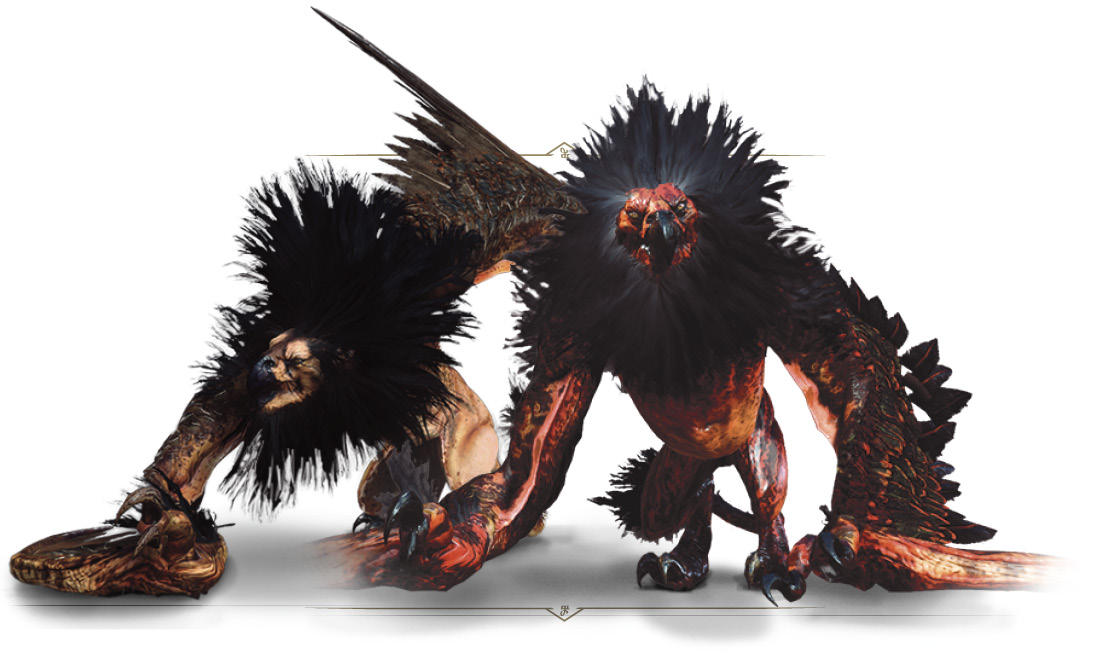
GRIFFINS
Griffin Danger Alert

Frequency

Opinicus, ArchGriffin Danger Alert

Frequency

The embodiment of courage, loyalty, and fighting spirit. This last attribute no one would deny them. When provoked, they will not cease their attack until they have torn their opponent to shreds.
|
Loot (Griffin): Griffin egg, Griffin feathers, Griffin mutagen, Infused dust, Raw meat |
|
Loot (ArchGriffin): ArchGriffin mutagen, Infused shard, Amber dust |
|
Sub-Species or Named Variants: Griffin, Royal Griffin, ArchGriffin, Opinicus |
|
Environments: Griffins have been sighted nesting in Skellige, Velen, the wilderness near Oxenfurt, and even terrorizing White Orchard. |
|
Specific Encounter:An ArchGriffin lurks atop Snidhall Isle, due north of Ancient Crypt (Ard Skellig). |
|
Specific Encounter (Opinicus, ArchGriffin): Contract: The Creature from Oxenfurt Forest (see page 519). |
Vulnerable Against

Enemy Attacks
Royal Griffins are toughened variants of the usual Griffin you encounter. The named Griffin (known as Opinicus, an ArchGriffin), is a toughened variant of the usual Griffin you encounter, with an additional acidic projectile attack. There are additional ArchGriffins to face, too.
Though still wary of main roads and towns (where folk with the means to hire a Witcher are likely to dwell), these half-eagle, half-wildcat creatures have gone from rarities to oft-encountered pests known throughout the Northern Realms.
Pounce and Clawing (Airborne): While airborne, or after leaping into the air, this foe may attempt to land devastating overhead blows with its claws. These can be parried or quickly dodged; rolling is preferable as you duck away from the outstretched claws.
A Rough Landing: The Griffin drops down with a heavy thud onto the ground, which can stagger you. Rolling or dodging to the side, timing this so you can roll into the beast’s flank to inflict sword damage afterward, is a good plan.
Acidic Spittle: Watch for an ArchGriffin to cough up a disgusting ball of acidic goo, before dodging or rolling to ensure it misses you, and you’re not poisoned by it.
Ground Charge Tackle: You can be staggered by a Griffin’s extremely quick charging tackle, which occurs when it is on the ground, at mid or long distance from you. Close the gap so this maneuver isn’t attempted, or swiftly roll to the side to avoid it.
Wing Swipes (Ground): Griffins use their wing and foot talons in sweeping attacks occurring in either direction, which can cover a huge distance if necessary, and can stun you. Having Quen active to absorb such a strike, or rolling under the wings to the torso of the Griffin to inflict damage is worth planning for. Remain active, as standing at a Griffin’s flank ensures you’re struck by these swipes.
Staggering Roar: A mighty screeching roar echoes from the beast’s maw, staggering you and opening you up to further attacks by this foe. Constant aggression on your part usually means the Griffin hasn’t the time for this. Otherwise, roll away from the soundwaves so you aren’t stunned by them.
Beak Bite (Ground): The Griffin quickly snaps its neck and full body forward a few feet and bites at you. This should be dodged, or Quen used earlier to absorb the hit, which can stagger you.
The Best Battle Tactics
Griffins enjoy toying with their prey, swooping in from the skies and raking victims with their talons. A
shot from your crossbow, or a well-timed Aard, can bring a Griffin to the ground, but this only means the fight truly begins.
Grounded Griffins make excellent targets for explosive crossbow bolts, just be sure to fire them from a safe distance. You can use Northern Wind bombs to freeze a Griffin in place, useful if you need a moment’s respite. On the ground, a Griffin is still incredibly dangerous. They can roar at such a high pitch that even a Witcher can be put off balance, pounce from great distances claw and bite at prey.
From the sky, Griffins try to repeatedly claw at their targets as they sweep past, or attempt to dive onto their prey. ArchGriffins also spit highly corrosive acid at their targets, weakening armor and leaving the man under it exposed to its talons. Every slash or bite from a Griffin can cause serious bleeding. Counter this by casting Quen, or with Swallow potions to regenerate any wounds sustained throughout the battle.
When facing a Griffin on the ground, try to stay in and around the reach of your silver sword. If you are too far away, the Griffin may try to tackle you. This can be very difficult to avoid, and failing to do so could result in death. Watch the wings of a Griffin while fighting it on the ground. Each swipe from the wing talons is telegraphed by that wing being raised high. Try to evade to the flanks of the Griffin to score hits on its unprotected side for greater damage (using your swords as well as grapeshot bomb throws), with Quen absorbing the beast’s first strike at you.

SUCCUBI
succubi Danger Alert

Frequency

Salma Lilith Danger Alert

Frequency

One should not be fooled by their fair appearance. Under the velvety skin of their arms lie muscles of iron, and blows delivered with their rear, goat-like legs or the thick horns on their head can easily crush bone.
|
Loot: Perfume, Flowers, Succubus mutagen |
|
Sub-Species or Named Variants: Succubus, Salma Lilith |
|
Environments: Succubi will try to live close to their ‘prey’, near towns and villages. Bolder Succubi have been known to inhabit cities. |
|
Specific Encounter:Secondary Quest: Practicum in Advanced Alchemy (see page 416). |
|
Specific Encounter (Salma Lilith): Contract: Deadly Delights (see page 520). |
Vulnerable Against

Enemy Attacks
The named Succubus (known as Salma Lilith), is a toughened variant of the usual Succubus you encounter.
Succubi are motivated by an insatiable lust, engaging in sexual acts with any other humanoid species they encounter; their never-ending advances, though pleasurable at first, have pushed more than one man to madness or even death.
Fire Ball: If you’re at mid or long range, you may receive a conjured ball of fire to the face, which should be dodged or absorbed using Quen. As a Succubus plays with fire constantly in battle, interrupting these attacks is the order of the day.
Fire Burst: If you manage to land a few impressive strikes, or you’re remaining at melee range, you may be pushed back with a large ball of fire emanating from a Succubus’ ample chest region. A possible stagger and fire damage are inflicted on you. Roll around or out of the way after three hits and don’t be greedy to avoid this.
Fire Swipe: The most frequent of her strikes, she casts a diagonal cutting slice of flame from her hand, which sets you ablaze. Quen helps remove the fire, but in compact environments, closing the distance, or attacking from cover helps overcome this fire damage. Cast Aard to interrupt the spells before you’re fried.
The Best Battle Tactics
If you’re attempting a more cunning plan than simple bludgeoning, you may be able to talk down a Succubus instead of attacking one, regaling it with stories of Witchers seducing Succubi and allowing them to flee a region—stories normally only whispered among commoners. Should you choose to slay a Succubus, you must act quickly. Succubi are known for their surprising constitution and spellcasting. They can command fire with natural aptitude.
The simple flashes of fire that a Succubus calls upon can disrupt any sword technique you’re capable of, and there is no defense, save for Quen or frantic rolls away from the flames. Relentlessness is key. A Succubus cannot be allowed to control a battle. Dimeritium bombs, explosive bolts, or Aard can disrupt their spell-weaving; Northern Wind can freeze them in place. You succeed in slaying a Succubus if you can pin one down and unleash a flurry of sword strikes.
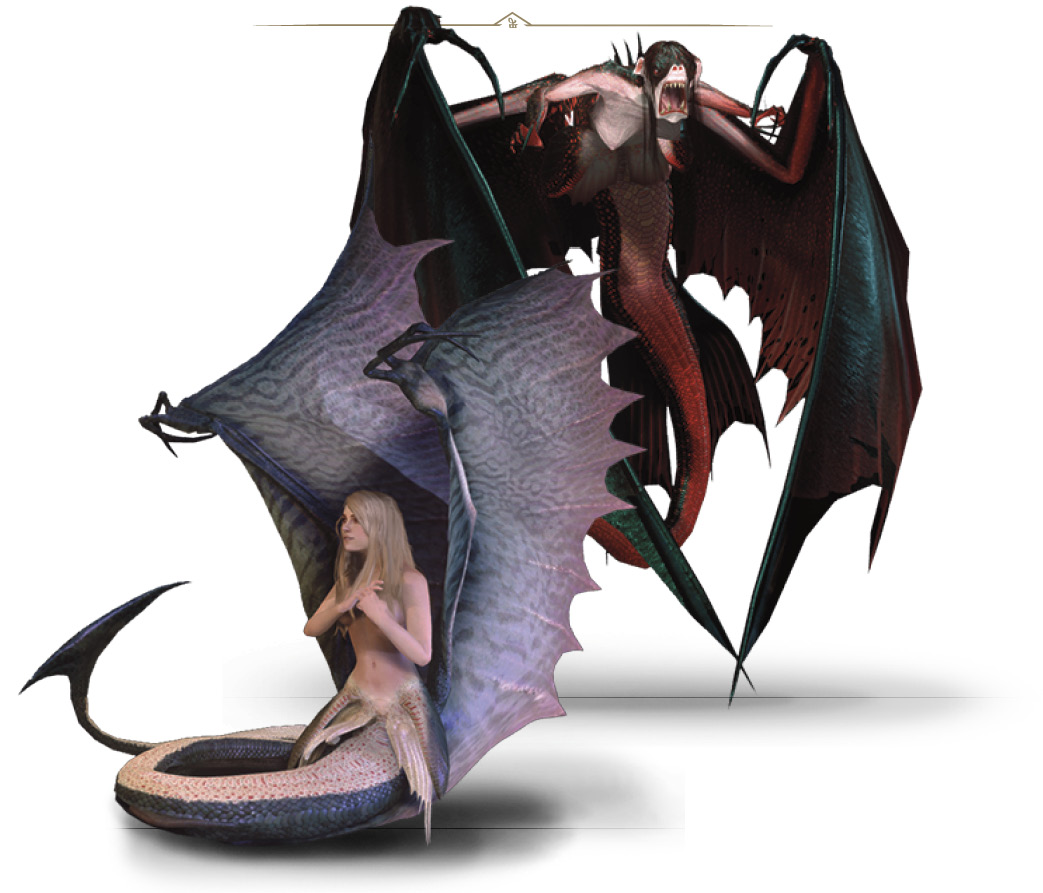
SIRENS
Sirens Danger Alert
Frequency
Melusine Danger Alert
Frequency
Like skilled hunters setting out wooden ducks to lure in drakes, Sirens lure men near, using their own bodies as decoys. Once a naïve sailor gets within arm’s reach of these beautiful creatures, their fair faces suddenly turn fang-filled with fish-like maws, and lovely tails promising unknown delights become sharp, death-dealing talons.
|
Loot (Siren): Siren vocal chords, Water essence, Shell |
|
Loot (Ekhidna): Lock of Ekhidna hair, Water essence, Mutagens, Shell |
|
Sub-Species or Named Variants: Lamia, Ekhidna, Melusine |
|
Environments: Sirens can be encountered in coastal regions throughout Velen and Novigrad, though Skellige has the most prolific breeding grounds. |
|
Specific Encounter:Ruined Inn along the south coast of Ard Skellige. |
|
Specific Encounter (Melusine): Contract: Here Comes the Groom (see page 528). |
Vulnerable Against

Enemy Attacks
The named Siren (known as Melusine), is a toughened variant of the usual Siren you encounter.
Sirens and Ekhidnas (the Sirens’ more dangerous cousins) usually hunt in flocks making use of their numbers as well as their ability to move effortlessly through water and air.
A Flocking Swarm: Sirens attack in flocks, swooping in from all directions, and attempting to confound you. Don’t let this happen by targeting one Siren at a time, knocking it out of the air, and slaying it on the ground using the tactics indicated below.
Siren’s Swoop: A diving swoop with a swipe or claw designed to infuriate or confuse you while others of the flock prepare their own attack. This is the best time to cast Aard, shoot a crossbow, blow your horn, or otherwise drop the Siren to the ground with a counter. Otherwise, parry the attack. Once a Siren is on the ground, it attempts to fly away again; knock the foe off their feet for a quick skewering.
Siren’s Screech: Supposedly a frightening scream, this has limited effects during combat, though it tends to coincide with a swoop (which helps you time a downing strike or counter). Otherwise, ignore the sounds you hear, and concentrate on downing and delivering killing blows, or quick three-hit fast combinations on hovering Siren foes.
Bleeding Strikes: The Siren’s talon strikes have a chance to inflict bleeding damage.
The Best Battle Tactics
Sirens work in flocks, akin to Harpies and their ilk. They can also move as quickly in water as they do in the sky. When sailing in Siren-infested waters, expect to see the monsters transition from the seas to the air as they surround their prey. Remove any Sirens from attacking your boat with the use of the Hornwall Horn, or Aard. If you’re fighting Sirens underwater, it is preferable to return to shore where you have many more combat options. Otherwise, automatic crossbow shots are the only way to slay.
Aard, Grapeshot, the Hornwall Horn, and a Witcher’s crossbow are enough to ground a flying Siren (time it so the Siren is swooping in toward you). Sirens of all types are especially vulnerable to Igni, as well as any bombs that can set victims on fire. It is possible to counterattack a Siren as they dive out of the air at their target. This grounds them and can severely wound them.
Sirens prefer swooping on their prey, slashing with their claws or tails as they sweep past their victims. They rarely stay still in the air, but are at their most vulnerable when they do so. As with the Harpy, a grounded Siren is a Siren that has all but presented themselves for execution. Witchers presented with this opportunity should not hesitate, especially as the skewer kills the Siren with a single sword plunge, quickening combat considerably.
Wounded Sirens can produce an ear-piercing screech that stun their attackers. Other Sirens can use this moment to rescue their sister, diving in on the enemy and allowing their injured to escape.