Super Smash Bros. Ultimate Guide Ultimate Glossary of Terms and Mechanics
Ledge-Hanging
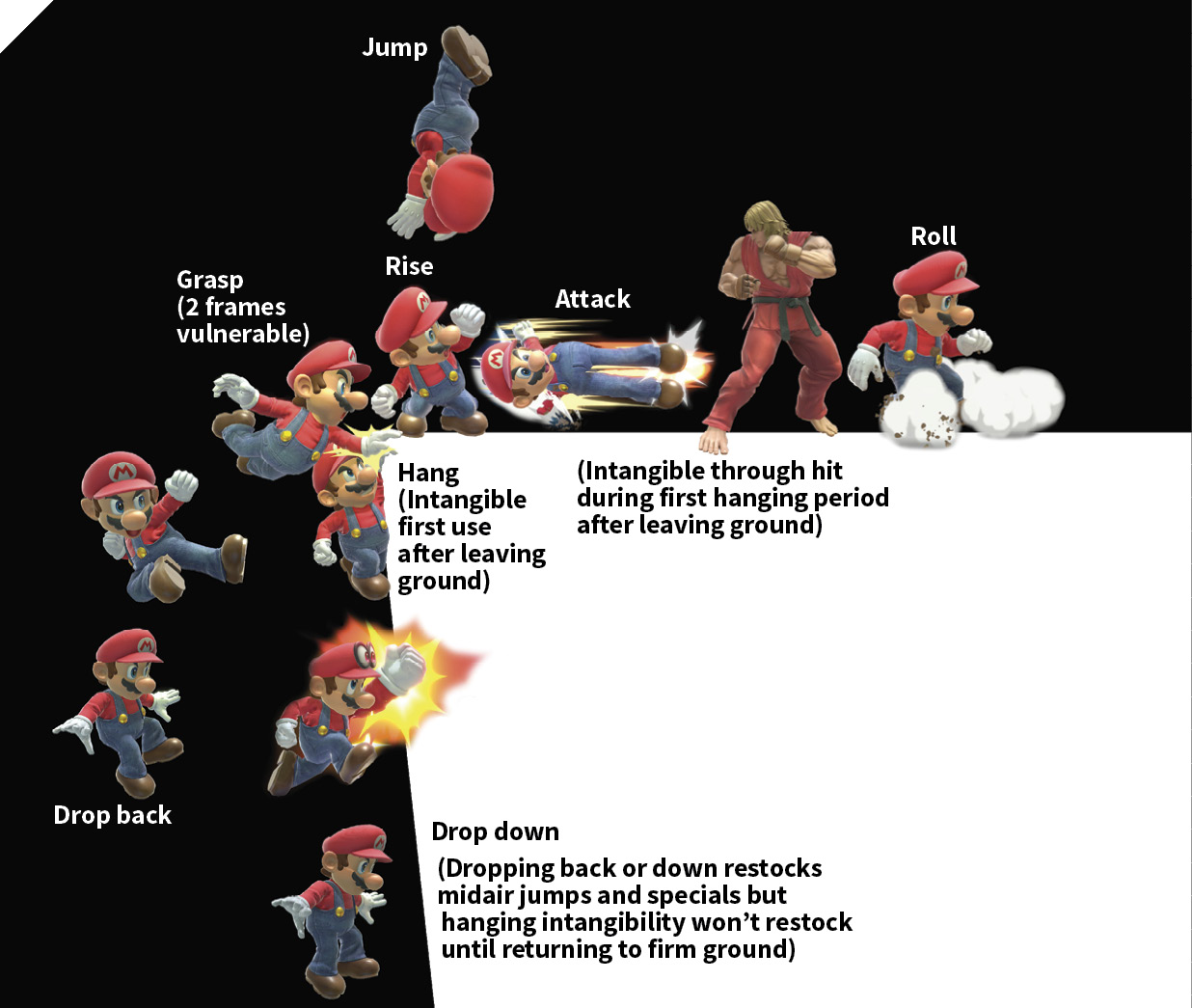
Whenever a fighter falling offstage passes a viable handhold, they grasp it, arresting their fall and hanging from the ledge.
Don’t think of ledge-hanging as an imperiled, panicky position. Instead, think of it as another base of operations, with its own set of follow-ups, opportunities, and weaknesses, just like standing or jumping or dashing.
The first time a fighter hangs from a ledge per airborne period, the move has significant evasive properties that make ledge options hard to deal with for edge-guarding adversaries. There are long intangible periods on any rising action from the ledge.
Repeated ledge-hanging instances in the same airborne period (like grasping a ledge, dropping, then double-jumping back up to the handhold) drastically diminish any intangibility bonuses conferred to options out of a ledge hang. Persistent edge-guarders count on this, finding each time they knock hangers off a handhold easier than the previous time, until there’s nowhere for hangers to go but down and out.
Ledge-Hanging Intangibility*
*These values serve as guidelines, but can vary depending on how long you dangle during each ledge hang.
| Consecutive Ledge Hangs | Hanging | Ledge Attack | Rising | Rolling | Jumping |
|---|---|---|---|---|---|
|
1 |
1.5 seconds |
Through active frames (attack is basically unbeatable) |
20 frames of vulnerable end lag |
12 frames |
|
|
2 |
0 |
Ends just before active frames (start-up unbeatable, active frames vulnerable) |
Tenth of a second of vulnerable end lag |
24 frames of vulnerable end lag |
10 frames |
|
3 |
0 |
Only briefly as fighter starts rising |
Quarter-second of vulnerable end lag |
32 frames of vulnerable end lag |
6 frames |
|
4 |
0 |
0 |
0 |
0 |
0 |
From a hanging position, there are many actions one can undertake, whether aggressive or defensive. Ledge-hanging doesn’t have to be a defensive posture or exclusively a part of recovery.
Ledge Attack
Attack performed, naturally, with the Attack button, causing the ledge-hanging fighter to rise with a strong forward strike.
Rising from the first ledge hang, ledge attacks can’t be pre-empted or beaten head-on. An edge-guarder has to block and attack out-of-shield to punish a ledge attack, like with wake-up attacks.
Ledge Rise
Performed by tapping forward toward the ledge. Makes the fighter rise in place at the edge, like getting straight up after a knockdown.
Overall, on paper, this is the least risky way to return to the stage after hanging. With every other edgier option being flashier and scarier to edge-guarders looking to counter, ledge-hangers can usually get away with just rising in place.
Ledge Roll
Aggressive rising movement, performing by tapping the Shield button while ledge-hanging. The fighter rises and rolls forward, regaining control about a dash’s distance from the edge.
If edge-guarders place themselves right at the edge, looking to crowd, block, and punish the rising-in-place and ledge-attack options, rising with a roll can sneak past them. This can also happen if they’re lagging close to the ledge after a failed swing at your ledge-grasping fingers. Either way, be ready with double-sided moves and short-hopping back air, exploiting the back-to-back situation, with you now on the big slice of the stage.
Ledge Jump
Tapping upward on the control stick (even with up to jump disabled) or the Jump button makes ledge-hangers throw themselves up into a jump. Now that’s shoulder strength!
Attacking, rising, and rolling from the ledge are all canned actions, which have global counters. Like, if you know foes are going to use ledge attacks, the answer is to crowd the edge, block, then punt them right back off, no matter what the matchup is. If you know they’re going to rise, wait for them at the edge and grab them. If you smell a ledge roll, back off from the edge and wait to greet them with a powerful hit where the roll ends. Using these is kind of a rock/paper/scissors game.
Mix in jumping off the ledge to keep savvy edge-guarders honest—being able to jump off the ledge adds so many more angles to get past the guard attempt, moving back onstage. If they’re too preoccupied waiting to see how they can thwart myriad jumping options (midair jumps, air pokes, directional air dodges, good midair specials…), your odds of getting away with canned ledge options go away up.
Ledge Drop
There are two ways to simply release the ledge, intentionally falling. Tap down to fast-fall from the ledge like a stone. Or tap back to drop more gently and slightly away.
Ledge-dropping is a somewhat high-level tactic, going the extra mile along with ledge-jumping toward making a ledge-hanging posture less defensive and more empowered.
The first time you grasp a ledge each jump, you’re backed up by lots of intangible frames. But the following times, none at all. The major tactical victory an edge-guarder can make as you maneuver to a ledge is to swipe at your fingers, nailing a two-frame punish and basically stealing any ledge intangibility for the rest of the volley.
The point is, you can’t always count on intangibility, and one great way to get around that is to be comfortable dropping away from the ledge. When attackers swing at your follow-up ledge hangs, which are fully exposed, you can intentionally fall away with good timing, then double-jump or use up special to zip right back to the ledge. Depending on their whiff and your up special, you might even hit them back on the way up.
Ledge-dropping also enables aggressive alternate avenues back onstage. Drop backward gently, then immediately double-jump forward, sticking out your most dominant air poke (hopefully one with safe landing lag). This will surprise someone crowding the edge while getting you back onstage, safer from reprisal than a ledge attack or standard rising maneuvers.
Ledge-dropping can be used when edge-guarding too, when shooing away recovering enemies somewhere below the stage. As they struggle to move up toward the stage, in range to target the ledge with an up special, hang from the ledge and drop toward them. Now nail them with back air or down air attack immediately, intercepting their recovery lunge, blasting them away, and leaving you with time to double-jump and up special back to the handhold yourself!
Ledge Snap
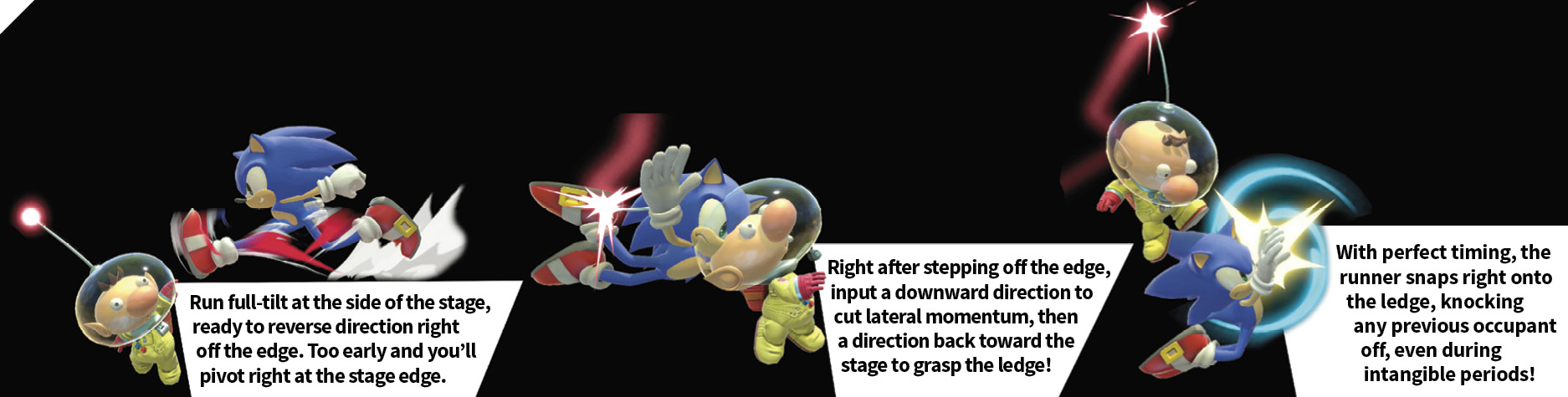
An advanced movement technique that involves sprinting right off the side of a stage, immediately cutting lateral inertia, then hanging from the ledge. If properly done, fighters seem to go straight from running at the side to hanging from it, with not much in between.
There are various ways to execute this, with different inputs some players prefer. The gist is that you have to overshoot the edge, register a downward direction (starting fast fall, which kills forward momentum), then register a backward direction (grabbing the ledge, which should still be right there).
A well-timed half-circle rotation, going from forward off the stage and twirling to down and then back, is one way to do it.
If the fighter pivots at the stage edge, you’ve cut momentum too fast. If they tumble away from the stage, too late.
While this is very hard to learn, it’s one of the most potent edge-guarding tools available when mastered. By running to the edge and ledge-snapping just after someone recovers and clings to the handhold first, you force them off by clinging second, ending their intangibility! They’ll probably be a bit disoriented, having been popped off the ledge just a bit when they expected to be intangible. Immediately dropping backward from the ledge, then double-jumping up-forward with a great air attack can hit them quick, maybe even spiking them off the side of the stage!
This is a fantastic alternative to the two-frame punish, where you swing at enemies below the stage right before the first time they ledge-hang. In a way, it’s just as hard, but at least it gives aggressive edge-guarders an extra option for setting up knockouts.