
Super Smash Bros. Ultimate Guide Donkey Kong
Brawler Arsenal
Grounded Attacks
Neutral Attacks
Neutral Attacks
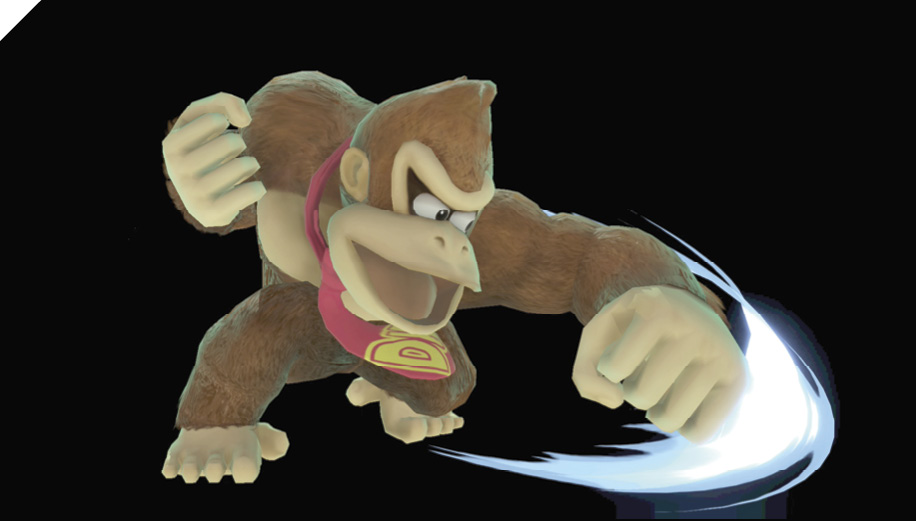
The original Nintendo bruiser attacks directly in front of him with a hook punch, followed by an uppercut. Most of Donkey Kong’s other attacks are fairly slow to hit compared to quicker fighters. Donkey Kong’s punch combo is no Zero Suit Samus jab, but it’s not bad, dealing solid damage with two hits. The first hit can be used as a poke to tick close-range foes and hold them in place, after which you can follow up with a grab attempt. The first hit shielded isn’t disastrous for Donkey Kong, but both hits being shielded leaves him very open.
Dash Attack
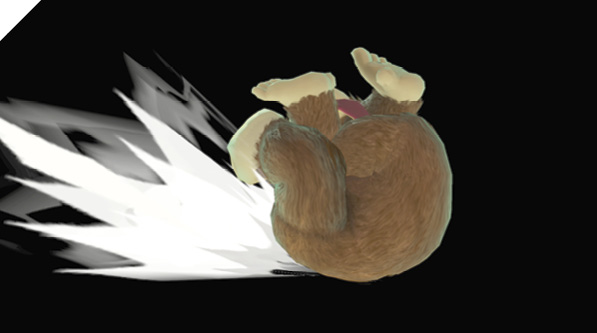
While running or dashing forward, Donkey Kong can start rolling, turning his body into an impromptu boulder! Anyone in the way is rudely displaced. Hitting with the early part of DK’s boulder roll launches foes into the air, but hitting with the later part deals less damage and knocks them out of the way just a little.
Defensive Attacks
Tilts
| Move | Damage | Note |
|---|---|---|
|
Side tilt |
7 |
Arm intangible. Can be aimed up or down a little. |
|
Up tilt |
10 |
Arm intangible. Damage less away from hand. |
|
Down tilt |
6 |
Swinging arm is intangible. Turns opponents around when it hits them in the back. |
Side Tilt
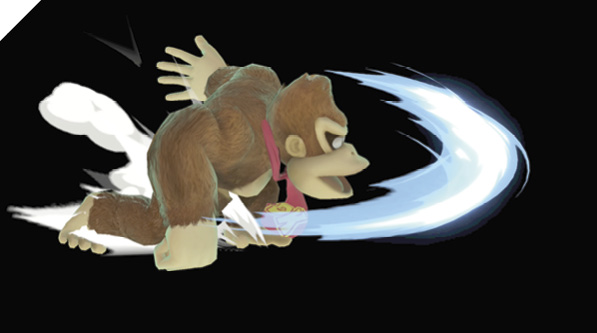
Donkey Kong’s farthest-reaching ground attack. He can’t be hit on his punching arm, which helps him overwhelm other pokes. Aiming slightly up or down when performing side tilt angles it a bit, which is helpful for being sure when the target is slightly off-center.
Up Tilt
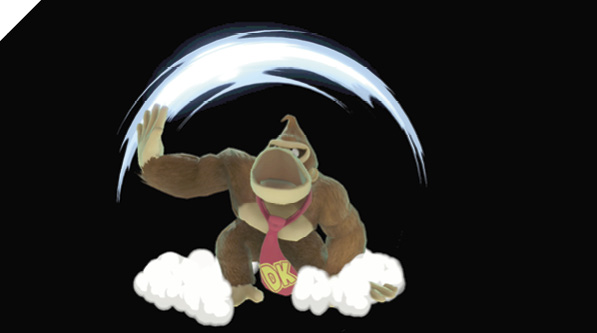
Starting at his front shoulder, the gorilla takes a mighty swat front-to-back, covering all upward angles. Though up tilt is tailored mainly for anti-air and juggling, the very beginning of the attack hits close enemies on the ground.
Down Tilt
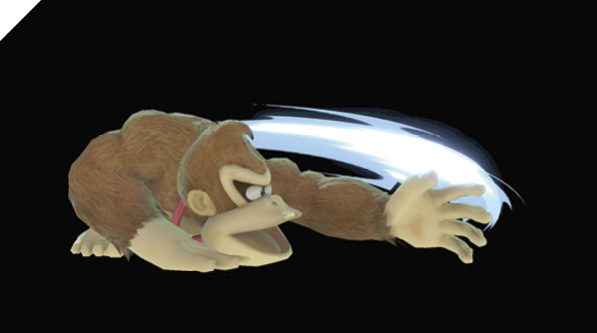
The king of the jungle hunches low and swings with a far-reaching slap attack. Donkey Kong’s arm is intangible for the attack, helping him out-prioritize enemy attacks within range.
Interestingly, this punch turns foes around if their backs are to Donkey Kong, forcing them to face him. Whether they’re facing him or not, DK’s down tilt also has an unusually high chance to trip them off their feet until damage gets well past 100% (at which point this slap starts knocking them down outright).
This poke is great for setting up grab attempts. Messing with enemy movement is always a bonus, and scoring a trip guarantees the follow-up grab succeeds. Down tilt does less damage than Donkey Kong’s other ground pokes, but leads more directly to good stuff right after.
Smashes
| Move | Damage | Note |
|---|---|---|
|
22-30.8 |
Hands intangible. |
|
|
Up smash |
19-26.6 |
Hands intangible. |
|
Down smash |
17.2-25.2 |
Arms intangible. Less damage on shoulders. |
Side Smash
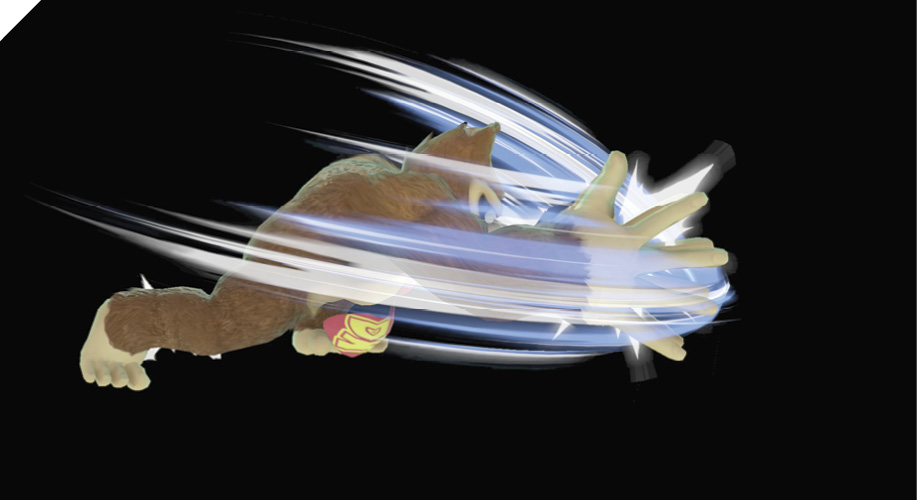
Donkey Kong reaches far forward with a mighty two-handed clap. Charging can increase the damage to absurd proportions for a single hit, if the opposition gives you the time to try it.
Up Smash
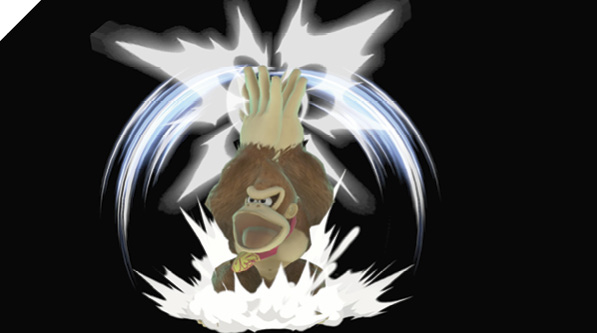
DK brings both hands together above his head for another powerful clap. This attack’s effects make it look a little bigger than it actually is. The hitboxes cover Donkey Kong’s arms only while they’re straight up, palms together. His arms don’t hit foes to the sides on the way up, unlike up tilt. This is for clapping back at foes directly above, like on shallow platforms or ramps, or descending from a jump or launch.
Down Smash
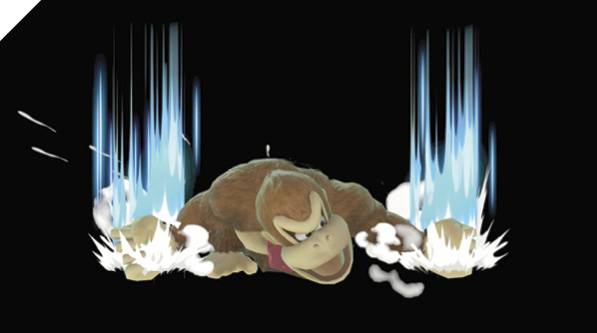
Donkey Kong brings both fists down with arms out, slamming both sides. He also has surprisingly good coverage above his shoulders. This is his most reliable clear-out move when surrounded on the ground. Also, keep Spinning Kong in mind, although it’s a much bigger commitment. With this move’s generous hitbox across the ground between his fists, down smash can work shooting for enemy fingers as they grasp for a ledge.
Grabs
| Move | Damage | Note |
|---|---|---|
|
1.6 |
— |
|
|
Front throw |
0 |
Kong Karry; see table. |
|
Back throw |
11 |
Backward throw. |
|
Up throw |
9 |
Hurls foe into potential juggle position. |
|
Down throw |
7 |
Bounces foe off ground. |
Kong Karry Throws
| Move | Damage | Note |
|---|---|---|
|
Front throw |
12 |
Forward throw. |
|
Back throw |
13 |
Backward throw. |
|
Up throw |
12 |
Hurls foe into potential juggle position. |
|
Down throw |
11 |
Bear hug squirts foe forward. |
Grabs
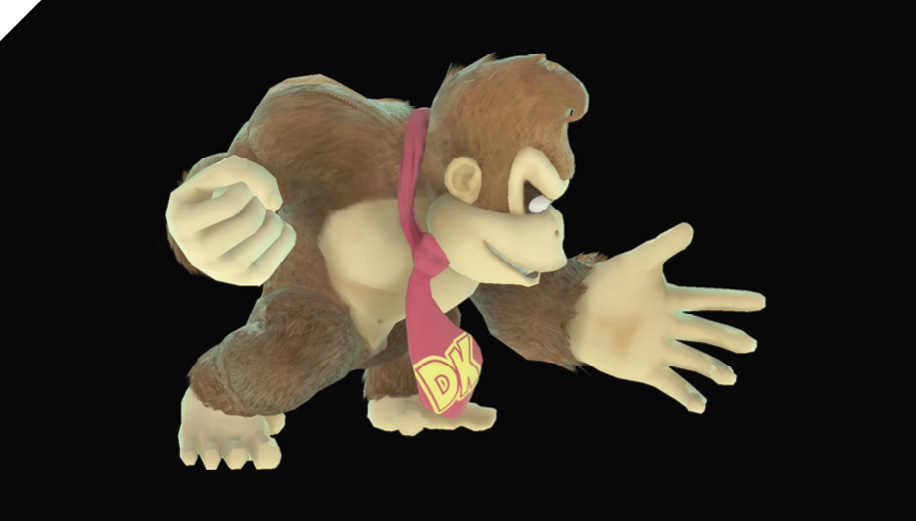
Donkey Kong’s grab animation is quick for a heavyweight, but slow compared to most fighters. Once he pulls in a defender, he has lots of options. You can take the standard route and pummel them a couple of times before hurling them with back, up, or down throw, with up throw having the best follow-up juggle options.
But Donkey Kong can also throw the defender over one shoulder like he’s carrying a sack of cargo with a maneuver called the Kong Karry. It is started by grabbing someone, then tapping forward on the stick. From here, Donkey Kong can move around and jump with the foe helplessly perched. Press direction+Attack/Grab to end the cargo carry by tossing them in the chosen direction. The throws during a cargo hold are unique and not the same as Donkey Kong’s normal throws. Don’t wait too long before throwing cargo, because the victim will recover and shake out of Donkey Kong’s grasp after a few seconds.
Cargo throws cause a little more damage than normal throws, and allow for higher-altitude combos. Grab and shoulder a foe, jump up, throw them straight up, then double-jump after them for another hit. Depending on what they do in the air, you might be able to go for more juggles.
Being able to move around before tossing someone adds some tactical considerations. For example, Donkey Kong has an easier time than anyone when he wants to toss someone off a stage ledge: just walk over to the stage ledge and toss them off. If you’re feeling adventurous, you can even step off an edge, cargo in tow, to fall and throw them back under the stage. This will either spike them off the wall or put them in a position that’s very hard to recover from. With good timing, you can double-jump, then use Spinning Kong back to a ledge handhold.
Aerial Attacks
Aerials
| Move | Damage | Note |
|---|---|---|
|
11 |
Less damage after initial spin. |
|
|
Forward air attack |
16 |
Strongest up-forward. Meteor smash from forward to down. |
|
Back air attack |
13 |
— |
|
Up air attack |
13 |
Head intangible. |
|
Down air attack |
16 |
Neutral Air Attack
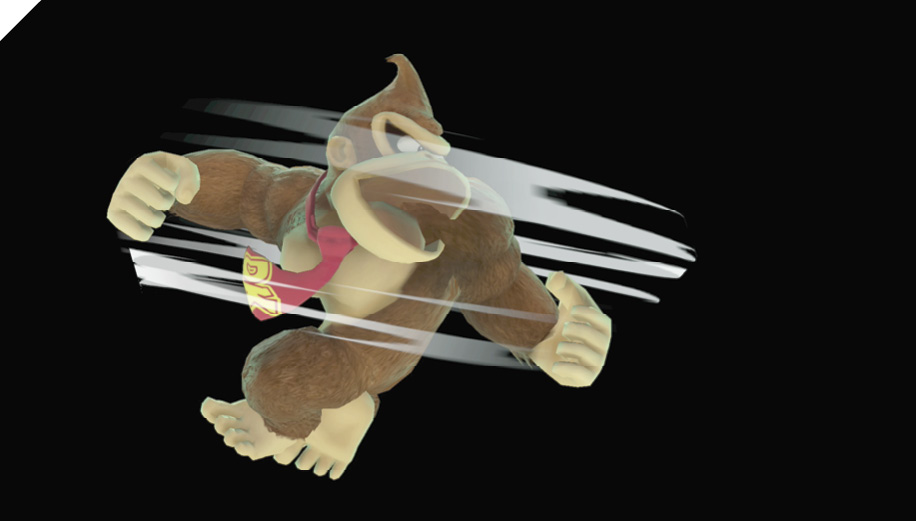
Putting his immense upper-body strength to work, DK spins himself like a top in midair. He hits to his front and back, with good attack duration for an air move. This is his best attack when trying to escape air scrambles. It’s not multi-hit, though. It can easily plow through multiple opponents, but it hits them each only once.
Forward Air Attack
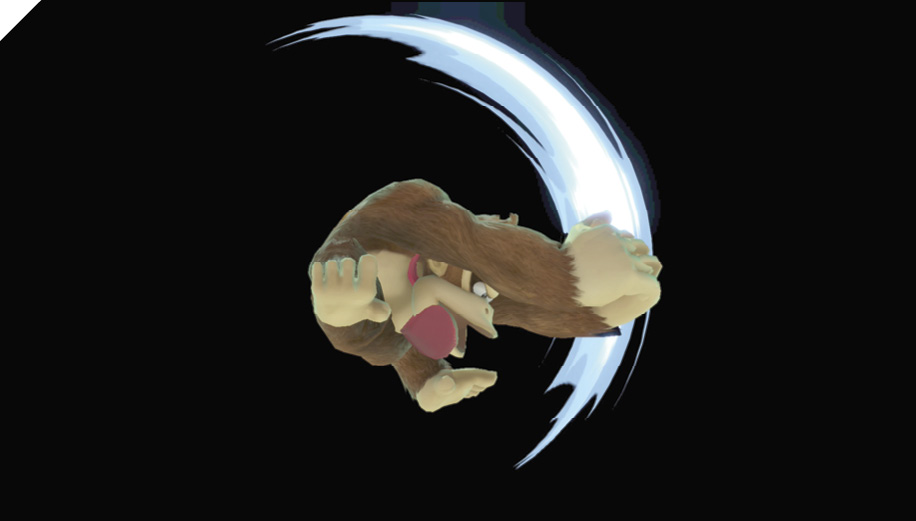
Donkey Kong swings forward with his fingers interlocked, hitting anything in the way with a hammer-blow punch. The gorilla’s wingspan gives the move incredible coverage. Starting almost straight back, swinging over the top, and ending at straight down, forward air attack covers almost 75% of the space around the ape at some point in its hit arc. It even has a meteor smash effect during later frames as the fists descend.
Back Air Attack
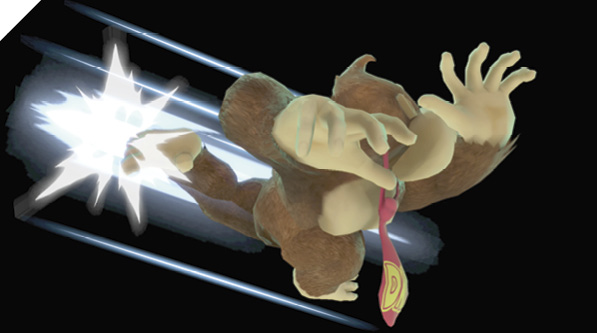
In a rare kicking maneuver, DK hits backward with one leg. Back air attack has surprising reach, and stays active for a long time for a move of its type (though not as long when compared to neutral or forward air attack). When going air-to-air with floaters, back air attack hits quicker than forward air and farther than neutral air attack, while requiring a little more precision than either.
Up Air Attack
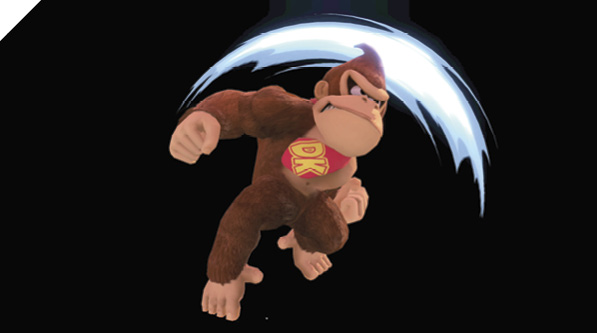
While down air attack, forward air attack’s last third, and air side special can all spike targets to bounce or plummet off a stage, up air hits hard straight up, launching victims high and outright knocking out targets with high damage built up. Donkey Kong sweeps his head quickly upward, covering a little bit above his shoulders. The hitbox is just around DK’s head and it’s not active for long, so it requires precision when looking to headbutt someone into the sky. Don’t expect this to hit anyone sideways or below.
Down Air Attack
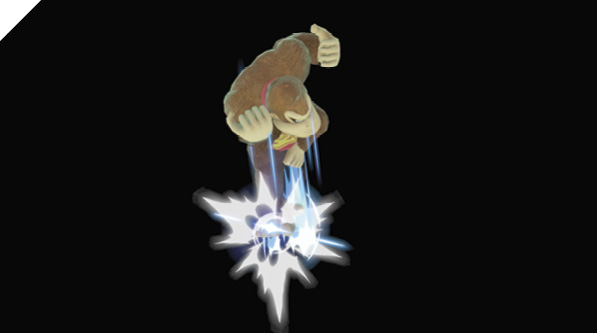
Donkey Kong stomps hard with one foot, spiking victims. Down air attack hits briefly and only around his foot, so it’s harder to aim than some attacks. The rewards are worth it if you catch someone offstage or ledge-grasping. Off short hops it can help work the shield of overly defensive opponents, along with side special and air down special.
Special Moves
Specials
| Move | Damage | Note |
|---|---|---|
|
Neutral special |
10-28 |
6-25 in midair. Punch must be charged first (at least momentarily) . |
|
Side special |
10 |
Super armor before hitting frames. Plants standing targets. Meteor smash on downward air hit. |
|
Up special (ground) |
5, 1.4x5, 4 |
Backswings do 3.5 rather than 1.4 damage. Arms are intangible. Donkey Kong can move forward during attack. |
|
Up special (air) |
5, 1x11, 2 |
Arms are intangible. Donkey Kong can move forward or backward during attack. |
|
Down special (ground) |
14 |
Two launching slaps hit front and back. |
|
Down special (air) |
5, 6 |
Meteor smash effect on second hit. |
Neutral Special: Giant Punch
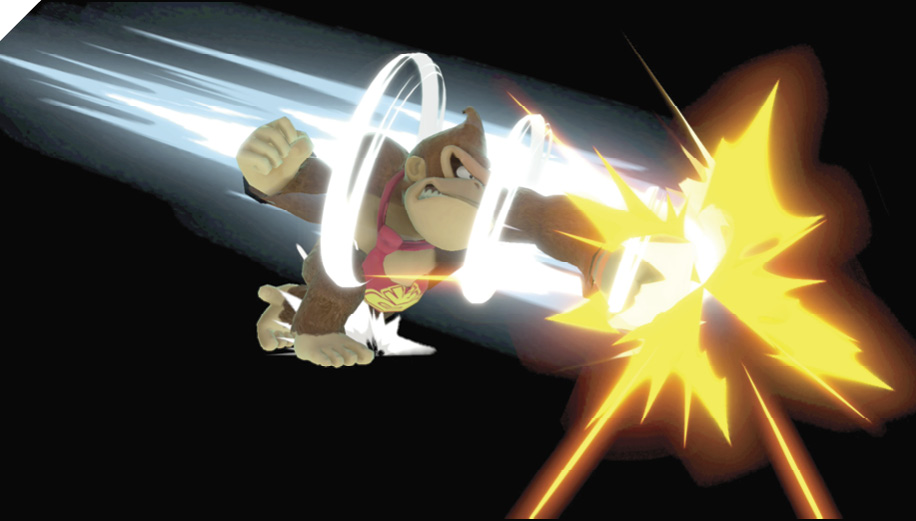
Donkey Kong’s signature megaton punch must be charged before it can be used. Start the charge with an initial neutral special input. Donkey Kong spins one arm, building up power. When Giant Punch is fully charged, DK stops spinning his arm and returns to a neutral state; you can tell he’s got a max-power Giant Punch stored because of his enraged facial expression! Charging takes a while, though, and leaves Donkey Kong open to punishment. Luckily, the charge-up period can be cut short by tapping down (triggering an on-the-spot dodge), or left or right (triggering a side roll). You retain charge already built up, so it’s fine to build up a maxed Giant Punch in bits and pieces, dodging whenever someone encroaches on your preparation.
With a max-power Giant Punch stored, Donkey Kong becomes much more threatening. Such a forceful blow is a KO threat even at medium percentages, and can seriously surprise enemies in midair or edge-guarding trying to keep DK off the stage. If you have your double jump remaining on an airborne period as you drift past a ledge with a fighter guarding it, you can take a shot at them with Giant Punch as you glide by, perhaps totally obliterating their attempt at playing king of the hill! With your double jump and Spinning Kong up special, you can still recover, too.
You can double-tap the Special button on activation for an immediate, weak-powered punch, but the lag on Giant Punch is so significant that this is not recommended. It’s better to fully build up Giant Punch’s charge, even if the charging is in bits and pieces. This assures the punch will be worth the lag when you decide to use it.
Side Special: Headbutt
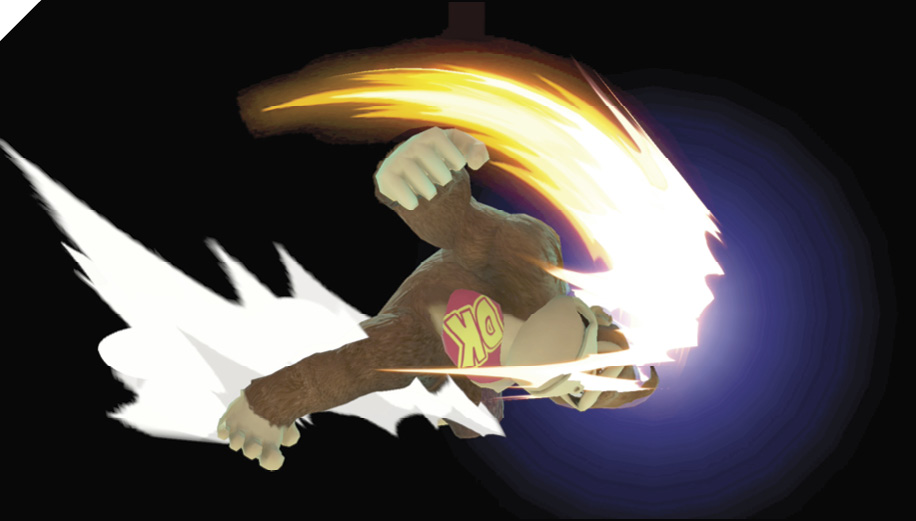
Donkey Kong rears back for a moment before swiping forward with a mighty forehead headbutt. This move doesn’t have much range, but it has a lot of uses because of some special traits. First, during the start-up, Donkey Kong has super armor. This means he can plow through incoming attacks and hit them back, if they strike him before he lunges with the headbutt. Second, on standing or crouching targets, eating a Donkey Kong headbutt briefly plants them in the ground like one of Peach’s turnips. They’re totally vulnerable to more hits while they try to shake out of the dirt. Third, when using a headbutt to joust with other jumpers air-to-air, hitting squarely with the bottom of the hitbox can spike them straight down with a meteor smash effect, scoring fast KOs offstage and leading to bounce combos midscreen. Finally, when shielded, the headbutt deals tremendous damage to an opponent’s shield. If it doesn’t outright break their shield, it’ll put them in serious danger of it should they block any more attacks.
The only caveat for such a strong, multipurpose attack is that it’s slow to hit, a deficiency mostly covered up by the initial super armor phase. Whereas other slow attacks often get interrupted by faster strikes beating them to the proverbial punch, DK’s headbutt can soak those hits up.
Up Special: Spinning Kong
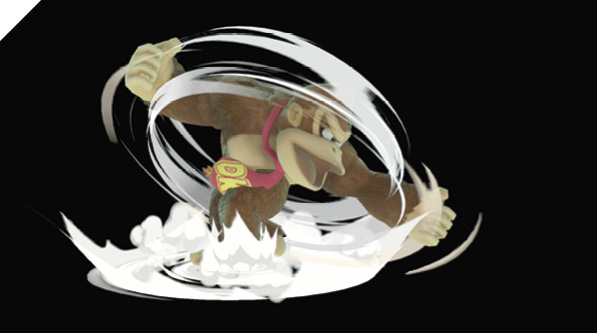
On the ground or in the air, Donkey Kong spins furiously with a powerful multi-hit attack. Does the ground version remind you of anything, Street Fighter V fans? Perhaps a certain grappler’s V-Trigger? Anyway, Donkey Kong’s up special is the culmination of his brute-force approach. He whirls with intangible arms, striking both sides, fast enough to slightly lift himself in midair like a hairy helicopter. The first and last hits are the most powerful whether on the ground or in the air, and in between are lots of lower-damage hits that pile up quickly on anyone close.
During Spinning Kong on the ground, Donkey Kong advances if you hold forward on the stick. During aerial Spinning Kong, Donkey Kong can be piloted in either direction. Aerial Spinning Kong is DK’s main (or only, really) recovery move when punted offstage. It doesn’t gain much height, and its trajectory is extremely predictable. It’s lucky, then, for Donkey Kong that his brute force keeps it effective; opponents might be able to read the path Donkey Kong will traverse using Spinning Kong to float back to safety, but if they can’t overpower his size, weight, and intangible spinning arms, they can’t stop him.
After aerial Spinning Kong completes, DK floats back to the ground, unable to act until landing, apart from steering left or right a bit. So you might make it safely back above terra firma, but don’t be surprised if antagonists are right back on top of Donkey Kong as soon as his dangerous spin slows.
Down Special: Hand Slap
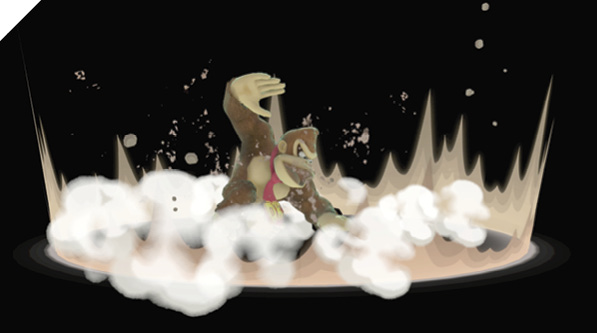
The gorilla slaps ferociously one hand after the other, with different results depending on whether it’s used on solid ground or flying through the air. In midair, down special is basically a powerful two-hit frontal jump-in, covering only diagonal down-forward angles. Used near the ground, it has minimal lag when landing, and deals huge amounts of shield damage against defenders. On the ground, each slap causes a minor local tremor, launching anyone caught in a wide swath. On the ground, down special is basically an area-of-effect explosive in the form of DK’s hands. You can perform it over and over again to keep slapping the ground, perhaps repeatedly juggling challengers who react poorly or misjudge counterattacks.
Final Smash: Jungle Rush
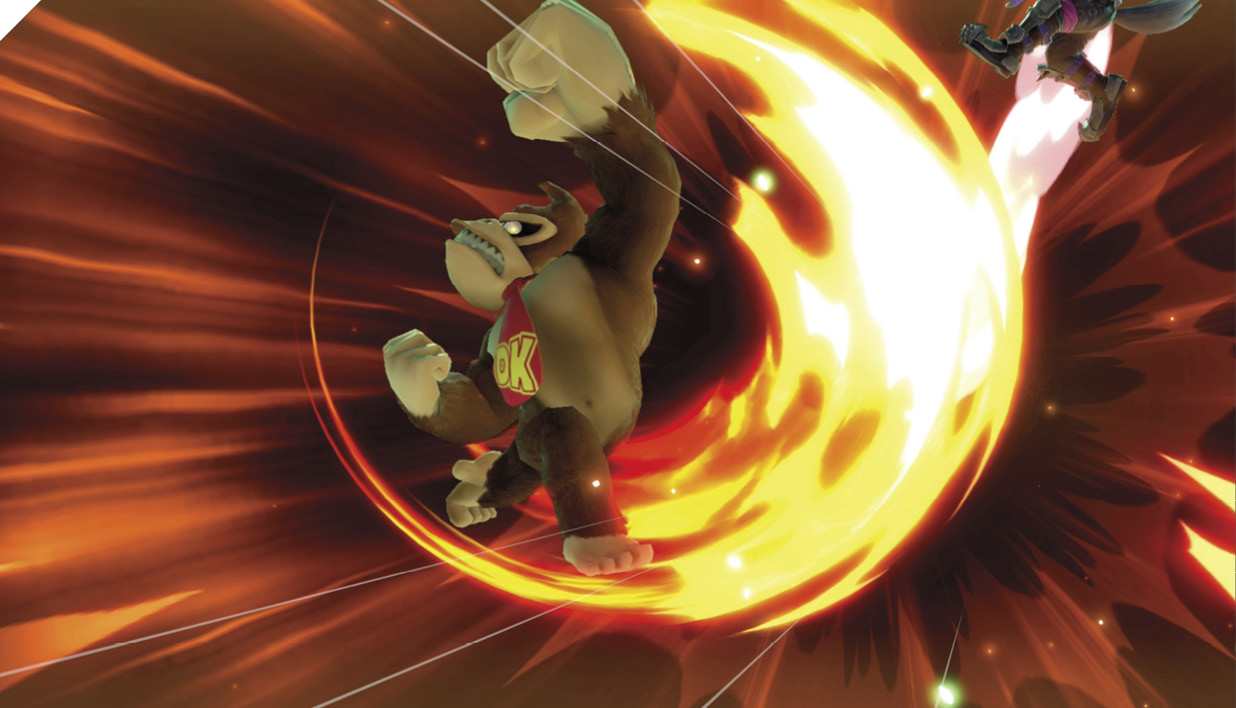
If you thought charged Giant Punch was scary, wait until you see Jungle Rush. Load up by breaking a Smash Ball (or filling FS Gauge, if enabled), then get into punching range. Neutral special unleashes a terrifying hook punch, which traps anyone struck by it in a hugely damaging rapid-fire combo. For a Final Smash this has unusually small range, so make sure the target would be viable to swing at with Giant Punch. Groups are even better; Donkey Kong can make multiple defenders into punching bags together.