
Super Smash Bros. Ultimate Guide Pikachu
Brawler Arsenal
Grounded Attacks
Neutral Attacks
Neutral Attacks
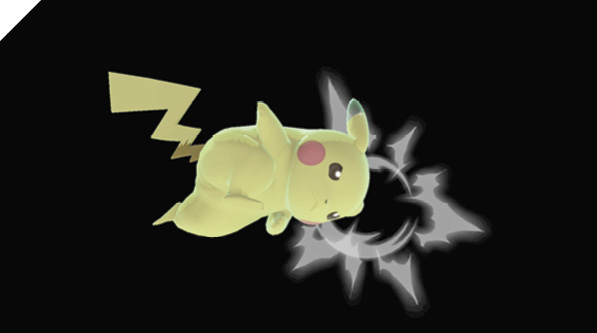
Pikachu leans and jabs its head forward rapidly. Hold down the neutral attack input, and Pikachu repeats the headbutt so quickly the little Electric-type blurs. Pikachu doesn’t have a neutral attack combo with different stages; the same neutral attack repeats itself. The headbutt does the most damage right next to Pikachu, but the range is surprisingly good, extending a little past Pikachu’s crown. Enemies caught in a continuous stream of neutral attack headbutts can be hit several times for a combo, but they’ll eventually be pushed away. The most you can feasibly get is about eight hits for 10% damage, but hitting them with more than three or four headbutts means they’re pushed out of range for a potential follow-up grab.
Dash Attack
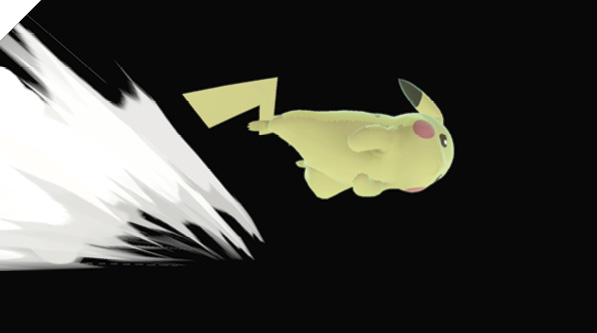
Pikachu throws itself forward from a run with a heavy headbutt, much more powerful than its neutral attack head bash. Hitting early in the dash attack deals the most damage, but hitting late in the dash attack pops recipients into the best position for a follow-up juggle.
Defensive Attacks
Tilts
| Move | Damage | Note |
|---|---|---|
|
Side tilt |
10 |
Can be aimed slightly up or down. Upward version does most damage, downward version does the least. |
|
Up tilt |
5 |
Pops foe into potential juggle position. |
|
Down tilt |
6 |
High chance to trip foes. |
Side Tilt
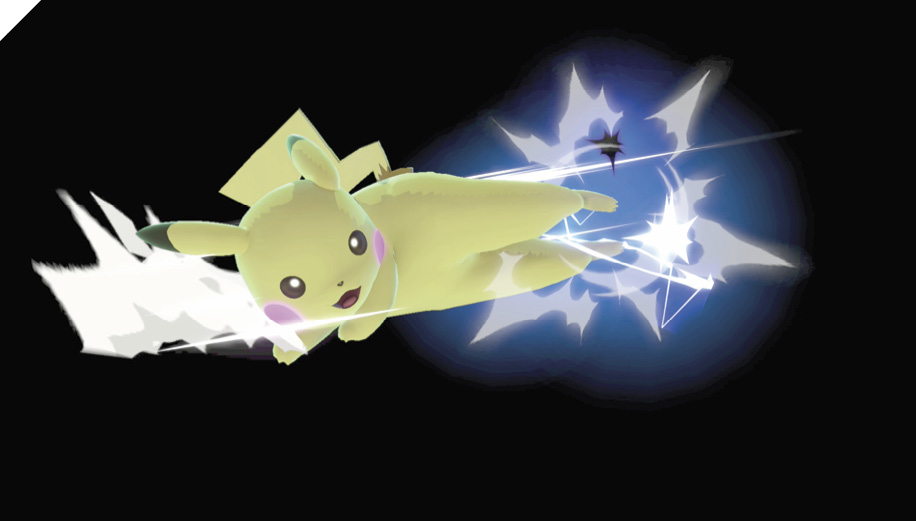
Pikachu plants its front paws to kick forward with both back limbs, with decent hitboxes around the legs and a big one around the feet. This side tilt can be aimed a bit up or down, with the upward-angled version doing slightly more damage, and the downward-angled one doing slightly less. The damage on this move is very good, but the knockback is low, so don’t expect this to gain you breathing room.
Up Tilt
The mighty Pokémon attacks with its tail stretching up over its body from behind, hitting first to the back before covering upward and forward angles. If you think of this as an attack to swing at people in front of Pikachu, it’s not very fast. But if you think of it as an anti-air and juggle tool that happens to hit anyone in front at the end, it’s great. Even on a low-percentage hit, it knocks victims off their feet in position for an immediate juggle hit. At low percentages, you can almost always juggle with up tilt twice in a row; at higher percentages, after launching with up tilt, you’ll have to jump to chase foes for more hits.
Down Tilt
Pikachu shifts to the side to sweep its tail to the front for a quick hit. This hits a tiny bit slower than side tilt while doing less damage, but it has slightly more knockback at low percentages and the potential to briefly trip foes off their feet, so it’s a better poke when unsure of your advantage. It also syncs up well with Pikachu’s ability to crawl forward, so you can move toward enemies and dodge under many projectile attacks before swiping at them with down tilt.
Smashes
| Move | Damage | Note |
|---|---|---|
|
18-25.2 |
— |
|
|
Up smash |
14-19.6 |
Pops foe into potential juggle position. |
|
Down smash |
2x5, 3-2.8x5, 4.2 |
Hits both sides. Launches foes in direction Pikachu faces. |
Side Smash
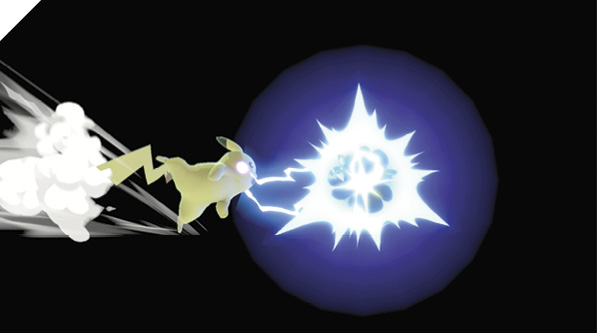
Pikachu cuts loose with its command of electricity, sending a sparking blast forward from its rosy cheeks. After a typical smash attack windup period, the spark starts right in front of Pikachu’s head, then travels forward quickly, greatly outranging any tilt attack options. The spark is active for a huge amount of time for a ground poke, staying active almost as long as the uncharged windup takes. The lengthy active period alone makes this a great ground move. The spark deals max damage in the middle of its travel; it does slightly less close to Pikachu (15%) or at max range, just before it fizzles out (12%).
Up Smash
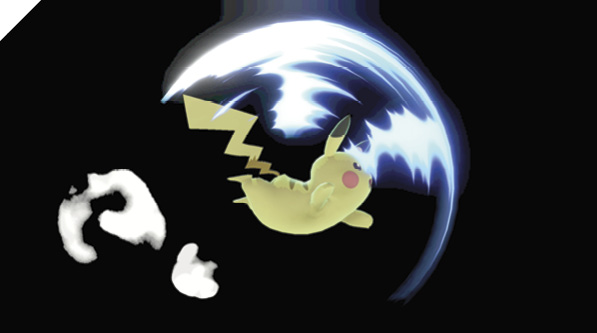
Pikachu backflips in place, sending its zigzag-shaped tail around as a launching attack. The tail hits in front first, then sweeps overhead to hit above, then behind. A hit at any point along the way pops the victim up above Pikachu. When aiming at tumbling enemies or jumpers, uncharged up smash strikes upward angles only marginally slower than up tilt, while dealing much more damage. Damage is highest on the initial front-facing hit, and lowers bit by bit as the tail sweeps toward the back. The backward-facing hit at the end gives up smash clear-out power against anyone sneaking up from behind, though it’s not fast or strong enough to be noteworthy as an intentional backturned poke.
Down Smash
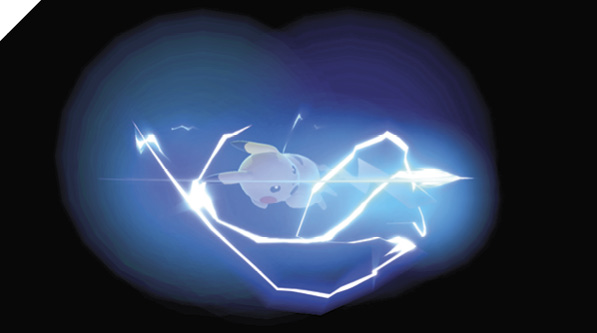
Lying flat, Pikachu spins in place twice, sparks flying all around. During the spins, Pikachu creates large hitboxes to either side, and a small one centered on its body. Anyone caught by one of the hits is pulled into the rest, getting hit several times before a stronger final hit launches them low in the direction Pikachu is facing. For a clear-out-capable attack, down smash hits with shocking (sorry about that) speed; it’s only slightly slower than down tilt, while covering both sides. Since it’s basically identical whether aiming to the front or back, you can choose how to attack with down smash based on the direction you’d like to punt targets afterward. For example, if you’re backed to a stage edge with the enemy encroaching, fluidly turn to face the edge while performing down smash (one trick to make this more consistent is to turn with the control stick just before using the C-stick to down smash). If they’re caught by the attack while going after Pikachu, they’ll be launched low right off the side!
Grabs
| Move | Damage | Note |
|---|---|---|
|
1 |
— |
|
|
Front throw |
2x5 |
Forward throw. |
|
Back throw |
9 |
Rolling backward throw. |
|
Up throw |
3, 5 |
Launches foe into potential juggle position. |
|
Down throw |
5 |
Bounces foe into potential juggle position. |
Grabs
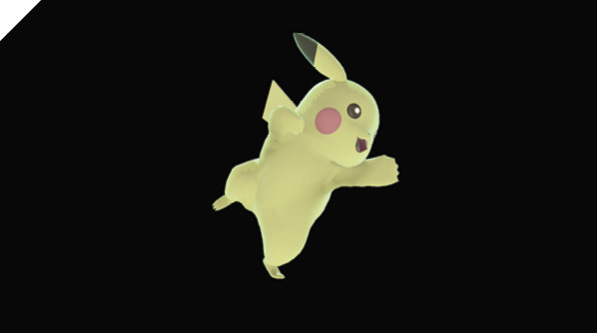
Pikachu’s grab isn’t one of the fastest, but it’s not quite heavyweight grab territory either. The variable neutral attack combo length of Pikachu gives it ample chances to mess with opponents’ minds so they don’t know exactly when a grab attempt is coming. You can jab at them with varying numbers of close-range neutral headbutts before pausing, then going for a grab, or before dodge-rolling behind them to grab from behind.
Front and back throws cover the usual roles, moving enemies toward a desired stage edge. During up throws, Pikachu hurls victims straight upward, in position for a jumping attack juggle or (at higher percentages) even an immediate Thunder special move. Down throw bounces them close in front, in ideal position for immediate jumping air attacks.
Aerial Attacks
Aerials
| Move | Damage | Note |
|---|---|---|
|
1.8x3, 3.5 |
— |
|
|
Forward air attack |
1.4x5, 4.8 |
— |
|
Back air attack |
1x5, 3.6 |
— |
|
Up air attack |
6 |
— |
|
Down air attack |
13 |
4 damage on landing. |
Neutral Air Attack
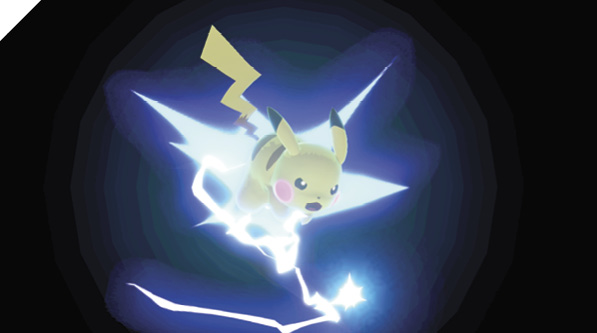
For this simple and effective air poke, Pikachu emits stored electricity in several bursts. Pikachu’s body itself is the hitbox here, so the attack’s range is nothing to write home about; you basically have to plow right into targets with Pikachu’s torso. But the attack starts up almost instantly and lasts for a long time, making it an excellent all-purpose move. Go up against enemies air-to-air with it, use it to escape from a helpless tumble, or jump in on grounded enemies on either side, front or back.
Forward Air Attack
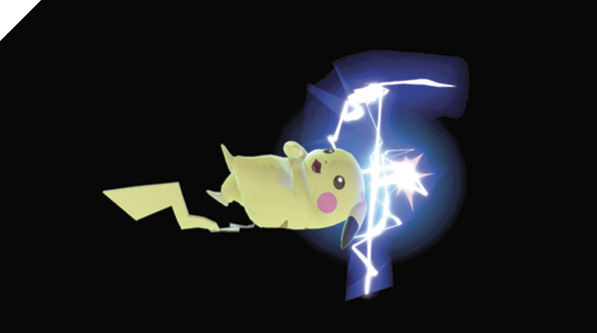
Pikachu lies prone facing forward in midair, emitting sparks from either side of its head. This air attack has a forward-stretching hitbox that also covers slightly above and below Pikachu’s head. This is much slower to hit than neutral air attack, but stays active for a long time once it’s out. It’s great for aiming directed attacks at foes in front, as long as there’s time to get it out.
Back Air Attack
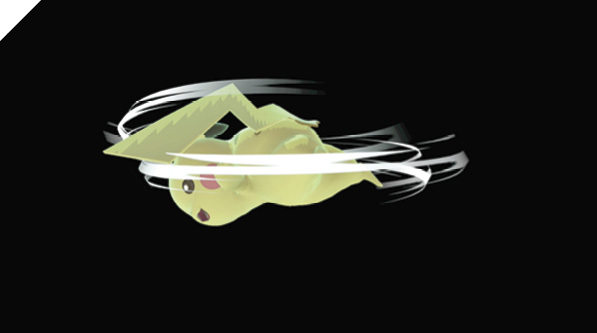
Pikachu spins sideways repeatedly in midair, almost like a jumping version of down smash. Back air attack hits extremely quickly, just slightly slower than neutral air attack, and much faster than forward air attack. However, the range is extremely short. Like with neutral air attack, the hitting area is basically just Pikachu’s body, but flatter. But like most of its air attacks, back air stays out a long time, making it easier to connect with.
On hit, the opponent is blended up for a second before being kicked away to Pikachu’s back. When catching foes air-to-air, back air hits so fast and lags so little that you can often combo them immediately with another back air by double-jumping as soon as the first one finishes. Back air is so fast that it makes a great backward-moving short hop attack. A backward short hop with back air hits as fast as any tilt attack.
Up Air Attack
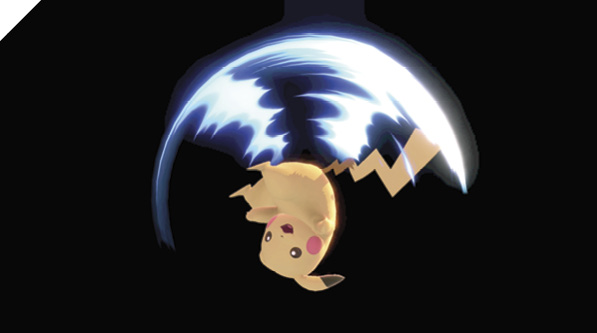
Swinging its tail from up-back to up-forward during a forward flip, Pikachu swats at anyone above. The hit is very fast, with the initial up-back-directed hitbox emerging with the same speed as back air attack. Up air attack is great for the usual purpose of attacking upward and juggling, but since it’s so fast and is Pikachu’s only quick single-hit jumping attack, it has some use as a late falling jump-in attack too, used against standing targets just before Pikachu lands.
Down Air Attack
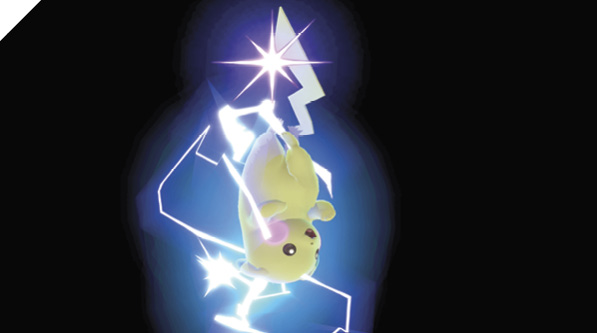
Pikachu’s strongest air attack is also its slowest, almost like a downward-aimed smash attack. Use this offstage when trying to spike recovering foes downward, and midstage when falling on grounded foes. Down air attack has unique landing lag if used just before hitting the ground, with Pikachu’s touchdown force capable of delivering a secondary hit. Drop on someone with a perfectly aimed down air, and you net the falling attack’s damage plus the landing hit.
Special Moves
Specials
| Move | Damage | Note |
|---|---|---|
|
Neutral special |
5 |
— |
|
Side special |
6.2/10-21.4 |
Charge for more damage; smash-style input for free pre-charge. |
|
Up special |
2, 3 |
After input, hold two separate directions for zipping moves. |
|
Down special |
8/15 |
Damage increases if bolt hits Pikachu. Intangible while being struck by lightning. |
Neutral Special: Thunder Jolt
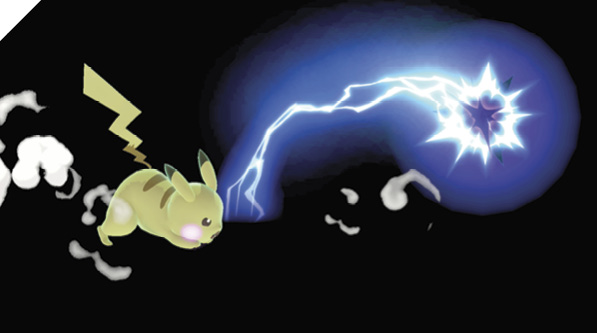
For Pikachu’s staple projectile attack, a small bouncing thunderbolt is fired in the desired direction. You can change the direction before it’s released by inputting the opposite direction immediately after inputting neutral special, which is important for redirecting your offense in midair. Once released, a Thunder Jolt projectile travels down-forward toward a hard surface. Once it hits a hard surface, the little lightning bolt travels along any continuous surface, bouncing seven times before disappearing. Thunder Jolts can travel up sheer walls and even curl around corners to keep traveling along their paths. Since Thunder Jolt’s eventual range is based on bounces, you get farther-reaching bolts by jumping high in the air before releasing them. The first bounce doesn’t register until it reaches the ground.
Thunder Jolts can be fired repeatedly, up to three on-screen if you throw the first one while airborne. They have myriad uses, whether to chip from afar along the ground, or to cover yourself while falling back to the stage. With the wall-skipping ability, Thunder Jolts can even protect Pikachu’s recovery, on stages with cliff edges. While drifting back to safety, fire a Thunder Jolt so the bolt hits the side of the wall, then make your usual play to return (double-jumping and using Skull Bash or a two-stage Quick Attack). The bolt will climb up the cliff, then curl onto the stage, right where edge-guarding enemies wait for you.
Side Special: Skull Bash
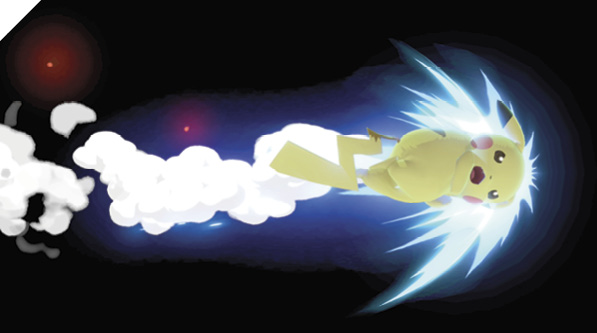
Pikachu launches suddenly to one side, flying laterally with a spinning electric headbutt. The horizontal travel is impressive for a relatively quick special move of this type, sending Pikachu rocketing across about four dashes’ worth of space. Skull Bash’s damage doesn’t diminish with distance traveled.
Skull Bash can be charged before release, greatly increasing damage at the cost of start-up time. For a little bit of free pre-charge, perform Skull Bash with a smash-style input, snapping the control stick all the way to the side. This starts the base damage at 10 instead of 6.2, and there’s no reason not to use this method, since it doesn’t add any extra windup. Used near the ground, Pikachu has considerable landing lag at the end. Used high in midair, you can act again after Skull Bash ends. This makes the attack a useful recovery tool.
Up Special: Quick Attack
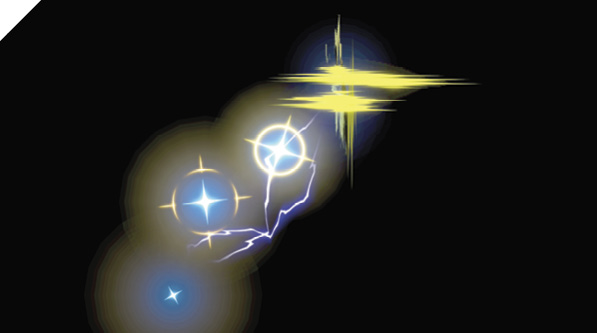
Upon inputting up special, Pikachu briefly preps for a moment while waiting for you to input a different direction. If you don’t, Pikachu zips straight upward. If you hold a direction, Pikachu zips precisely in a straight line in that direction. During this zipping movement, hold a different direction to make Pikachu zip a second time along the new heading. Each zip deals a little damage, with the second zip being slightly stronger, but this move’s purpose isn’t really attacking. It greatly reinforces Pikachu’s status as a lightning-fast, erratically moving combatant who’s hard to pin down. You don’t have to use both parts of Quick Attack; you can simply use a single Quick Attack in any direction if desired, then forgo a second directional input to fall to the ground. There’s lag until landing, though, so make sure the situation below is calm first.
When recovering back to safety after getting hurled out over a pit, you basically always want to use both segments. To curl up over the top of a ledge or cliff, Quick Attack upward, then diagonally over the intended landing zone. Or, below a graspable ledge, you can zip laterally right under the handhold, then zip straight up to grab it. Pikachu’s unpredictable and super-fast movement during Quick Attack can make it hard for edge-guarding foes to deter it (especially if you throw a Thunder Jolt at the side of the stage first for extra cover).
Down Special: Thunder
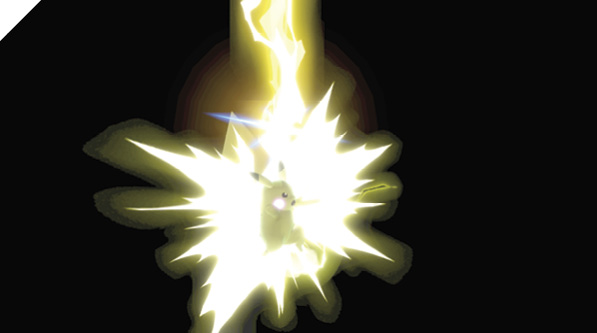
Pikachu calls down the Thunder! While the Pokémon beckons the sky, a powerful lightning bolt streaks straight down toward Pikachu’s location. The bolt has a long vertical hitbox and can hit anyone above Pikachu while still streaming downward. If the bolt hits Pikachu, the Electric-type Pokémon explodes in an even more powerful hit, striking anyone nearby. (If the bolt strikes Pikachu in midair, it zaps the Pokémon upward a bit.) Pikachu is intangible while exploding with lightning energy, overpowering anyone trying to attack at the same time.
If you use Thunder while on the ground or jumping straight up, the lightning bolt is guaranteed to hit Pikachu and trigger the secondary effect. However, if you use Thunder while drifting sideways in midair, the lightning bolt misses Pikachu and sputters out upon striking the ground. You can use this to great effect when edge-guarding. Jump off the stage, use Thunder so the lightning bolt plunges past the stage edge, then go about recovering (by double-jumping and Skull Bashing or Quick Attacking back to safety). Time this properly, and the bolt can intercept someone just as they’re trying to lunge toward a ledge from below! Thunder can also be used for offstage stalling tactics, thanks to the mild bump Pikachu gets in midair. Double-jump straight up when hovering over a sheer drop and perform immediate Thunder. Pikachu ends up slightly higher than the double jump starting point, ready to Skull Bash/Quick Attack for more air movement. Stalling on the edge of a stage and attempting to lure foes into vulnerable positions, you can jump off the stage, double-jump up, Thunder in place, Skull Bash farther away from the stage, and still do a two-stage Quick Attack back to earth!
Final Smash: Volt Tackle
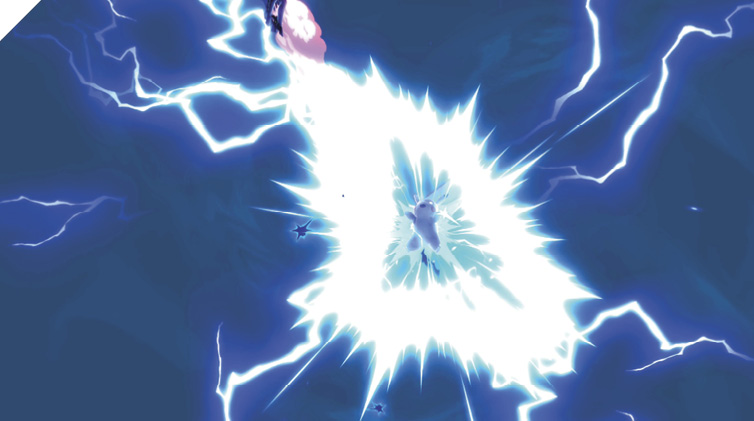
Chase down a Smash Ball or fill the FS Gauge to ready Volt Tackle. Pikachu travels laterally in a flash upon activation, starting a full-screen crisscrossing attack upon contact with the first opponent. Pikachu scurries back and forth rapidly in blue flashes, focusing on the main target but fully capable of hitting everyone else in the way.