
Super Smash Bros. Ultimate Guide Ultimate Glossary of Terms and Mechanics
Edge-Guarding
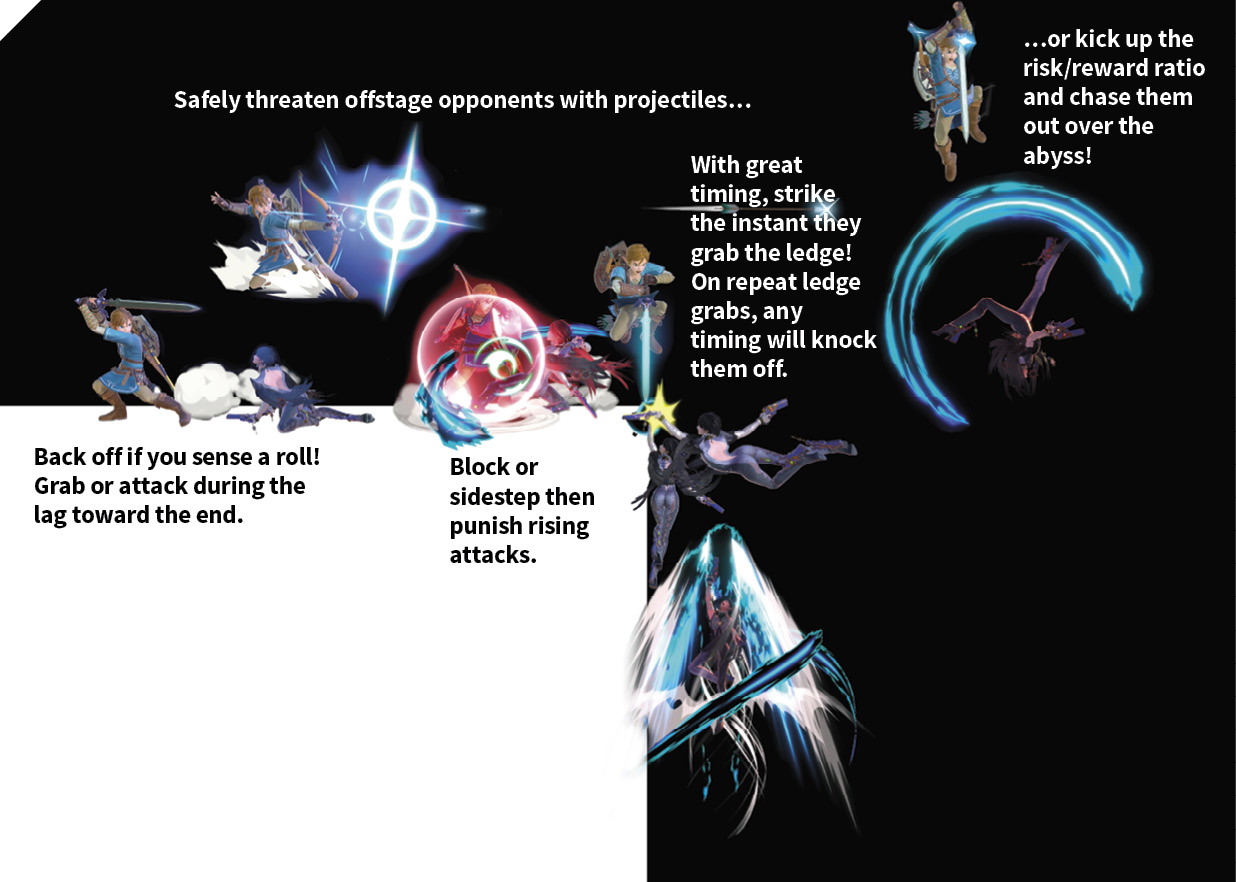
In a nutshell, edge-guarding means preventing someone offstage from recovering safely. Many knockouts come from building damage on an opponent to a high level, like 80%+, then smacking them with a heavy move with high KO potential, like a good air move, smash, or your strongest throw. The rest comes from edge-guarding: tossing someone over an edge, then stopping them from making it back. Ideal edge-guarding essentially involves giving recovering fighters more chances to mess up.
Being Annoying
One basic edge-guarding tactic is to toss items and projectiles into the likely return path of offstage fighters. Most fighters have a pretty telegraphed way to return to solid ground: they drift a bit; employ a tactic to move laterally, like a side special or directional air dodge; then use up special to lunge for an edge. So every object put in the way of this path forces them to modify their approach, even if just a little, and every time they have to do that is a chance for them to miscalculate over a sheer drop. Sure, if they get hit by tossed objects, they can reuse midair specials (giving them another crack at an up special, for instance), but they take a bit of damage and are knocked off their midair track. And if they take successful evasive action against a tossed object (using a special earlier than desired to move out of the way, or air-dodging through the item or shot), they limit their recovery options the rest of the way, perhaps making it easy for you to chase them with a spiking follow-up hit after the obstacle toss.
Chasing Them Over the Abyss
A higher-risk, higher-reward tactic is to chase enemies out over thin air. Aggressors put themselves at risk this way but are naturally still safer than whoever is trying to recover; someone who jumps off a stage or drops from a ledge on purpose is more in control of their situation than someone trying to drift back to safety after getting launched off the side. You can step off the stage, take a strong swing at someone with your best air move (often, back air and down air attack make excellent jousting options, with back air usually having lots of knockback and power, and down air often capable of meteor smashing), and still have a double jump and midair specials available to move back to the edge. Fighters with high air mobility, great air moves, and more midair jumps than the usual have an edge when getting proactive about interfering with recovery.
Canceling Out Hanging Intangibility
Experienced fighters won’t recover simply by drifting out over a stage to fall to their feet. The vast majority of up specials leave their users helpless until landing, so recovering by drifting alone makes you an easy target for being launched and juggled with moves like up tilt and up air attack. Savvy players usually try to drift in position to target an edge with their side or up specials. Well-aimed, this lets them go from surging toward the edge to hanging from it, intangible. Edge-guarding against these players involves either stuffing their up special in progress, stopping them from making it to the ledge at all, or slapping at the ledge just when they arrive. The first time an airborne fighter hangs from an edge, they become fully intangible, but only after two frames of initial vulnerability as they first reach out and grasp the handhold. So, if you know someone wants to reach for the edge this way, use moves with down-forward-stretching hitboxes to target their hands. The timing is exacting, but it’s a crucial tool for scaring recovering fighters.
If you slap at their ledge-grasping fingers and succeed, knocking them off before the intangible hanging period, it technically counts as them touching the ground, so they restock the ability to use their midair jumps and special moves. However, since this new midair period of theirs begins by being slapped off a ledge handhold, they’ve already used up ledge intangibility. If they lunge for the ledge again, this time it’s easy to knock them off! You don’t have to try for frame-perfect timing sniping their fingers; you can hit them anywhere. This makes it much easier to convert an edge-guarding encounter into a knockout. Their recovery potential is drastically reduced when they can’t rely on up specials carrying them into a briefly intangible ledge sanctuary.
Ledge-Snapping
Besides slapping foes’ fingers during the two-frame window when they’re just starting to grab an edge but haven’t yet become intangible, there’s another way to knock ledge-hangers off, ending their intangibility. Only one fighter can hang from a given edge at a time. Anyone who gets close enough in midair to grasp the same ledge knocks the first hanging person off! It takes too long to hop off an edge, fall, and grasp it to knock someone off, but there’s a trick makes you appear to “snap” directly from running off the edge of a stage, to hanging off the side:
On the ground, a few steps from the edge, flick and hold the control stick to run toward it. Run clean off the side, and right when you do, rotate the control stick in a rapid half-circle from forward, to down, to back toward the edge. You have to register you’ve left the stage, but without drifting away from it at all. Properly executed, this “ledge snap” maneuver makes it look like a fighter is running toward the edge, then is suddenly hanging off the side. If you see them pivot at the edge, you’ve rotated the stick backward too fast; if you see them plunge off the side, you’ve done it too slow. Don’t fret if it’s hard to see how this works for a while—it is hard! Practice in Training Mode first, with the speed reduced (Training Mode allows you to try stuff out at 2/3, 1/2, and 1/4 speed, which is really useful for understanding concepts and mechanics). This trick also tends to be easier with fighters who have slower movement speed, for obvious reasons. You have to run confidently far enough off the stage to be considered airborne, then pull the stick across a downward direction to cut forward-moving momentum, then move the stick back toward the edge to grasp it.
Leveraging the Position
Holding off and blocking may work better when it seems like the enemy will probably make it back to the stage edge or a ledge-hanging position (whether you’re not in position to interdict with good timing, or other skirmishes are developing close by, or you’re playing a fighter who lacks great edge-guarding tools). The key to passively edge-guarding like this is to make sure you still end up facing the edge, most of the stage at your back, with the enemy hanging from the ledge or touching down on the short slice of stage in front of you. Even if you don’t chase them offstage or toss annoyances at them, you control the situation if you control the space. If they fall to the stage after most up specials, you can definitely hit them. If they fall with an air move, you can block it and attempt to punish. If they hang from the ledge, any option they pick can be thwarted if you react correctly: you can shield and punish against a rising ledge attack or hopping move, and you can grab them right after their attempt to roll past you or climb up in place. If they drop from the edge voluntarily, they’ve just given up the biggest ace a recovering brawler can play, exploiting hanging intangibility; their next ledge grasp in the same airborne interval won’t have any!
The TL;DR version of this extremely important article is that edge-guarding involves finding a balance between bold moves—tossing stuff in the enemy’s way, chasing them offstage proactively to go for a spike, sprinting off an edge and ledge-snapping to nudge them back off right after they start hanging—and not overcommitting recklessly, overplaying your positional advantage.