
Assassin's Creed Origins Guide Reference and Analysis
Enemies
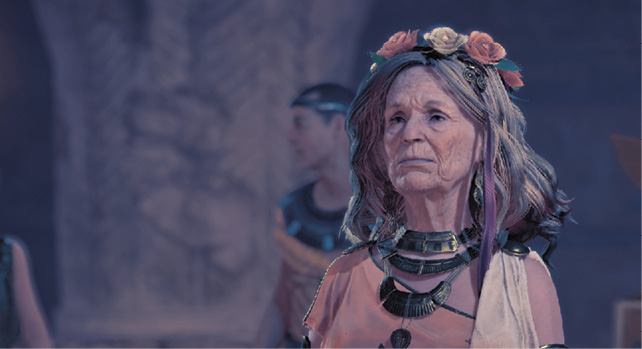
Berenike—The Crocodile
Ethnicity: Greek
Born: Faiyum
Age: 60s
Sex: Female
Berenike is the Nomarch of Faiyum, the Governor of the region.
She is an idealist who has the means to effect change on a sweeping scale, but her wealth and power are largely inherited. She has a vision for peace and order that comes from the Greek aphorism “A society grows great when old men plants trees in whose shade they shall never sit”. While her father was content to reap the personal fruits of wealth and power, Berenike is driven to create a better world, a philosophical ideal inspired by her childhood tutor.
It was this agent who engineered conflict after conflict between Berenike’s ideals and her father’s personal greed, until she was forced to choose whether to kill her father for the sake of the land or to abandon her ideals to save her father. She was inducted as a member of the Order of Ancients on the day she slipped poison into his wine. Ever since then her obsessive pursuit of order and control has been her only means to justify in her own mind her horrific act of patricide.
Berenike’s Order of Ancients mission is to use her control of Faiyum to fund their operations. She maximizes this revenue by enacting taxes and regulations that force the consolidation of landholdings into the hands of the Hellenic ruling class.
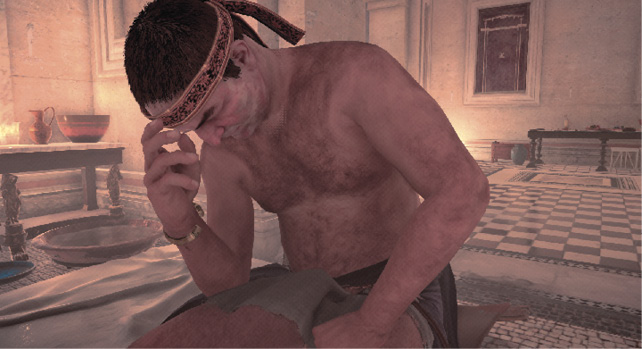
Eudoros of Alexandria—The Hippo
Ethnicity: Greek
Born: Greece
Age: 60s
Sex: Male
A proud and regal man, Eudoros is a shining light of the Peripatetic schools of philosophy, and one of the most respected intellectuals in Alexandria. He is tall and regal, slightly overweight but very healthy looking. He is also quite handsome and enjoys the finest pleasures life has to offer. He is also a respected and accomplished philosopher, having written many books on a number of scientific topics.
He is detached and aloof and has no interest in the affairs of the common people of Egypt, but he is not a misanthrope. He is merely an intellectual enamored with the operation of his own thoughts and opinions. When he does relax, he does so lavishly, firmly believing that his intelligence and charisma are proof of his importance. A firm believer in the idea of inherent nobility, he naturally feels he is one of the most inherently noble.
As a philosopher, scribe, and historian, Eudoros has given himself the task of creating propaganda that proves the inarguable superiority of men like him (Nobles, etc.). He therefore has a vested interest in all things that tell his story “the right way”… legends, myths, political pronouncements, etc.
He has also been given the task of executing all those in opposition to King Ptolemy XIII’s rule.
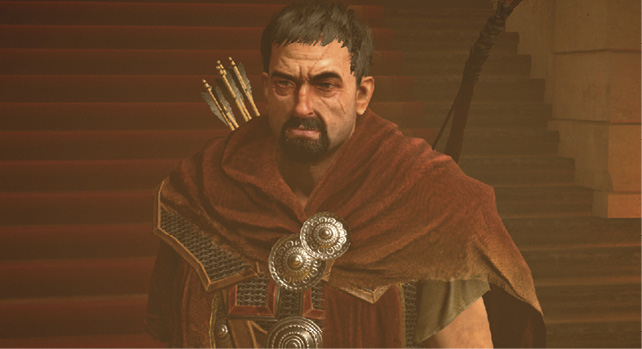
Flavius Metellus—The Lion
Ethnicity: Roman
Born: Rome
Age: 40s
Sex: Male
Flavius is a powerful and far-reaching Roman soldier with a distinguished military career. He is an ally of Caesar’s. He came from an older patrician family that had lost much of its wealth, but he married a wealthy woman Porcia Orestilla to restore his family’s treasuries. This was his second marriage, and certain enemies whispered that he had murdered his first wife and son to be able to marry into money.
Flavius came to prominence as proconsul (governor) in the Roman province of Cyrenaica, and spent time in Cyrene, the capital of that region and the oldest and most important of the five Greek cities on the north African coast of the Mediterranean city (modern day Libya). He has been hungrily eyeing the wealth of Egypt for as long as he has been in the region.
Although one of Caesar’s allies, it is an alliance built on Flavius’ wealth and military strength rather than trust, or honesty, or respect. Flavius knows Caesar needs him, and in return, Flavius uses Caesar to increase his position. Flavius is extremely ambitious—personally and politically—and will use any opportunity to improve his lot. Although he has a reputation for ruthlessness and brutality when it comes to his enemies, he can be obsequious or servile in regards to his superiors—like Caesar—until he is certain he has an advantage over them.
Flavius believes Caesar is too lenient and accepting of his enemies, and in particular looks upon the Egyptians as a resource to be exploited for Rome’s—and his own—gain.
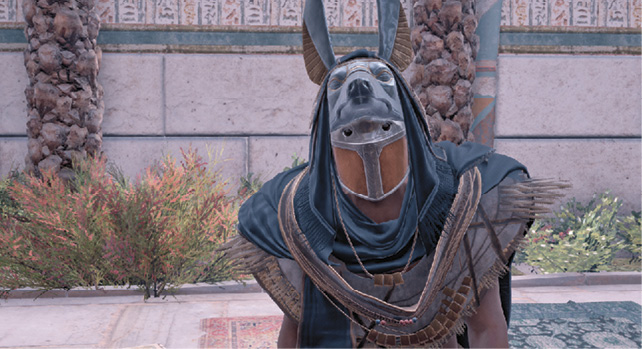
Hetepi – The Lizard
Ethnicity: Egyptian
Born: Unknown
Age: 40s
Sex: Male
Hetepi is a Second Priest of Ptah, under Pasherenptah, the High Priest of Ptah in Memphis. Working as a member of the Order of Ancients in a city predominantly in support of Cleopatra, Hetepi’s attempts to change the identity of Memphis are continuously thwarted by his status. A quiet and reserved fellow, Hetepi draws little attention to himself, facilitating his bid to usurp the High Priest and take his spot.
Hetepi oversees a massive fraudulent operation of “curses” in his bid to manipulate the minds of the people and dethrone the High Priest. He poisons his wife to prevent childbirth, sabotages mummification, and is responsible for the slow and imminent death of the Apis bull. As long as these problems exist, the finger will continue to be pointed at Pasherenptah, and it is only a matter of time before Hetepi benefits from the High Priest’s inability to find a solution.
Once nominated to take over for Pasherenptah, Hetepi will “banish” all curses, gain the support of the people, and establish a clear alignment to Ptolemy XIII.
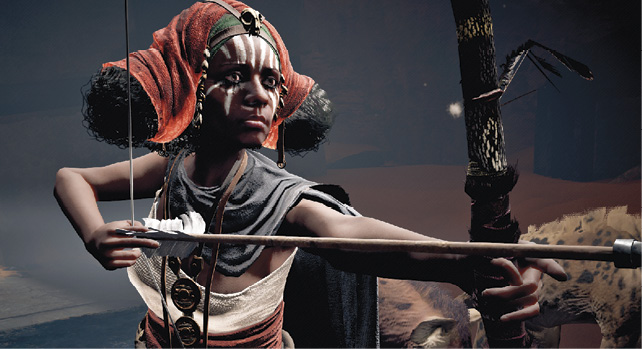
Khaliset—The Hyena
Ethnicity: Kushite or Nubian
Born: Thebes, Egypt
Age: Mid 30s
Sex: Female
A skilled thief and tomb-raider from Thebes. She dresses in the manner of a hunter and tracker well accustomed to the arid climate of the desert. She has few —only weapons, water, and a reasonable amount of food. The colors and roughness of her outfit allows her to blend with the colors of the desert (for proper coloring, see mission design for the region she will inhabit.) Her primary weapon is a bow, but she is equally good with short blades too. Due to her particular skillset, she has been given the task of locating rare deposits of silica and ancient technology artifacts hidden in tombs and throughout the deserts. This silica, is the primary power source for ancient technology.
Now, with a firm belief entrenched in the spiritual properties of these ancient artifacts, Khaliset holds out hope that she can one day return her daughter’s (ESHE) soul to her body, and bring her back from the dead. Seeing the Order of Ancients’s obsession with ancient technology and having recently discovered an ancient technology room beneath the great pyramid, Khaliset feels that if there is any hope left for her daughter, it would be through the wonders of this great ancient civilization.
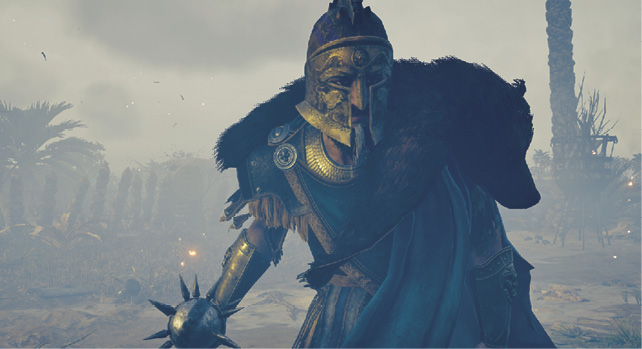
Lucius Septimius—The Jackal
Ethnicity: Roman
Born: Roman Republic
Age: 40s
Sex: Male
A Roman Military Tribune stationed in Alexandria, killer of Pompey the Great, and master manipulator. He is a member of the Gabiniani faction of Roman Soldiers, a group of Roman soldiers who are permanently stationed in Alexandria to protect the Ptolemaic kings and queens.
In 55 BC, Septimius accompanied the General Aulus Gabinius to Egypt to serve as one of Ptolemy XII’s protectors. He fell in love with the city almost immediately and married a local Egyptian named Nebetia, vowing to spend the rest of his life there. Around this time he also fell in with members of the Ptolemy’s court, men like Pothinus, Achillas, and Ganymedes, a move that solidified his position in the upper echelons of Egyptian society. When Ptolemy XII died of a sudden illness, his advisors Pothinus, Ganymedes, and Theodotus promote Septimius to their inner circle. It was under the orders of Pothinus that Septimius killed Pompey as he came ashore in Pelusium, thus landing the first blow of what would become the Battle of Alexandria.
Septimius is a strong and hearty man who can be friendly in times of calm, but who may also explode in bouts of irrepressible rage at the slightest provocation. Oppressed by the feeling that someone is always taking advantage of him he is twitchy and quick to brand associates as enemies. When agitated he stalks about like a panther searching for prey. He only feels at ease when he is in the company of those he knows are his allies and co-conspirators; otherwise can be brooding, sarcastic, and aloof.
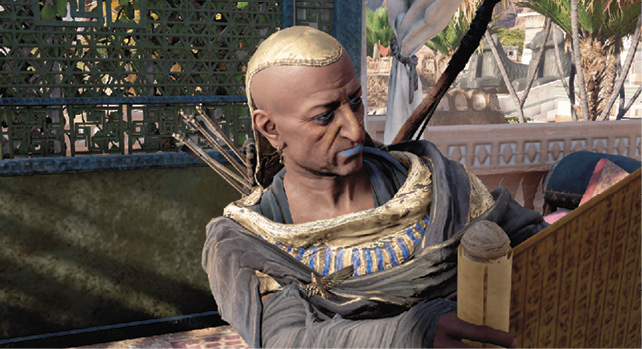
Medunamun, The High Priest of Amun—The Ibis
Ethnicity: Egyptian
Born: Thebes, Egypt
Age: 55
Sex: Male
Medunamun has replaced the old Oracle as the new brutal spiritual overseer of Siwa. He has very close ties with the Pharaoh and his handlers. He is an intelligent but embittered man who hides great doubts about his role behind a veneer of excessive piety. He pretends to be religious but in reality has a deep insecurity about his understanding of the Gods and the world around him. He has a slightly sadistic side and cares nothing for the feelings of other people when they get in the way of his personal goals.
He has come to Siwa in search of the secrets beneath the Temple of the Oracle.
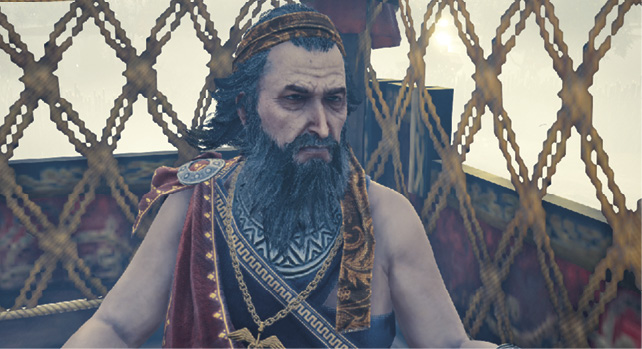
Pothinus—The Scorpion
Ethnicity: Greek
Born: Pelusium
Age: 40s
Sex: Male
Pothinus, Ptolemy XIII’s Advisor, is a rather deceptive character. Outwardly gentle and well-mannered, he is in fact Alexandria’s central member of the Order of Ancients. Given the task five years before of guiding Ptolemaic Egypt into a position more suitable for the Romans, Pothinus has carefully influenced and shaped the actions and decisions of two generations of Ptolemys, Father and Son. Unfortunately for grander plans, Queen Cleopatra has been a thorn in his side since the day she ascended the throne, sidelining him almost immediately after her father’s untimely death.
Since 51 BC, Pothinus has worked tirelessly to manipulate young Ptolemy XIII and his court to do the bidding of the Order of Ancients—transforming Egypt into a vassal of the Roman Empire.
He is loyal to Cleopatra’s brother Ptolemy, and wants to see him restored to his place on Egypt’s throne. His fight, therefore, is against Caesar and Cleopatra.

Rudjek—The Heron
Ethnicity: Egyptian
Born: Unknown
Age: 33
Sex: Male
Rudjek is a member of the Order of Ancients. And he was there when Bayek and Aya’s son died.
An Egyptian who lives in Giza, around Saqqara, Rudjek is a strong warrior who helped in the corrupt natron trade around the mines of Giza.
He received a lot of wealth from the Order, and enjoyed his life, which explains his Wife and his ability to have a mistress. He is very Pro-Ptolemy and does not understand those who are not. His connection to the Order has given him benefits he never dreamed of and he considers himself lucky, he even at times masquerades with the title of Prefect.
A normal person who has been sucked into a crazy situation. “Just accept the Order. They are there. You can’t avoid them.”
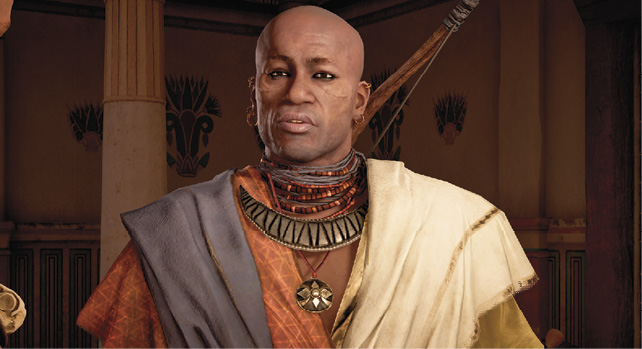
Taharqa—The Scarab
Ethnicity: Nubian (Kush Kingdom)
Born: Unknown
Age: 33
Sex: Male
Taharqa is a lively personality, fond of excitement and heightened stimuli. He’s a man of the people, and a real crowd pleaser who knows how to earn the support of the people. As busy as he is, he never lacks for time with his family. His two children adore him to death, and his wife is his biggest supporter. He treats them with respect and often travels with city with them, occasionally teaching them the street tips of a man who has seen a lot.
Taharqa’s great intolerance is to those who try to impede his progress. He cannot align with those who are passive or non-action oriented, and believes anyone who does not believe in his work is defying the will of the gods.