
Assassin's Creed Origins Guide Reference and Analysis
The Heroes
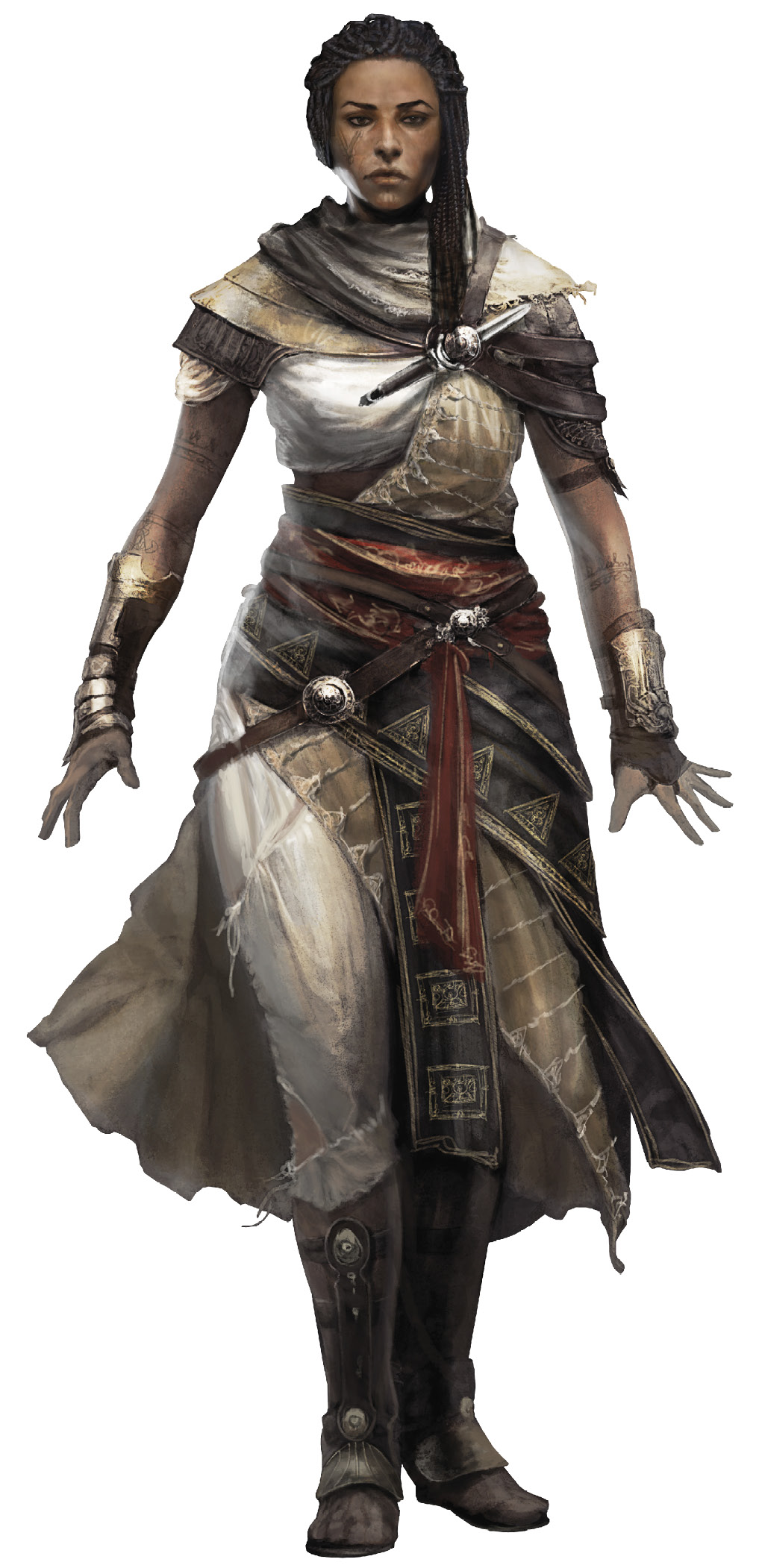
Aya
Ethnicity: Greco-Egyptian
Born: Siwa, Egypt
Age: 30
Sex: Female
A Greco-Egyptian who moved to Siwa later in life, Aya was one of the most respected members of her community in Alexandria before she left it behind. A hunter and a peacekeeper, she has dedicated her life to her family and to the honorable cause of helping others. She is a passionate adventurer caught between two cultures of origin, and personifies Egypt’s state of flux at the time our story is set.
Unable to cope with the loss of her child nor her husband’s thirst for revenge, Aya went to Alexandria where her cousin Phanos lives. There she studied at the great library, learning about ancient history, philosophy, mathematics, and mastering various languages and also becoming a cold-hearted killer, dead set on destroying those who work for Ptolemy, whom she views as the one responsible for killing her son. Her brilliant mind and quick wit brought her to the attention of Apollodorus, who eventually introduced her to Cleopatra.
She is now one of Cleopatra’s most trusted allies, and the exiled queen considers her a friend and a bodyguard.

Bayek
Ethnicity: Egyptian
Born: Siwa, Egypt
Age: 30
Sex: Male
An Egyptian born and raised in Siwa, a remote oasis near the Egyptian-Libyan border, Bayek took on the ancient role of protector, or “Medjay” of his village as he grew to adulthood. This duty instilled in him the values of a peacekeeper, upholding the law and protecting the people. A wise soul and a man of few words, Bayek is steadfast in adhering to his personal code.
When Ptolemaic soldiers came to the oasis demanding access to the sacred Temple of the Oracle of Amun, Bayek refused to cooperate. A fight ensued and they quickly found themselves on the losing side. Their son was mortally wounded and eventually died in their arms.
Bayek survived, but was cast out and lost everything: His son, his home, and eventually Aya, the woman he loved. He has crossed the desert searching for those responsible for the murder of his son. Tattooed on his forearm are the murderers’ names, some scratched off by thick scars.
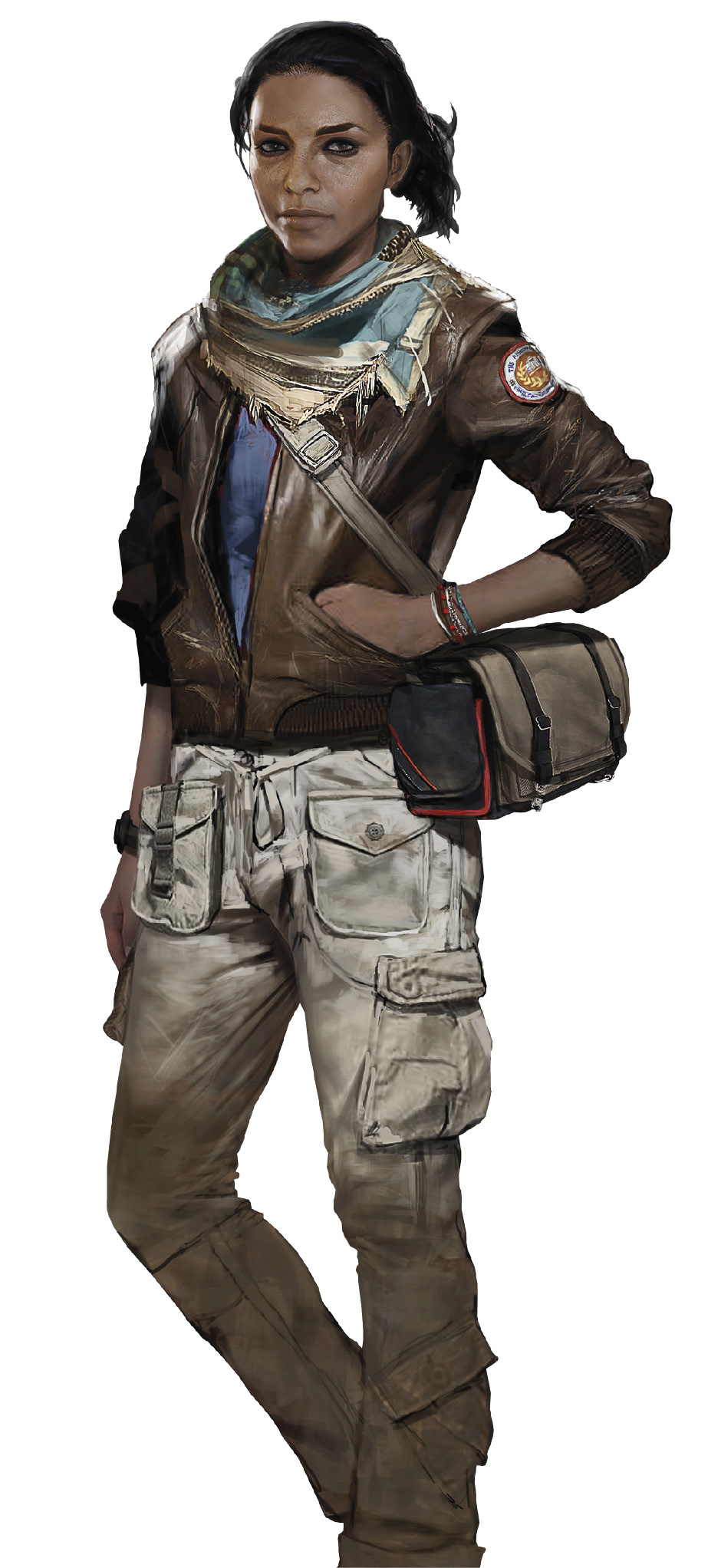
Layla Hassan
Ethnicity: Egyptian
Born: Cairo, Egypt
Age: 33
Sex: Female
Layla Hassan was born to a wealthy Muslim family in Cairo, Egypt, in 1984. Two years later, she immigrated to New York City with her family. As a child, she drove her parents crazy by disassembling her toys rather than playing with them. She was always very practical-minded, and disliked both surprises and objects that seemed to work by magic.
Showing a penchant for rule breaking early on, Layla disliked the regimented nature of formal schooling… with the exception of shop class, of course. She had an unpleasant childhood experience of being punished for playing by the rules, which cemented her existing tendency to buck authority.
After high school, she had no plans to continue her studies, but her father pressured her into post-secondary enrolment. Though her marks were generally poor, her early promise in engineering was such that with the help of a few strings pulled by her father, she was able to enroll in Berkeley’s electrical engineering program.
Though she thrived in the highly politicized atmosphere on campus, she remained uncommitted to her studies, preferring her own projects to her courses. She also feuded with university administration, and was on her way to flaming out of school when she met Sophia Rikkin, who was part of a delegation of Abstergo employees touring campuses with the company’s “young innovators” recruitment program.
Sophia, prompted by Layla’s intense interest in technology, offered her a job with Abstergo where she could work her way up to the animus lab. Leila leaped at the chance to drop out of school and gain early access to the high-tech world. With the promise of work on the animus project to come, Sophia placed Layla in the R&D division of Abstergo athletics.
At Abstergo, Layla’s disinclination for teamwork did not endear her to her colleagues, though her engineering brilliance continued to shine. She hit her stride once she was removed from the lab and put into the field on behalf of Abstergo’s historical research division. From 2006 to 2010, Layla became a valued employee. She turned into a one-woman toolbox—taking on difficult jobs in remote locations without complaint, as long as she was allowed to do things her way. Occasionally and without notice, Sophia would reach out to Layla for what seemed to be a friendly conversation, but Layla began to suspect that she was being used for her ideas. She pressed to join the animus team in Madrid; Sophia’s promises of “one day” were beginning to wear thin.
When Egypt’s people took to the streets in protest against their government, Layla felt a corresponding revolution build inside her. She asked for a leave of absence, and took her sketchy childhood grasp of Arabic to Cairo’s Tahir square, alongside demonstrators calling for the resignation of President Hosni Mubarak. There, she became deeply involved in the country’s revolutionary youth culture, helping her new friends to communicate through social media and hacked digital devices in the face of widespread government censorship. She was in Cairo when William miles, the assassin mentor, was captured at the Egyptian museum.
After the coup d’état that installed Abdel Fattah el-sisi as the Egyptian president in 2013, Layla decided to leave the country. Reluctantly, she returned to Abstergo where she was issued a portable animus unit, but her job had lost its savor. Contact with Sophia had grown almost non-existent, and Layla—angry over the withdrawal of the professional opportunity—decided to show Abstergo where she belonged.
Secretly, she began work on an ambitious personal project: modding her portable animus so that it would allow users to experience the unmodified, unsanitized genetic memories not just of their ancestors, but of anyone in the world. Her modifications would also allow for reading of DNA samples too damaged for the ordinary animus to handle. She felt confident that once she presented a successful prototype to Abstergo, they would give her the opportunity to join the animus team that she had coveted for so many years. The destruction of Abstergo’s Madrid facility in 2016 resulted in a complete withdrawal of contact by Sophia, but Layla knew that the team was regrouping and would soon be looking to expand.
When work on her Animus was almost complete, Layla received an assignment to return to Egypt, this time to investigate a burial chamber that was believed to contain an isu relic. What she found instead was even better: the mummy of a man who seemed to have some connection to the early assassins. Layla, with medical officer Deanna Geary in tow, decided that this was the perfect opportunity to test her animus. Though this approach went against standard procedure, that was nothing new for Layla, and she felt that Abstergo would condone this more significant breach of protocol in exchange for the valuable information her findings would provide. This assignment represents Layla’s chance to prove herself.