
Pillars of Eternity Guide Training
Combat
Overview
The game uses a real-time with pause system to control the pace of combat. The player commands one or more of his or her party members by issue orders, ranging from continuous activities, like making standard attacks, to the activation of limited-use tactical abilities, such as spells. Positioning the party and coordinating attacks and abilities is one of the major keys to success.
Successful combat requires understanding the game’s combat system and utilizing each character’s unique abilities and spells to take down the enemy. Also, it helps to know what the relative strength and weakness of the enemy is, which can be partially revealed by placing the cursor over it. After battling many of the same type of monsters, the Bestiary becomes filled valuable information to prey against its weakness.
Combat is very dynamic and there’s no set rule for winning every encounter as it is largely depend on the members of the party, their equipment, and spells and abilities at their disposal. Generally speaking, each class of character should fill a role in the party to aid in combat. For example, the heavily armored melee fighters should be positioned (using the formation feature) to engage the enemies at close range to pin them down. Meanwhile, the ranged character should focus on projectile weapons or spells to support their comrades or deal massive damage to single or groups of enemies.
Stealth
Scouting mode can be used to sneak up upon foes and ambush them. This is especially useful for spell casters to get into range while the melee fighters rush the enemy. On the other hand, using Stealth to become stealthy allows players to avoid a lot of combat. Many encounters are forced in the game, but there many situations where it may be a better option to sneak past, unseen and unharmed.
Melee Engagement
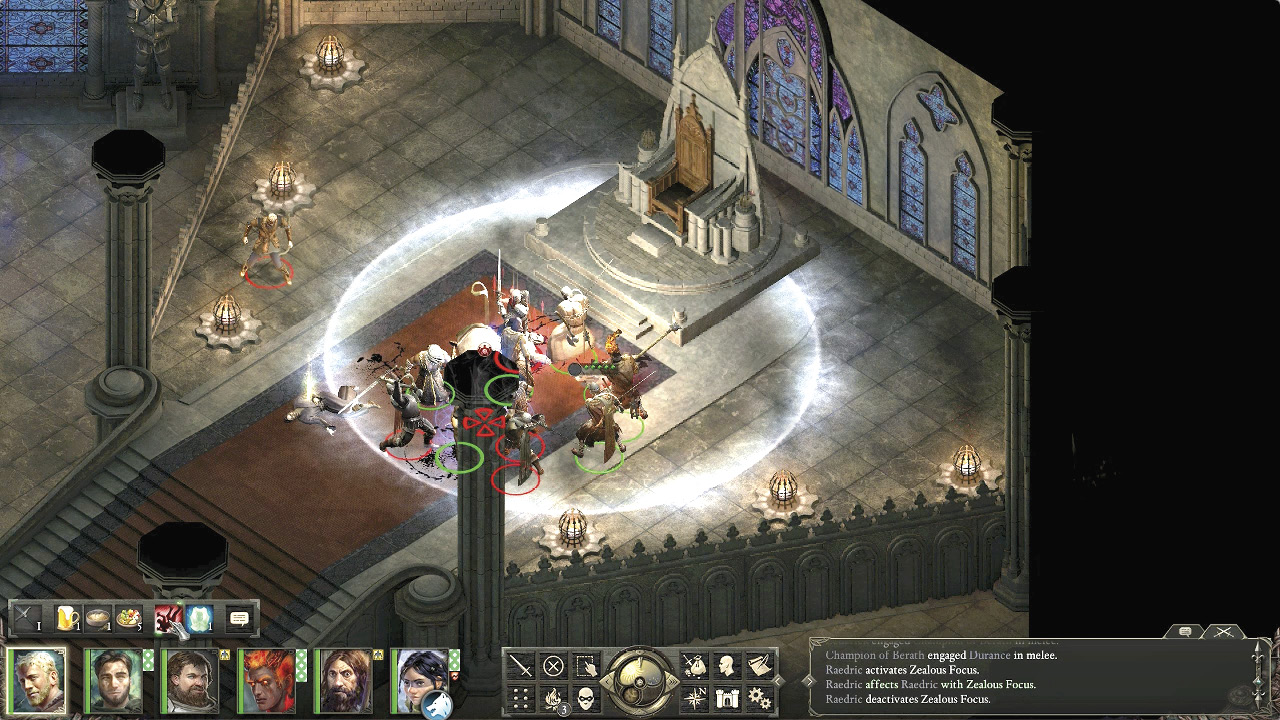
When two combatants come near each other and one of them A) has a melee weapon equipped, B) is not moving, and C) is not currently at their maximum limit of engagement targets, the other character will be Engaged. When an opponent is Engaged by an attacker, moving any significant distance away from the attacker provokes a Disengagement Attack, a “free” action with no recovery.
Disengagement Attack
A Disengagement Attack has an inherent Accuracy bonus. When it’s initiated, a Disengagement Attack automatically breaks Engagement on the target, but if the target is also the attacker’s current melee target, the attacker will typically be able to re-establish Engagement before the target can move farther away. However, a character cannot immediately re-engage a target that has just broken engagement.
End Conditions
If the attacker switches to a non-melee weapon or performs a non-melee-based action, Engagement immediately ends. If the attacker moves away from their Engagement targets, is paralyzed, knocked down, or otherwise prevented from maintaining a threat, Engagement will also immediately end. If the attacker has a limited number of Engagement targets (as most do) and switches his or her attack focus to a different character, Engagement immediately ends.
Engagement range is only a little more than a character width and most characters can engage only one enemy at a time. If they don’t have a target, it’s the first enemy who enters their radius. For fighters in Defender mode, it’s the first three, one of which is typically someone they are attacking. Fleeing targets can be engaged, as soon as the pursuer catches up to them and stops moving, forcing them to also stop.
Combat Actions
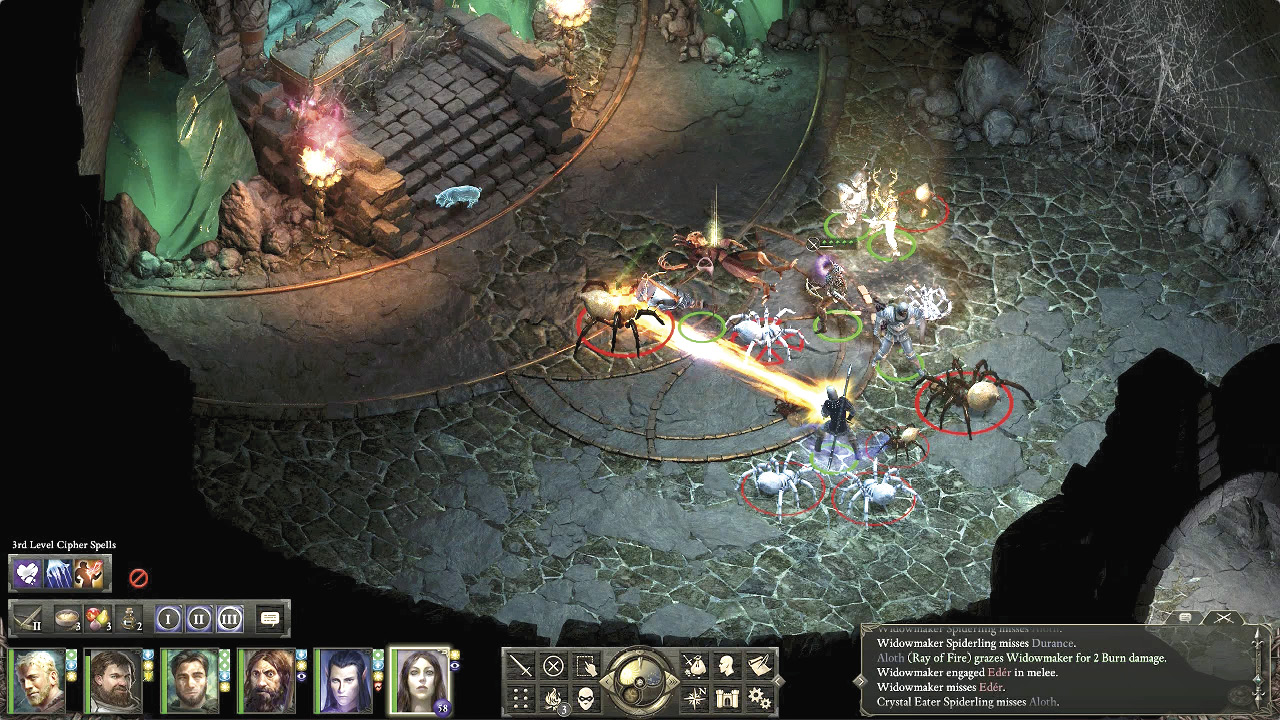
Actions take place in a real-time environment, which include repeated action, such as standard attacks and reloading/firing, and one-off/special use actions such as spell casting and item use. Selecting an action to perform results in the character performing that action as soon as they are in range. Each action takes time to perform, as the relevant animation plays out, and can be interrupted. Each action is followed by recovery time until the next action can be performed (movement simply pauses recovery time). Note that there is usually a trade off in the amount of damage a weapon does compared to the attack/reload rate.
Key Factors
- Certain Spells and abilities can speed up attacks/actions.
- Heavier armor hamper recovery time between actions, thus decrease attacks/action speed.
- Weapons have different attack speeds (and reload speeds).
- Generally, a two-handed weapon takes more time to use than a fast one-handed variety, or using magical implement.
- A character wielding two weapons is making more frequent attacks than when wielding one weapon.
Attack Resolution
All rely on using Accuracy to overcome one or more of the target’s four defenses. The Accuracy of an attack is determined by the character’s class, level, equipment, and special bonuses. The effectiveness of a strike is determined by an attack roll. Note that a successful attack may Interrupt the target Action and result in an impact animation.
Attack Roll
This represents a character’s attempts to strike an opponent. Each attack can result in Critical Hit, Hit, Graze, or Miss, which affects the attack damage or duration. The likelihood of each outcome is based on the difference between the attacker’s Accuracy vs. target’s defense values and can be further modified by various class abilities.
Accuracy
Accuracy is based on Dexterity. It represents the measures of a character’s chance to hit with any attack melee/ranged weapons, spells etc. It can be further modified by various class abilities. The Base accuracy calculation is as follows: class base + [(level-1) * 3] + Dexterity
Defense
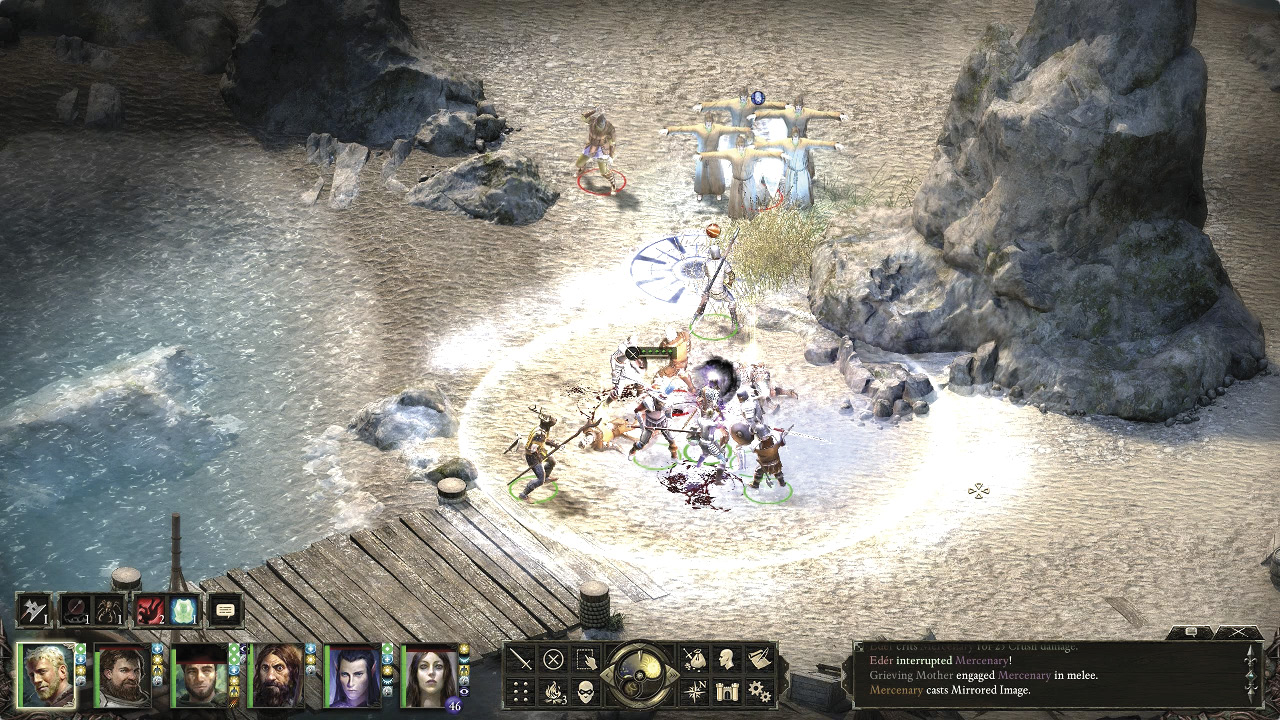
A character’s Defense represents how hard it is for opponents to land damaging blow on the character. There are four Defenses: Deflection, Fortitude, Reflex, and Psyche. The higher a character’s Defense, the more likely the opponent is to miss or only graze. Defenses are determined by character attributes and class and are further modified by level, equipment, spells, abilities, and talents.
Deflection is used to resist most weapons and the natural attacks of monsters. It is defined primarily by the character’s class and level. No attributes affect Deflection. Fortitude helps characters defend against attacks that can physically overpower them, such as knockdowns, poison, or disease (Might and Constitution). Reflexes resist area attacks like fireballs or a dragon’s breath (Dexterity and Perception). Mental attacks almost always target the character’s Will (Intellect and Resolve). As with Accuracy, characters’ defenses all increase as they gain levels.
When an attack is made, the target’s appropriate defense score is subtracted from the attacker’s Accuracy. That difference is then added to a random number between 1 and 100 to determine the results.
- >15 = Miss - No effect on the target
- 16-50 = Graze - Damage and durations are halved
- 51-100 = Hit - Standard damage and durations
- >100 = Crit - Damage and durations are increased by 50%
Interrupts/Concentration
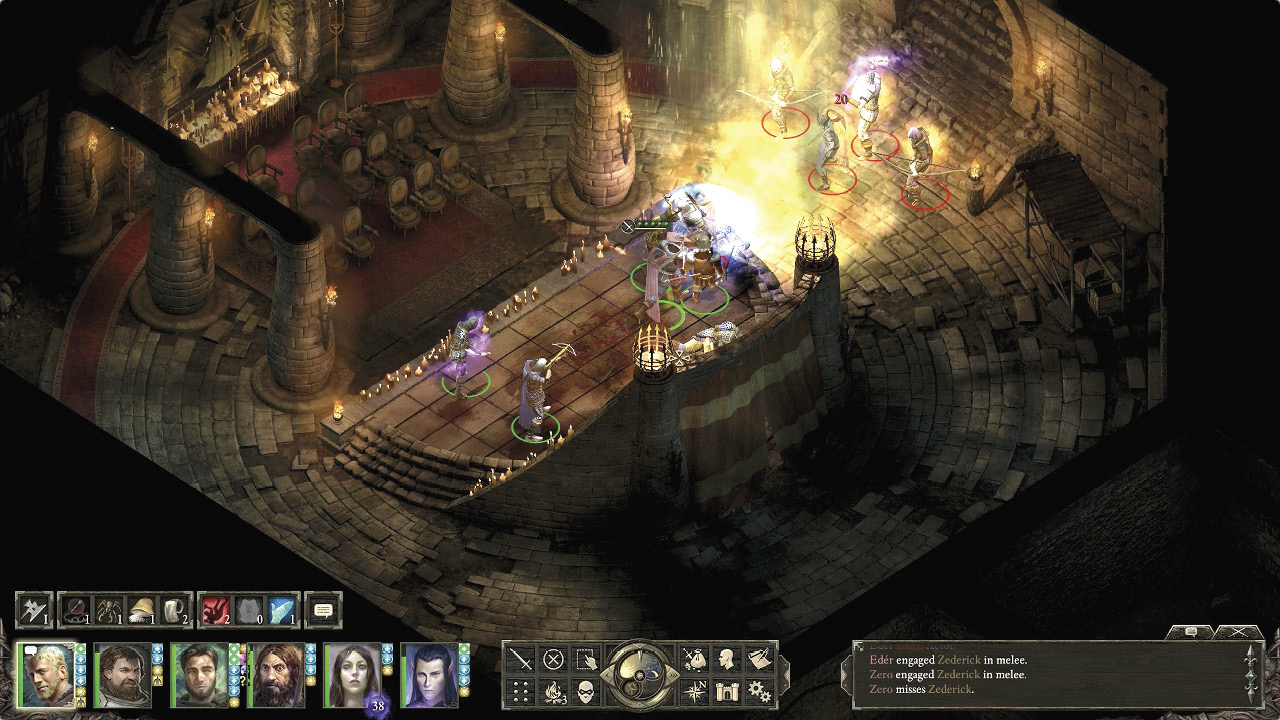
If a character is hit while performing an action such as casting a spell, attacking an enemy, or reloading a weapon, their action is interrupted if they can’t maintain Concentration. If an action is interrupted, it completely stops. If it’s a repeated action like reloading/firing or performing standard attacks, it restarts from the beginning as soon as the interrupt animation finishes. For one-time/special use actions, the action isn’t “lost,” but it will not automatically re-attempt.
Concentration
Concentration prevents characters from playing hit reactions when they take damage. If a character cannot maintain Concentration, they will play a hit reaction and the attack/reload/spell is interrupted. Concentration is influenced by Resolve.
The calculation for concentration is: Base Concentration * (1 + [{Resolve * 3}/100])
Interrupt
Interrupt chance is based primarily on the attack result and the Perception of the attacker vs. the target’s Concentration. Every Attack can have a base Interrupt value but the attacker must at least score a Graze. Also, Interrupt duration is defined by Interrupt Strength.
If a character’s Interrupt is high it can stop the enemies actions if they hit them more often. Each weapon/attack have a base interrupt value and attacks that have high rates of fire (like wands and spell missiles) or area of effect abilities generally have low Interrupt values. However, firearms have relatively low base Interrupt and high damage.
These values can further be modified by magical weapons, items or the talent Interrupting Blows. Magical weapons can have a special property that bumps their base Interrupt rating up by one category. Magical items (usually armor) and spells/abilities can have a special property, called Interrupting, that increases the base value by a percentage.
Damage
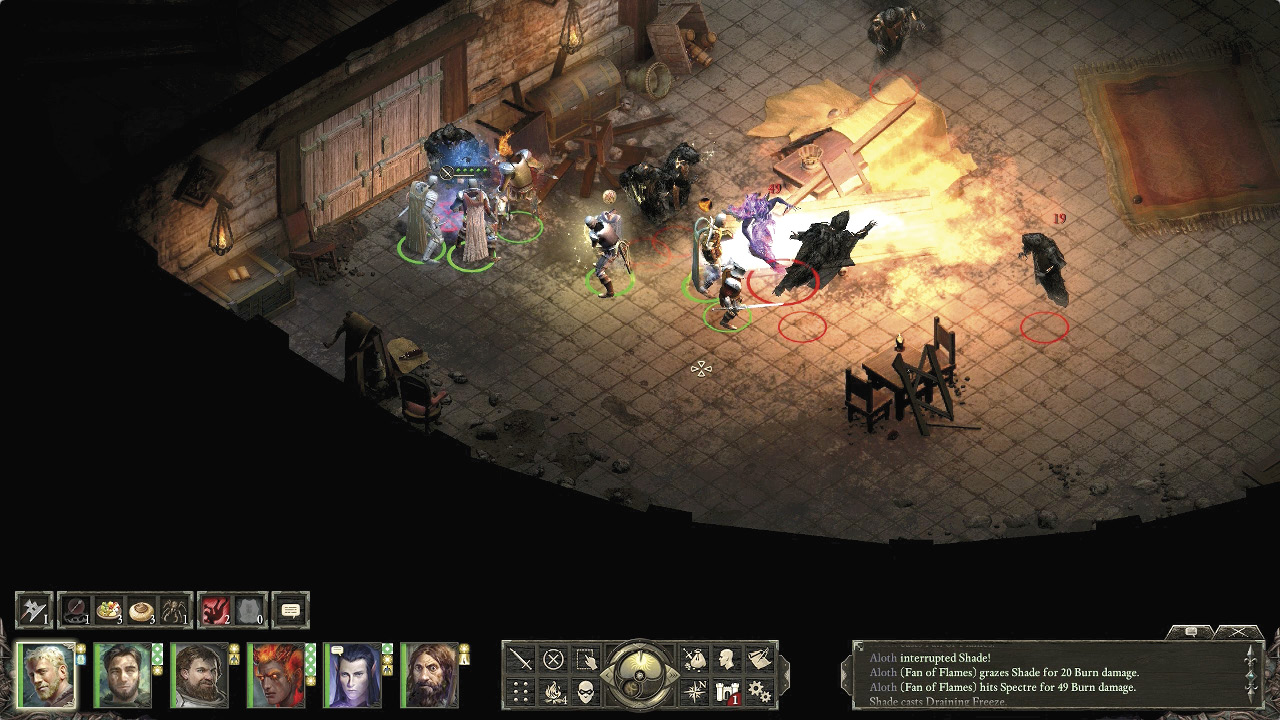
When a character lands a damaging blow, they deal damage according to the damage type vs. Damage Reduction. Damage is typically associated with one of seven damage types: Slash, Crush, Pierce, Burn, Freeze, Shock, or Corrode. However, an eighth damage type, Raw, always ignores armor. It is typically inflicted only by poison, bleeding wounds, or similar effects. Whenever damage is applied, the target subtracts their Damage Reduction, though even with very high Damage Reduction, the target always takes a small amount of damage. Many armor types, worn by the player’s characters and enemies, have special resistances or vulnerabilities to specific damage types.
Damage affect the target’s current Health and Stamina. Health loss occurs at the same time as Stamina loss and at the same rate.
Key Factors
Damage Type: All damage dealt has a certain Damage type, affecting the efficiency of the target’s Damage Reduction.
Damage Reduction (DR): This is the amount of damage that armor directly subtracts from each attacks taken (after Damage Type calculations), though a small percentage of damage may get through even the thickest armor.
Minimum Damage: No matter how high the DR, a minimum amount of damage will get through armor.
Afflictions
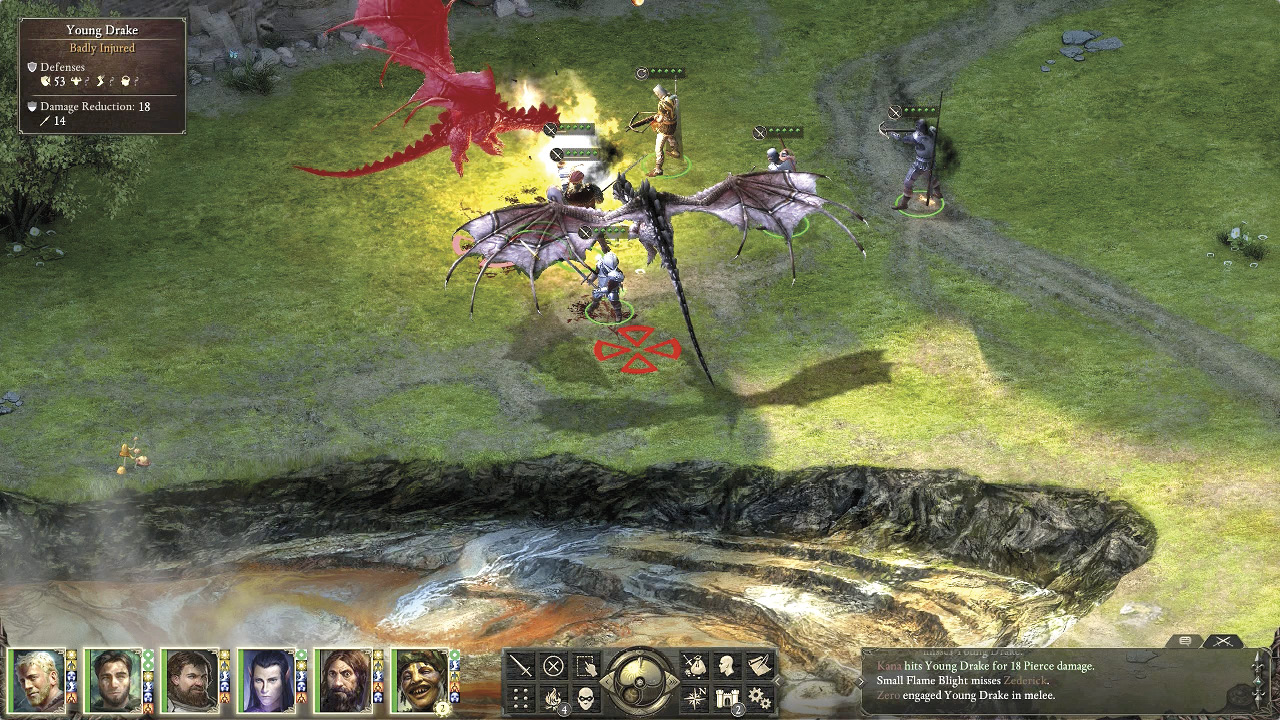
Some enemies and situations may cause Afflictions on the party members. These can be seen above each character portrait—hover over them for more information. Some Afflictions are lost over time, while others can be recovered only through healing and resting. Note that some creatures can be immune to one or more afflictions.
Blinded
Accuracy is reduced by 25 for all sources. Perception is reduced by 4. Movement is reduced by 2. Reflexes and Deflection are reduced by 20.
Charmed
Target fights on behalf of the enemy at reduced capacity. Speed, Accuracy, and all defenses are reduced by 25. Charmed is exclusive, meaning a character can only have one Charmed affliction at a time. A newer one will dispel any older one present.
Confused
Every 6 seconds, the target checks randomly to do one of the following: behave normally (25% chance), attack ally (25%), walk in random direction (25%), do nothing (25%).
Dazed
Accuracy is reduced by 10 for all sources. Dexterity, Perception, and Intellect are all reduced by 2. Speed is reduced by 15%.
Dominated
Target is subservient to the will of the enemy and uses everything at its disposal to fight its former teammates. Overrides Charmed. Dominated is exclusive, meaning a character can only have one Dominated affliction at a time. A newer one will dispel any older one present.
Flanked
Deflection is reduced by 10.
Frightened
Resolve and Dexterity are reduced by 2. Accuracy is reduced by 10 for all sources.
Hobbled
Dexterity is reduced by 2. Movement is reduced by 3. Reflexes are reduced by 20.
Paralyzed
Can’t take action. Dexterity is set to 0. Reflexes and Deflection are reduced by 40. Overrides Stunned, Stuck, and Prone.
Petrified
Soul manifests as stone = you turn to stone. As Paralyzed, but attacks damage Health directly instead of Stamina. Overrides Paralyzed, Stunned, Stuck, and Prone.
Prone
Can’t take action. Dexterity is reduced by 2. Reflexes and Deflection are reduced by 10.
Sickened
All attributes are reduced by 1. Fortitude and Will are reduced by 20.
Stuck
Immobile. Dexterity is reduced by 2. Accuracy is reduced by 5 for all sources. Reflexes and Deflection are reduced by 20.
Stunned
Can’t take action. Dexterity, Perception, and Intellect are all reduced by 4. Reflexes and Deflection are reduced by 30. Overrides Stuck and Prone.
Terrified
Resolve and Dexterity are reduced by 4. Accuracy is reduced by 20 for all sources. Overrides Frightened.
Weakened
Strength and Constitution are reduced by 2. Movement is reduced by 2. Fortitude and Will are reduced by 20.
Injuries
Injuries are long-term afflictions and they last until the character rests. Unlike Afflictions, Injuries are typically gained through scripted interactions and not a result of combat. Yet, they still have a significant impact to the fighting shape of the party.
Bruised Ribs
Fortitude Defense Penalty
Concussion
Will Defense Penalty
Sprained Wrist
Deflection Defense Penalty
Swollen Eye
Accuracy Penalty
Twisted Ankle
Reflexes Defense Penalty
Wrenched Knee
Combat Movement Speed Penalty
Wrenched Shoulder
Action Speed Penalty
Life and Death
A character’s vitality is represented Endurance and Health. It is the measure of how much punishment a character can withstand before going unconscious, maimed or dying.
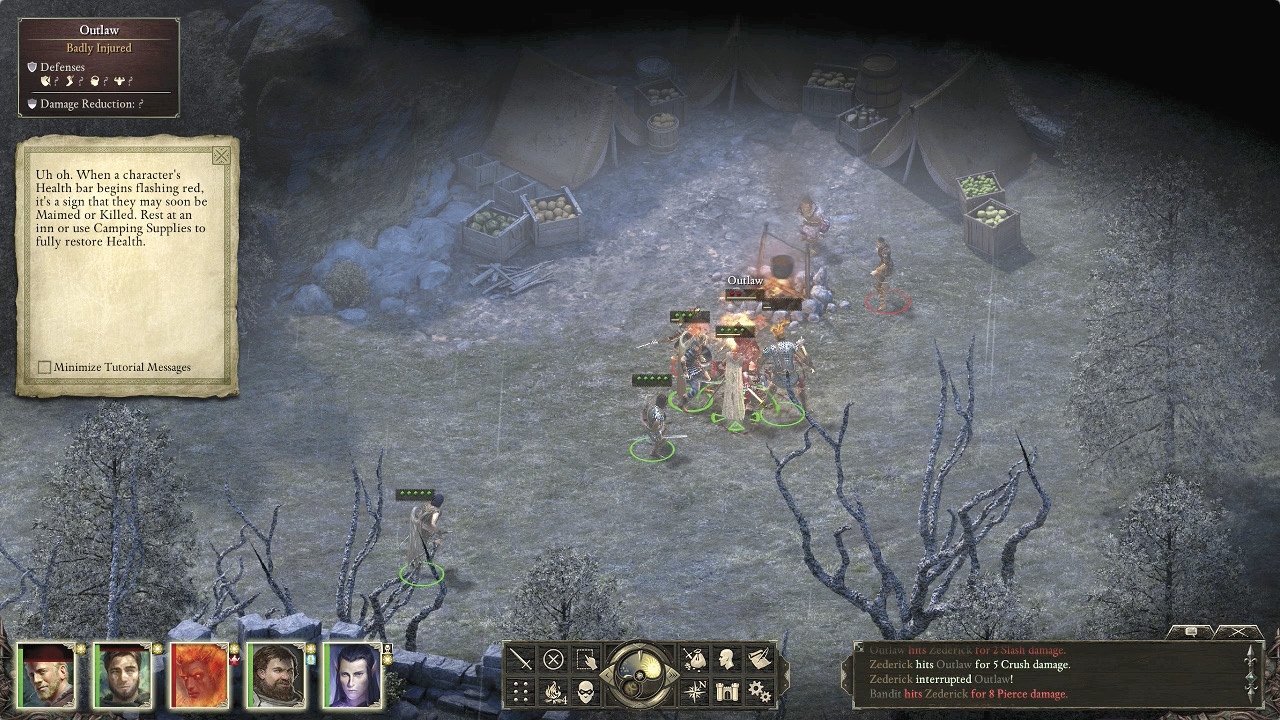
Unconscious
The majority of damage a character takes applies to Endurance. If a character loses all of his or her Endurance, they are knocked unconscious, unable to move or take any actions. Unconscious characters cannot benefit from stamina healing, but they can be revived to life via certain abilities. Once the fight ends, they regain consciousness and eventually recover their Stamina.
Maimed
Health loss occurs at the same time as Endurance loss, but at a character has much more Health than Endurance. If a character loses all Health and Endurance) during a fight, they become maimed and near death. A maimed character may still move and take any actions, but suffers severe penalties to their Accuracy and all defenses. This condition can be remedied with Rest.
Dead
If a character loses all Health during a fight, and is maimed, any damage they sustain results in death. Dead characters cannot be restored and are removed from the game. Their soul leaves its body and their energy moves forward in the eternal cycle of the Wheel.