
Battlefield Hardline Guide Multiplayer: Getting Started
Multiplayer Tactics
Tactics is the combining of maneuvers and firepower to achieve an objective. Both movement and weapons have already been covered, so this section focuses on using the two together in an effort to gain an advantage over your opponents.
Play the Objective
There is an old saying that those who fail to plan, plan to fail. You need to come up with a plan before the bullets start flying. The best place to start is to look at your game mode’s objectives, since those determine victory or defeat. While killing the enemy is helpful, it is often a means to an end. Instead, focus on the objectives. Do you have to destroy a target, defend a position, or just get to a certain point on the map?
Once you know what you must do, look at the map and examine the terrain. Where are you located? Where is the objective? How will you get there? Are there any vehicles you can use? These are all questions you need to ask yourself. Once you have determined how to get to the target, you must then consider how to accomplish your orders. Will you need to get in close and set a charge on a vault door? If so, how will you secure the perimeter? Finally, you need to take into account your opposition. What does the enemy have and where are they located? Usually you will not know that type of information until you get in close to the target and can see the enemy with your own eyes. Therefore, planning continues on the fly as you learn new information about enemy positions and actions.
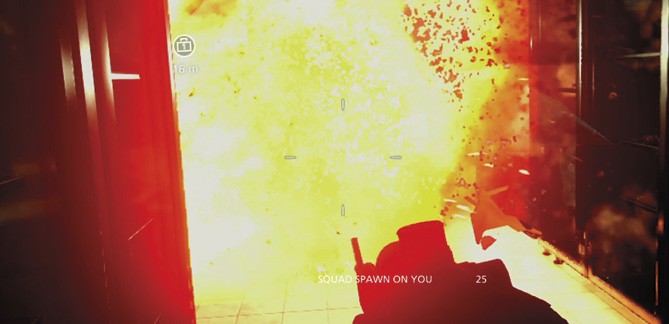
When playing as the criminals in Heist mode, you need to find a way into a vault. Discuss your plan of attack with your squad before the match begins.
Cover
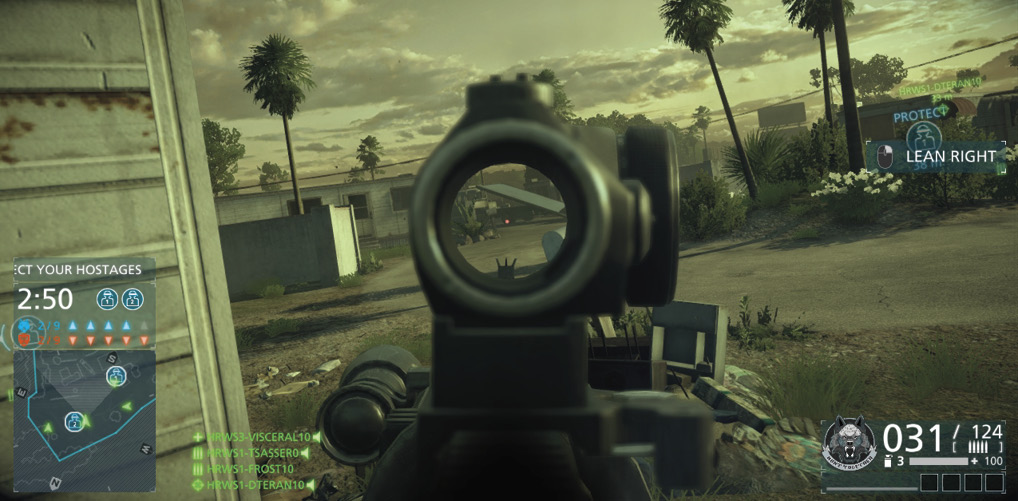
Aim down your weapon sights when standing behind cover. This allows you to peek around or over the piece of cover.
Combat is very dangerous. Bullets and other deadly projectiles fly through the air and can kill you outright if they make contact. The concept of cover is to place something solid between you and the enemy that stops those projectiles and keeps you safe. The multiplayer maps are filled with objects that you can use as cover: buildings, walls, trees, rocks, earthen mounds, and so on. Some types of cover stop small arms fire such as rifle bullets, but does not stop the heavier weapons. Most walls stop machine gun fire, but not rockets or grenades. Therefore, pick cover that protects you from the current threat. Objects constructed from wood or flimsy sheet metal don’t stop a bullet.
Cover should become ingrained in your combat thinking. In addition to looking for enemies, you also need to be looking for cover. During a firefight, always stay behind cover. The only reason to leave cover is to move to another position with cover. If the cover is low, you may need to crouch down or drop prone to get behind it, standing only to fire over it. When moving from cover to cover, sprint to get there quicker. If carrying a compact weapon, you can lean around corners, allowing you to peek out and return fire while keeping most of your body behind cover.
While you want to stay behind cover, you also want to try to deny the benefit of cover to your enemies. Destroying their cover is a way to do that. Another way is to reduce the effect of their cover by moving to hit them from a direction for which they have no cover. This is called flanking. For example, if an enemy is taking cover behind a wall, move around to the side of the wall so that the wall is no longer between you and your target. Or, if you have an explosive weapon, you can simply blow a hole in the wall, taking your target out in the process.
Destructible Environments
One of the awesome features in Hardline is that many of the structures and objects can be damaged or outright destroyed. This presents a large range of possibilities and opportunities that affects the tactics you use. For example, if the enemy is holed up in a house on Dust Bowl and taking shots at you from the windows, you could try to throw a grenade through the window or rush into the house via the doorway and clear the threat out with close-range combat. However, with destruction as an option, you can launch a rocket at a wall of the structure and blow a hole in it. If an enemy was on the other side of the wall, that threat might be killed. Otherwise, you can then use direct fire to kill the enemy, since you destroyed the wall providing cover.
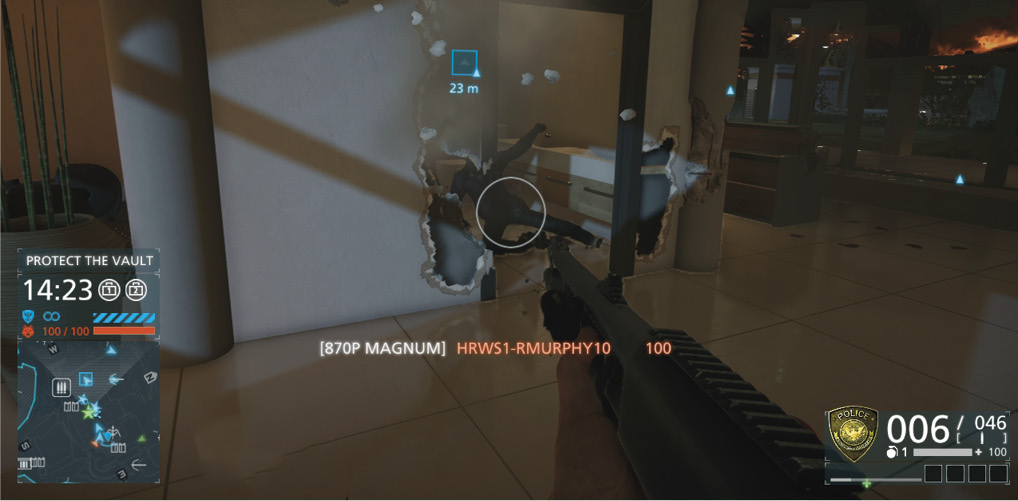
The interior of the mansion on Hollywood Heights is highly destructible. Use gunfire and grenades to punch holes through walls.
Often structures can funnel you into a kill zone the enemy has set up. But you can blast your way through walls or other objects and come at the enemies from different directions that they might not expect. While this may seem to favor the attacker, the defender can also use this as an advantage. Destroy potential cover the attacker may use to approach your position.
As a result, you can create your own kill zones which the enemy must traverse while exposed to your team’s fire.
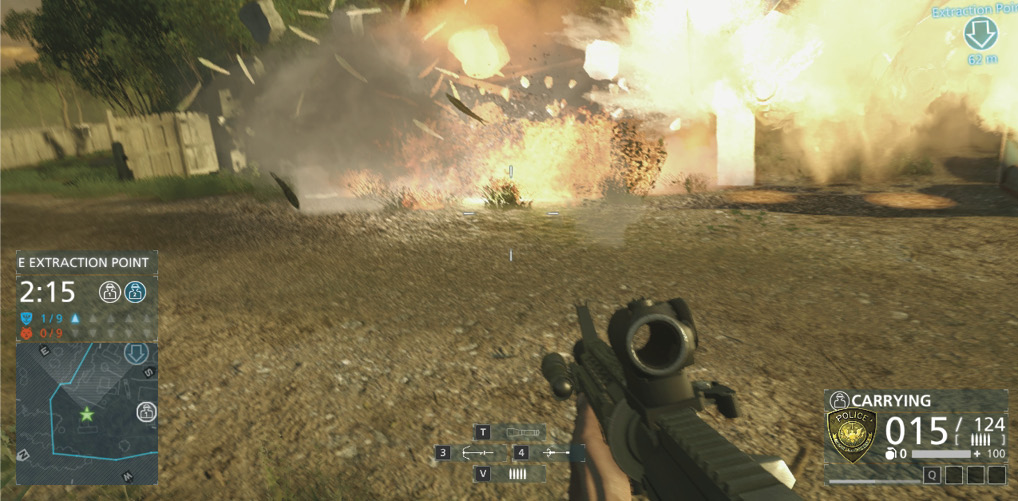
Use grenades and other explosives to knock down walls and other barriers, opening new paths and lines of sight.
Close Quarter Combat
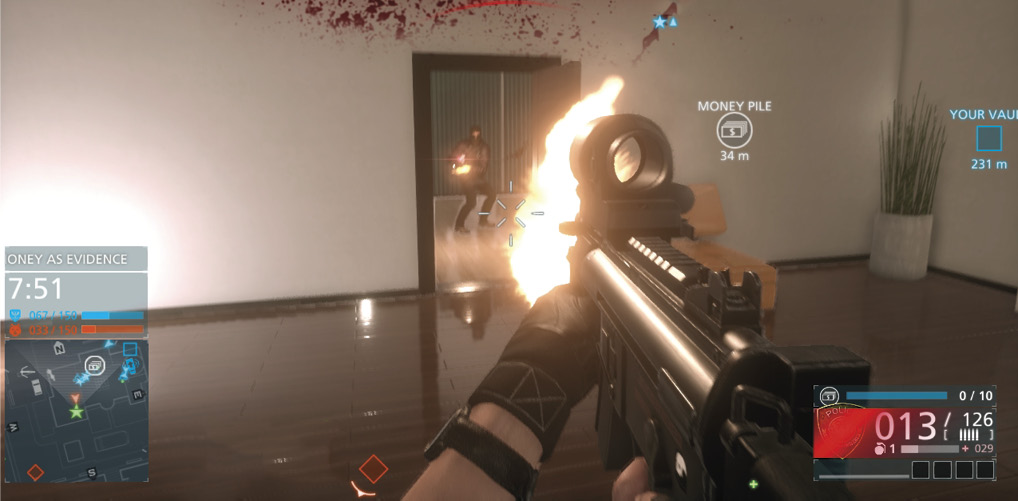
The mechanic’s submachine guns and the enforcer’s shotguns are ideal for close quarter firefights.
In close quarters, such as in a town or even within a building, you don’t have a lot of time to aim before shooting. However, at such short ranges, accuracy is not really a factor. Instead, you need a weapon that puts out a lot of firepower with some spread so you are more likely to get a hit while moving. Shotguns and SMGs are great for close-quarters combat. Your minimap is also an important tool, especially if teammates have spotted targets. Since you can see where enemies are located, use this info to set up shots while strafing around corners. Your weapon will already be aimed at the target as it appears on the minimap, which saves you just enough time to have the advantage and make the kill rather than be killed. Don’t forget to use grenades, which can be thrown around corners or over walls to hit enemies who think they are safe behind cover.
Long-Range Combat
If possible, it is best to try to attack the enemy at long-range before they’re even aware of your presence. While sniper rifles work great for this type of combat, you can even use assault rifles, battle rifles, or rocket launchers to hit targets at long-range. The key to winning at long-range is to take your time. Drop prone, stay still, and use iron sights or optics to increase your magnification and accuracy. As always, make sure you have some good cover in case the enemy decides to shoot back—if you can see them, they can see you. Also, when firing an automatic weapon, fire in short bursts to ensure that more of your bullets hit the target. For greater accuracy and precision, switch to semi-auto mode.
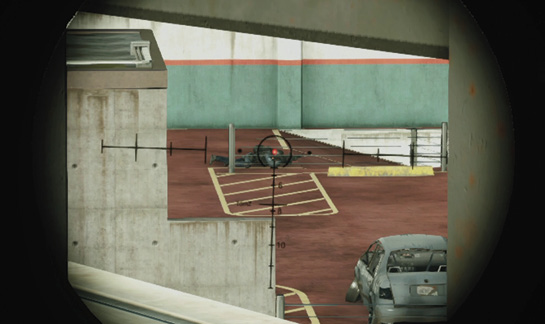
When sniping with a high-powered optic, remember to hold your breath to steady your aim by holding down the sprint button/key.