
Dark Souls III Guide (Steam) Gameplay
Creating Your Character
Now that you know what the stats do, it’s time to create a character. In Dark Souls games, this process has a great deal of bearing on your first hour or two of play, but the choices you make only have limited relevance after that. Instead of being locked into a character class, you’re merely deciding on a gender, visual appearance, and a starting set of attributes that you can modify to a great extent as you level.
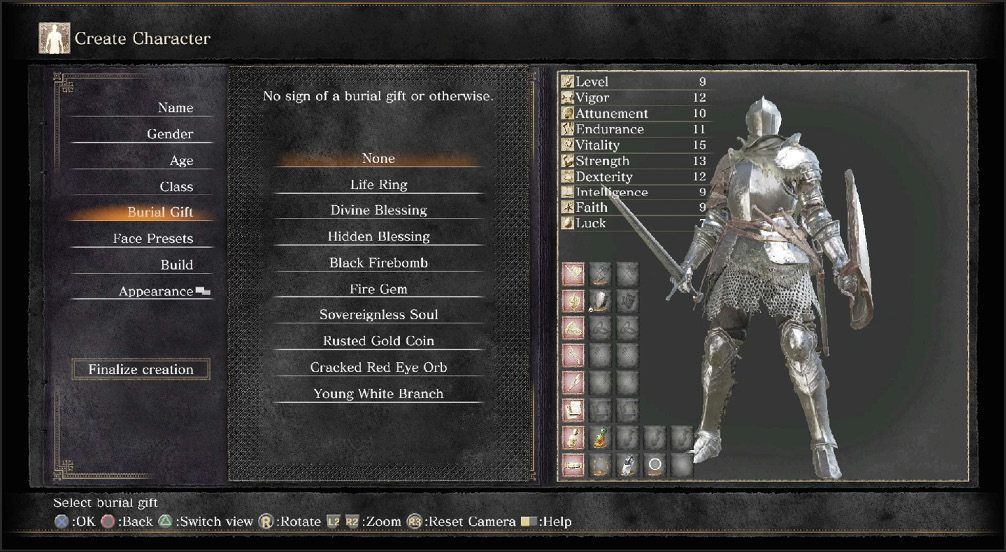
Starting Choices
Select New Game, and watch the introductory movie when you’re ready to begin. This takes you to a screen where you figure out your first character. You can make others later if you want, or you can stick with your first character for multiple plays through the game.
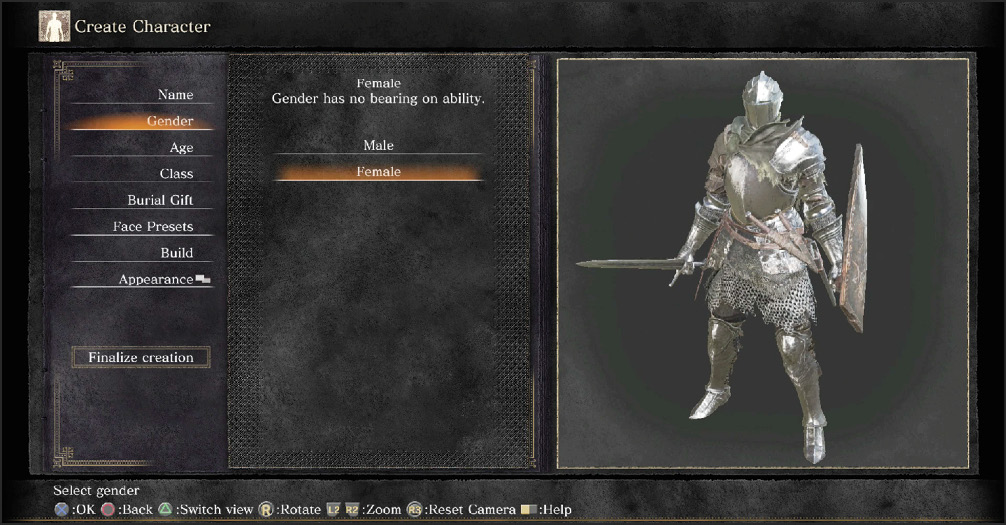
Basic Customization
Choose a suitable name for your character, their gender, and an age. These have no influence on the game’s progression.
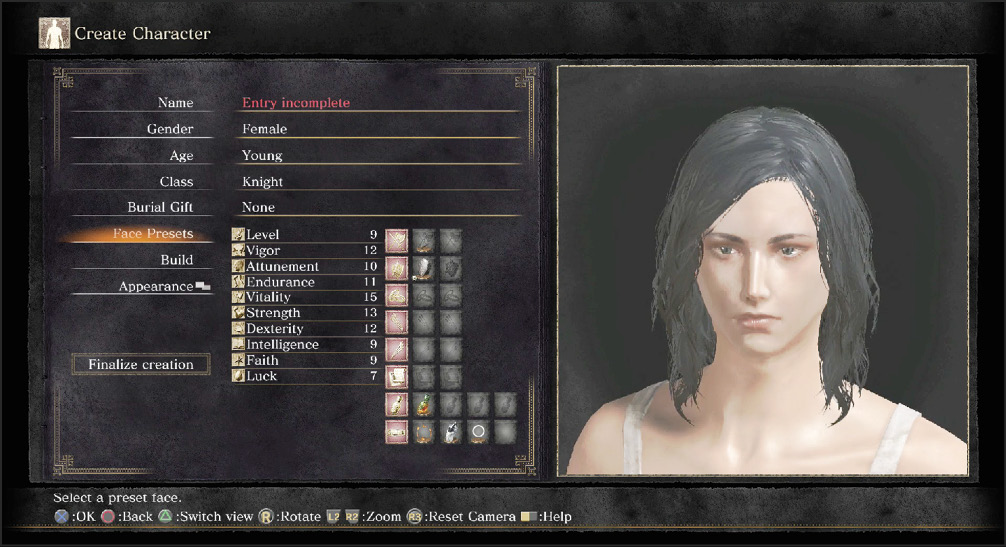
If you want more control over the aspects of your character, use Face Presets and Build for major changes, or click on Appearance to go into the main engine for selecting your voice and visual attributes.
Make a character you like looking at, you’ll be spending a lot of time with them! Later in the game, the Covenant leader Rosaria allows you to change your appearance a limited number of times per playthrough.
Classes Only Matter for a Short Time
This leaves class and Burial Gift as the only two things that remain. Burial Gifts are starting items. You can take one from this list, or nothing at all. There aren’t any powerful items. The Life Ring gives you bonus HPs and its usage lasts longer than most of these items because it’s a ring instead of a tool. Diving Blessing is hard to obtain otherwise, so that is a decent choice, as well. No matter what you take, you’re not going to hurt your character or regret your choice.
Burial Gifts
| BURIAL GIFT ITEM | ADVICE |
|---|---|
| None | There is no real reason to pick this, unless you want more of a challenge right off the bat. |
| Life Ring | An excellent choice because it is a permanent item. This helps you for hours of the early game. |
| Divine Blessing | A single-use item, but with the power to fully restore HPs and to cure ailments. This is a very good choice if you’re confident in your early game and want something for later. |
| Hidden Blessing | Fully restores FPs. Similar to the Divine Blessing, this is a good later-game choice if you’re unconcerned about your starting needs. |
| Black Firebomb | A decent thrown weapon, but it doesn’t have any lasting value. |
| Fire Gem | Used to upgrade weaponry. Add Fire to an early melee weapon. |
| Sovereignless Soul | For a person who just wants extra Souls for the first time they get to the Firelink Shrine, this is very solid. A good choice for anyone who wants an early game boost but doesn’t need tools or equipment. |
| Rusted Gold Coin | A single-use item to help with Item Discovery. This won’t get you very much by itself. |
| Cracked Red Eye Orb | Gives you a single chance to invade another player. Ideal only for hardcore PvPers who want to get their blades wet that much sooner. |
| Young White Branch | Not a powerful option. It’s a single-use item that lets you hide. |
You might already know this, but your class is just a starting point in Dark Souls III. It determines your initial gear and attributes, but everything is still possible over time. The way you build your attributes and the equipment you use is everything. Any starting class can become a melee fighter, a ranged attacker, a spellcaster, or a hybrid of everything. Always plan ahead, but know that it’s possible to shift your strategy midstream if it’s absolutely essential.
The starting classes are listed below.
Knight
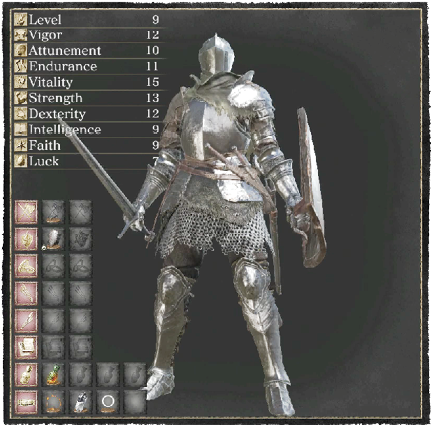
Knight (Level 9)
| Vigor | 12 |
| Attunement | 10 |
| Endurance | 11 |
| Vitality | 15 |
| Strength | 13 |
| Dexterity | 12 |
| Intelligence | 9 |
| Faith | 9 |
| Luck | 7 |
Best start for: Beginners
Equipment: Long Sword, Knight Shield, Knight Armor Set
One of the easiest starting classes to begin with, the Knight has a decent shield, strong armor, and stats that favor a direct approach to problems. You can invest in a basic Miracle without changing your stats, and basic melee and ranged combat are both doable.
There isn’t a single downside or tough spot for Knights; they’re a wonderful starting point for beginners. You get a very good shield, higher-quality armor than your rivals, and a completely solid weapon, as well. You’re tough, and you can still deal damage.
Mercenary
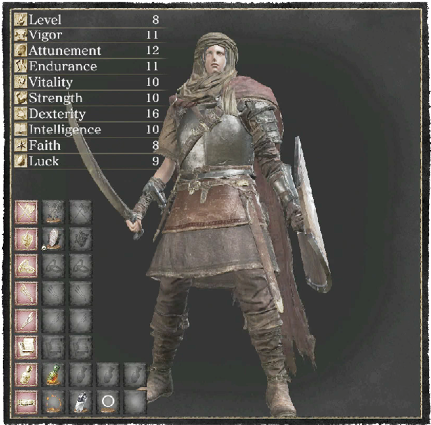
Mercenary (Level 8)
| Vigor | 11 |
| Attunement | 12 |
| Endurance | 11 |
| Vitality | 10 |
| Strength | 10 |
| Dexterity | 16 |
| Intelligence | 10 |
| Faith | 8 |
| Luck | 9 |
Best start for: Dexterity builds
Equipment: Sellsword Twinblades, Wooden Shield, Sellsword Armor Set
Mercenaries are a fast melee class with the potential to get involved in ranged damage as soon as they get a bit of equipment. You’re likely to go in this direction if you’re interested in trying lighter armor, Dexterity builds, and perhaps a tiny amount of magic. Not as survivable as the Knight, nor as aggressive as a Warrior, this is a tougher choice unless you know from the beginning that you want to favor a Dexterity character.
If you want to check out dual-wield weaponry as soon as you begin, a Mercenary’s Sellsword Twinblades can do that for you. They’re a lot of fun.
Warrior
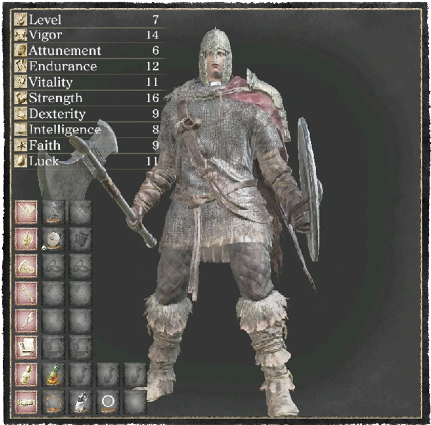
Warrior (Level 7)
| Vigor | 14 |
| Attunement | 6 |
| Endurance | 12 |
| Vitality | 11 |
| Strength | 16 |
| Dexterity | 9 |
| Intelligence | 8 |
| Faith | 9 |
| Luck | 11 |
Best start for: Strength builds
Equipment: Battle Axe, Round Shield, Northern Armor Set
With high health, damage output, a strong weapon, and decent armor, Warriors are likely to be quite popular. Their extremely low Attunement means that it’s going to take them a long time to become even weak casters, so avoid these characters if you want to dabble in any magical spells.
Warriors are ideal for a pure Strength character. If you favor heavy melee and direct solutions, you’re going to be pleased with your choice. The Battle Axe is somewhat slow for a traditionally one-handed weapon, but it’s high on damage. The Round Shield and Northern Armor Set aren’t wonderful, but they’ll serve you just fine.
Herald
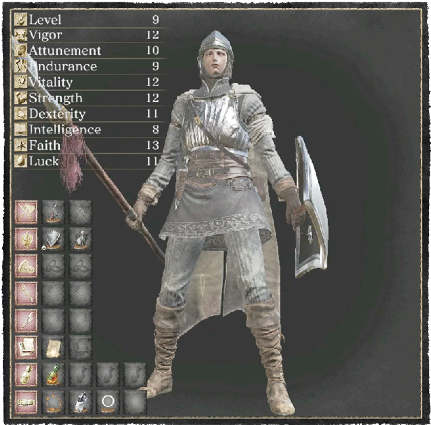
Herald (Level 9)
| Vigor | 12 |
| Attunement | 10 |
| Endurance | 9 |
| Vitality | 12 |
| Strength | 12 |
| Dexterity | 11 |
| Intelligence | 8 |
| Faith | 13 |
| Luck | 11 |
Best start for: Melee/Faith hybrids
Equipment: Heal Aid Spell, Spear, Talisman (Catalyst), Kite Shield, Herald Armor Set
Heralds give you options for healing and some survivability straight from the beginning. They’re a decent option for players who want to try out melee and Miracles without dedicating themselves fully to either route.
Having a longer weapon and healing means that your Herald is more likely to survive engagements than some of the other options. Your damage output isn’t stellar, but you are hard to burst down. The downside is that you have longer fights.
Thief
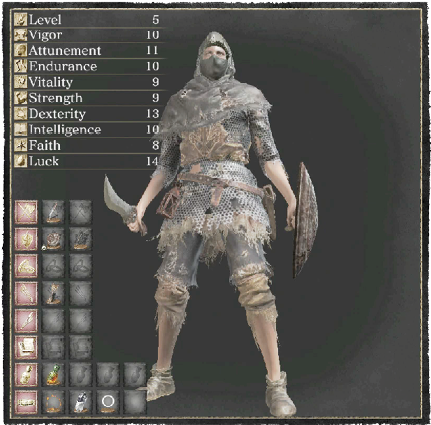
Thief (Level 5)
| Vigor | 10 |
| Attunement | 11 |
| Endurance | 10 |
| Vitality | 9 |
| Strength | 9 |
| Dexterity | 13 |
| Intelligence | 10 |
| Faith | 8 |
| Luck | 14 |
Best start for: Exploring ranged and melee combat
Equipment: Bandit’s Knife, Short Bow, Iron Round Shield, Deserter Armor Set, 30 Wood Arrows
Thieves begin with a dagger and a bow. This lets you practice ranged combat and melee without having to wait. Your learning curve will be steeper than some, but this pays dividends later as you become proficient in more combat types very quickly.
Thieves start at a lower level than almost any other class, but that isn’t necessarily a problem. Alhough your first boss fight may be tougher, you have a huge amount of flexibility in determining your early build. Thieves aren’t very strong outside of their starting Dexterity, which means that you can go anywhere with them almost immediately and not feel like there are many wasted Souls. Like the Deprived, there are upsides and downsides to this.
Thieves do have a modest problem that should be mentioned. Having Luck as a high starting attribute is a bit of an issue. Luck is fun and is good for farming items, but it doesn’t help your survivability very much, nor does it end battles any faster. So, you won’t have a strong character in the early stages. You must learn how to fight intelligently as soon as you begin (though maybe that’s a hidden virtue in its own way).
Assassin
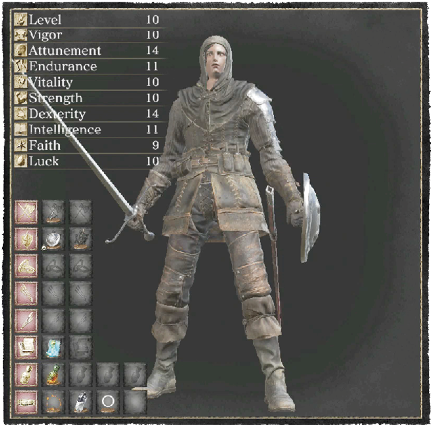
Assassin (Level 10)
| Vigor | 10 |
| Attunement | 14 |
| Endurance | 11 |
| Vitality | 10 |
| Strength | 10 |
| Dexterity | 14 |
| Intelligence | 11 |
| Faith | 9 |
| Luck | 10 |
Best start for: Melee/Sorcery hybrids
Equipment: Spook Spell, Estoc, Sorcerer’s Staff (Catalyst), Target Shield, Assassin Armor Set
Assassins have basic melee and Sorcery as soon as the game begins. They get to start with two Attunement slots (a rarity), and they know how to cast Spook.
Assassins get a good thrusting weapon that is fast and makes up for moderate hits with good combos of blows. To enhance this further, your Spook spell lets you creep up on enemies and start fights greatly in your advantage. You have weak armor, so this is important because Assassins don’t do as well against groups of foes that rush together.
Sorcerer
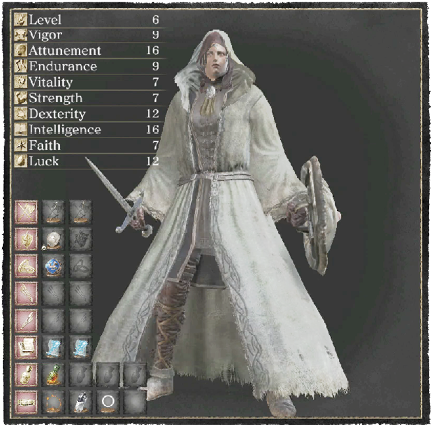
Sorcerer (Level 6)
| Vigor | 9 |
| Attunement | 16 |
| Endurance | 9 |
| Vitality | 7 |
| Strength | 7 |
| Dexterity | 12 |
| Intelligence | 16 |
| Faith | 7 |
| Luck | 12 |
Best start for: Full Sorcery hybrids (challenging)
Equipment: Soul Arrow, Heavy Soul Arrow, Mail Breaker, Sorcerer’s Staff (Catalyst), Leather Shield, Sorcerer Armor Set
Sorcerers are dedicated Sorcery characters. Their initial Attunement and Intelligence makes them a very awkward choice unless this is the route that you want to push. They have two slots and two spells, weak armor, and very low HPs. Even if magic is your planned forte, consider taking another caster unless you already know what you’re doing. The Sorcerer is one of the harder choices in the beginning in Dark Souls III.
Your weak armor and poor shield mean that direct combat is very dangerous until you learn how to dodge well and keep foes away from you.
Pyromancer
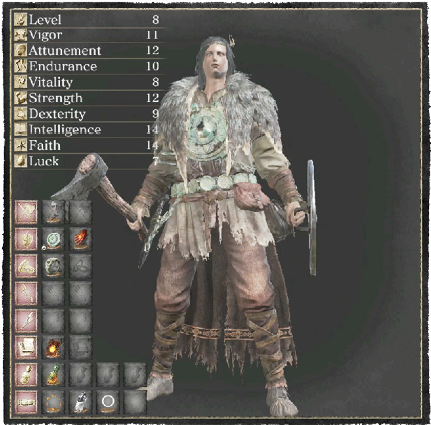
Pyromancer (Level 8)
| Vigor | 11 |
| Attunement | 12 |
| Endurance | 10 |
| Vitality | 8 |
| Strength | 12 |
| Dexterity | 9 |
| Intelligence | 14 |
| Faith | 14 |
| Luck | 7 |
Best start for: Melee and magic hybrids
Equipment: Fireball, Hand Axe, Pyromancy Flame (Catalyst), Caduceus Round Shield, Pyromancer Armor Set
Pyromancers are interesting characters. They need both Intelligence and Faith to a fair degree, and they also have to put points into some of their direct melee stats. This hybrid build takes a while to figure out, but the results are potentially quite powerful because of the flexibility that you gain.
Pyromancers start off with very nice offense options. Your ranged spell deals quite a bit of damage, and your Hand Axe is easily good enough to get the job done in short-range combat. You need to watch out for return attacks, but otherwise, you’re in good shape. Win by taking the initiative and killing enemies quickly so that they don’t outlast your modest HPs and armor.
This build promotes very specific types of weapon upgrades. If you follow this
all the way through your game, make very careful choices when you’re infusing your weaponry. You need to find gems that take advantage of your complex, mixed attributes. Don’t get something that pushes your weapon into a single-attribute scaling set if it robs the item of your other decent attributes.
Cleric
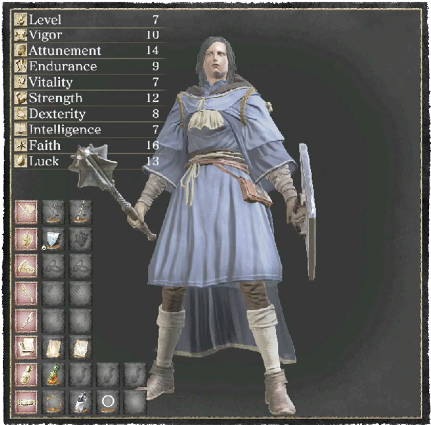
Cleric (Level 7)
| Vigor | 10 |
| Attunement | 14 |
| Endurance | 9 |
| Vitality | 7 |
| Strength | 12 |
| Dexterity | 8 |
| Intelligence | 7 |
| Faith | 16 |
| Luck | 13 |
Best start for: Miracle builds
Equipment: Heal, Force, Mace, Cleric’s Sacred Chime (Catalyst), Blue Wooden Shield, Cleric Armor Set
This dedicated Miracle character will usually build with Strength, Faith, and at least a decent amount of Attunement. Because of a Cleric’s higher survivability compared to a Sorcerer, this is not as unfriendly a choice for new players. It’s still harder to try out than a basic Knight, but if you love the idea of a Miracle-based character, you aren’t going to waste any stats. The Knight and Herald, on the other hand, already have way more invested in attributes that you won’t use as much. This lets a typical Cleric build toward their goals a bit faster.
Balance your FP use carefully. If you cast Force too often, you won’t have anything left to heal your character. Save Force for emergencies, and let most of your early FPs work toward healing and sustainability.
Deprived
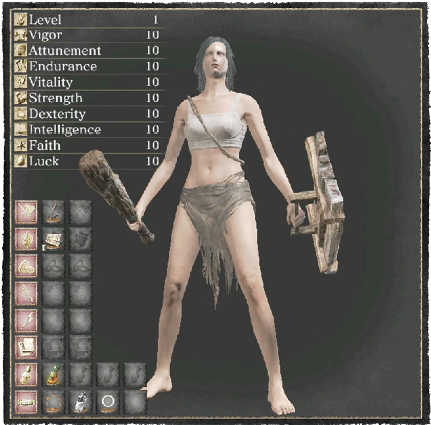
Deprived (Level 1)
| Vigor | 10 |
| Attunement | 10 |
| Endurance | 10 |
| Vitality | 10 |
| Strength | 10 |
| Dexterity | 10 |
| Intelligence | 10 |
| Faith | 10 |
| Luck | 10 |
Best start for: Masochists
Equipment: Club, Plank Shield, Loincloth
If this is your first time playing a Dark Souls game, just go ahead and stop looking at this class. Deprived begin the game at the lowest possible level and can build toward anything they want. Their early hour or two in the game is potentially very tough because they have no good equipment and no particular skills, and there aren’t any great rewards for being them. They’re simply there as a challenge.
You might think that they have an advantage by being “level one” in terms of building in the direction that you want. That’s sort of not true, though; it’s half true. Stop for a second and look at their starting attributes. Everything is a 10. Though you get a few easy levels to invest anywhere you want, you don’t have the advantage of dumping a weak stat that you don’t care about. This is a bit complex, so more explanation is warranted.
Look at the Warrior. Notice that they have very low Attunement, and somewhat low Dexterity, Intelligence, and Faith. That is why they have such high Vigor and Strength. Every class, when adjusted for level, has the same amount of attribute points. The Deprived doesn’t really benefit from being level 1 because their flat attribute starting points ensure that they can’t min-max at all. It’s good to have low stats in some areas because that lets you have higher starting points for the attributes that you really care about. Flat 10s make your career tougher throughout the entire playthrough of the game.
To make a long story short—Deprived are very tough to play unless you want the game to kick you around a lot.
Finishing
When you’re happy with all of the starting elements, finalize your character, and load into Dark Souls III. Prepare yourself for battle.