Prima Games eGuides
primagames.com Browse Redeem a code Help
Playing With Super Power: Nintendo Super NES Classics eGuide
Sign in My Guides

Sign in or create an account

We'll email you a link. No password needed, and if you don't have an account yet, the link makes one.

By creating an account or signing in, you agree to our Terms of Service and Privacy Policy.

Have a password?

Had an account on the old eGuides site, or a code from a printed guide? Help and troubleshooting

Sign in with a password

By signing in, you agree to our Terms of Service and Privacy Policy.

Check your email

A sign-in link is on its way. It works once and expires in 15 minutes. Open it and you're in, with an account if you didn't already have one.

Contents

  • Earthbound
    • Overview
    • Development
    • Characters
    • Say “Fuzzy Localization!”
    • Places of Interest
    • 16 Bits
    • Confidential Information
    • Legacy
    • Earthbound Credits
  • Super Fans
    • Introduction
    • Sam Filstrup
    • Artist Spotlight: Studio Tamago
    • Ben Hickling
    • Sam Santala
    • Artist Spotlight: Orioto
    • Sophie Pearson
    • Nadyasonika
    • Artist Spotlight: Alain “Wuppes” Wildgen
    • Fansite Spotlight: Zelda Universe
    • Xavier Garcia
    • Gonzalo “Genzoman” Ordoñez
    • Music Spotlight: Video Games Live
    • KlausBoss
    • Artist Spotlight: Per Fhager
    • Fansite Spotlight: Metroid Database
    • Artist Spotlight: Dan Cattell
    • Fansite Spotlight: F-Zero Central
    • Zoki64
    • Ted Graves
    • Li Kovacs
    • Music Spotlight: Metroid Metal
    • Artist Spotlight: Josue Martinez
    • Fansite Spotlight: Starmen.Net
    • PrinceOfRedroses
    • Artist Spotlight: Tsurera
    • Fansite Spotlight: StarFox-Online
    • Thiago Almeida
    • Artist Spotlight: Jenni Källberg
    • Efraim Rodríguez
    • Artist Spotlight: Gnomo del Bosque
    • Fansite Spotlight: DK Vine
    • Layze Michelle
    • Matthew Z.
    • Artist Spotlight: Joel Sousa
  • Realizing the 16-Bit Dream
    • Introduction
    • Launch Titles
    • Lifespan
    • Legacy
    • Design
    • Under the Hood
    • Across the Generations
    • Accessories
    • Top 20 Best-Selling Games
    • Nintendo Hardware Museum
  • Super Mario World
    • Overview
    • Development
    • Characters
    • World 1: Yoshi’s Island
    • World 2: Donut Plains
    • World 3: Vanilla Dome
    • World 4: Twin Bridges
    • World 5: Forest of Illusion
    • World 6: Chocolate Island
    • World 7: Valley of Bowser
    • World 8: Star World
    • World 9: Special World
    • 16 Bits
    • Confidential Information
    • Legacy
    • Super Mario World Credits
  • The Legend of Zelda: A Link to the Past
    • Overview
    • Development
    • The Hero of Hyrule
    • Hyrule
    • Franchise Firsts
    • 16 Bits
    • Confidential Information
    • Legacy
    • The Legend Of Zelda: A Link To The Past Credits
  • Super Mario World 2: Yoshi’s Island
    • Overview
    • Development
    • Characters
    • World 1
    • World 2
    • World 4
    • World 5
    • World 6
    • 16 Bits
    • Confidential Information
    • Legacy
    • Super Mario World 2: Yoshi’s Island Credits
  • Kirby’s Dream Course
    • Overview
    • Development
    • Abilities
    • Demo Play
    • Traps & Tricks
    • Courses
    • 16 Bits
    • Confidential Information
    • Legacy
    • Kirby’s Dream Course Credits
  • Donkey Kong Country
    • Overview
    • Development
    • More Than Just a Pretty Ape
    • Soundtrack
    • Characters
    • Animal Buddies
    • Donkey Kong Isle
    • Kongo Jungle
    • Monkey Mines
    • Vine Valley
    • Gorilla Glacier
    • Kremkroc Industries, Inc.
    • Chimp Caverns
    • Gangplank Galleon
    • 16 Bits
    • Confidential Information
    • Legacy
    • Donkey Kong Country Kredits
  • Super Metroid
    • The Metroid Menace
    • Development
    • Samus
    • Zebes
    • Crateria
    • Brinstar
    • Wrecked Ship
    • Maridia
    • Norfair
    • Tourian
    • 16 Bits
    • Confidential Information
    • Legacy
    • Super Metroid Credits
  • Star Fox
    • Overview
    • Development
    • Characters
    • Items
    • Courses Overview
    • 16 Bits
    • Confidential Information
    • Legacy
    • Star Fox Credits
  • Super Mario Kart
    • Overview
    • Development
    • Racers
    • Items
    • Tracks Overview
    • Mario Circuit
    • Ghost Valley
    • Bowser Castle
    • Choco Island
    • Koopa Beach
    • Vanilla Lake
    • Rainbow Road
    • Notable Foes
    • Battle Mode
    • 16 Bits
    • Confidential Information
    • LEGACY
    • Super Mario Kart Credits
  • F-Zero
    • Overview
    • Development
    • Gameplay
    • The Machines and Their Pilots
    • Tracks Overview
    • Mute City I/II/III
    • Big Blue, Sand Ocean, Death Wind I/II
    • Silence
    • Port Town I/II
    • Red Canyon I/II
    • White Land I/II
    • Fire Field
    • 16 Bits
    • Confidential Information
    • Legacy
    • F-Zero Credits
  • Star Fox 2
    • Overview
    • Development
    • Teaching a Young Fox New Tricks
    • Invisible Legacy
    • Characters
    • Locations
    • But Wait, There Was More…
    • Enemy Gallery
    • Star Fox 2 Credits
  • Super Punch-Out
    • Overview
    • Development
    • Minor Circuit
    • Major Circuit
    • World Circuit
    • Special Circuit
    • 16 Bits
    • Confidential Information
    • Legacy
    • Super Punch-Out!! Credits
  • Kirby Super Star
    • Overview
    • Development
    • The History of Twinkle Pop
    • The Evolution of the Inhale
    • Games
    • 16 Bits
    • Confidential Information
    • Legacy
    • Kirby Super Star Credits

Playing With Super Power: Nintendo Super NES Classics Guide › Super Punch-Out

Development

With Mario, the secret to success was making the character unique enough to be memorable, but still understated enough to not overshadow the game world. The complete opposite was true of boxers in the Punch-Out!! series, which offered nothing but in-your-face personalities. Without the need to render entire worlds or dozens of different enemy and item types like in other games, Nintendo IRD put the emphasis solely on making the boxers themselves larger-than-life. They were the world of Punch-Out!!

While most players likely discovered Little Mac and his motley crew of opponents on the NES, the franchise’s roots lie in the arcades. Three years before Mike Tyson’s Punch-Out!! hit home consoles, Nintendo released the original Punch-Out!! for the arcade. The game featured only six challengers and a wireframe player character, allowing arcade-goers to see both their own boxer as well as their opponent. The surprise success of the game led to an arcade sequel, Super Punch-Out!!, being released the following year.

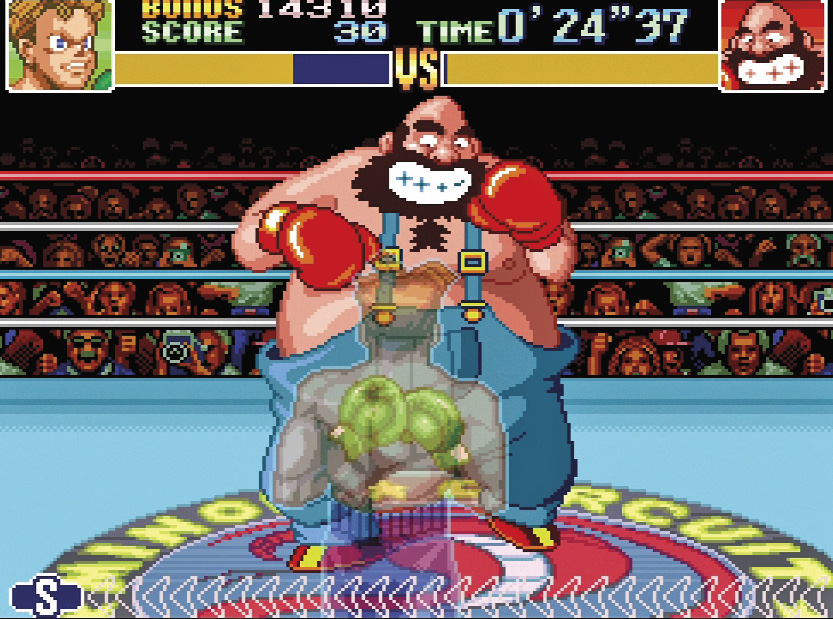
Nearly a decade later, Super Punch-Out!! was remade for the Super NES, featuring many of the same characters from its coin-op and NES predecessors. The enhanced graphical capabilities of the 16-bit hardware allowed the series’ signature caricatures to get even more attention, making them more colorful, and more punch-able.

Mac & Weave

Despite the series spanning 25 years of releases, Punch-Out!!’s core gameplay never changed. Whether it was on the NES, Super NES, or Wii, two and a half decades after its arcade debut the seemingly simple mechanics’ deceptive depth has enabled rookie pugilists to quickly get in the ring, while allowing veterans aiming for high scores and no-damage runs to endlessly hone their technique.

The recurring player character, most commonly known as Little Mac—though he can be renamed in Super Punch-Out!!—has a streamlined set of moves. He can throw jabs and body blows, as well as block, duck, or dodge to the left and right. Each Punch-Out!! game also has a special meter or star system that allows Mac to unleash extra powerful uppercuts and hook combinations.

The game’s depth has little to do with what the player can do, and everything to do with what the enemies are capable of. Each boxer’s fighting style is as eclectic as they are. Some characters may take to the offensive but leave themselves open to easy counterattacks; others may dance around the ring or use tricks such as spitting to blind Mac, kicking, weapons, and even magic. Each boxer also has at least one signature move that either knocks Mac to the floor outright, or does critical damage. To a certain extent these tactics follow specific patterns and can be memorized, but this is not always true due to sporadic randomized sequences, keeping even the most experienced Punch-Out!! masters on their toes.

Knockdowns can be delivered by depleting a boxer’s stamina meter, or by delivering a punch at just the right time, often as they’re about to unleash the aforementioned signature attack. Super Punch-Out!! also features a hidden “dizzy meter” that puts boxers into a stunned state after a number of consecutive punches land. Certain characters can be dizzied faster than others. Similarly, most—but not all—boxers are guaranteed to be KO’d if knocked down within a few seconds of getting up from the mat the first time, though this requires a lot of a skill and a bit of luck.

Keep reading with a free account

The first 3 sections of Playing With Super Power: Nintendo Super NES Classics are open to everyone. An account opens the rest of it, and every other guide in the archive. It's free, and there's nothing to buy.

Bought guides on the old Prima Games site? Your account and every guide you own moved here, so there's nothing to buy again. Sign in.

Create a free account Or browse our free guides

PreviousOverview NextMinor Circuit