
Playing With Super Power: Nintendo Super NES Classics Guide Super Mario World
Confidential Information
Speedrunner Truman and Speedrunner Bramz
Super Mario World’s immediate accessibility and long-running popularity make it a prime candidate for speedrunning. The tight controls and short levels provide the ideal playground for endless experimentation and reiteration. And the game’s charming visuals and catchy music never seem to get old even after playing hundreds of times through, as is the case for the most dedicated speedrunners.
Super Mario World categorizes its speedruns slightly differently than the usual Any% and 100% titles used for most other games. Instead, it focuses on exits, of which there are 96 total in the game. For instance, Donut Plains 1’s normal exit leads to Donut Plains 2, but there is a second, secret exit that opens up Donut Secret 1. So for the 96 Exit category of speedrun, the player must clear all 96 exits and the run ends when Peach appears after defeating Bowser. Currently this can be done in under an hour and a half. There is also an 11 Exit category, which can be done in under 10 minutes. Over the years, new types of runs have been invented by the community to create new challenges and provide more variety. These can include restrictions such as not using the Cape, which drastically changes how the speedrun plays out, or only allowing small Mario, meaning a single hit can end a run.
The most mind-bending category is the 0 Exit, which uses a series of pixel-perfect movements and actions to manipulate the game’s memory, sending the player from the first stage directly to the end credits. This can be done in under a minute and 15 seconds, though very few players have actually pulled it off, let alone quickly.
On the following pages, Truman and Bramz, two high-level Super Mario World speedrunners, provide various tips and tricks for achieving unthinkably quick completion times in this beloved game. Born after the game’s original release, Truman and Bramz both experienced Super Mario World first through its Game Boy Advance port, Super Mario Advance 2. Many, many years later, upon discovering speedrunning, they returned to the classic. “The nostalgia from my childhood is what made me initially want to speedrun the game,” said Truman. “But after starting to run, what has really kept me around is the great community.”
“I spent about two months off and on learning the basic strats for 11 Exit, using a notepad document to keep track of my best times for each level,” said Bramz. “I would study other people’s runs and hop in Twitch chats asking questions to experienced runners. Luckily, Super Mario World has an amazing community and plenty of extremely useful resources that make learning the game a breeze.” That said, Bramz explains that it wasn’t an overnight success story. “At the time I thought [my first runs] were amazing, but looking back on them now the only word I can come up with is ‘trainwreck.’ But I was definitely having fun when I started learning and was always encouraged to beat my times.”
Basic
Truman
Capeology 101
The Cape Feather is the most useful power-up in all of Super Mario World. Using the Cape alters gameplay so much that most major categories have a no-Cape variant on the leaderboards. The most obvious use of the Cape is to fly over levels, since you are able to remain in the air indefinitely. Some levels have hazards in the ceiling to try and prevent you from doing this, but they are usually avoidable and most levels don’t even have them.
Building off of this, you are also able to maintain your takeoff meter through both doors and pipes. This means that if you enter a door or pipe within 80 frames of your initial takeoff, you can jump after you exit the other side and start flying immediately. You can combine this mechanic with the cannon pipes in the game to fly at a speed higher than what was intended by the developers. In addition, you can use the Cape to skip cycles in levels such as Morton’s Castle by maintaining your takeoff meter.

The Cape can also be used to avoid taking damage in many places. If you are in normal flight and run into an enemy, you will lose flight, but keep your Cape, and be invulnerable for a short period of time. This can be used both as a safety measure and also as a way to boost through objects without having to avoid them. Using your Cape in this way is generally referred to as “Cape-canceling.” Many levels in the game feature the use of Cape-canceling to progress through obstacles that you would normally have to wait to avoid.
Fast Flight
In Super Mario World, you do not actually move at a constant speed when you are holding right. Instead, you oscillate between five speed values. Because you don’t need to hold right while you are flying, you can lock in your value at the highest speed by tapping right until you can tell that you have the best value.
Block Duplication
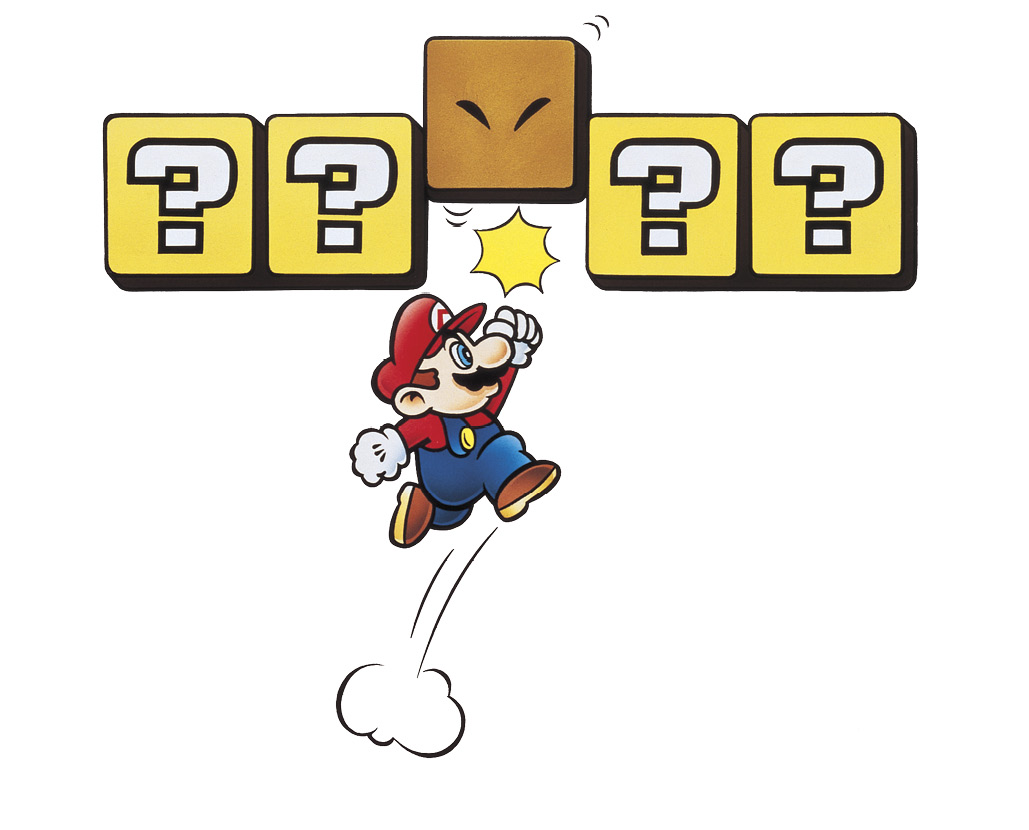
While standing next to a Turn Block or a ? Block, you can jump up and throw an item during a small frame window and duplicate the Block in many different directions. This frame window occurs when the item you are holding is near the bottom of the Block you are trying to dupe. This can be used to get extra power-ups or to obtain glitched Yoshi Wings.
Advanced
Truman
Yoshi Clip
This trick is used to obtain the secret exit in Vanilla Dome 2 and both exits in Forest of Illusion 2. To clip into corners with Yoshi, you have to dismount Yoshi in the water next to the corner and move slightly over toward the corner. If you do this correctly and remount Yoshi at the proper time, he will snap to your position and you will be inside the wall. Once in the wall you need to hold down and then tap A so you dismount and remount Yoshi again. Even if done correctly, there is still a chance you will not clip and will need to try again.
Morton Fly
The Morton Fly is a strategy for flying through the vertical room of Castle 2. While tricky for new runners, this strat is essential for almost every category in the game. The key to maintaining flight through all of this room is to swing out wider than you would think for most of your jumps.
Duplicating Yoshi Wings
Doing this trick requires both having a Yoshi and a knowledge of Block duplication, which is explained in the Block Duplication section. In this level, take Yoshi to the middle section of the first room by all the Turn Blocks and where the first Dragon Coin is. Using the nearby Buzzy Beetle, duplicate the Turn Block up so that it is inside the Dragon Coin, then collect the Coin. While it will look like there is nothing there, there is actually an invisible Key Block where the duplicated Block was. Re-stun the beetle so it does not wake up, and then duplicate the invisible Block to the side. Wings appear and you can then collect them with Yoshi to end the level and get the normal exit.
Orb Glitch
Basically, if you eat a Clappin’ Chuck with Yoshi using the item swap glitch when you’re in power-up state three (Fire Mario), you get the Orb from the end of Sunken Ghost Ship in your reserve box, which can then be dropped in any level, and collected to instantly end the level.

Expert
Bramz
Sandbar Clip
The second to last stage is Valley of Bowser 2 (secret exit). In the second room, there is a maze featuring a moving yellow platform referred to as the “sandbar.” If you are big Mario ducking in a one-tile gap, you can Spin Jump and clip into the floor. This can be used to skip one cycle of the sandbar, saving 12 seconds. Toward the start of the sandbar section you must run, duck, and press A within a two-frame window. Once you’re out of bounds, you have to quickly build up speed to fly up and duck into a gap. If you clip but don’t make it into the gap, you’ve missed the skip and won’t save time.
Groovy Boss Kill
There is a very complicated glitch in the Special Stage, Groovy, called “GBK,” short for “Groovy Boss Kill.” Enter Groovy with a Blue Yoshi, a Cape, and Fire Flower in reserve. When you approach the end of the second raised slope, simultaneously press Select (releasing the Fire Flower) and X. After you lick up the green Koopa, spit out the shell and spin it with your Cape. Right before the flower touches Mario’s head, press B and Y on the exact same frame (if you did this correctly, you get the “double tongue glitch” (DTG) and a second tongue will come out of Yoshi’s closed mouth).
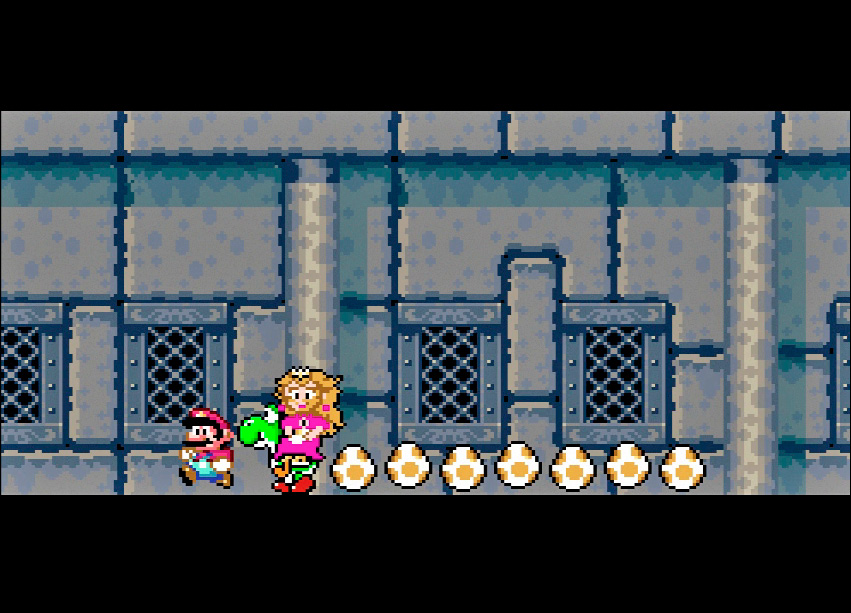
During DTG, grab the blue Koopa with your second tongue, but run into the red Koopa before swallowing it. This is called an “eat cancel.” After remounting Yoshi, stomp the blue Koopa and run back toward the beginning of the stage. You will see a shell-less Koopa sliding down one of the slopes; he is your target. Jump on him with Yoshi, then quickly spit out the contents of Yoshi’s mouth and dismount Yoshi. Shoot 12 fireballs into the invisible boss that you just spawned, dropping your Cape from reserve. After you hear the boss die, grab the Cape and hop back on Yoshi as the level ends.