
Playing With Super Power: Nintendo Super NES Classics Guide Super Mario World 2: Yoshi’s Island
Development
While Super Mario World was meant to sell the Super NES, nearly half a decade later its sequel was positioned to help keep the SNES alive. And what a difference those few years made! Super Mario World 2: Yoshi’s Island exudes supreme confidence by the developers in their craft: stages are larger and more intricate; gameplay is deeper and more demanding; and the hand-drawn storybook aesthetic is still a sight to behold many decades later.
Knowing this would be the final Mario game for the Super NES, producer Shigeru Miyamoto and the Nintendo EAD team didn’t hold back. Many partially implemented concepts for Super Mario World were left on the cutting room floor, yet in Yoshi’s Island very few ideas ended up being jettisoned once development was underway. The team had aspired to create a true Yoshi-centric adventure for years, believing there was plenty of room for the character to grow beyond what players had seen in the previous game.
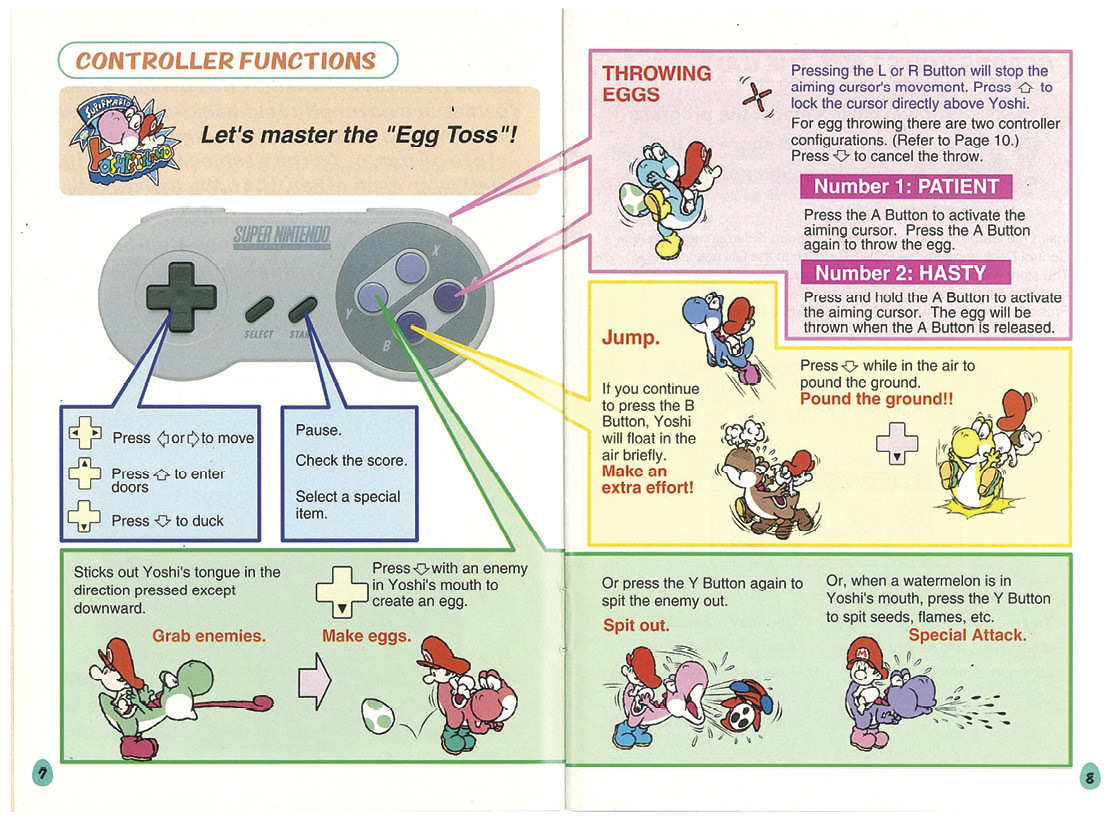
Yoshi’s signature enemy-eating abilities from Super Mario World were heavily upgraded. Yoshi could now swallow enemies to create an Egg, and carry up to six Eggs at a time, which happily followed behind him in his Egg queue. Eggs in the queue could then be aimed and thrown using a targeting reticle. Nearly every puzzle, gimmick, and boss in Yoshi’s Island was built around this Egg-throwing mechanic. For example, Shy Guys on stilts couldn’t be tongued from the front, but hitting them with an Egg knocked them off their stilts, making them vulnerable. Eggs could be used to change certain terrain types, or ricocheted off walls and skipped across water for trick shots. Collectibles were automatically collected when hit by Eggs. Most bosses were not so much difficult, as they were imaginative ways to show off the developers’ clever design, sense of humor, and technical exploits.
Super Mario World’s Block switches were used as the primary difficulty modifier, but Yoshi’s Island took a different approach. The elaborate level design and diverse collectibles encouraged multiple playthroughs, and the more complex gameplay cultivated perfection. Yet, in some ways, the game was also made more accessible. Mr. Miyamoto strived to break free of what he considered a traditional yet “absurd” mechanic in video games where touching an enemy resulted in death.
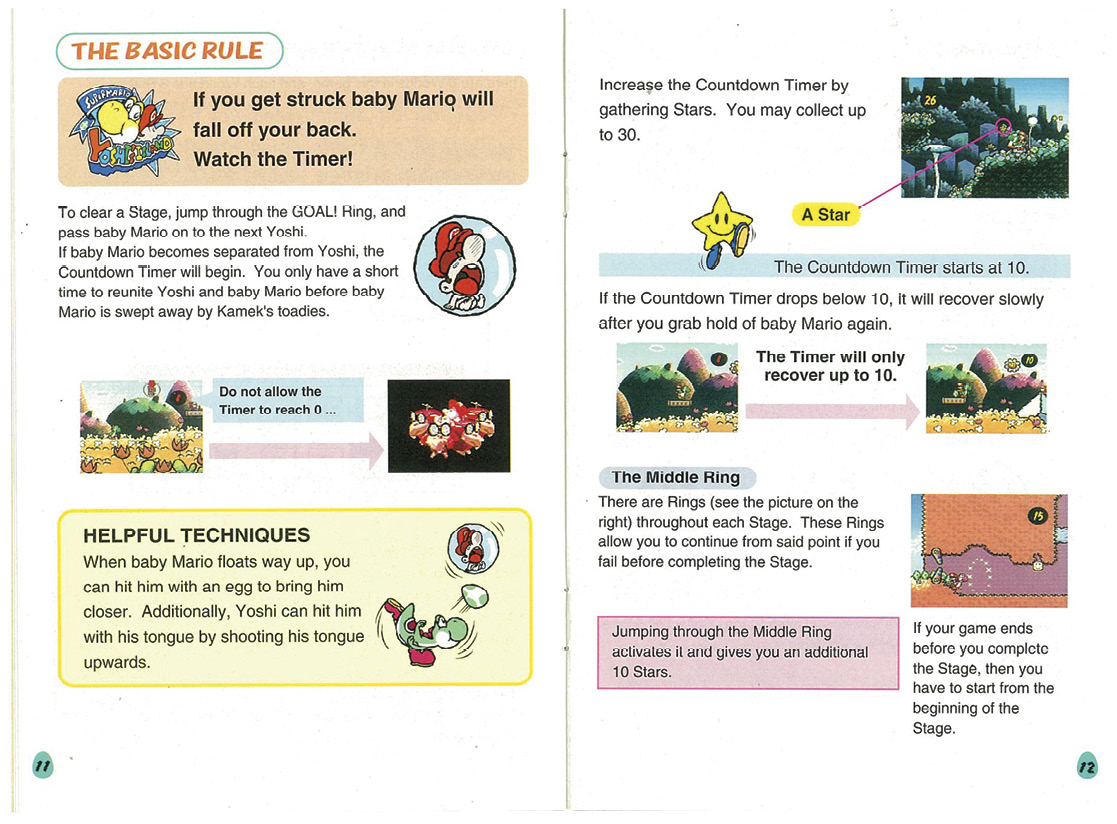
In Yoshi’s Island, taking damage from most sources usually results in Baby Mario floating around the screen in a bubble, crying. A short countdown timer begins, and Baby Mario is kidnapped if it reaches zero, resulting in the loss of one “life” and a level restart. If Yoshi touches the bubble before the countdown ends, Baby Mario is rescued and the player can continue through the level as if nothing had happened.
As remarkable today as it was upon release, Yoshi’s Island is a monument to Nintendo EAD at the apex of its 16-bit achievements.
Level Design
The stage layout in Yoshi’s Island differs greatly from previous Super Mario games, which generally followed a linear horizontal path. Stages in Yoshi’s Island tend to have facets of verticality to them, somewhat similar to Super Mario Bros. 2, which was initially developed as a separate Japanese game before being rebranded as a Mario title by Nintendo of America.





