
Playing With Super Power: Nintendo Super NES Classics Guide Super Mario Kart
Items
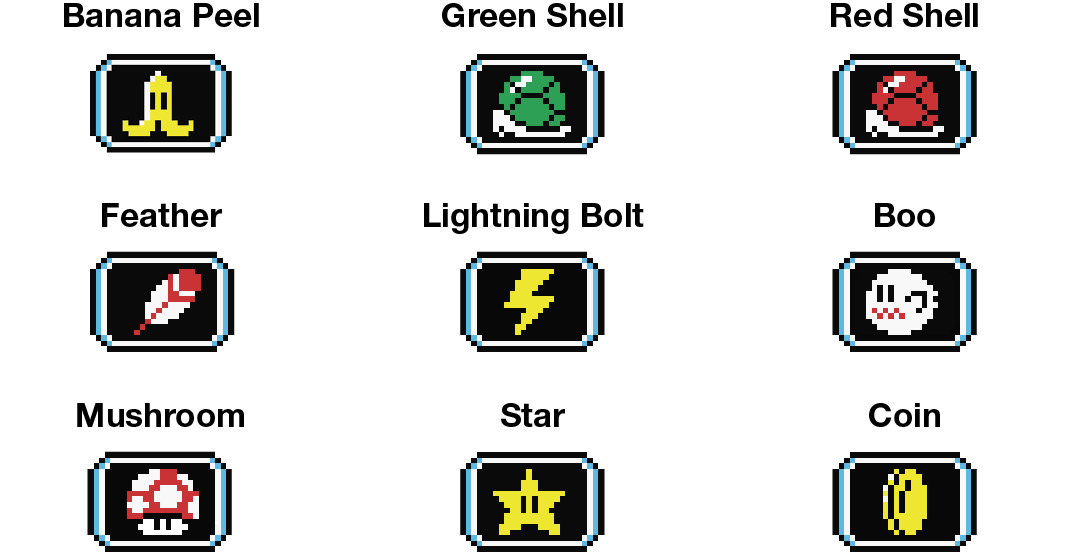
There were two more key aspects of Super Mario Kart that would come to define it. The first of these was the control scheme. Driving a go-kart should prioritize fun and accessibility over technical skill, so the team spent a lot of time tweaking it to be just right. A drift mechanic was added that allowed players to slip and slide around the tracks for easier and faster cornering. A jump was added because what would a Jumpman game be without it? The idea was to create a racing game unlike any other, which leads to the second key aspect of Super Mario Kart, and the one the team believes is the most integral ingredient to any entry in the series: items.
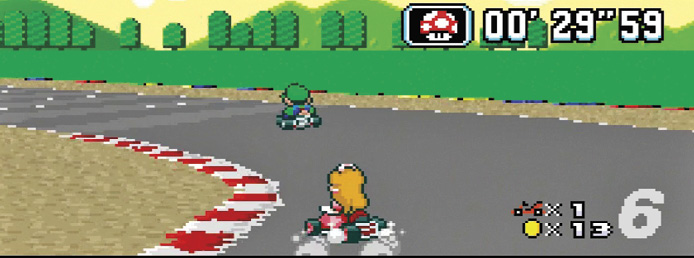
Super Mario Kart can be largely credited for the popularity of weaponized vehicular combat games. The developers see items as an inseparable aspect of Super Mario Kart as they present opportunities to overcome skill differences between friends and family. Likewise, they are looked at as “communication tools” where players can interact with each other no matter where they are on the track. That communication just happens to take the form of shrinking you with a Lightning Bolt and then running you over.
Coins
Coins aren’t always the most thoroughly understood mechanic in the Mario Kart series, likely due to their ever-changing functionality, yet they add a notable amount of depth in an otherwise intentionally simple game. In Super Mario Kart, Coins can be found scattered around the track or by using the Coin item, which instantly grants the player a pair of Coins. Obtaining a Coin increases the player’s speed slightly, with the maximum effect being achieved at 10 Coins. Racers are given a set amount of Coins at the start of each race, with lower positions being given more in order to gain an initial speed advantage over the front of the pack. That they’re used as a key balancing solution by the developers shows just how important they can be to anyone looking to get the edge on their opponents.
There is no limit to the number of Coins that can be carried at one time. This provides a buffer to prevent being deprived of the speed bonus, since there are a multitude of ways to lose held Coins. First, and most importantly, bumping into another racer knocks loose a Coin. If you have no Coins, you’ll spin out. Taking hits from items also causes both a spinout and the loss of four Coins. And last, if Lakitu has to tow you out of a pit, the cloud-riding ferryman levies two Coins for safe passage. If you can’t pay Lakitu, you’ll be forced to roam Koopa Beach for one hundred years… Just kidding! Nothing happens.
AI Items
The following items are only used by AI racers, who have access to an unlimited stash. However, AI racers cannot use items from Item Pads as the player can. AI opponents automatically jump over enemy items as if they had a Feather, but it’s still possible for them to get hit under certain circumstances.

Poison Mushrooms made their first appearance in the Japanese version of Super Mario Bros. 2 (aka The Lost Levels), but they had a skull icon and darker color scheme, whereas the Poison Mushrooms in Super Mario Kart share an appearance similar to the Super Mushroom found in later Mario Kart games. Unlike most other items such as the Fireball and the Egg, Poison Mushrooms do not spin out racers, instead shrinking them and making them drive more slowly. However, eating a Poison Mushroom while already small, even if it was caused by a Lightning Bolt, returns the racer to normal.
