
Playing With Super Power: Nintendo Super NES Classics Guide Super Mario World
Development
Super Mario World was developed over the course of three years by Nintendo’s all-star Entertainment Analysis and Development (EAD) division. Director Takashi Tezuka, producer Shigeru Miyamoto, artist Shigefumi Hino, and composer Koji Kondo were tasked with translating the Mario phenomenon into the 16-bit era. Super Mario World not only had the unique pressure of a console launch title, requiring it to showcase the capabilities of Nintendo’s new hardware, but it also needed to catapult the Super Mario franchise forward, rather than laterally. Nintendo needed to prove that it, along with Mario and the industry as a whole, could continuously evolve.
Concern both within and from gamers and critics about “more of the same” was an early hurdle. Although Super Mario Bros. 3 released in Japan in 1988, the game debuted in the West in 1990, less than a year before Super Mario World’s launch. Any similarities between the two would be fresh in the minds of American consumers. Reflecting on development in the official 1990 guidebook, Mr. Tezuka noted, “Many people at Nintendo who saw Super Mario World being developed remarked to us, ‘It doesn’t look all that different from the Famicom games.’ We felt the same way.”
Super Mario Bros. 3.5
Due to the team’s unfamiliarity with the new hardware and the software tools still being in development, it was decided to port Super Mario Bros. 3 into the Super NES and use that as the foundation for the next big Mario game. Early screenshots reflect this decision by showing different sprites for Mario and a plethora of visuals unique from what ended up in the final game. Raccoon Mario saw screen time early on but was eventually replaced by the Magic Cape. “We no longer had the restrictions on scrolling and the number of colors that the Famicom had,” Mr. Miyamoto revealed in an interview from the official guidebook in 1990. “So it became much easier to depict things. That was nice. However, before starting Super Mario World we ported Mario 3 to the Super Famicom as a hardware experiment, and even though the colors and sprites were more detailed, it was still the same game. It made me realize that we couldn’t just make the same game again: we had to create something new. It was in that context that we talked about how to make the most use of the new hardware.”
The team continually discovered “cool things” the hardware was capable of, yet didn’t necessarily add to the game in a meaningful way. “If it ruined the balance or flow of the game, we didn’t want to include it,” said Mr. Miyamoto. Additionally, while Super Mario World had a 4 Mbit cart compared to Super Mario Bros. 3’s 3 Mbits, the expanded colors demanded more memory, and as a result placed limitations on the team. As players have unraveled the inner workings of the game over the decades, the curtain has been pulled back on the interesting methodology used to manage the game’s memory and graphics.
Eventually, Super Mario Bros. 3 was given a 16-bit makeover in Super Mario All-Stars, further bridging the gap between the two titles.
Balance and Control
While most NES players had several Mario titles under their belt upon the Super NES’s debut, Super Mario World was intended to reach beyond current fans and captivate entirely new audiences. “Super Mario Bros. 3 was made for experienced players who had delved deep into the previous Mario games,” explained Mr. Miyamoto. “In contrast, we aimed to make Super Mario World friendly to beginners as well, but still exciting for those who played Super Mario Bros. 3.”
To this end, a Tanooki Suit-esque Magic Cape was introduced. “The Cape controls—where you open the Cape and catch the wind, rising upwards—were a little different at first,” explained Mr. Tezuka. “We didn’t know if it would feel right, so as we had done withExcitebike’s controls back in the day, we solicited a lot of feedback from test players. As we expected, players found the Cape too difficult to control, so we adjusted the way it handles so that even though Mario’s flying is a little clumsy, the controls feel much more playable.”
While the project was not without its challenges, Mr. Miyamoto ultimately felt a lot of the groundwork had already been established, allowing the team to focus their efforts elsewhere: “With the first Super Mario Bros. I started out by trying to create an athletic game where the movement felt instinctively ‘right.’ I was starting from scratch, so that meant a lot of experimentation. In contrast, with 3 and now 4, I don’t have to worry about the basic direction of the Mario games. It’s more about how much polish we can give them, and what kind of fun new elements we can add.”


And though the game did introduce numerous new elements, the record of those directly responsible was lost in the shuffle even during development. “I really don’t know anymore who came up with which idea,” Mr. Miyamoto stated in 1990. “Things get decided by everyone throwing their two cents in: ‘Oh, how about this?’ or ‘Make it do that!’ Although people do still claim certain things from past games, like, ‘Hey, that was my idea!’ Taking Zelda and Mario as an example, though, it’s almost entirely the same team for both series, and while we’re bouncing ideas off each other you often hear things like, ‘Oh, that idea would work better for Zelda, I think.’ So maybe you’ll see Link riding a dinosaur next game.”
It’s been over 25 years and we’re still eager for The Legend of Yoshi, Miyamoto-san!
Malleable Difficulty
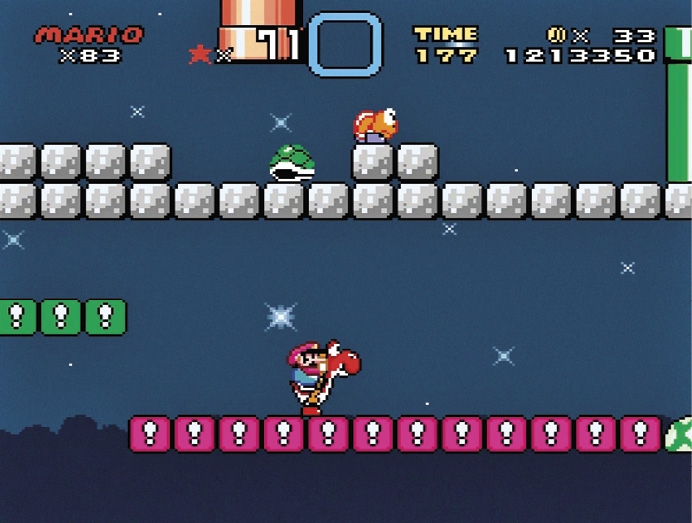
“One of the issues with action games is how to make something that can be enjoyed by all skill levels, from beginners to more advanced players,” said Mr. Miyamoto. “One way is to add an ‘Easy Mode,’ but I think the best method is when the player can adjust the difficulty himself while playing. The dotted line Blocks fill that role in Super Mario World.”

The color-coded, dotted line Blocks sprinkled throughout the game can be permanently materialized by finding the corresponding Switch Palace. Switch Palaces require Mario to find alternate “exits” to specific stages. Once toggled, the newly tangible Blocks provide a variety of aid, such as covering dangerous pits, allowing new areas or items to be reached, and furnishing power-ups immediately before boss battles.

Audio
You can thank composer Koji Kondo for most of the catchy 8- and 16-bit tunes cemented into your memory to this day, including the original Super Mario Bros. theme. When switching to the Super NES hardware, Mr. Kondo found an entirely new set of obstacles to overcome. “With the Super Famicom you have to create the sound samples themselves, so compared with the Famicom, it was 100x more difficult. I remember working on it for a year and saying, ‘I’m still working on this?’ I think it took about a year and a half in total. Of course, this was my first time writing music for the Super Famicom, so I was having to figure out its capabilities and the software tools at the same time.”
In the 2001 book Game Maestro Vol. 3, Mr. Kondo reminisces about the impact the new hardware had. “The Super Famicom [was] a decisive split from the game music of the past. It truly was a new sound. I spent a lot of time then thinking about what direction game music should go from here. The cheap square wave sound of the Famicom had come to define ‘game music’ for most people, but the Super Famicom could play a much wider variety of tones and sounds. That being the case, should I try and imitate ‘regular’ music that we hear all around us? Or should I try and use these sounds to create a new style and lexicon of game music? I had to really pause and think here. For Super Mario World, I decided that for now, at least, I would try and use sounds that resembled the normal instruments you hear in the real world. However, my idea was to arrange the individual instruments in a way that you don’t normally hear. Like putting banjo and steel drum together, for instance.”