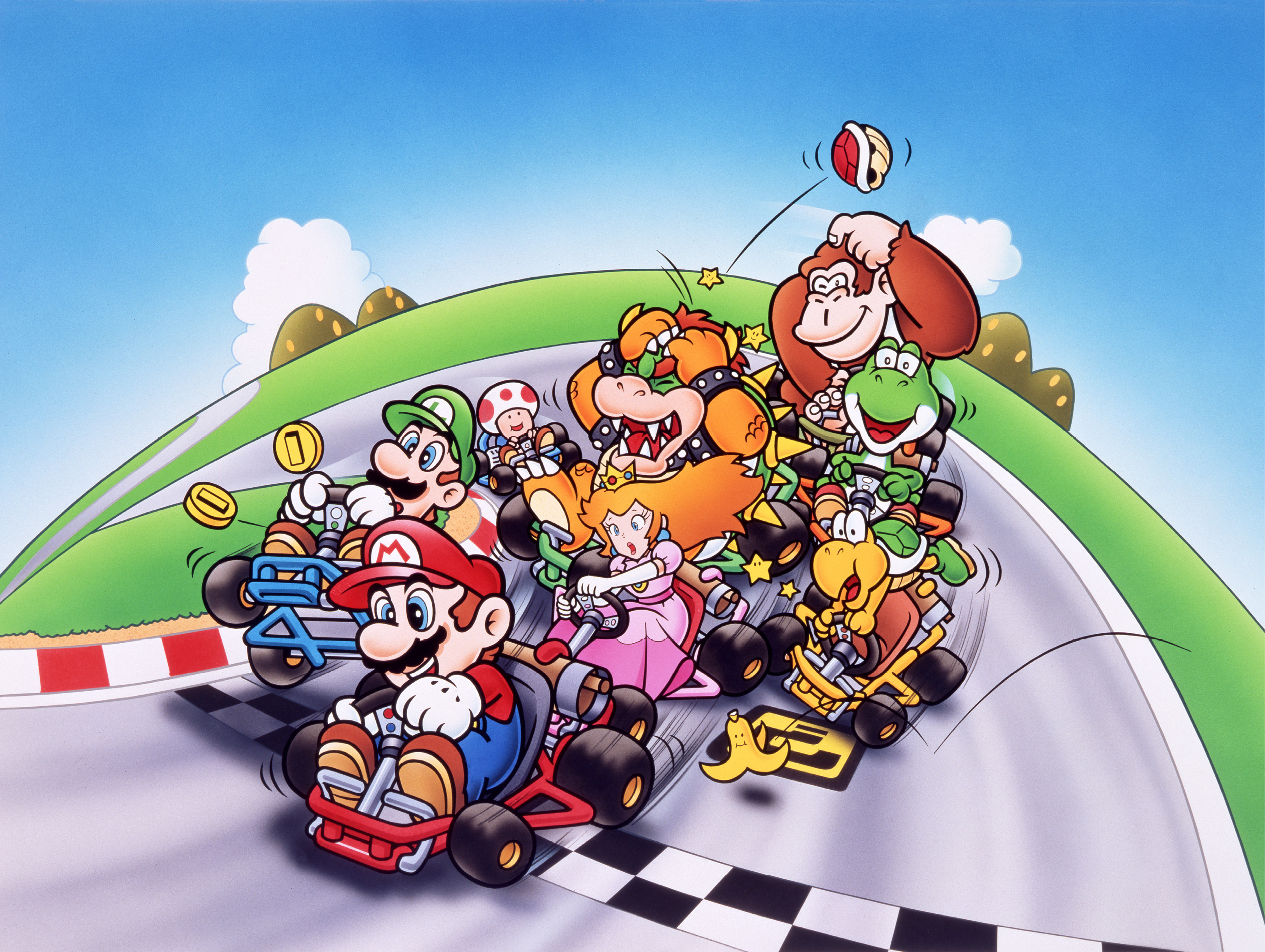
Playing With Super Power: Nintendo Super NES Classics Guide Super Mario Kart
Confidential Information
Speedrunner KVD and Speedrunner SamI Cetin
World Records Held: KVD: All Cups — 2P (31m 08s), Sam Cetin: Numerous Time Trial Records
“I love how skill in this game is very transparent,” says current speedrunning world record holder, KVD. “Even to the untrained eye it is easy to recognize when a highly skilled karter is behind the driving wheel.” KVD’s competitive nature has always been the driving force behind his time with Super Mario Kart. “When I was around 10 years old (1994), my sister and I started out renting this game in the local video games store. I would try and beat the Time Trial records other rentees had set on the cartridge and ended up renting it over and over to keep on (re)claiming those records. Of course I ended up actually getting the game, and at some point I was trying to beat records that had been submitted via letters to the nationwide gaming magazine Power Unlimited.”
After a bit of a hiatus thanks to something called the Nintendo 64, the dawn of the Internet opened up the competition on a global scale. “I remember one of the first things I searched for was world records for Super Mario Kart,” explains KVD. “The result completely blew me away and you might as well call it a life-altering event. A guy from the UK called Sami Cetin had driven times that I deemed impossible at first glance. Skeptically, I clicked on the video link provided for the record…I had opened a door to another universe; the level of driving on display in that video pretty much shocked me to the core. I had never seen video gaming until that point.”
“Of course I was immediately hooked, and little over a year later I became a (Time Trial) World Champion myself.”
“Time, dedication, and patience are keys for [mastering] any game,” says Sami Cetin. “Watching other players, maybe different styles to see what works and what doesn’t. Watching your own failures to see where you went wrong so you can improve next time. For Super Mario Kart the most important thing is to play Time Trials on all of the tracks to learn the game thoroughly. Then when you reach a consistent level, it’s a great time to start speedrunning.”
“We have a long history with setting records on this game from back in the 1990s,” continued Cetin. “I started the Time Trial World Rankings site for Super Mario Kart, which exists within the wider Mario Kart Time Trial community covering all of the games in the series. Championships, which are held in France, began in 2002 and this involved Time Trial one-try sessions. Out of this, with the growth of speedrunning on several other games, there was interest in doing speedruns on the Time Trial and Grand Prix Modes.”
In the following pages, KVD and Sami Cetin share the key techniques they, and many other Mario Kart runners, use to compete for the best times around the world.

Basic
KVD
Countersteering
The bread and butter of Super Mario Kart, this is an absolute necessity to get those tight corners. It is almost impossible to optimize this, so it falls in the Easy/Intermediate to Learn, Lifetime to Master category. First, approach a corner, turn, and hop a few times. Then, as soon as the corner finishes, tap the opposite turn direction and press Jump once more to straighten up. That is the countersteer hop. You can mostly just let go of the turn direction and hop to straighten up, but on sharper corners you need more of a forceful straighten-up method, so tap the opposite turn.
For example, in the second corner of Mario Circuit 1, you turn left and hop a few times; then at the end of the turn, let go of the left turn and hop with R to straighten up and stop drifting out. Corner 3 is sharper, so you can turn left and hop a few times, then as soon as you reach the pipe and have just turned past it, tap Right, turn once, and jump once more with R to straighten up. That’s a countersteer hop.
Platform-Jumping (Ghost Valleys)
All the Ghost Valley tracks have a platform-jump; all of them are possible, even in Time Trial. In GP 150cc Mode these moves are actually not that hard, with the extra speed enabling a higher success rate. All that is needed for this is a well-timed jump a few frames before the road ends and you will make it to the other side. The move itself is easy to learn, but dealing with the driving trajectory after landing is where the real challenge is.
Manual Jump-Plate Skips (Bowser Castles, Ghost Valleys, and Rainbow Road)
Instead of choosing to hit the jump-plates on Bowser Castles to make it across the lava when driving over the islands, you can manually jump over them. Hitting these jump-plates makes you lose a lot of momentum; successfully navigating the Bowser Castles without hitting any literally wins seconds. Though each individual jump-plate skip is not too hard, it is quite a challenge to line them all up properly, on Bowser Castle 3 in particular. Avoiding jump-plates is a good idea in general; if you hit some of them with full speed, you overshoot the intended landing strip and end up in the lava…oops!
Mushroom-Assisted Wall-Skip on Donut Plains 3
This looks quite impressive, but it’s surprisingly easy to pull off. All you need is to fire a Mushroom in the sweet spot (there is a little bit of leniency for where the sweet spot is, too), directly perpendicular to the wall. This move is executed immediately after the second bridge, using the Mushroom to cross the wall next to the finish line. Be sure to stay to the left of the finish line, otherwise the next lap will not trigger. It is normally not possible to skip across walls using Mushrooms, but because there is some water before the wall, your kart bounces on that when you use the Mushroom and carries you over. There are similar Mushroom-assisted wall-skips on the other two Donut Plains tracks, but those are much harder to pull off due to the shape of the water and the position of the wall. When you’re given the Mushroom, this is pretty much a free six-second gain on Donut Plains 3!
Advanced
Sami Cetin
New Boosting Technique (NBT)
The new boosting techniques involve generating mini-turbos by holding the L/R Jump button while sliding around a corner and zig-zagging with the D-pad to charge the boost, then countersteering and releasing the L/R Jump, or counter-jumping to generate a mini-turbo boost. If this is executed just before a bit of off-road terrain (grass/sand/mud/light water/snow), the kart boosts across the small patch of off-road terrain at high speed. This boost is very short, but you can generate it again on other corners. If executed on a road, it saves on Time Trial around 0.06 seconds on PAL and 0.10 seconds on NTSC. The length of the boost varies on each version. It is Super Mario Kart’s equivalent of a mini-turbo from the other games in the Mario Kart series, except no colorful sparks come out of the kart; the engine sound just increases a little and the kart sometimes twitches to the side. These are the main driving strategies on Time Trial for speedrunning and record setting.
KVD
Gas-Releasing
This is actually very easy to execute, but belongs in the advanced section anyway, as it is an extension of the boosting mechanics. When you’re still off-road at the time a boost runs out, you experience immediate and harsh slowdown. This can be circumvented by releasing the Gas button toward the end of the boost. You still slow down, but at a much slower rate.
Sami Cetin
Long-Boosting (LB)
Long-boosting is another advanced technique in Super Mario Kart. It is generated with a Mushroom that gives you a burst of speed, or one of the yellow arrows (zippers) which can be seen on the Bowser Castle tracks, Mario Circuit 2 (just before the jump over the road), Mario Circuit 3, and Ghost Valley 3, which give the same effect. You basically line yourself up with a wall/corner, use the Mushroom, and just before you impact the wall at high speed, let go of B, jump with R at the wall, and hold R down. You must make sure B is released before impact, otherwise this will not work.
If executed correctly, you bounce off the wall and zoom off at high speed for maybe three to four seconds, then you can press B and revert to normal driving. This is a long-boost, and ideally needs to be done where there is a big open space in front of you. Choco Island 1 has one of the best spots, as you can long-boost off a wall and drive on one of the little bumps on the road which makes you bounce high. Sometimes you can hit more of them, which keeps you jumping high and extends the length of the long boost a bit more. The same can be triggered with the yellow arrows on the Bowser Castles, where you can also do it in a reverse way, by jumping against a wall after already releasing B and holding R. The kart goes into a slow skid motion for a few moments, then you hit an arrow, which makes your kart drive at long-boost speed. Using Bowser Castle 1 as an example, you can go on the arrows in this manner, and if you have a Feather, turn to the left and use it with the higher burst of speed to jump across the hairpin and land on the final corner.
This can also be generated on the big jump of Mario Circuit 2 (in Time Trial also) but it is tricky. Touch the arrows, release B, and jump with R. If triggered at the right time, you bounce off the arrows and jump at high speed, hopefully clearing the wall. You can steer to the left and boost through all of the sand on the next few corners. It is hard to get a strong enough long boost, but with practice testing out the angles, it can be done.

KVD
Infinite Boosting (IB)
A speed boost that can essentially last forever! The IB can only be achieved by releasing the gas while boosting over turbo arrows; then, for as long as no buttons other than the directions are pressed, and no obstacle is hit, a full-speed boost lasts and lasts! This strategy is mainly used on Mario Circuit 3, though some expert players are also known to perform it on Ghost Valley 2. In GP 150cc it is borderline impossible to finish a full lap with an intact IB, though it can still be used to cut a few corners until the hairpin. In Match Race it is routinely used for entire laps. It’s a bit easier to manage with Mario and Luigi (and the other smaller characters), who have much more forgiving turning angles.
Expert
KVD
Scouby Feather
This is a Feather move invented by the current SMK multiplayer World Champion, Julien Holmiere (nicknamed ScouB). Essentially you are using a Feather to generate a long boost. Though you don’t get the crazy speed that you would when firing a Mushroom, it still means you can cross off-road areas without losing as much speed. It is used on Choco Island 1 at the finish line. You need to boost backwards toward the wall, trigger the Feather, rebound into the wall at the onset of the Feather, pass the wall to the far right to circumvent the finish line, and hold R down during the landing to circle back through the chocolate. As the Feather move spends very little time in contact with the ground, the timing is extremely hard. It’s something else when it’s successful, though.
Pipe Boosting
When you skim a pipe while a (normal) boost is charged, you can clear a much larger off-road section than normal. For example, this can be done using one of the pipes in the corner leading up to the hairpin on Mario Circuit 3. When a boost is charged, just barely hitting the pipe on the side results in your kart being launched in a prolonged boost. When you hit it too much in the middle, you dead-stop at the pipe. This is mostly used in Time Trials, as it wins very little time. It’s a high-risk, low-reward move, no matter which level of player you are.
Extended Wall-Ride Boost
Collision with a pipe or wall temporarily disables the slowdown properties of off-road sections. This mechanic is exploited at the final boost of Choco Island 1, but only in the final lap. There is a very long stretch of wall leading up to the finish line. You can clear the entire off-road section by launching a boost at the beginning and then repeatedly rebounding into the wall until the finish line is reached. It requires a complicated mix of D-pad dashes and alternating between hitting the gas and releasing it to pull it off successfully. It’s a rhythm of sorts that needs to be figured out. It can win a few tenths, so it’s another one of those high-risk, low-reward type deals.
Multiplayer
There is also a plethora of tech used specifically in multiplayer. You wouldn’t believe how many different techniques there are to launch and avoid Red Shells. Just watch the World Championships online, or better yet, join yourself!