
Playing With Super Power: Nintendo Super NES Classics Guide Super Mario World
16 Bits

 Super Famicom Box Art
Subtitled Super Mario Bros. 4 for its original Japanese release, the Super Famicom box art emphasized Mario’s new pal just as the international box art did.
 Winged Red Coin
Super Mario World has an unused flying Red Coin stored in its memory. Taking a page out of Link’s playbook, the Red Coin would have been worth more than a normal Coin (five). The Red Coin would eventually make its official debut in Super Mario World 2: Yoshi’s Island, sans wings and with different functionality. It would go on to become a staple in the Mario franchise, often requiring the player to collect all 5-20 in each level to unlock a bonus of some sort.
Not to be outdone by its crimson counterpart, there is an unused Blue Coin in the game’s code as well. This Coin has the unusual effect of turning into a Magenta Block when the player hits a P-Switch.
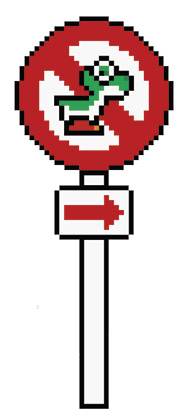
 No Yoshi Sign
In the final game Yoshi cannot enter certain areas such as Ghost Houses and Castles. However, an unused graphic would have made the “No Yoshis Allowed” message a little more blatant.

 Hiding Koopa Troopa
Yet another item that didn’t make the game’s final release is a Block that spawns a Koopa Troopa hiding inside its shell. This Koopa can’t be hurt by fireballs.
 Tiny Doors
Digging even deeper into the game’s code reveals tiny doors that Mario could only enter when he was small. This would have been an interesting mix-up to the standard gameplay, which, understandably, never openly rewards you for avoiding power-ups.
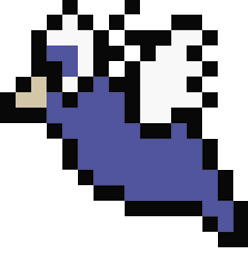
 Companion Bird and Lakitu
At one point, two different characters would follow Mario around the world map. The first was a blue bird (also seen carrying an unused flying cage), and the second was a Lakitu.
 Yoshi Dust
There is a special effect that would have had dust poof out when saddling a Yoshi. Though this effect was disabled in the final release, it could be re-enabled with a Game Genie.
 Fireball Attacks
A few notable enemies have fireball animations in the game code, but do not use fireballs in the final game. These include Koopalings Roy and Morton, as well as the Dino Rhinos. This is further backed by the fact that Dino Rhinos can breathe fire when in their smaller Dino-Torch form, and are immune to fireballs themselves.
 Dino Rhino Cameo
Speaking of Dino Rhinos, their sprite was re-used in the Super Mario All-Stars version of Super Mario Bros. 3, where the Water Land king has been transformed into a purple Dino Rhino.
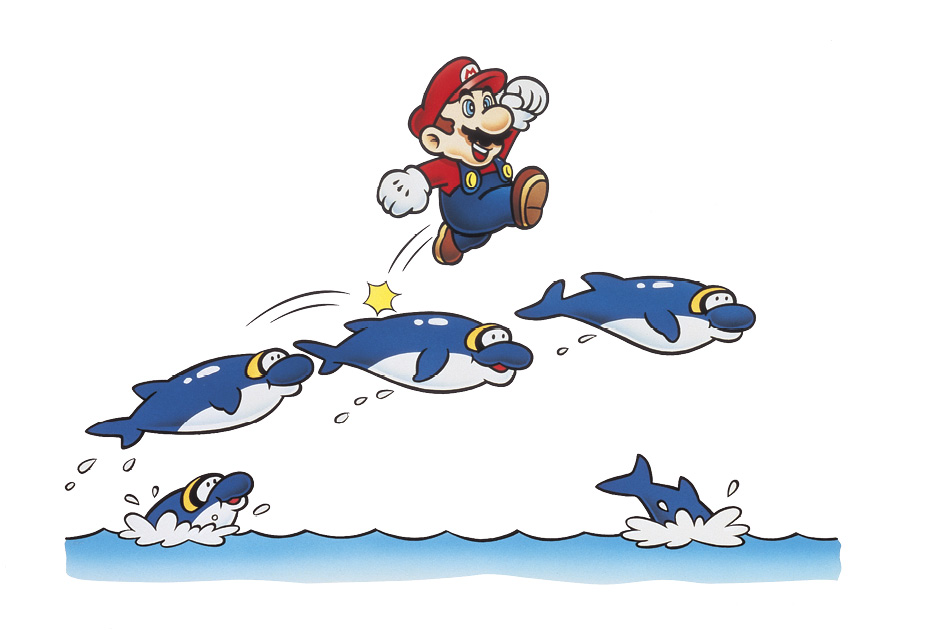
 Dolphin Snack
In the Japanese release of Super Mario World, Yoshi could eat the friendly dolphins that appear in two levels, but in the US release this was disallowed. The decision was reversed in future re-releases such as Super Mario Advance 2, should Yoshi be in the mood for seafood.

 Forest of Illusion
In Japanese the Forest of Illusion shares the same name as the Lost Woods from The Legend of Zelda series. Likewise, both have similar mechanics of being difficult to navigate, repeating the same screens or areas, and both franchises were originally developed by much of the same staff.
 Swoopers
Though the bat-like Swoopers appear green in the game, there’s a scrapped blue version still partially viewable in the game’s code. In all subsequent Mario games, Swoopers are, in fact, blue.
 Flying Cage
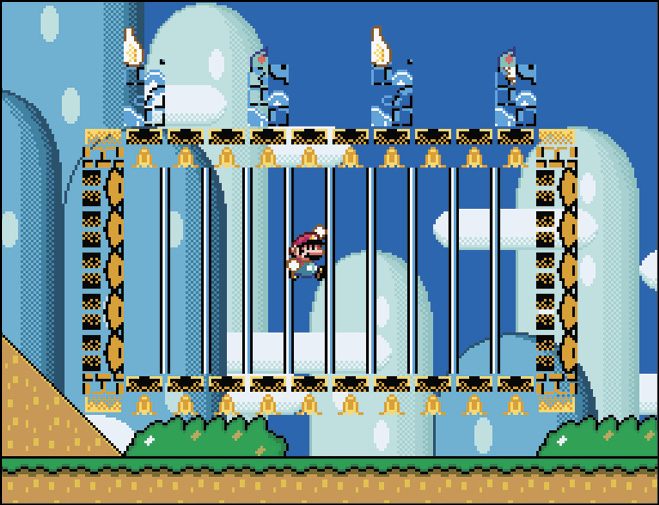
One of the more fascinating mysteries buried inside the game’s code is a large, flying bird cage. The cage would have housed Mario as birds carried him through an auto-scrolling level. Incoming obstacles and enemies would need to be dodged from inside the cage.
 Iggy’s Do
Perhaps the most egregious oversight in gaming history, Iggy Koopa’s mohawk is reversed when you battle him, mirroring Larry’s hairstyle. Yet in Super Mario Bros. 3, as well as Super Mario World’s credits, Iggy is shown with his signature forward mohawk. The correct mohawk graphics appear in the game’s code despite not being used.
 Wacky Worlds
A sequel titled Super Mario’s Wacky Worlds was in development by developer NovaLogic for the Philips CD-i but was ultimately canceled due to the console’s poor sales. Mario could be seen visiting ancient Greek- and Egyptian-themed worlds. Three prototypes of the unfinished game are said to be in circulation, with one selling for as much as $1,000 on eBay.
 Dancing Mario
Once you defeat Bowser, holding L+R+X+Y+Up until the credits begin causes Mario to do a funny dance instead of his normal walk animation.