Prima Games eGuides
primagames.com Browse Redeem a code Help
Playing With Super Power: Nintendo Super NES Classics eGuide
Sign in My Guides

Sign in or create an account

We'll email you a link. No password needed, and if you don't have an account yet, the link makes one.

By creating an account or signing in, you agree to our Terms of Service and Privacy Policy.

Have a password?

Had an account on the old eGuides site, or a code from a printed guide? Help and troubleshooting

Sign in with a password

By signing in, you agree to our Terms of Service and Privacy Policy.

Check your email

A sign-in link is on its way. It works once and expires in 15 minutes. Open it and you're in, with an account if you didn't already have one.

Contents

  • Earthbound
    • Overview
    • Development
    • Characters
    • Say “Fuzzy Localization!”
    • Places of Interest
    • 16 Bits
    • Confidential Information
    • Legacy
    • Earthbound Credits
  • Super Fans
    • Introduction
    • Sam Filstrup
    • Artist Spotlight: Studio Tamago
    • Ben Hickling
    • Sam Santala
    • Artist Spotlight: Orioto
    • Sophie Pearson
    • Nadyasonika
    • Artist Spotlight: Alain “Wuppes” Wildgen
    • Fansite Spotlight: Zelda Universe
    • Xavier Garcia
    • Gonzalo “Genzoman” Ordoñez
    • Music Spotlight: Video Games Live
    • KlausBoss
    • Artist Spotlight: Per Fhager
    • Fansite Spotlight: Metroid Database
    • Artist Spotlight: Dan Cattell
    • Fansite Spotlight: F-Zero Central
    • Zoki64
    • Ted Graves
    • Li Kovacs
    • Music Spotlight: Metroid Metal
    • Artist Spotlight: Josue Martinez
    • Fansite Spotlight: Starmen.Net
    • PrinceOfRedroses
    • Artist Spotlight: Tsurera
    • Fansite Spotlight: StarFox-Online
    • Thiago Almeida
    • Artist Spotlight: Jenni Källberg
    • Efraim Rodríguez
    • Artist Spotlight: Gnomo del Bosque
    • Fansite Spotlight: DK Vine
    • Layze Michelle
    • Matthew Z.
    • Artist Spotlight: Joel Sousa
  • Realizing the 16-Bit Dream
    • Introduction
    • Launch Titles
    • Lifespan
    • Legacy
    • Design
    • Under the Hood
    • Across the Generations
    • Accessories
    • Top 20 Best-Selling Games
    • Nintendo Hardware Museum
  • Super Mario World
    • Overview
    • Development
    • Characters
    • World 1: Yoshi’s Island
    • World 2: Donut Plains
    • World 3: Vanilla Dome
    • World 4: Twin Bridges
    • World 5: Forest of Illusion
    • World 6: Chocolate Island
    • World 7: Valley of Bowser
    • World 8: Star World
    • World 9: Special World
    • 16 Bits
    • Confidential Information
    • Legacy
    • Super Mario World Credits
  • The Legend of Zelda: A Link to the Past
    • Overview
    • Development
    • The Hero of Hyrule
    • Hyrule
    • Franchise Firsts
    • 16 Bits
    • Confidential Information
    • Legacy
    • The Legend Of Zelda: A Link To The Past Credits
  • Super Mario World 2: Yoshi’s Island
    • Overview
    • Development
    • Characters
    • World 1
    • World 2
    • World 4
    • World 5
    • World 6
    • 16 Bits
    • Confidential Information
    • Legacy
    • Super Mario World 2: Yoshi’s Island Credits
  • Kirby’s Dream Course
    • Overview
    • Development
    • Abilities
    • Demo Play
    • Traps & Tricks
    • Courses
    • 16 Bits
    • Confidential Information
    • Legacy
    • Kirby’s Dream Course Credits
  • Donkey Kong Country
    • Overview
    • Development
    • More Than Just a Pretty Ape
    • Soundtrack
    • Characters
    • Animal Buddies
    • Donkey Kong Isle
    • Kongo Jungle
    • Monkey Mines
    • Vine Valley
    • Gorilla Glacier
    • Kremkroc Industries, Inc.
    • Chimp Caverns
    • Gangplank Galleon
    • 16 Bits
    • Confidential Information
    • Legacy
    • Donkey Kong Country Kredits
  • Super Metroid
    • The Metroid Menace
    • Development
    • Samus
    • Zebes
    • Crateria
    • Brinstar
    • Wrecked Ship
    • Maridia
    • Norfair
    • Tourian
    • 16 Bits
    • Confidential Information
    • Legacy
    • Super Metroid Credits
  • Star Fox
    • Overview
    • Development
    • Characters
    • Items
    • Courses Overview
    • 16 Bits
    • Confidential Information
    • Legacy
    • Star Fox Credits
  • Super Mario Kart
    • Overview
    • Development
    • Racers
    • Items
    • Tracks Overview
    • Mario Circuit
    • Ghost Valley
    • Bowser Castle
    • Choco Island
    • Koopa Beach
    • Vanilla Lake
    • Rainbow Road
    • Notable Foes
    • Battle Mode
    • 16 Bits
    • Confidential Information
    • LEGACY
    • Super Mario Kart Credits
  • F-Zero
    • Overview
    • Development
    • Gameplay
    • The Machines and Their Pilots
    • Tracks Overview
    • Mute City I/II/III
    • Big Blue, Sand Ocean, Death Wind I/II
    • Silence
    • Port Town I/II
    • Red Canyon I/II
    • White Land I/II
    • Fire Field
    • 16 Bits
    • Confidential Information
    • Legacy
    • F-Zero Credits
  • Star Fox 2
    • Overview
    • Development
    • Teaching a Young Fox New Tricks
    • Invisible Legacy
    • Characters
    • Locations
    • But Wait, There Was More…
    • Enemy Gallery
    • Star Fox 2 Credits
  • Super Punch-Out
    • Overview
    • Development
    • Minor Circuit
    • Major Circuit
    • World Circuit
    • Special Circuit
    • 16 Bits
    • Confidential Information
    • Legacy
    • Super Punch-Out!! Credits
  • Kirby Super Star
    • Overview
    • Development
    • The History of Twinkle Pop
    • The Evolution of the Inhale
    • Games
    • 16 Bits
    • Confidential Information
    • Legacy
    • Kirby Super Star Credits

Playing With Super Power: Nintendo Super NES Classics Guide › Super Fans

Fansite Spotlight: DK Vine

2000

Years Online: 18

@DKvine | Facebook.com/dkvine | Dkvine.com

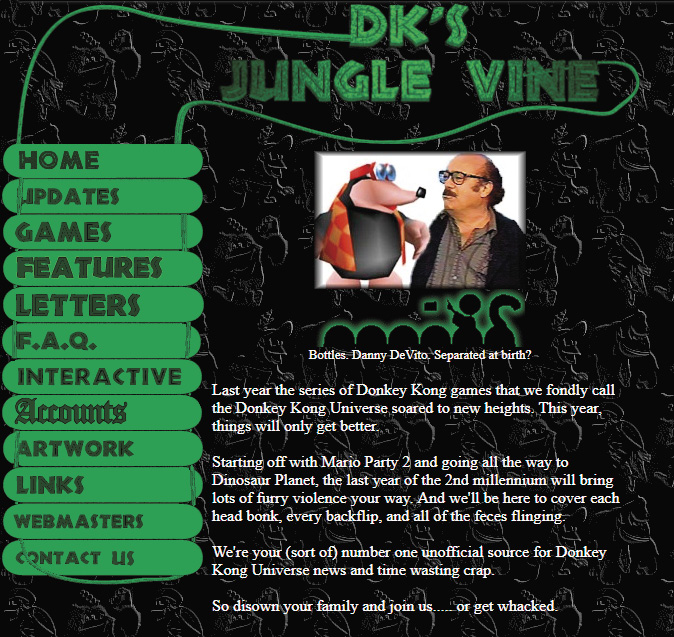
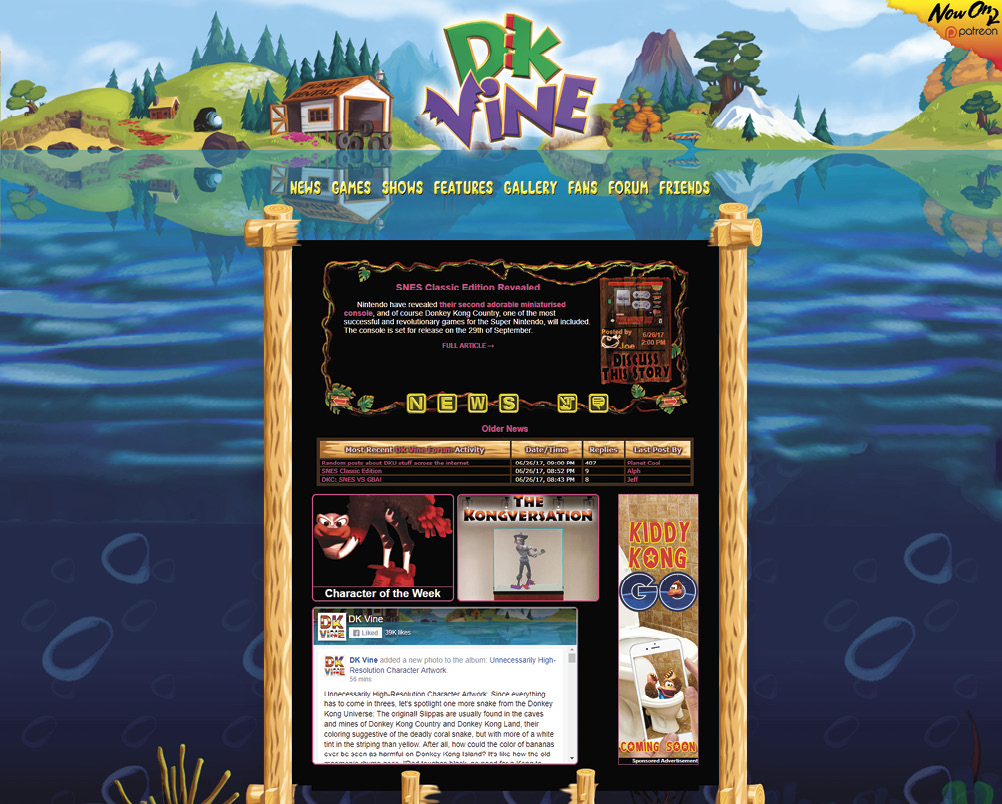
Fansite DK Vine swung onto the scene just before the turn of the century, catering to an existing fandom established by the sensational Super NES releases. “DK Vine was launched in August of 1999, ostensibly in anticipation of Donkey Kong 64’s arrival later that year,” began Hyle Russell, Co-Founder and Editor-in-Chief of DK Vine. “More than just that, we were created as a celebration of the shared world of Nintendo games created by Rare Ltd. that kicked off with Donkey Kong Country for the Super NES.” Although initially created to celebrate the work of Rare Ltd., the site continued to follow DK through modern interpretations, with “The site and community experiencing something of a renaissance with the arrival of Retro Studios’ two Donkey Kong Country revivals.”

Reminiscing about the first Country title, Russell didn’t know what to expect when he picked up the Super NES game. “Obviously the graphics were unlike anything I had ever seen, but it was reading the instruction manual before I played the game where the charm of the game’s world crystallized for me. A cheeky humor was pervasive on every page, buoyed by Cranky Kong himself slagging off on the game from cover to cover. The added lore of Cranky actually being the original Donkey Kong sealed the deal for me. This wasn’t your typical sidescroller, and this wasn’t your standard Nintendo game. There was magic to be found in Donkey Kong Country!”
Current

The “cheeky humor” of Donkey Kong Country is the foundation upon which DK Vine was built. “We’ve always celebrated the Donkey Kong Country series by presenting ourselves as a pseudo-parody of fansites, displaying with humor the bizarre dedication and absurd attention to minutiae that these kind of endeavors usually adhere to. That it was all centered around a series starring an ape in a tie really helped drive that point home, and that helped create a community that never took itself too seriously and rooted itself in self-deprecation and a bemusement at its own existence.”

Russell launched DK Vine with his friend Chad, when they were both in their impressionable teenage years, and has watched the community grow up alongside them. “The surreal thing about being around so long is that your fansite, which exists due to an appreciation of the creative works of others, actually goes on to influence other people in turn. There have been a myriad of fansites that have sprung up over the years based off our model, many of whom we’ve struck up a friendship with. For example, while we primarily focus on Donkey Kong Country, there’s now a Donkey Kong arcade fansite called DK Girder that delves into the early, pre-Super NES days. That there can be multiple websites that individually focus on one niche aspect of a larger series really shows the versatility and variety of fandom.”

“Some of the best friendships of my life have developed thanks to DK Vine,” Russell continued. “Between the people who have worked on the site through the years and the readers who merely ‘got it’ the most, I’ve had the opportunity to befriend and meet people from all over the world. The self-identifying term for those that find a home at DK Vine is ‘like-minded weirdos’, and it’s been a pleasure to get to know said weirdos from across North and South America, Europe, and Australia. More than that, we’ve even had people meet and fall in love through DK Vine, which is something I could have never fathomed back in 1999 when all I wanted to do was talk about Lanky Kong.”

DK Vine’s dedication hasn’t gone unnoticed from official sources. “We’ve had many kind and gracious interactions, both online and in-person, with the shepherds of the series. Retro Studios has sent words of support our way, while Rare has gone so far as to invite us to their studio in the UK!”

“Without a doubt, it was Nintendo announcing that Retro Studios was developing Donkey Kong Country Returns in 2010,” affirmed Russell, singling out a most meaningful moment in his community’s history. “When Reggie Fils-Aimé stood on a stage and announced that Retro Studios was bringing back the beloved series, it was seen as a validation for our community and our fanbase. Donkey Kong Country was indeed a Nintendo classic, and its legacy would never be extinguished.”

Super Nostalgia: Donkey Kong Country

“Donkey Kong Country is one of those flashpoints in my life,” began Russell, “in this case where video games took on an entirely different meaning and language than they had initially. I didn’t realize it, but Donkey Kong Country was the title I had been waiting for since the moment I played my first video game. Here we had an amazingly fun platformer that mixed humorous characters with a world that felt strikingly realistic.”

“There was a vitality to it that I had never felt with a Nintendo game up until that point, created thanks to the marriage of the jaw-dropping ACM graphics, brilliant stage design, and naturalistic soundtrack. It obviously raised the bar for the industry, but most importantly for Nintendo it threw down the gauntlet,” explained Russell, echoing a common sentiment that DKC was pivotal in proving the Super NES’s shelf life was nowhere near over.

“Donkey Kong Country built a world for Donkey Kong. DKC not only aged up the characters, but it gave us a Donkey Kong who was explicitly heroic for the first time in the franchise’s history. Giving him a sprawling cast of friends, family, allies, and enemies also helped set apart Donkey Kong from Mario, who up until that point had always overshadowed his former co-star. The combination of protégés and mentors teaming up to solve larger problems gave this community aspect some serious sentimental heft, while removing Donkey Kong from the city and placing him on his own tropical island brought a message of environmental stewardship that’s been featured in nearly every DK game since.”

Diddy Kong in particular had special relevance to Russell. “Younger gamers may only know him as an annoying, banana-spamming fighter in Smash Bros., but here was a sidekick who was portrayed as a similar age to me and actually felt relatable.” As relatable as a monkey who doesn’t wear pants can be, he clarified. “That he had something of a character arc that carried forward into the sequel, with him wanting to become a genuine ‘video game hero’ like his idol Donkey Kong, was the kind of fourth-wall breaking meta-writing that really helped sell the characters and their world.”

“Choosing a favorite level in Donkey Kong Country is like a parent choosing a favorite child, or being forced to pick the best Beatles song,” he continued, lamenting over being asked to highlight a standout stage. “There’s so much kinetic, fluid platforming found in that first game. If you know what you’re doing, you can fall into an almost hypnotic rhythm, bouncing, swinging, and barrel blasting from point-to-point while in a trance-like state of being. If push came to shove, I’d have to give the vote for the snow levels, with a highlight being the exemplary Snow Barrel Blast. Both the environmental effects and the stage design were married to create the perfect gaming experience, with secrets just out of reach and challenges that became slightly more possible with each failed attempt. That’s the magic of Donkey Kong Country right there.”

Keep reading with a free account

The first 3 sections of Playing With Super Power: Nintendo Super NES Classics are open to everyone. An account opens the rest of it, and every other guide in the archive. It's free, and there's nothing to buy.

Bought guides on the old Prima Games site? Your account and every guide you own moved here, so there's nothing to buy again. Sign in.

Create a free account Or browse our free guides

PreviousArtist Spotlight: Gnomo del Bosque NextLayze Michelle