
Titanfall Guide Behind the Scenes
Art: Joel Emslie
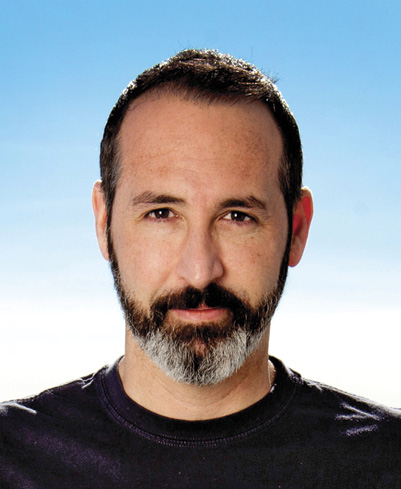
Joel Emslie: Lead Artist
Past Projects
Call of Duty: Modern Warfare 2
Call of Duty 4: Modern Warfare
Call of Duty 2
Kill.Switch
Legend of the Blademaster
Armor Command
Prima Games: What was it like starting at Respawn?
Joel Emslie: When I started with Respawn, I was with the original crew on our previous games. Day one when we got here, there was broken glass on the floor, ripped rugs, stains from desks in the rug that had been there for years. We hadn’t even signed a lease yet, but we were here with permission from the landlord, and we were hanging out here—we were technically squatting on the site.
PG: How many people were you at that point?
Joel: I think day one we started with between 30 and 40 people. And I hadn’t even seen Vince or Jason since the firing over at Activision. It was a really weird thing where I knew about Respawn (a lot of people did), and we decided we didn’t like being at the other place, so we signed up. Day one was really cool ’cause you could see all your friends. We’d kind of gone dark and were all hanging out with our families and doing different things, soul searching. And then to walk in on day one at Respawn and see everybody was like this class reunion. There was an electricity in the air. It was cool.
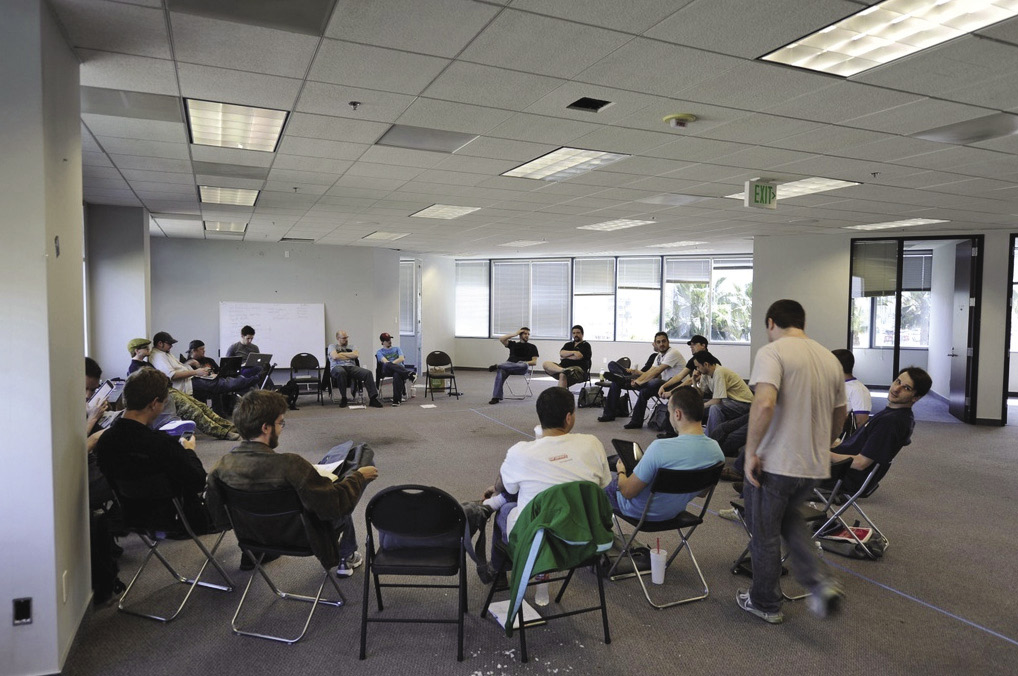
With little more than folding chairs, laptops, and iPads, early team members settled into their new office space.
But it was a little bit like holy crap. I mean, I remember walking into the place and one of the lights was hanging down from the ceiling, and there was a conduit cable hanging out of the PA. It just felt real, like a legit start of a situation. It’s not a traditional startup, ’cause normally you have to earn your credit. We came into this startup with a little bit of street credit, which is great. And we got a publisher behind us, which is great, but obviously you have to make good on that eventually. So that was basically day one. Then we went on from there.
We kicked around the most insane ideas ever. We really had the attitude of a brand-new company. We were trying to step as far away from what we’d done in the past as possible and just really explore crazy stuff. And then eventually, we had to come to terms with our first game. We had to heavily modify the Source engine; we’d played with other engines before as well. We hadn’t even decided that we were gonna go next-gen at that point, but eventually, we had to accept the fact that, okay, we do first-person shooters really well. We really know how to do multiplayer, so let’s start boiling down our crazy ideas into our strong suit—at least for the first game that we do.
PG: Starting from scratch sounds really scary, but it’s probably somewhat exciting too. From a visual perspective, what was that like?
Joel: It was a little bit frustrating. It took us quite a while to get into where we were actually building a game. I don’t know exactly when. I can’t put my finger on a date, but when you’re in that situation artistically and trying to create concepts that complement the ideas that are being kicked around in the company, it’s super exciting. You can go anywhere with it. But there does come a point where you get exhausted creatively. Where you’re just turning out ideas and turning out ideas, and people can’t come to a consensus on what to do.
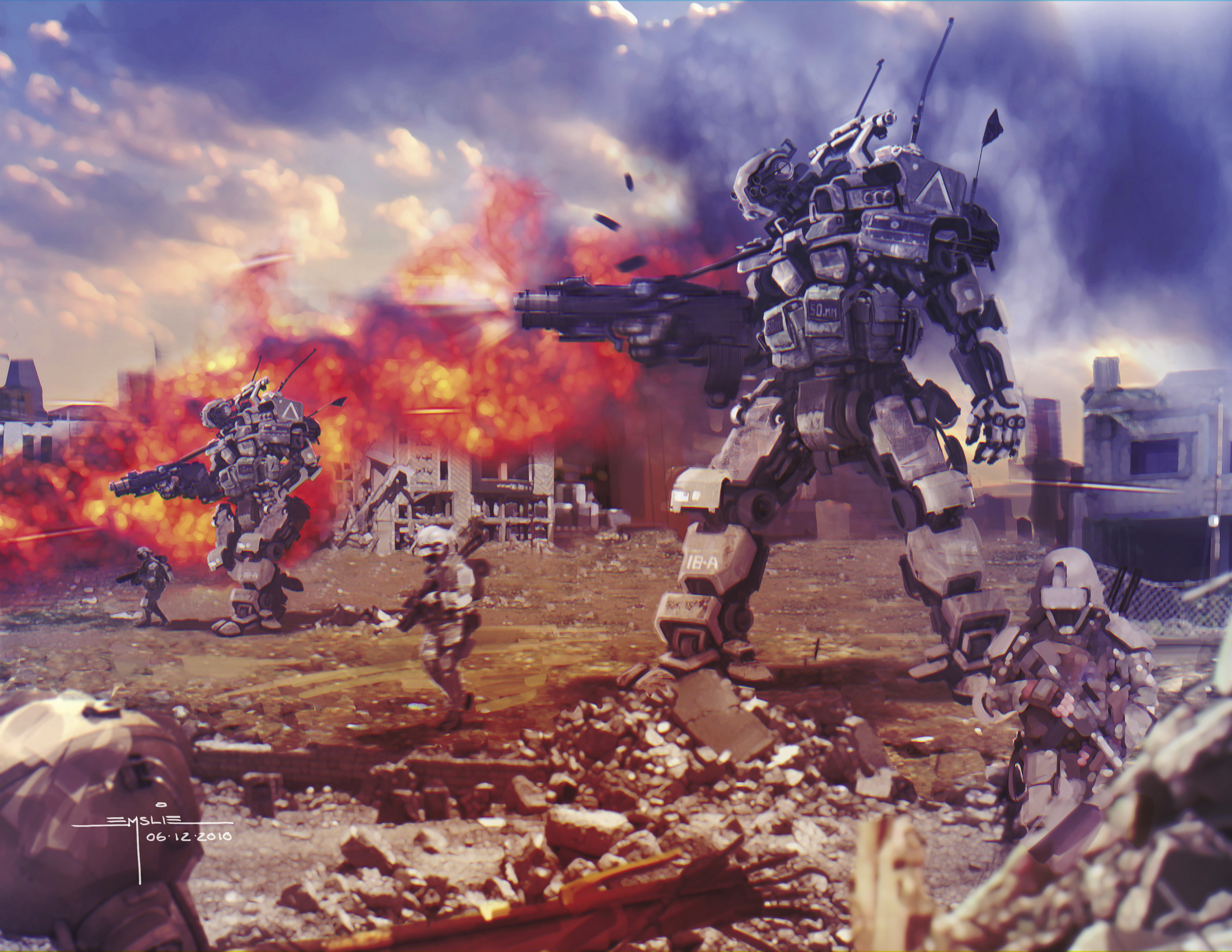
Paintings like this ultimately helped inspire the direction for Titanfall.
I can look back at one of the first pieces of concept art I did. It was a long-lens shot of a bunch of 20-foot-tall robots with troops in this scorched environment, and they’re walking in formation. I did that really early on, and I had no idea that visual would end up being something we’d put in the game. I just painted it, but painting takes a long time. As an artist, it takes like 24 hours to do a good painting sometimes, like a big panoramic shot. And so I resorted to older-school techniques, like model making, kit bashing, and scratch building. I thought if we had a tangible model on the table that we could all get around and really look at it from a 3-D practical view, then maybe we could get some new ideas out of that. The concept art was photo bashing, traditional concept art, line work—we did every type of concept art, including model making that helped Titanfall get its look. I don’t think you always get that opportunity, and this is like the perfect storm of opportunities in a startup. With a new IP and with a next-gen switch where, as an artist, you get to kind of stretch out and be really experimental with the mediums that we were using to find the look of the game. So, really exciting, but super frustrating ’cause, it’s the age-old problem—when you have limitless possibilities, you just get exhausted.

An early conceptual painting depicting giant robots fighting alongside infantry.
PG: So once you knew what direction you were going with this game, did they come to you and say, “Hey, we need some giant robot-looking things?” Or did it evolve from the gameplay?
Joel: We knew that giant robots are not loved by everybody. So, the design goal with them was to make them approachable by a larger market. We didn’t want to alienate parts of our future fan base. We had expectations on us. So, we have a really heavy military background and understanding of military hardware within the art department and a lot of experience with it, especially the weapons. I mean, looking at the weapons in Titanfall, you could probably smith those weapons right now and have them work. We put a lot of thought into how a bullet gets chambered, and this goes into gameplay too—the action on a weapon and how it reloads and how you use it. It goes into the personality of the weapon. The same goes for the Titans. They’re really heavily based on our understanding of how an M1 Abrams works, how the Abrams exhaust port works, and how a foot soldier would interact with it. We put thought into how the Grunts in the game work with a Titan, and if you let an AI Titan roll with Grunts, they kind of acknowledge each other. It’s pretty cool. Early on we knew we wanted to do some cool stuff, and I think when people look at Titanfall on a screenshot, they go, “Oh, it’s just a modern combat game with mechs.” But it’s really not. When you introduce another scale of character into the environment and you’re transitioning back and forth dynamically between those two scales, there’s a lot of really crazy shit happening.
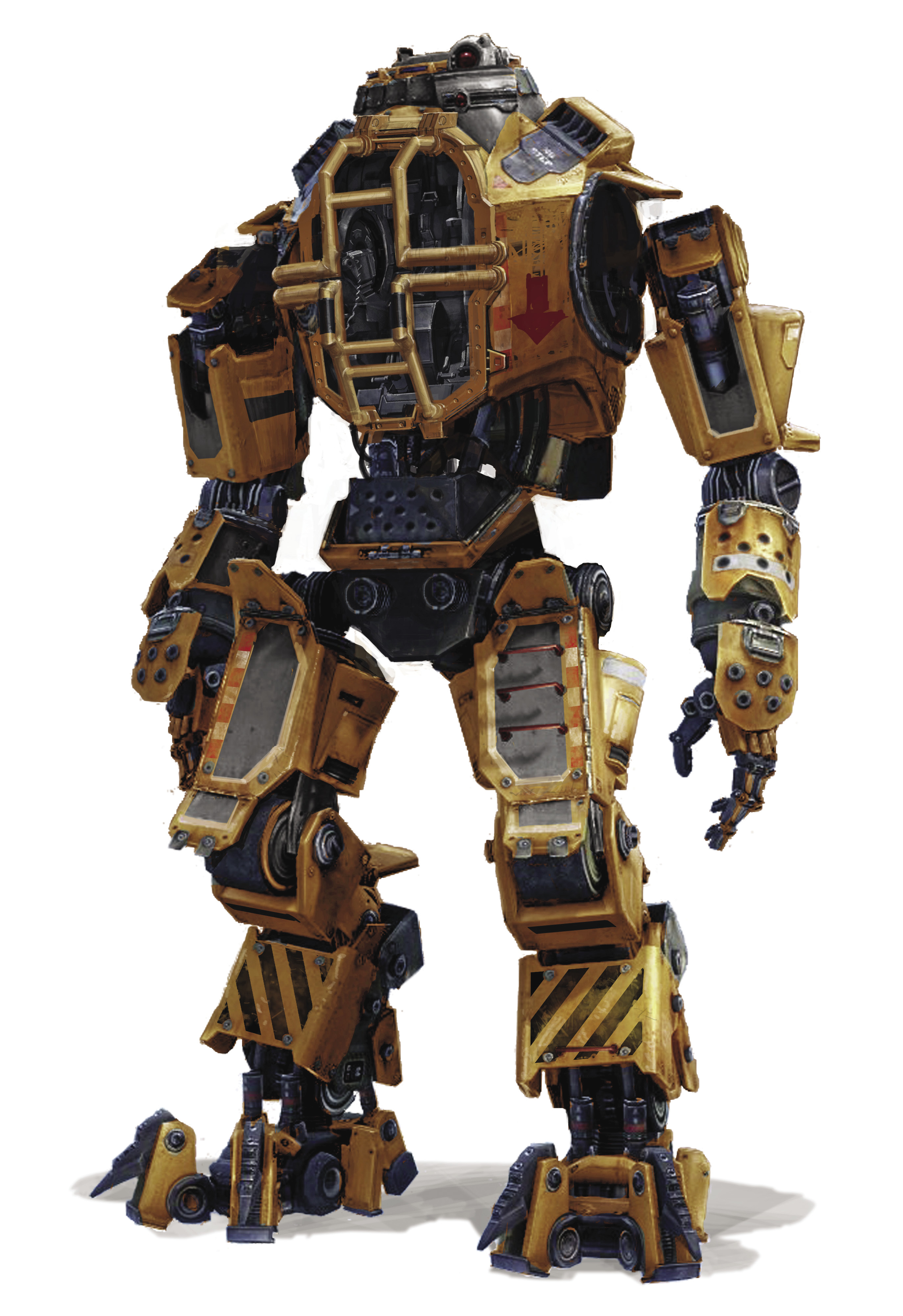
The art department’s understanding of military hardware helped inspire the design of the Titans and weapons.
PG: What sources did you draw on for inspiration?
Joel: Visually, you can only create so many fresh mech designs. Like when you look at a Titan, I don’t think we’re groundbreaking visually with our robot designs, because we’re drawing from a lot of influences. I look back at District 9, at old Star Wars, Blade Runner, and Aliens—like the power loader from Aliens. The power loader was very believable as a tool. It didn’t come off like a stupid thing; it felt very practical in its design. And that’s what we’re after on the look of the Titans. So, we’re not doing anything exactly new with that, but I do think we’re doing something really fresh that people haven’t seen before with the way the Titans move—their motion models are heavily balanced and just the way that you embark and disembark from them is so fresh and new. I think that’s what people are really responding to.
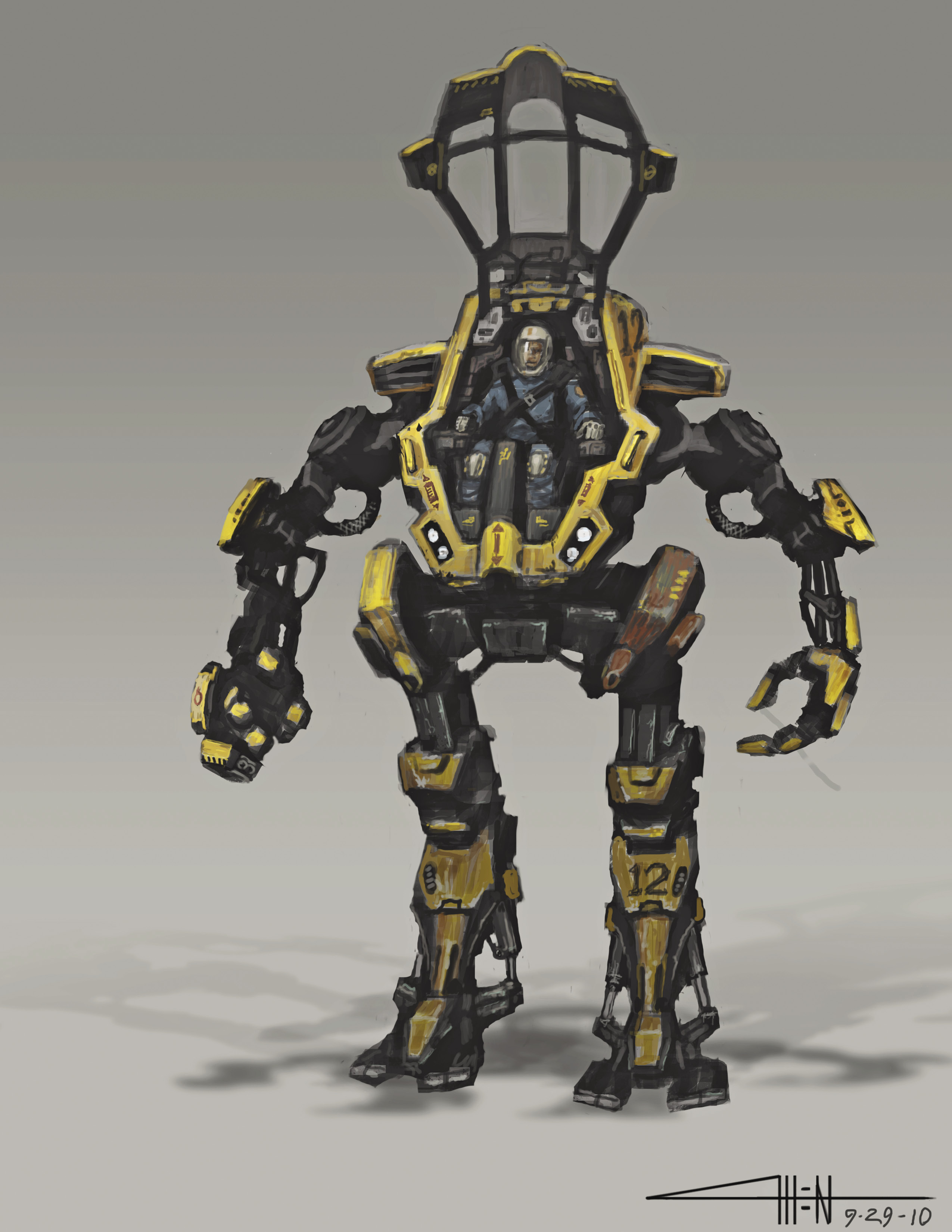
This early utility walker illustration emphasizes the team’s focus on practical designs.
So, with all that being said, we have to support the design visually. We’re making sure that the hatches open in certain ways. Titans have hands and fingers so they can pick up guns on the battlefield when you’re out there fighting. I played the other day and got to the end of a match and I wanted to transition to another weapons platform real quick, so I just grabbed someone’s gun, another Titan weapon, off the ground. Suddenly I was in a whole new situation. The map turned into a close-quarter fight. It was like me and two other guys, and I picked up someone else’s gun. So, it’s important to be able to do that stuff. People don’t really think about it. They just think gun hands and mech design. We had a lot of arguments over that in the beginning. I wanted to give them hands because there’s limitless opportunities to rip open doors, swat or punch another Titan, rip a Pilot out of the other Titan. You can do all these different things.
Also, each Titan has its own melee. So, you get into these things where you rip people out or the Ogre rips a Titan’s arms off, you catch his punch, and all this stuff. The Stryder squishes the Pilot in his hand, like in a vapor. So, it’s all this functionality and cool gameplay ideas, and animation drove the look and feel of the Titans.
At the Respawn art department, we’re massively focused on what’s in the game. That’s what we care about the most. That’s why even in the art book, there’s not a lot of high-res insanely photographic, movie-quality, 70mm film shots of these characters. We’re giving you a look at what we’re shipping, what our game really is. There’s no smoke and mirrors on the art.
PG: How much influence did you have with the Hammond Robotics aspect of the game?
Joel: There’s different manufacturers in the game. The IMC—Industrial Military Complex—originally was just a brand that we used. It grew into Interstellar Manufacturing Corporation, and then it has affiliates—Cody Industries and Brockhard. There’s all these different gun manufacturers that are under this umbrella that’s Hammond. But we were looking at it like it’s a Monsanto of space, or it’s a Halliburton, and we got into that idea of pushing those really creepy, industrious corporations. And it goes back to our roots where we’ve had these really unpleasant dealings with big corporations, and Titanfall has this soul that is Respawn. You can see it in the first commercial. It’s like we left everything behind; we had to start over and we’re in this fight and we really gotta bring it ’cause we’re against everything. We were in a two-year lawsuit with some really, really intimidating people. But we got through that. And we got to make a game.
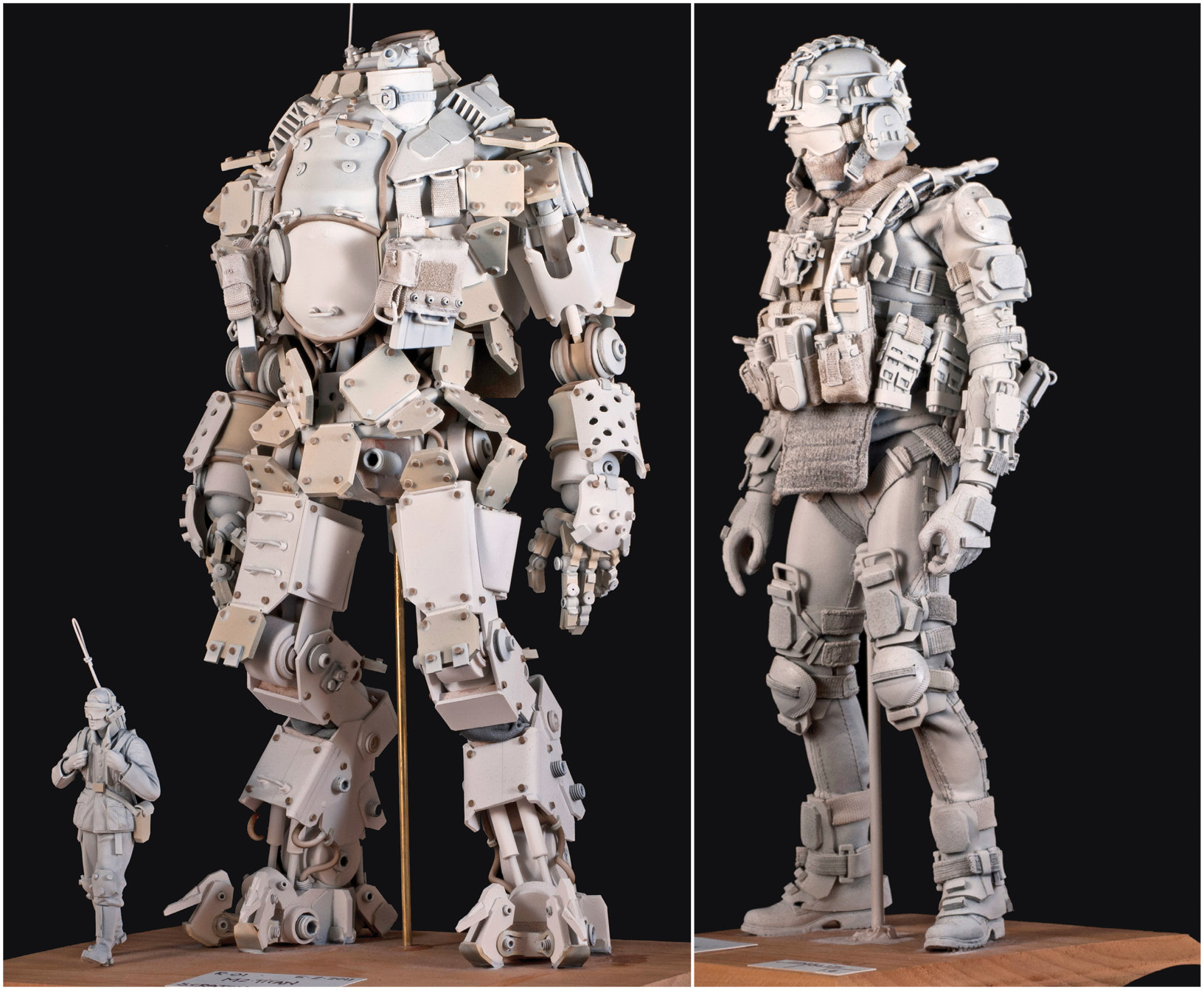
Joel’s elaborate models served as key sources of inspiration for the art department.
PG: If I’m not mistaken, you did the 3-D models that are out in the front lobby. Those are awesome. How many of those did you make?
Joel: I ended up doing them as needed. There’s Titans and Pilots and stuff and then there’s heroes. We started getting into the universe and the character design. There are two factions of the game. I looked at it like World War II where the U.S. military was really very cotton-oriented; their webbing was cotton and metal. They had different parts to it, and the bandoliers looked a certain way. Then you go over to the Germans and the bandoliers were leather and it had a different vibe. So I looked at the two sides, the Militia being very army surplus and having that American World War II vibe, with lots of cottons and stuff. And I looked at the IMC being very super tactical, evolved U.S. military, with lots of really kick-ass plastics and carbon fibers.
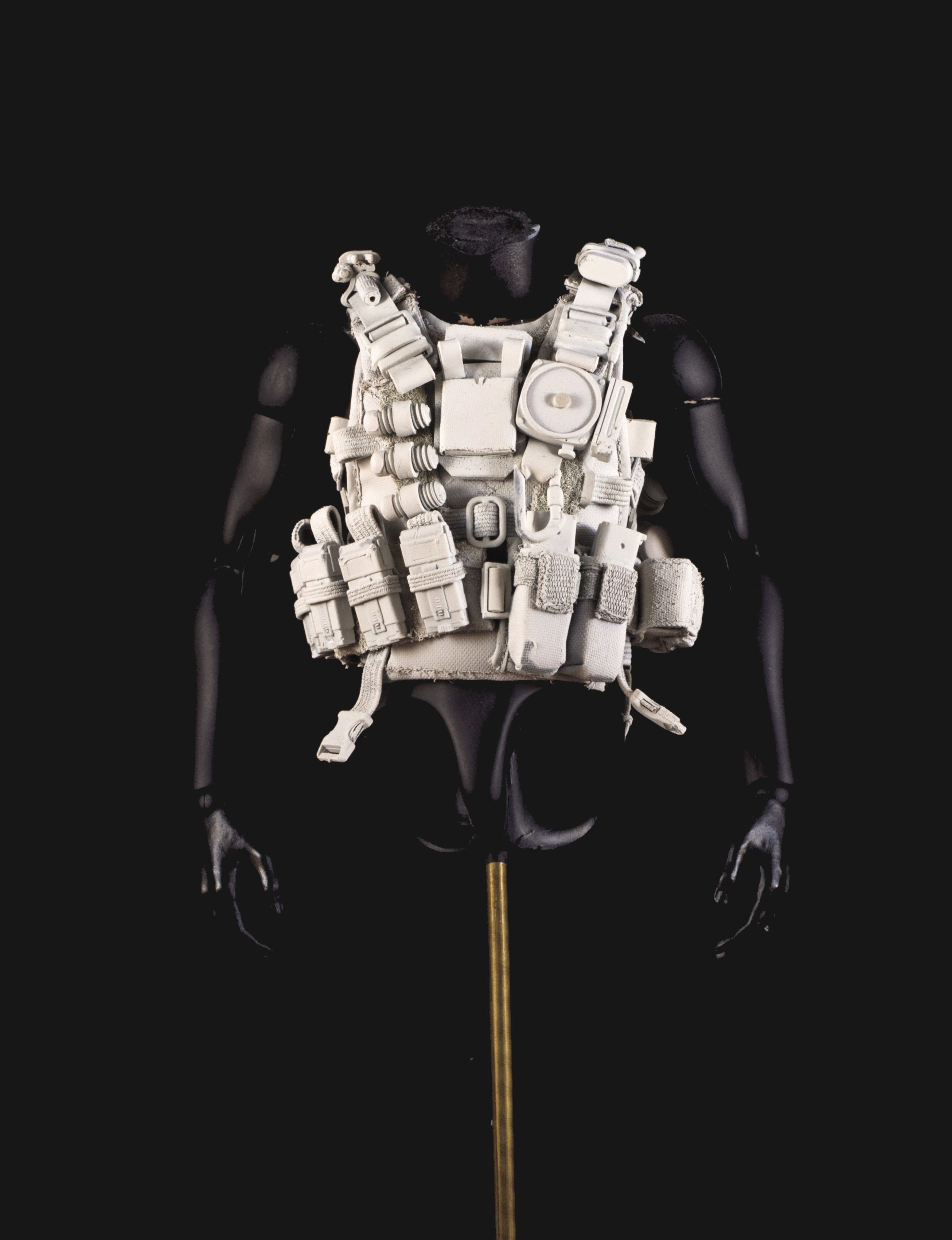
Tactical vests are packed with gear, holsters, pouches, and bandoliers.
We worked toward making sure that the Grunts and the AI on IMC were very masked, even though you could see they’re human—they have flesh arms. They have a very stormtrooper quality to them. So, we would get to a point where we needed characters, and they would tell me to do some helmet designs. You can get really wrapped up in helmet design in 2-D and just start going nuts. I would go to the hobby shop and buy a bunch of 1:6 scale helmets and then I would just start kit bashing helmets together. I would have like ten different concept pieces up on my screens—concepts off the Internet and the stuff I was inspired by, like a cool motorcycle helmet or something I saw on the news or a riot helmet. I would just bring it up and find the element I liked. I would try to find it in the kits that I had. I would twist it on its head and flip a magazine pouch this way or that way and I would add something to it to make it look different. It’s just really old-school techniques. They still use it a little bit in Hollywood today, but it’s grounded in reality—it’s the right scale, it hangs right, and I would build these models real quick. I can get to a really decent character design within three days. I just glue this thing together, spray paint it white, and hand it to an artist and hope they get inspired by it. But we never held the artist completely accountable to doing a one-to-one interpretation of the concept art. We wanted the artist to look at the models and be inspired by them. So that’s how we ended up with those models.
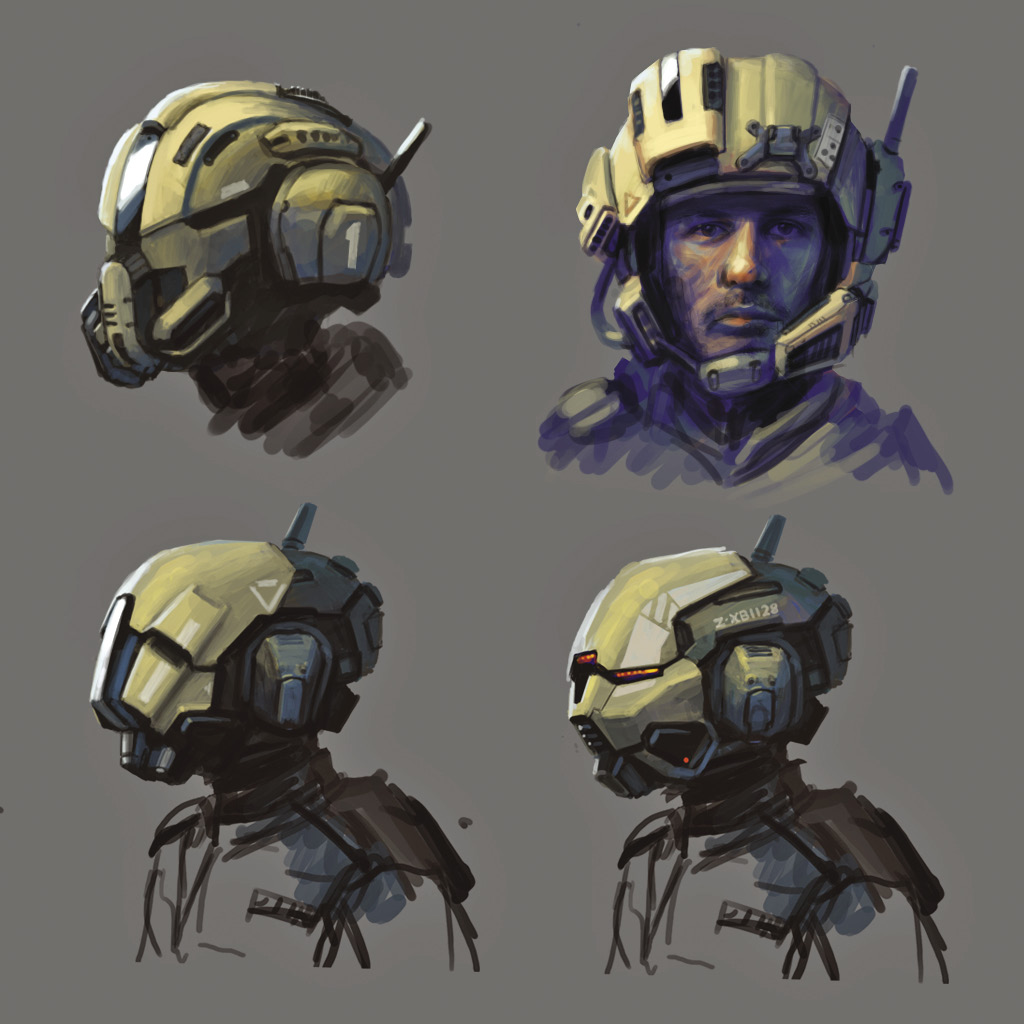
A few early helmet concepts show numerous possibilities.
PG: Could you talk about the design of the different worlds?
Joel: It was really hard. We had our art director and early on he consulted on half the projects. He had to go off and do other things. But he was pulling his hair out because he was saying, “Okay, there’s a point where we are off-world and on-world. What’s happening? Why does this house have brick and mortar on an alien planet?” I mean, it went down to what bolts they used to fasten the structure together with. And once we decided how these characters got to this Goldilocks system that they’re in, it came down to what did they bring with them? What comforts? It also goes back to why would you redesign a chair just to be a space chair or why would you do a barrel? All of the art elements needed to support the fact that they’d been brought there and how long the settlement had been there. If you look at Angel City, it looks as if it was constructed from a space freight carrier or cargo containers. And it has that element that they’ve integrated into their society. It has this cool kind of Hong Kong vibe. But the materials they have are brought with them on space travel. So, the idea was IMC installations on an alien world, but every level has its theme—especially when it comes to campaign. It has a purpose, why it’s there. We had these great levels where an IMC ship had just stopped and landed in the lagoon. And you’ve got a village that built up around it to trade with them. It was basically how exotic can we go but still make it a place that’s a little bit familiar to the player as well. You want planets to be planets; you don’t want it to be like a creepy space planet they can’t relate to.
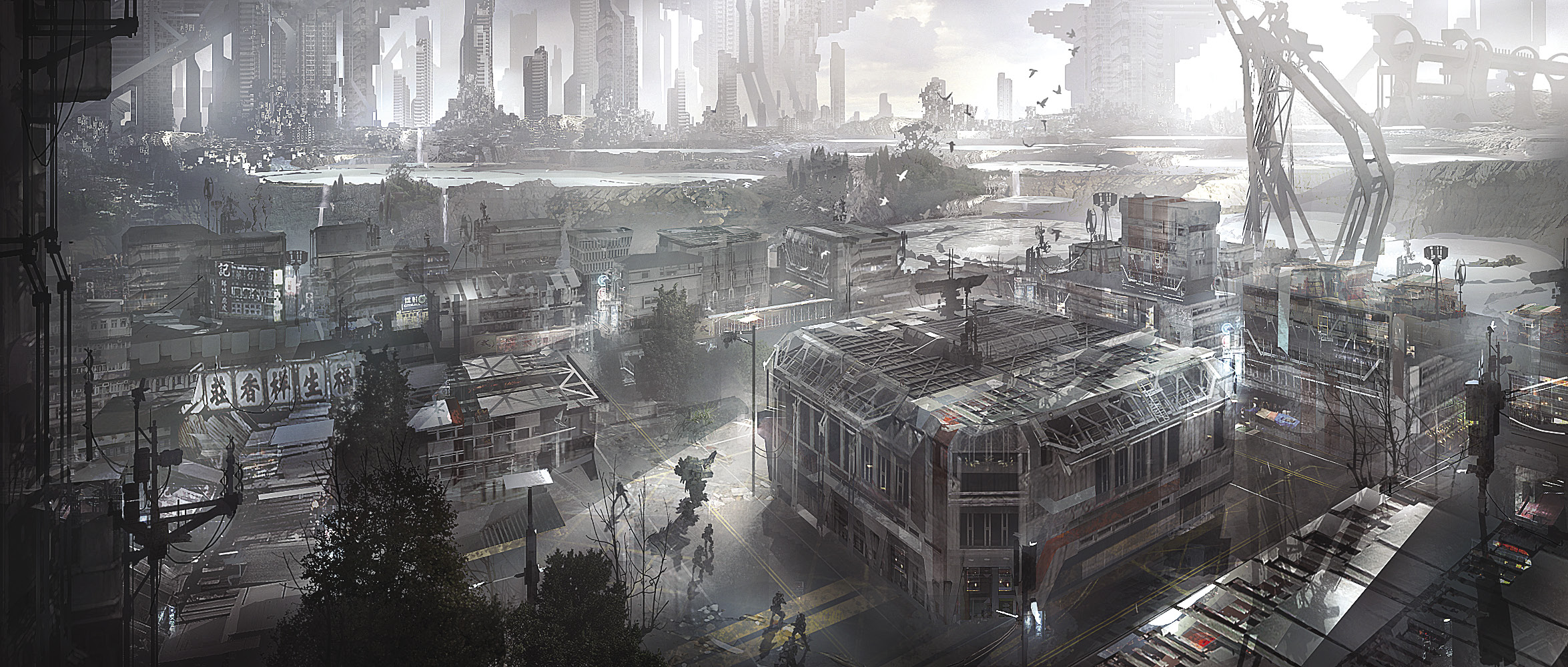

Environments, like Angel City, had to look believable within the context of the game’s narrative.
To do the environments, the designers come up with a scenario, start blocking out all that crazy gameplay and developing a good flow. Then maybe they need to put a story element into it that drives this element or this section. We worked really hard on making sure that the environments were exotic but that they had visual landmarks that you can easily relate to. In Angel City I can say I’m out on the dock near the crane or near the boat and people can look right away and tell that. So you want people to learn but not get crazy lost in the levels.
PG: Is there anything specific that you want to tell people about Titanfall that they might not already know?
Joel: I can spin my jets all day long talking about how it’s different. People really just need to play it and get into it. But I’m really proud of the Burn Cards that are in the game, ’cause just now we’re at that point in the process where we’re playing with Burn Cards and then playing with all the unlocks that are in the game. Before I looked at Burn Cards as just little power-ups for maps and stuff, but there’s amped weapons Burn Cards. We’ve been playing with those, and when I got my deck all sorted out and started discarding the ones that might not necessarily fit my play style, I started building an arsenal of amped weapons that I pull out when I want to have fun or really F*** with someone. I wanna see what people do with that, ’cause there’s some dirty stuff.