
Street Fighter V Guide Fighters Urien
Standing Normal Moves
Standing Jab 
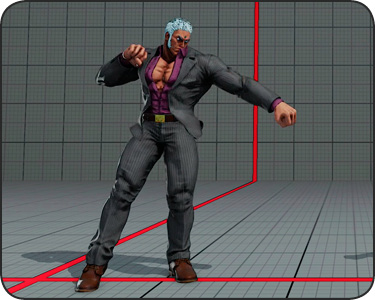
| Startup |
4 |
|---|---|
| Active |
2 |
| Recovery |
9 |
| Hit Level |
HL |
| On Hit |
5 |
| On Guard |
2 |
| B-VTX on Hit |
-4 |
| B-VTX on Guard |
-7 |
| F-VTX on Hit |
3 |
| F-VTX on Guard |
±0 |
| D-VTX on Hit |
-16 |
| D-VTX on Guard |
-19 |
| Cancel |
Sp, V |
| Damage |
30 |
| Stun |
70 |
| Meter Gain |
20/10 |
Standing Strong 
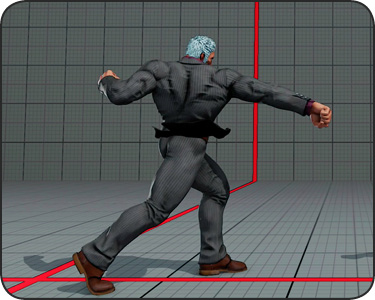
| Startup |
6 |
|---|---|
| Active |
3 |
| Recovery |
12 |
| Hit Level |
HL |
| On Hit |
4 |
| On Guard |
3 |
| B-VTX on Hit |
±0 |
| B-VTX on Guard |
-1 |
| F-VTX on Hit |
7 |
| F-VTX on Guard |
6 |
| D-VTX on Hit |
-12 |
| D-VTX on Guard |
-13 |
| Cancel |
SP, V |
| Damage |
60 |
| Stun |
100 |
| Meter Gain |
30/15 |
Standing Fierce 
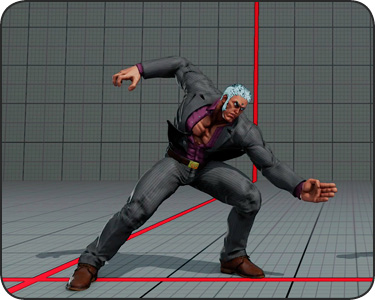
| Startup |
12 |
|---|---|
| Active |
3 |
| Recovery |
18 |
| Hit Level |
HL |
| On Hit |
4 |
| On Guard |
-2 |
| B-VTX on Hit |
7 |
| B-VTX on Guard |
1 |
| F-VTX on Hit |
14 |
| F-VTX on Guard |
8 |
| D-VTX on Hit |
-5 |
| D-VTX on Guard |
-11 |
| Cancel |
Ca, V |
| Damage |
90 |
| Stun |
150 |
| Meter Gain |
50/25 |
Charged Standing Fierce
| Startup |
22 |
|---|---|
| Active |
3 |
| Recovery |
15 |
| Hit Level |
HL |
| On Hit |
9 |
| On Guard |
3 |
| B-VTX on Hit |
9 |
| B-VTX on Guard |
3 |
| F-VTX on Hit |
16 |
| F-VTX on Guard |
10 |
| D-VTX on Hit |
-3 |
| D-VTX on Guard |
-9 |
| Cancel |
Sp, V |
| Damage |
100 |
| Stun |
180 |
| Meter Gain |
50/25 |
Standing Fierce (Charged): Let’s get this out of the way up front: Urien, by design, doesn’t have a cross-up jumping attack. There will be no ambiguous jump-ins or left/right mix-ups for the thonged one. Instead, he’s built around powerful linear attacks. His mix-ups involve space control and pressure from the front. (At least until his V-Trigger, Aegis Reflector, comes into play.)
Some of his frontal mix-ups involve unexpected timing, and to this end, both of his standing heavy normal attacks can be charged, transforming them into unique attacks with different properties.
Tap standing for Urien’s classic fierce “slap,” which, in Street Fighter III, was a terrific poke and simple juggle ender (for players who couldn’t charge-buffer Dangerous Headbutt at the end of juggles, a very advanced execution technique).
In Street Fighter V, it’s still a good heavy poke, with a hitbox extending to the tips of his fingers, while his hurtbox only starts around his palm. It also has hitboxes right on top of Urien’s head and the air in front of it, so this move isn’t helpless against jump-ins and airborne attacks (like Karin’s Ressenha), but Urien’s hurtbox extends vertically over the hitbox well above his shoulder, so if they stick out basically any downward-aimed jumping attack, they’ll still win; look elsewhere for reliable anti-air. It strikes in 12 frames, producing a +4 advantage with a normal hit, and leaving Urien at -2 when blocked. Most importantly, it’s Crush Counter-capable, so counter-hitting with standing nets a huge opening. The opponent’s extended Crush Counter hitstun gives plenty of time for whatever follow-up the Urien player desires. There’s time to follow-up with Chariot Tackle into Critical Art, or to dash in and normal throw, or dash in and start a juggle combo with crouching , or a grounded combo with Target Combo 1 or 2. If it counter-hits against an airborne opponent, they’ll be sent into a jugglable spinning knockdown.
Standing remains a good juggle ender, too. It spikes airborne victims into the ground in front of Urien, so even if they quick rise they’re in position to be threatened. Standing as a juggle can be canceled into Aegis Reflector so they’re greeted with an immediate electric mirror, or into his Critical Art for a stylish finish–though standing spikes floating foes, the Critical Art cancel catches them before touchdown.
However, when is held down, standing changes. The startup is increased, so it doesn’t hit till frame 22, ten frames later than normal. But on the bright side, it leaves Urien safe with plenty of advantage on block (+3), or at a whopping +9 after a normal hit–enough advantage to link a crouching , or Target Combo 2, among other options. Further, it’s still a Crush Counter, and charged standing grants even more advantage on counter-hit than normal standing . Finally, unlike normal standing , charged standing is special-cancelable. This allows the use of fairly safe two-in-ones like standing (charged)  Metallic Sphere, or standing (charged) EX Chariot Tackle (normal versions are easily punishable if standing (charged) is guarded).
The mix-up isn’t in what Urien cancels into from charged standing , it’s the staggered timing of using charged / in the first place. Urien’s jabs and crouching
  strike in four frames, his long-reaching standing (a fantastic button) hits in six, a slew of good attacks hit in eight frames (crouching , standing
  , LP Dangerous Headbutt, and uncharged standing , give or take). His forward dash is a speedy 16 frames in duration, and he has myriad other options that hit slower than eight frames or so, but not as slowly as charged /, or Urien’s other unique attacks. When the quicker options are used pin down the enemy, they’ll be less inclined to stick out quick moves that interrupt the slower startup of charged standing /... which of course opens the door to using charged standing /. When they’re properly conditioned against Urien’s frontal timing mix-ups, they’ll react too late when his slower attacks are coming, playing right into his Crush-Countering, special-cancelable hand. Quicker pokes are honesty-checks, and slower moves (hopefully) trick them into flinching late.
Standing Short
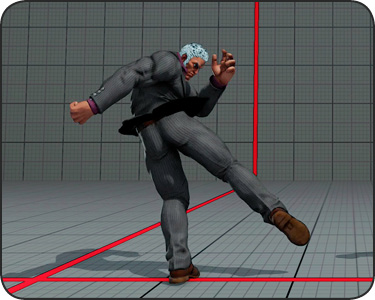
| Startup |
5 |
|---|---|
| Active |
2 |
| Recovery |
8 |
| Hit Level |
HL |
| On Hit |
3 |
| On Guard |
2 |
| B-VTX on Hit |
-6 |
| B-VTX on Guard |
-7 |
| F-VTX on Hit |
-1 |
| F-VTX on Guard |
±0 |
| D-VTX on Hit |
-18 |
| D-VTX on Guard |
-19 |
| Cancel |
Sp, V |
| Damage |
40 |
| Stun |
70 |
| Meter Gain |
20/10 |
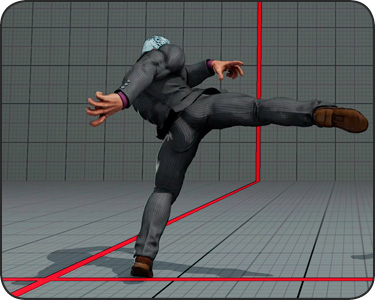
Standing Forward
| Startup |
8 |
|---|---|
| Active |
2 |
| Recovery |
18 |
| Hit Level |
HL |
| On Hit |
1 |
| On Guard |
-2 |
| B-VTX on Hit |
3 |
| B-VTX on Guard |
0 |
| F-VTX on Hit |
10 |
| F-VTX on Guard |
7 |
| D-VTX on Hit |
-9 |
| D-VTX on Guard |
-12 |
| Cancel |
V |
| Damage |
60 |
| Stun |
100 |
| Meter Gain |
30/15 |
Standing Roundhouse
| Startup |
9 |
|---|---|
| Active |
6 |
| Recovery |
19 |
| Hit Level |
HL |
| On Hit |
3 |
| On Guard |
-3 |
| B-VTX on Hit |
5 |
| B-VTX on Guard |
-1 |
| F-VTX on Hit |
12 |
| F-VTX on Guard |
6 |
| D-VTX on Hit |
-7 |
| D-VTX on Guard |
-13 |
| Cancel |
V |
| Damage |
80 (90) |
| Stun |
150 |
| Meter Gain |
50/25 |
Charged Standing Roundhouse
| Startup |
24 |
|---|---|
| Active |
5 |
| Recovery |
18 |
| Hit Level |
H |
| On Hit |
8 |
| On Guard |
0 |
| B-VTX on Hit |
2/9 |
| B-VTX on Guard |
-2/1 |
| F-VTX on Hit |
9/16 |
| F-VTX on Guard |
5/8 |
| D-VTX on Hit |
-10/-3 |
| D-VTX on Guard |
-14/-11 |
| Cancel |
V |
| Damage |
110 (50+60) |
| Stun |
180 (80+100) |
| Meter Gain |
50/25 |
Standing Roundhouse (Charged): Like standing fierce, standing roundhouse can also be charged up for a slower, more powerful variation on the heavy poke.
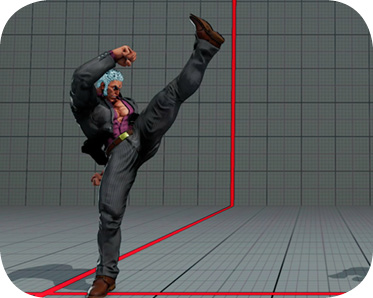
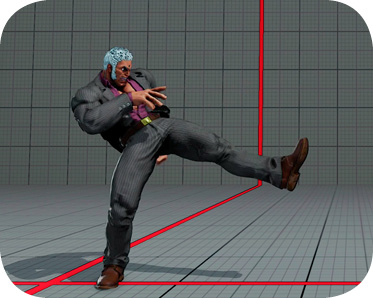
Standing is an axe kick that starts with Urien extending his leg at a 90-degree angle straight up. It hits initially on the ninth frame, but only right above Urien’s head. For the next two active frames (frames 10-11 overall), his leg descends so it hits at an upward diagonal angle, on the same anti-air trajectory as the first active frames of Zangief’s standing or Birdie’s 
 overhead. For all vertical-aimed frames of standing , Urien’s foot hitbox extends past his hurtbox, giving the attack great anti-air priority. Not until frame 11 after activation does the hitbox on standing descend enough to hit grounded characters. While the frame data’s listed startup of nine frames is accurate, standing doesn’t become a horizontal poke till the eleventh frame. Urien is left at +3 on hit and -3 when blocked. The lateral hitbox has great range (25 percent of the screen), but doesn’t extend out of Urien’s hurtbox, which covers his leg all over.
With the upward angle, the first three frames have interesting uses. For example, they can function as terrific anti-air against foes coming in from high angles (Rashid’s jump shenanigans for example). The early upward active frames also mean that this move may catch opponents who try to jump to escape expected throw attempts. Mixing up between lows, throws, and standing means that standing may often blow up the common defensive option select of blocking low briefly, then jumping backward while inputting (when successful, this releases pressure for the defender by making them briefly block low moves, before jumping backward while overlapping a throw-tech command; the defender is likely to either gain breathing room or tech the incoming throw, unless an attack that thwarts both is used, like close-range standing ).
Like with standing , holding down on activation produces a unique attack with different traits. Standing (charged) follows the same path as normal standing , but it’s slower to hit, striking on frame 24, and horizontally against standing/crouching foes on frames 26-27. The first two frames of charged standing [hk] don’t have the great anti-air properties of the uncharged version; they’ll only hit standing characters, while still whiffing over crouchers. (After two frames have elapsed, the falling kick is still high enough in the air to hit many aerial arcs, though the slow startup means this won’t really happen on purpose.) The lateral, anti-ground portion of the move has a hitbox that’s about twice as large as that of normal standing . Most importantly, this move must be blocked high. When guarded, Urien is left at even frames, and on hit, charged standing produces an advantage of +8. Against a dizzied foe, it’s actually more damaging to capitalize with charged  crouching (into whatever juggle combo), instead of doing a jump-in heavy attack into crouching . It’s also enough advantage to easily link Target Combo 2 off the overhead, providing a three-hit path to grounded V-Trigger combos that’s very easy to confirm.
Urien’s Aegis Reflector combos in V-Trigger mode often involve bouncing the defender between Urien and a reflector placed behind them. Urien’s hit-confirm into far Aegis sends them reeling toward it; the reflector sends them reeling back. While getting hit by a long, miserable combo like those Urien can dole out (or as another example, extended Guile V-Trigger combos), holding down-back in a kind of trance is a natural defensive instinct. This is actually a decent habit, especially for new and intermediate players, so they get back in the game if the attacker fails to finish the combo plate. Easily-frustrated players who mash or just don’t block during combos will turn their opponent’s execution errors into accidental resets. However, defenders who sit on down-back too much during bouncy Aegis combos give Urien the chance to sneak in charged standing mid-combo. If this occurred off the first Aegis in a given V-Trigger activation, then of course charged can link into crouching EX Metallic Sphere, which can be canceled into a fresh Aegis loop with the second mirror. (And maybe even another charged uncombo attempt, for maximum defender disrespect.)