
Street Fighter V Guide Fighters F.A.N.G.
Special Moves
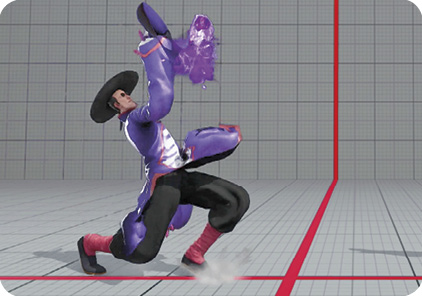
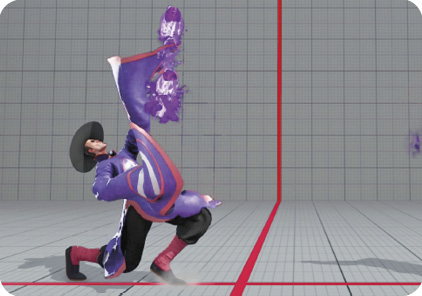
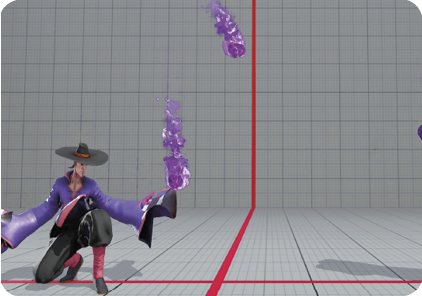
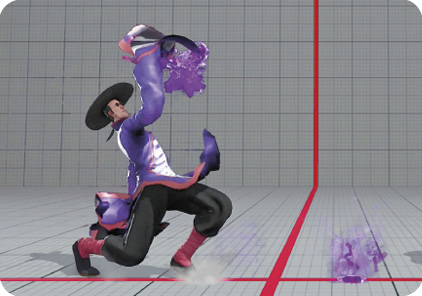
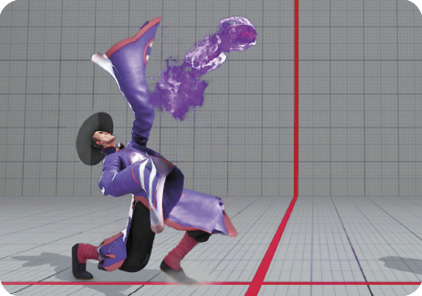
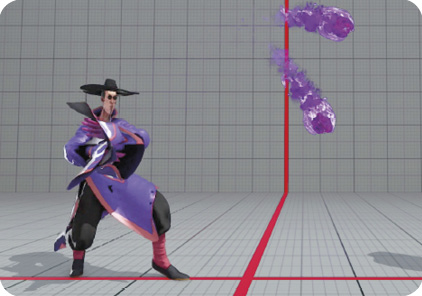
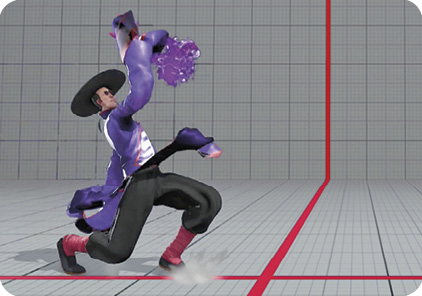
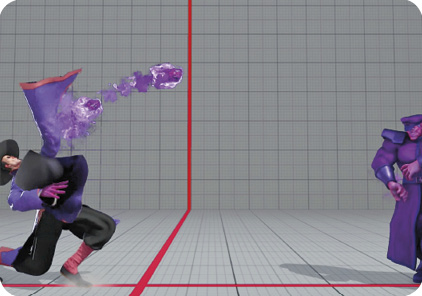
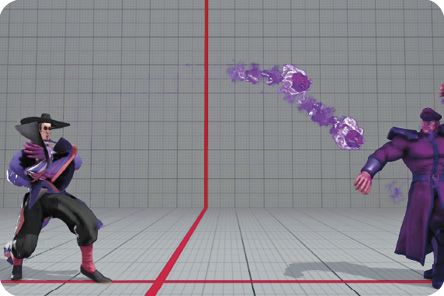
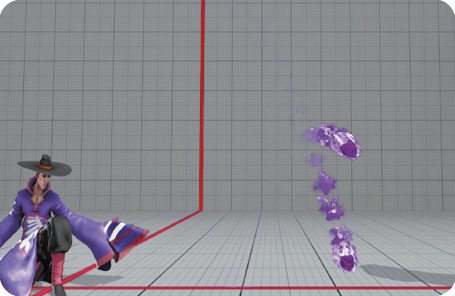
Nishikyu: F.A.N.G. tosses two poison balls at parabolic arcs across the screen. The poison balls deal minor damage on hit (just 20 apiece), but they inflict poison. The button used determines the projectiles’ arc. LP Nishikyu sends balls out on tall arcs that peak only 20 percent of the screen away, then fall at 20 percent and 40 percent of the screen’s distance, blocking jump-ins immediately and ground movement as the projectiles descend. MP Nishikyu sends balls out on shallower arcs that peak 40 percent of the screen away, then fall at 50 percent and 80 percent screen distance; this version misses targets who are very close or full screen. Finally, HP Nishikyu fires two shots on shallow arcs that peak 40 percent of the screen away; both fall at a full screen’s distance. The heavy version will miss foes within a half-screen, but it is still a dominating long-range tool.
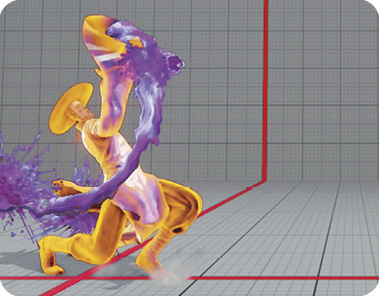
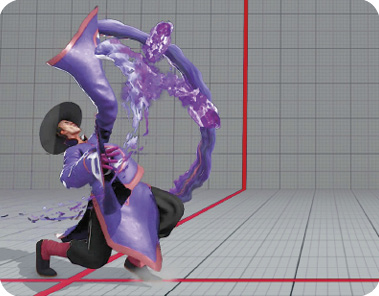
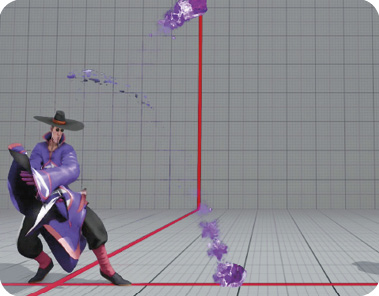
The EX version expends one stock of EX Gauge on a double-damage version (40x2) that has a trick-shot effect. One ball is tossed at a tall arc to land 60 percent of the screen away, while another ball is tossed low, bouncing once 40 percent of the screen away before traveling on a short secondary arc that ends 75 percent of the screen away.
The various versions of Nishikyu will work in combos point-blank against standing characters, but non-EX versions leave F.A.N.G. at a frame disadvantage here even on hit, so they’re definitely not recommended up close. Because they miss over crouching foes’ heads, they’re also not good for blockstring pressure up close. Nishikyu can sometimes start combos for you, though: if these hit an airborne opponent, the target will fall to the ground, perhaps in range for a Sotoja juggle (see Combo 10).
Use the LP version as an early anti-air and space-control tool up close, basically walling F.A.N.G. off from assault briefly. Employ the MP/HP versions to harass foes at mid to long range. The EX version temporarily asserts total screen control of three-quarters of the playing field and is a great asset in tense neutral games when you’re willing to spend meter. F.A.N.G.’s charge times are historically low for a fighting game charge character, so you should have no problem aggressively firing off Nishikyu back-to-back, with no old-school charge tricks needed. Perform Nishikyu with a motion of charging  to
to 

 so that you also retain charge for Ryobenda and Sotoja if needed.
Nishikyu can be canceled during its final few recovery frames into Nikankyaku (EX Nikankyaku can even be buffered earlier than the other versions and still work), allowing for long-range hit-confirms and rapid transitions from faraway zoning to close-range attacks. You can toss poison balls and then immediately slither in behind them, using lighter versions of Nikankyaku to gain ground and stop in front of the enemy, and heavier versions to potentially slip through them and attack from the other side.
LP Nishikyu Charge  ,
, 

| Startup |
13 |
|---|---|
| Active |
Notes |
| Recovery |
48 |
| Guard Level |
HL |
| On Hit |
-7 |
| On Guard |
-11 |
| Cancel |
CA |
| Damage |
40(20+20)+50 poison |
| Stun |
100(50+50) |
| Meter Gain |
10/20/10 |
MP Nishikyu Charge , 
| Startup |
13 |
|---|---|
| Active |
Notes |
| Recovery |
48 |
| Guard Level |
HL |
| On Hit |
-7 |
| On Guard |
-11 |
| Cancel |
CA |
| Damage |
40(20+20)+50 poison |
| Stun |
100(50+50) |
| Meter Gain |
10/20/10 |
HP Nishikyu Charge , 
| Startup |
13 |
|---|---|
| Active |
Notes |
| Recovery |
48 |
| Guard Level |
HL |
| On Hit |
-7 |
| On Guard |
-11 |
| Cancel |
CA |
| Damage |
40(20+20)+50 poison |
| Stun |
100(50+50) |
| Meter Gain |
10/20/10 |
EX Nishikyu Charge ,
| Startup |
13 |
|---|---|
| Active |
Notes |
| Recovery |
40 |
| Guard Level |
HL |
| On Hit |
2 |
| On Guard |
-2 |
| Cancel |
— |
| Damage |
80(40+40)+50 poison |
| Stun |
100(50+50) |
| Meter Gain |
-300 |
LK Ryobenda Charge  ,
, 

| Startup |
14 |
|---|---|
| Active |
3 |
| Recovery |
30 |
| Guard Level |
HL |
| On Hit |
D |
| On Guard |
-9 |
| Cancel |
CA |
| Damage |
60(30+30)+50 poison |
| Stun |
200(100+100) |
| Meter Gain |
5/70/36 |
MK Ryobenda Charge , 
| Startup |
19 |
|---|---|
| Active |
Notes |
| Recovery |
28 |
| Guard Level |
HL |
| On Hit |
1 |
| On Guard |
-8 |
| Cancel |
CA |
| Damage |
40+50 poison |
| Stun |
100 |
| Meter Gain |
5/10/5 |
HK Ryobenda Charge , 
| Startup |
23 |
|---|---|
| Active |
Notes |
| Recovery |
30 |
| Guard Level |
HL |
| On Hit |
-1 |
| On Guard |
-10 |
| Cancel |
CA |
| Damage |
40+50 poison |
| Stun |
100 |
| Meter Gain |
5/10/5 |
EX Ryobenda Trap —
| Startup |
— |
|---|---|
| Active |
220 |
| Recovery |
— |
| Guard Level |
HL |
| On Hit |
— |
| On Guard |
— |
| Cancel |
— |
| Damage |
40(20+20)+50 poison |
| Stun |
44(22+22) |
| Meter Gain |
0/0 |
EX Ryobenda Charge , 
| Startup |
15 |
|---|---|
| Active |
2 |
| Recovery |
33 |
| Guard Level |
HL |
| On Hit |
D |
| On Guard |
-2 |
| Cancel |
— |
| Damage |
60(30+30)+50 poison |
| Stun |
200(100+100) |
| Meter Gain |
-300 |
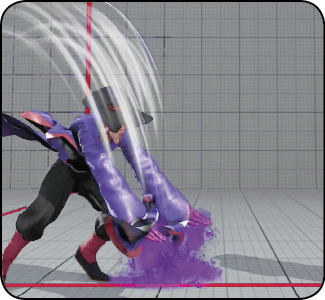
Ryobenda: F.A.N.G. slaps poison onto the ground directly in front of him with varying effects, then hops backward during recovery. LK Ryobenda has a two-hit projectile hitbox where F.A.N.G. slaps the ground. His arms are projectile-invincible during this slap, helping this move consistently destroy incoming fireballs—even two-hit ones (with good timing). On hit, LK Ryobenda poisons the opponent and knocks them up into a jugglable state, though the only way you can reach them before they’re floored is by canceling into Shishiruiui, his Critical Art. Because LK Ryobenda itself is a heavy hit, and because F.A.N.G. hops backward just after it, this is a somewhat safe blockstring ender unless the opponent is loaded with an extremely fast lateral punisher, like Ryu or Chun-Li Critical Arts.
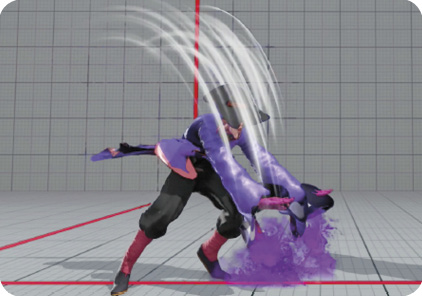
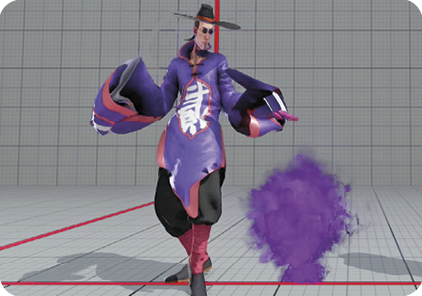
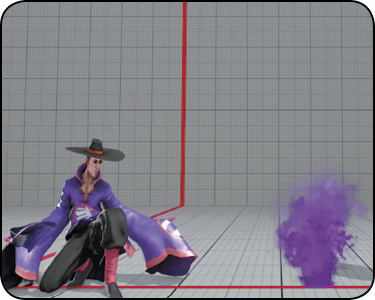
During MK and HK Ryobenda, F.A.N.G. sets down a temporary bubbling poison area on the ground in front of him. This basically works as a motionless projectile guarding space on F.A.N.G.’s behalf, like with Birdie’s Banana Time. The MK version creates a cloud that lasts for one second, while the HK version takes four frames longer in execution to set down a cloud that lasts 1.66 seconds. Both versions’ projectiles extend upward to about hip height and do 40 damage while inflicting poison (if your foe runs into them). F.A.N.G. doesn’t hop backward while setting the poison clouds for the MK and HK versions, and if he gets hit during recovery, it will count as a recovery counter-hit, like against a whiffed Shoryuken.
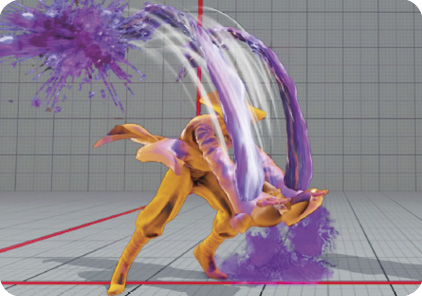
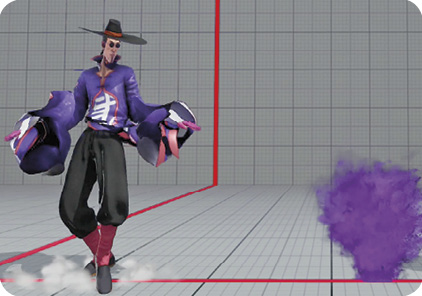
EX Ryobenda combines the best aspects of the LK and HK versions, with a two-hit projectile launcher that sets down a static, two-hit poison cloud. F.A.N.G. bounces back after the slap, like with the relatively safe LK version, but hits against him during this bounce register as counter-hits, like against his MK/HK version recovery. The EX version’s projectile landmine lasts for 3.66 seconds, far longer than the others. If you hit an enemy up close with EX Ryobenda, they’ll be launched into the projectile and bounce off it, giving you time to build charge for an EX Sotoja juggle. Spending two stocks of EX Gauge on this juggle is one of the standard ways to beef up F.A.N.G.’s damage output.
Contrary to typical unwritten Street Fighter rules about projectile zoners, you can lay down MK/HK/EX Ryobenda poison mines even while Nishikyu and Nishodoku projectiles are already on screen. Also, you can still use LK Ryobenda as an attack while a poison mine for a heavier version of Ryobenda is bubbling and active. Like F.A.N.G.’s poison effect, Ryobenda poison mines disappear immediately if F.A.N.G. receives a hit himself.
LP Sotoja Charge ,
| Startup |
16/18 |
|---|---|
| Active |
8 |
| Recovery |
25 |
| Guard Level |
HL |
| On Hit |
D/-4 |
| On Guard |
-11 |
| Cancel |
CA |
| Damage |
60(30+30)+50 poison |
| Stun |
200(100+100) |
| Meter Gain |
20/40/20 |
MP Sotoja Charge ,
| Startup |
20/22 |
|---|---|
| Active |
8 |
| Recovery |
23 |
| Guard Level |
HL |
| On Hit |
D/-1 |
| On Guard |
-9 |
| Cancel |
CA |
| Damage |
70(30+40)+50 poison |
| Stun |
200(100+100) |
| Meter Gain |
20/40/20 |
HP Sotoja Charge ,
| Startup |
21/23 |
|---|---|
| Active |
8 |
| Recovery |
24 |
| Guard Level |
HL |
| On Hit |
D/-2 |
| On Guard |
-10 |
| Cancel |
CA |
| Damage |
80(40+40)+50 poison |
| Stun |
200(100+100) |
| Meter Gain |
20/40/20 |
EX Sotoja Charge ,
| Startup |
14 |
|---|---|
| Active |
8 |
| Recovery |
19 |
| Guard Level |
HL |
| On Hit |
D |
| On Guard |
-3 |
| Cancel |
— |
| Damage |
100(50+50)+50 poison |
| Stun |
200(100+100) |
| Meter Gain |
-300 |
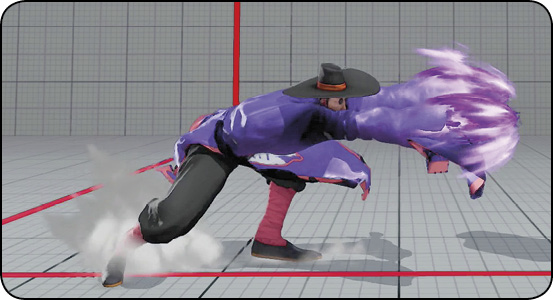
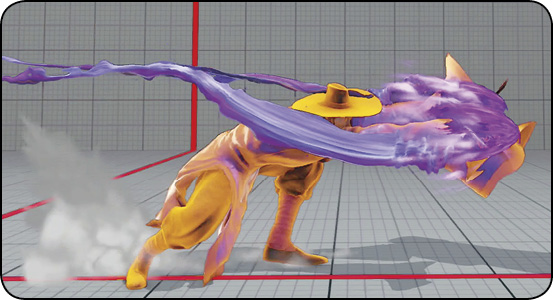
Sotoja: F.A.N.G. rears back, then thrusts his arms forward in a quick sleeve swipe. Like with LK/EX Ryobenda, Sotoja’s attack area is actually a two-hit projectile, while F.A.N.G.’s arms are projectile-invincible during the attack. The first two active frames only actually hit around F.A.N.G.’s head; the remaining six active frames strike all the way through to his hands. Though the LP version’s hitbox doesn’t quite extend to the tip of the hurtbox on the hands, the MP version almost does, and the HP version’s hitbox reaches to the tip of the hurtbox. The first two active frames, will cause a knockdown; if only the later six active frames hit, the attack just causes hitstun and leaves F.A.N.G. at a mild disadvantage on hit.
The EX version has a fully extended hitbox through F.A.N.G.’s hands on the first active frame, so it always knocks down on hit. The hitbox extends a little past the hurtbox on the end of his hands, giving this version the best priority as it moves forward. It also hits fastest, does the most damage, is safest by far if guarded, and is great as a juggle finisher. You can also use EX Sotoja to juggle an enemy immediately after they’ve jumped into your Nishikyu projectiles at mid range or closer.
Sotoja can be a decent neutral game special poke, as long as you aim to hit with the last few frames from the tip of its range. From far away, having the extended sleeves of Sotoja blocked is a relatively safe way to chip away from mid range. (As with LK Ryobenda, max-range Sotoja still isn’t safe against the fastest lateral moves, so watch it against characters with far-reaching Critical Arts loaded with EX Gauge.) Sotoja is also a good meterless hit-confirm combo ender. It’s too laggy to poke with up close or use as a blockstring ender, though; if it’s blocked starting with the first two active frames (around F.A.N.G.’s head), he’s at a guaranteed punishable disadvantage with any normal version (and -3 if the EX version is guarded).
LK Nikankyaku 
| Startup |
— |
|---|---|
| Active |
— |
| Recovery |
29 (total) |
| Guard Level |
— |
| On Hit |
— |
| On Guard |
— |
| Cancel |
— |
| Damage |
— |
| Stun |
— |
| Meter Gain |
— |
MK Nikankyaku
| Startup |
— |
|---|---|
| Active |
— |
| Recovery |
30 (total) |
| Guard Level |
— |
| On Hit |
— |
| On Guard |
— |
| Cancel |
— |
| Damage |
— |
| Stun |
— |
| Meter Gain |
— |
HK Nikankyaku
| Startup |
— |
|---|---|
| Active |
— |
| Recovery |
31 (total) |
| Guard Level |
— |
| On Hit |
— |
| On Guard |
— |
| Cancel |
— |
| Damage |
— |
| Stun |
— |
| Meter Gain |
— |
EX Nikankyaku
| Startup |
— |
|---|---|
| Active |
33 (total)— |
| Recovery | |
| Guard Level |
— |
| On Hit |
— |
| On Guard |
— |
| Cancel |
— |
| Damage |
— |
| Stun |
— |
| Meter Gain |
-300 |
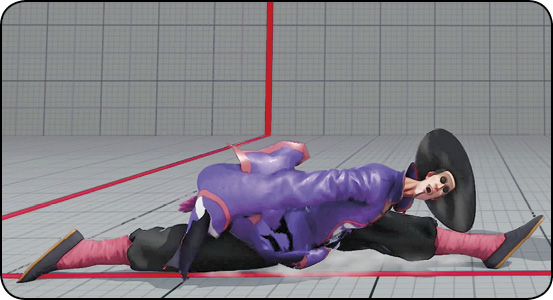
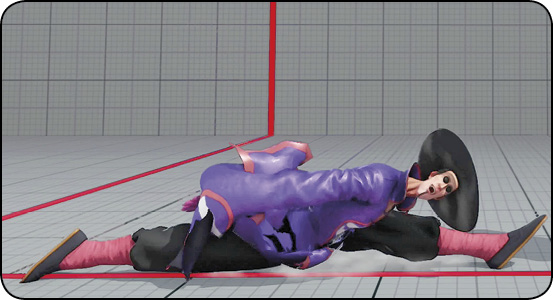
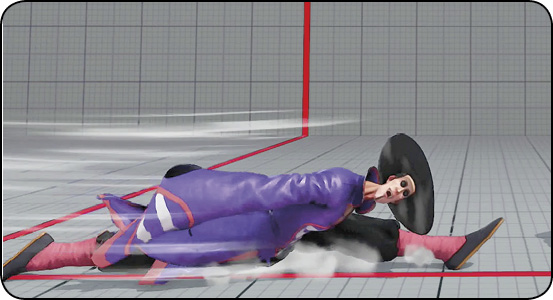
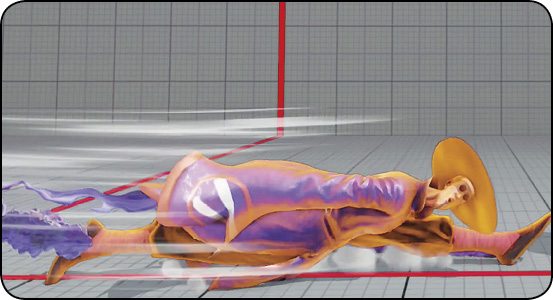
Nikankyaku: This sneaky forward movement is like a teleport and forward dash hybrid. Its function is a little different than for characters like Karin, Ken, and Laura, who also have forward-moving special movements that can be initiated from pokes. During Nikankyaku, F.A.N.G. fluidly swoops forward into a low-profile split before springing back up to his feet. During the low-profile portion (starting on Frame 6), he’s also projectile-invulnerable, so any version of Nikankyaku can easily pass through incoming fireballs. For much of Nikankyaku’s transit, it will also pass through anyone in the way, crossing over to the other side. That’s one of three main differences between this and other movement specials. The second difference is that you can cancel into Nikankyaku from a specific period during the recovery of Nishikyu, meaning that F.A.N.G. can lay down his own air cover before command dashing in. The third difference is the sheer variation of distance F.A.N.G. can travel: LK Nikankyaku travels a bit farther than a forward dash, and MK Nikankyaku travels just a bit farther than that. The HK version travels 60 percent of the screen’s length, allowing F.A.N.G. to immediately get all the way into close range whenever you correctly predict your enemy’s fireball toss. Finally, the EX version travels 80 percent of the way across the screen while being both strike-invincible and projectile-invincible starting on the first frame. (Unfortunately, all versions of Nikankyaku are vulnerable to ground throws for their full duration.) This makes EX Nikankyaku F.A.N.G.’s only non-Critical Art escape move (and, again, it’s no good against throw attempts). The extreme range of EX Nikankyaku and its ability to cancel from Nishikyu a little early allow for long-range hit-confirms and tricky pass-through stuff, depending on spacing.
The minor difference in length between the LK and MK command dash versions is important from close-range pokes. It’s long enough so that usually point-blank normals (most likely the first hit of standing , or counter-hit fishing with point-blank standing ) canceled into LK Nikankyaku won’t pass through, but normals canceled into MK Nikankyaku will. (This is also true using LK or MK Nikankyaku immediately after a Kyoshitsugeki backward throw.) From farther out, canceling good edge-of-range blocked pokes (like crouching and standing ) into MK or HK Nikankyaku can also be an interesting, if somewhat gimmicky, change-up to aggressive offense. The MK version will stay on the same side, while the HK version will pass through. Your advantage is that if your opponent tries to counter-poke too quickly on the pass-through, their poke can actually whiff in the original direction as F.A.N.G. crosses to their back, in position for an immediate throw attempt or fast attacks like crouching and standing .
Any version of Nikankyaku can be canceled near the end of recovery into Senpukuga, with F.A.N.G. coming out of the dash movement with a low-profile prone fall. If you’re going to do this, there’s little reason not to go ahead and cap it off with Senpukuga Follow-Up, kicking into a good frame situation. But Nikankyaku is almost always a disadvantaged forward movement in the first place, and even when you transition from the end of the low-profile dash immediately into low-profile Senpukuga, there are still seven frames where F.A.N.G. is standing tall and fully vulnerable directly next to the enemy. This kind of thing is best as a “fake” aggressive movement from long range, like doing LK Nikankyaku to Senpukuga to the follow-up kick from far away, or as a confusing motion against players who are already reacting poorly to your antics. It’s too slow of a maneuver to hold up against really fast players, though, which is why you’re going to get more mileage in general playing F.A.N.G. as a hit-and-run zoning character than as someone who wants to constantly cancel pokes into slip-through dashes into command crouches. But they’re still options to keep in mind and will sometimes work for sheer rarity if you save them for a rainy day or to show a different offensive look when you have a big stamina lead anyway.