Mass Effect 3 Guide Extras Collectors Edition
Q&A: The Art Direction of Mass Effect
Interview with Derek Watts – Bioware
The visual design of Mass Effect was one of the first things people noticed when the game was first announced back in 2006. To this day, the visuals in the franchise are still one of its strongest defining characteristics. How was this art direction conceived?
We developed the art direction for Mass Effect about eight years ago. We had just come off of Knights of the Old Republic, and that helped define what it was we wanted to do.
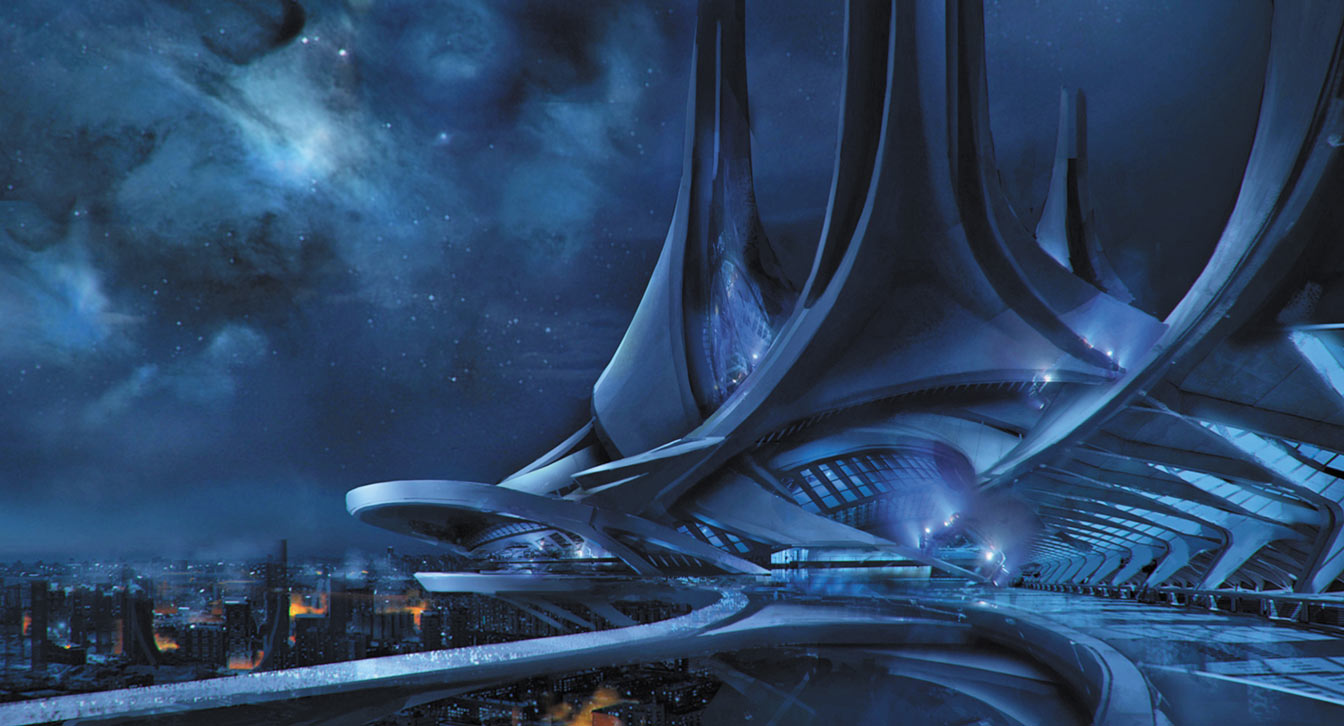
We knew we wanted to make a science-fiction game, but knew we couldn’t set it in a Star Wars–like universe. We were inspired by the clean, epic futurism of Syd Mead, John Harris, and John Berkey.
Syd Mead has a signature style that is clean, futuristic, purposeful, and very different from Star Wars.
His art suggested colorful and hopeful worlds with clean designs—not bleak settings.These were places you might want to go to, places you could imagine yourself being.
We drew inspirations from these artists and began working in our own element.
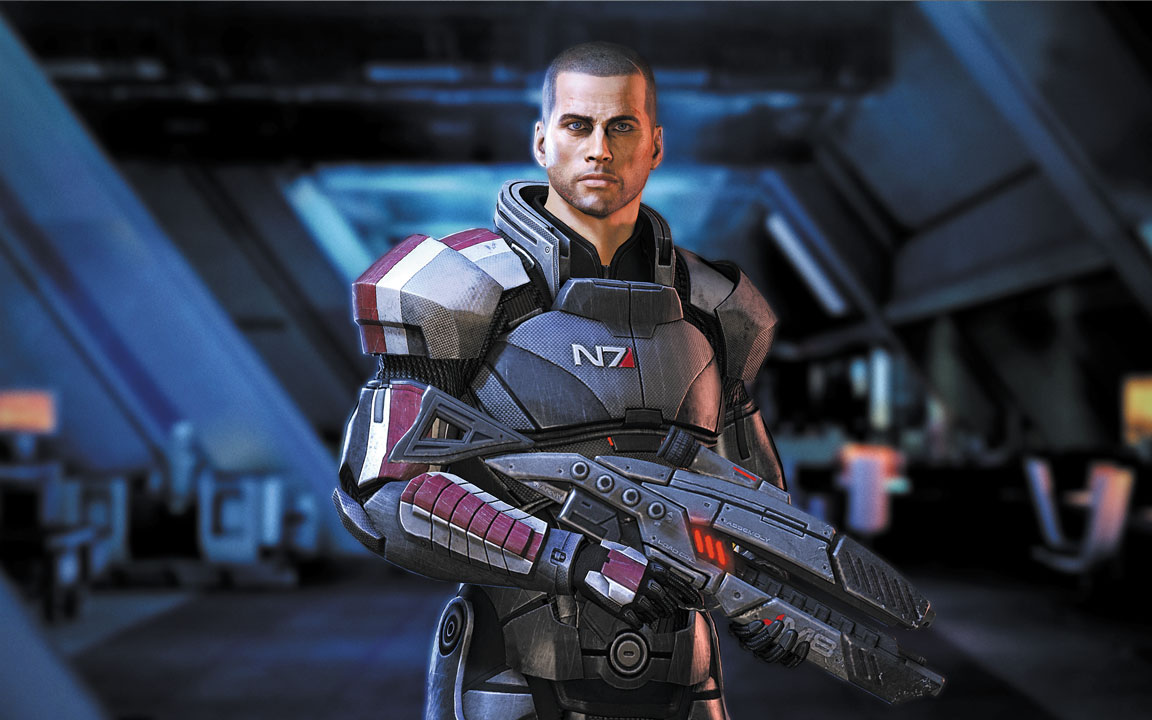
When we began designing other elements of the world, we knew we didn’t want characters to have bulky armor or clothing with too many layers.
We knew the design had to look futuristic but not ridiculous. Armor and clothing ended up being very tight.
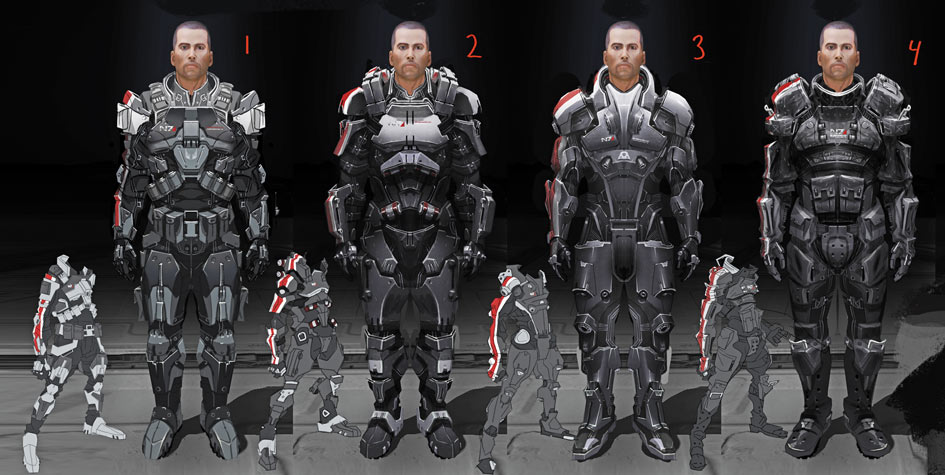
Based on fan feedback, we bulked up the armor on characters over the course of the franchise—for example, Shepard in ME1 looks small due to his armor being skintight.
In ME3, we’ve made his armor look more imposing to give him more presence. But regardless, the initial design principles have remained throughout the franchise.
For Shepard, elements like the red stripe and the N7 logo (which was actually extrapolated from a logo on a pair of skis) were things we played around with in concept art that stuck around and became part of Shepard’s personal branding.
It’s interesting when you are developing an artistic style for a game. At first all the feedback you get from people is comparing it to things they’ve seen elsewhere.
After the game comes out and resonates with players, the style becomes its own. Now we hear things like, “Hey, I just saw this movie and it had a Mass Effect feel to it.”
It was clear with the first screenshots for Mass Effect 1 that you guys were trying to differentiate yourselves visually from all the other sci-fi games out there, starting with the brighter color palette.
We definitely wanted to have pools of bright color, saturated color, etc. We didn’t want to have the desaturated browns and other earth tones that a lot of action games were using at that time.
We wanted to evoke the feeling in our players that these were places they would want to go to. They weren’t bleak, there’s a sense of hope, there’s purpose to the design, environments are uncluttered, etc.
We actually referenced a lot of real-world architecture. Santiago Calatrava, the Spanish architect, has designed these amazing buildings that are really there. They are built. They exist.
It was important to us that we were inspired by things that were functional and true, both from an architectural and engineering standpoint.
Do you have a label or name that you’ve come up with for your art direction?
Actually, we don’t. (Laughs). We basically call it the Mass Effect style. We know what it means, and when we look at something, we can evaluate whether it looks “Mass Effect-y” enough or not.
The Normandy, for example, has iconic features like the little metal frames around the exhaust ports. We recreate these same features on other ships to echo this design, and it becomes the “Alliance” style.
The Normandy itself was heavily based on the Concorde—a very futuristic-looking airplane in its own right.
The designs are very iterative. The Mako, for example, was initially designed to be large and heavy like artillery, but this led to problems with scale.
In the game, the enemies were too small to see by comparison, so we shrunk it down to support gameplay.
We ended up designing most of the Mako iterations with six wheels, and that stuck throughout the process.
Eventually we decided that six wheels was a characteristic of vehicles in the Mass Effect world, so we carried that throughout a lot of the vehicle design.
Of course, in the second game we decided to move away from the wheeled vehicle and made a flying shuttle instead, but a lot of the same design principles persisted.
What was the design process behind the alien races? They are such a big part of how you express the Mass Effect universe, and they are so unique in their own right.
When creating characters and races, we’ve followed pretty much the same process throughout the franchise: It usually starts with writing.
The concept artists like to get a paragraph describing the background of the alien. That gets the creative juices flowing. We then start designing in phases.
In phase one, we’ll give the character artist full freedom to explore the character, and they’ll create six or seven designs—they’ll go quite crazy and wild.
After this phase, we’ll winnow the design down to two or three concepts and then gradually just chip away at it until we have something that starts to feel right.
It’s a balance, though—you usually start with a rough idea, but you want the concept artists to have freedom to use their own creativity, because you never know what you’ll end up with in the end.
They usually don’t want too much information from writing—just enough to give them a starting point. For example, what is the inspiration for this “people”? Are they militaristic? Pacifists? Are they a birdlike race? Are they from lizards?
A good example of this process is the design of the krogan. In the original description from the writers, there was some mention of bats.
If you look at the krogan head, you can see some of the shapes of a bat head in there. A lot of people look at the design and assume we were going for reptiles.
With Garrus, the writers mentioned the turians were a proud, birdlike race with a strong military tradition. We went through tons of iteration across four different artists, and then when we finally nailed it, we didn’t change a thing beyond that.
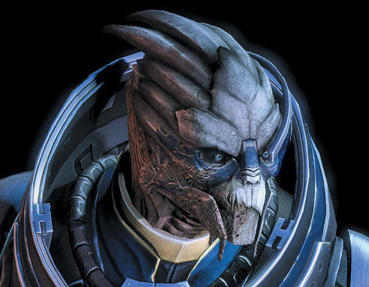
Garrus Vakarian
Sometimes the final design is a hybrid. For example, the salarians: one artist designed the head, another the body.
We always imagined salarians being our version of the “gray” alien—the one you always see in autopsy hoaxes.
Using that as a starting point, we explored different ideas for what their bodies would look like and hit on the idea of a sunken chest.
That really stuck, and then that informed what the rest of their body would look like. Their armor needed to follow the shape of their body, so the salarians ended up with this really iconic armor profile.
We designed all the aliens without clothing so that the modelers would know exactly how to create clothing and armor for them.
This mattered because otherwise the artists wouldn’t know if the hump on a krogan’s back, for example, was part of the armor or actually part of their physiology.
Knowing what the aliens looked like under their clothes helped ensure we could create realistic designs that conformed to their physical characteristics.
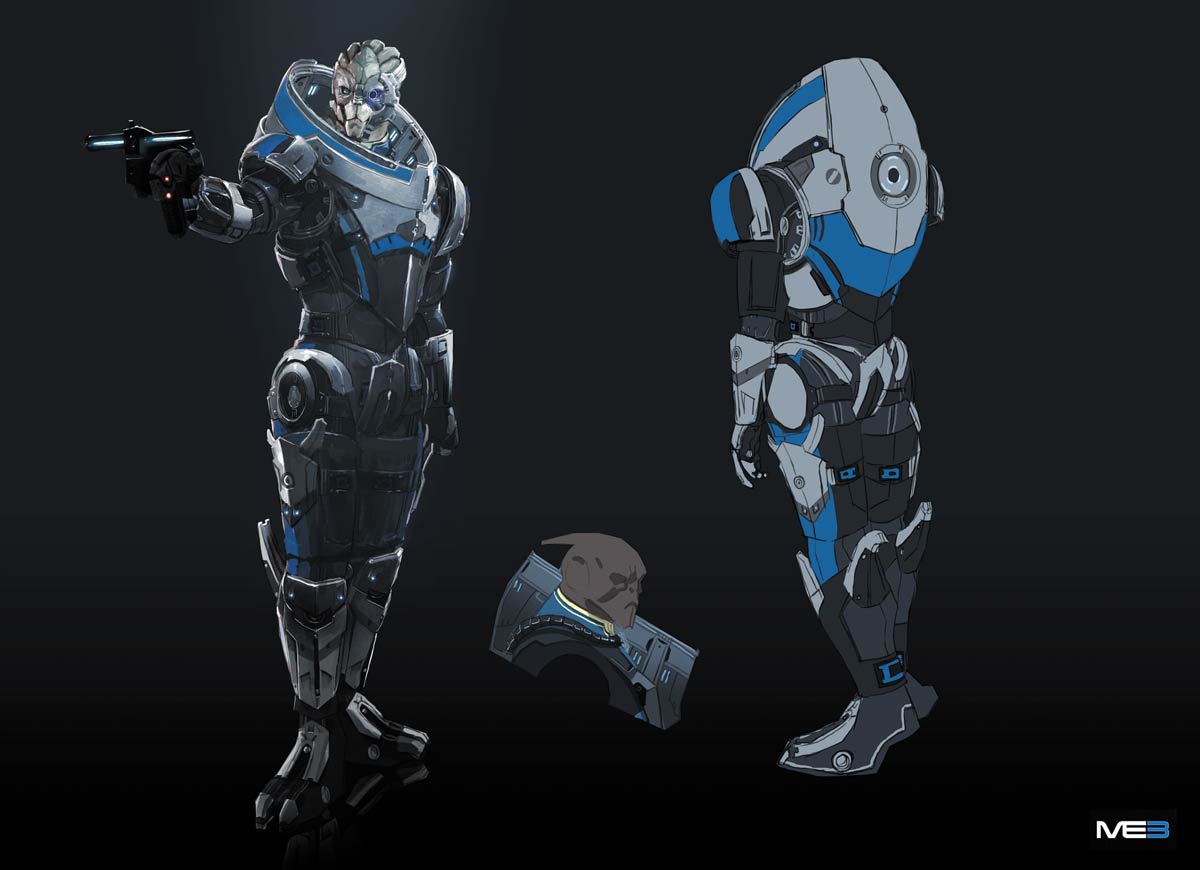
Garrus Vakarian
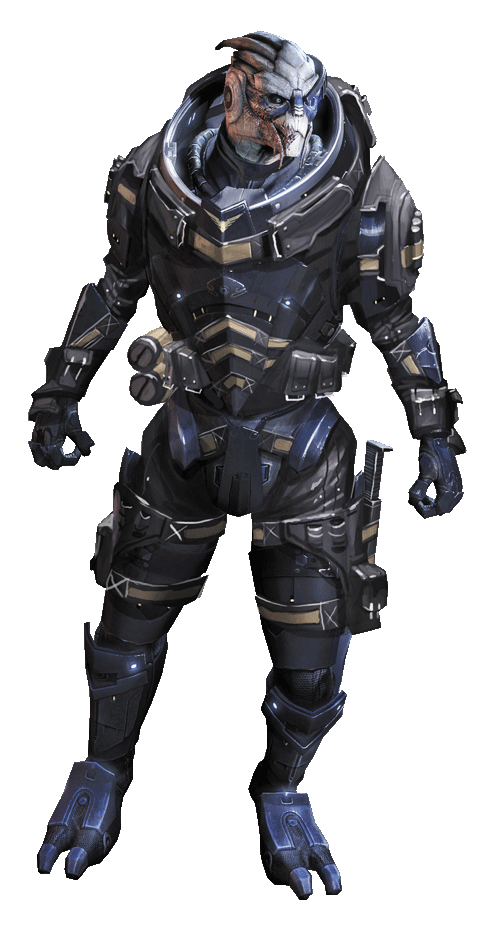
So the process was very exploratory, highly iterative. Sometimes you’d find it right away, and other times you really had to work to find the right design.
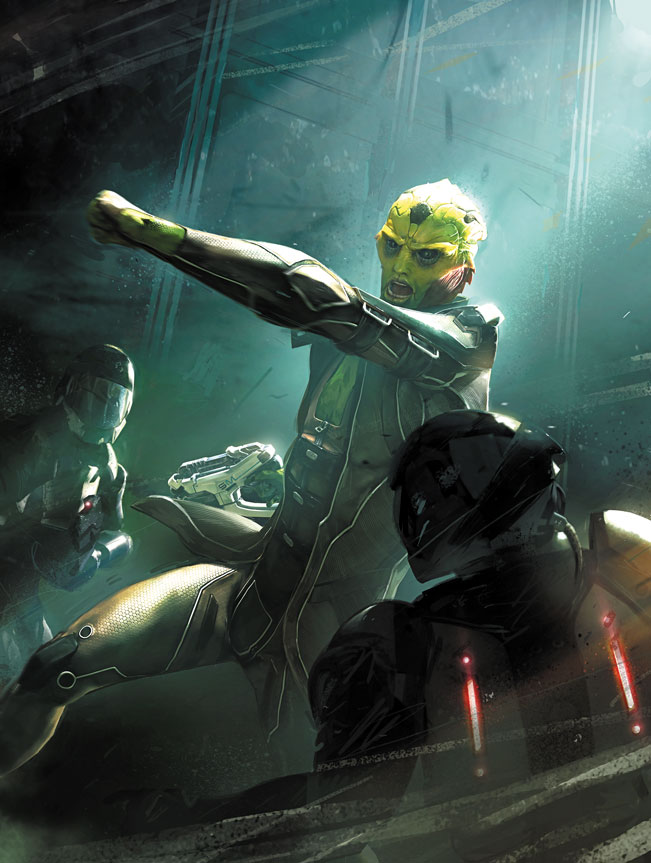
Exactly. A great example of this was Thane in Mass Effect 2. We had a lot of difficulty finding the right design for him. What threw the artists off was this note from the writers that said Thane was to be a potential female love interest.
We went through tons of iteration with his design. At one point he was a bird-of-paradise with feathers all over him.
He had white skin with giant red dots, he was transparent, etc. We asked for feedback from some of the women in the office to see what they thought, and the reaction was just horror.
We knew we needed to go back to the drawing board. In the end, we found a great design for Thane—it just took a while to get there.
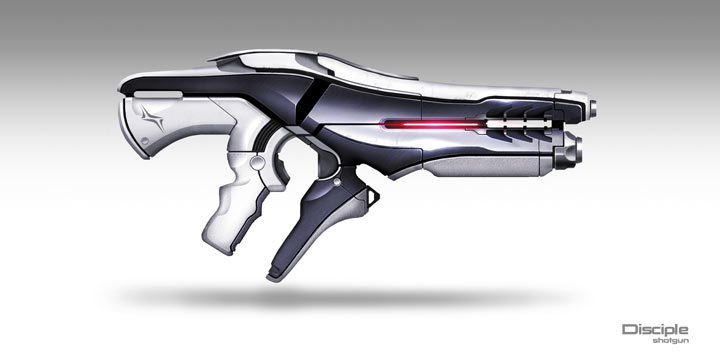
Disciple
What was your process for the industrial design for weapons? What did you use for reference?
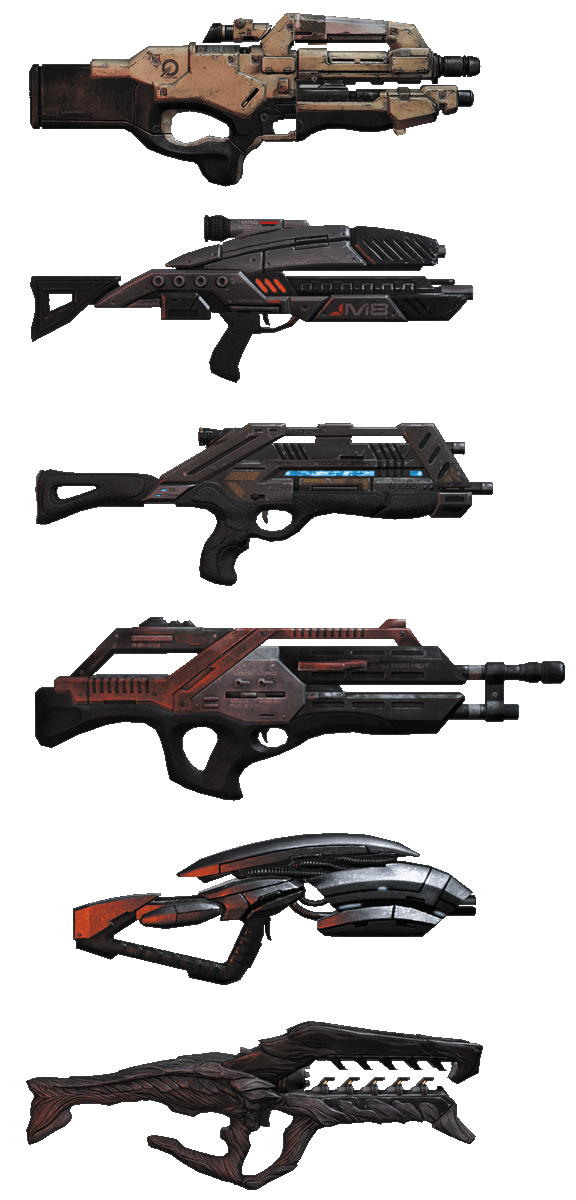
For Mass Effect 1, we made the weapons look a bit more like they belonged in a science-fiction film. We didn’t want to push that too far—we still wanted the weapons to look practical. As with ships, we tried to include the arch.
If you remember the M-8 from ME1, it had this strong sweeping arch in the design, but at the same time it would look right at home on a present-day battlefield.
We added dials and things to make the weapon look functional, but we didn’t want to take it too far; the designers are passionate about real-world weapons, so we were inspired by actual weapons.
We have always struggled to balance how futuristic the weapons should be. We were inspired by the Japanese anime movie Appleseed.
It has these phenomenal weapons with organic designs. We looked at a lot of anime, which often has really interesting ideas for things like panels and the way weapon handles form to the hand.
For Mass Effect 3, we had the chance to develop more alien weapons. We used the weapons in the movie District 9 for reference.
It was fun exploring these because, for human weapons, we had decided to not take the science-fiction elements too far, but for the alien weapons, we could push it.
So, for the asari weapons, we used a very clean design with shapes and curves that match the way the asari look.
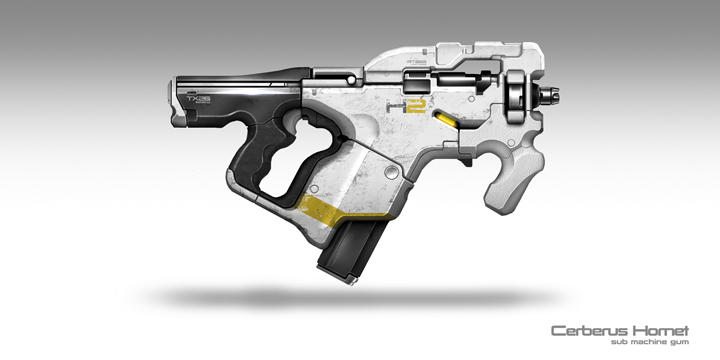
M-25 Hornet
In Mass Effect 1, you introduced the idea that the player could see their weapon loadout on their character. The weapons were modular and could collapse down to fit onto the character’s back.
But when the player would enable them, the character would grab them and the weapon would unfold and come to life, as if to say, “I’m ready.” How did that figure into the process of weapon design?
We looked at character designs showing all the weapons on the back and decided it looked really cool.
For the first few weapons, we designed them meticulously so that they could collapse realistically, and we involved the animators in the design since they would have to be the ones to make the weapons fold naturally.
We soon realized that it was incredibly hard to make weapons that could fold and collapse down in a realistic way, so we started to design them to identify “cut lines” where the modelers would break the weapon up into pieces.
The animators would then animate the collapse and unfolding animations using those cut lines. The end result was that the weapons did not always fold realistically, but they always looked good.
And it really came down to the animators finding clever ways to collapse the weapon down in such a way that there wouldn’t be too much of the weapon geometry crashing or sticking out from the player.
It was pretty challenging for the animators. Sometimes we would hand them these really huge guns and sort of wish them good luck in figuring out how to collapse them down. But they always did.
There are a lot of amazing locations in the Mass Effect games. Walk us through the process of how you create a new location. As with the characters, does it begin with story?
Pretty much. But even before the writing team gets too far, we’ll have concept artists working on ideas. Right after we finish a game, we start brainstorming new worlds.
We create massive art folders and just fill them with reference images and concept art. To start the process, we’ll gather ideas for locations without knowing much about the story.
There’s a bit of a chicken-and-egg process going on—it’s difficult for the concept artists to be inspired to create an image without text to help them get started, and the writers and designers work better when they have a piece of concept art to inspire them.
This early ideation process is really important for the concept artists, especially after we’ve completed the last project—it gives them a chance to unwind and try new ideas.
We use a lot of real-world references for these locations. There are so many amazing real places on Earth that people don’t know about.
We use National Geographic a lot to find these. We just look for a “hook,” something from the real world that inspires an idea, and then the final design feels more realistic because it was inspired by a place that really exists.
Sometimes the locations are inspired by what we think feels natural for the type of race. For example, we always thought the salarians would live in a hot jungle, so we created a lush, humid world for them.
We thought they might live near rivers and would set their structures in harmony with nature—they wouldn’t overbuild. They would blur the lines between the landscape and their architecture.
Even when you look at their bodies, which have a very organic feel to them, they don’t seem like they would build angular structures of concrete and steel.
So using that as a starting point, we go out and find as many real-world references as we can. For the salarian lab facility, we were inspired by a shopping mall in Turkey that had amazing arches and a kind of layered terracing between levels.
The concept artists use this reference art as a starting point when imagining these environments on a grander scale.
We’ve talked a lot about the conception of the individual races. Within that, what was your process for creating individual characters like Commander Shepard?
Well, Shepard was quite the challenge, being the main character and the face of the game in terms of how it was marketed.
We gathered a lot of references and built a huge folder of concept art while exploring the style of his armor, his appearance, his face, etc. For his face, we always knew we would scan in an actor’s face, but we needed to figure out what that actor should look like.
We had some good ideas for the armor. We drew versions of Shepard with light, medium, and heavy armor before deciding to use the heavy armor.
At one stage it was red. The iteration process is to create character concepts, pick the strongest direction, put the designs on the wall, and then gather as much feedback as possible.
The team thought Shepard’s red armor looked too clean and made him look like a medic. At one point an artist did a charcoal-colored version of the armor with a stripe and a symbol on it.
Everyone really liked that, so it set the tone for the direction we would take. After that, we only explored dark armor.
We gave Shepard the white and red stripe to make his design a bit more iconic, and then we came up with the logo.
The logo was actually originally inspired by a logo on a piece of ski equipment. We put it on Shepard just to see what he might look like with a logo and didn’t really give it much more thought.
It resonated really strongly with the team and fans, so we made it part of his uniform.
For Shepard’s face, we took the body we had built and tested it with heads from different actors. We went through a lot of different actors but couldn’t find the right fit.
We had a stack of magazines we used for reference nearby, and the one on top had some photos of a popular male model.
We tried his face and it really worked. It gave him a unique look; he wasn’t the “all-American” hero, but one that looked multicultural, a bit of a mixed European look.
This suited what we thought the future of human heroes might look like, where ethnic lines would become more blurred.
And at that point, when the artwork started to be seen more and more—by the team, by the fans, in marketing material, etc.—the iconic elements like the logo and the stripe would appear more and more often, and we kept putting it on more and more things because it seemed to resonate so strongly.
We discovered how important those elements were to Shepard’s “brand.”
How big is the art team on Mass Effect 3?
The number fluctuates between 50 and 75 artists and animators.
That breaks down by focus to be about 5 character artists, 2 to 3 concept artists, close to 20 level artists, 10 to 12 cinematic animators, 5 gameplay animators, and a number of additional artists to support cinematics and prerendered scenes.
We also outsource at times. The attention to detail poured into the game by each of these artists and animators is truly phenomenal.
If the art in Mass Effect is special, it’s because of the love these artists have for the license, the universe, and wanting to continue pushing the visuals to create compelling worlds for players to experience. It shows in all the work they do.