
Mass Effect 3 Guide Essentials Special Tactics and Reconnaissance
Character Development
PARAGON OR RENEGADE?


During the course of Mass Effect 3 , you’ll often be asked to make some tough decisions as a means to an end or decide on a appropriate dialogue response based on your own feelings.
It can be as simple as being nice to a potential romantic interest or planting a fist firmly in the face of a crew member when they least expect it or deciding the fate of a planet that is under Reaper assault. It is important to stress that there is not a single “right” decision.
You can be the most ruthless and renegade Commander Shepard around, or you can be kind and helpful, or you can be a little of both and still reach the end of the game based on the decisions you’ve made.
Paragon
This side of the spectrum is the more diplomatic of the two alignments. Potential love interests typically respond better to Paragon answers during conversations.
These are usually on the upper half of the conversation wheel.
The Paragon path usually has the least amount of bloodshed, but this can sometimes play against you.
A fully Paragon Shepard may not be able to acquire certain War Assets because of his leanings, or a potentially dangerous threat could be set loose simply because you weren’t willing to finish the job.
Renegade
While not necessarily evil, Renegade choices are often seen in a negative light.
Renegade is not about playing it safe or nice. Renegades will just as soon shoot an unarmed man as they would an armed one; they would shoot a friend in the back if it meant the ultimate mission was a success.
They will bribe, cajole, and kill, and do it with their ultimate goal in mind at all times.
Certain War Assets can only be acquired through this path, and certain quests can be made easier to accomplish, if you feel the ends justify the means.
Just remember that ruthlessness can alienate certain allies, and a bully may find himself without friends.
INTERRUPTS

Returning from Mass Effect 2 , Interrupts are timing-based events that can occur midconversation. An icon will appear onscreen, telling players to hit a certain trigger or button before the icon vanishes.
These are color-coded red for Renegade and blue for Paragon. Interrupts are worth additional points toward either alignment, sometimes by a significant amount, so keep your eyes open for Interrupt indicators.
Pay attention to the color! Just because an Interrupt is available does not necessarily mean you want to trigger it!
For instance, if a virus was being uploaded to a defense network, and your dying ally tells you to stop the upload, you may not want to trigger the Interrupt that will save his life if you don’t feel comfortable with sacrificing millions of lives for one soldier.
Interrupts like this can change the tone of a conversation and sometimes may sour relations with important individuals or even lead to violence and deaths!
REPUTATION
A new mechanic introduced to Mass Effect’s morality system, Reputation points are gained by engaging in conversation with squadmates, intervening in conversations and debates between two NPCs, and by making tough Renegade or Paragon decisions.
Reputation is another variable that factors in to whether you can successfully persuade others to see your point of view or diffuse a highly volatile situation.
Reputation isn’t just something that supplements your Paragon or Renegade scores. Some of the most important turning points in the game require high levels of Reputation.
AMBIENT CONVERSATION


As you walk through the Citadel and the Normandy, you will sometimes hear exchanges between two characters, with icons indicating Shepard can support one side of the conversation or the other.
Selecting one boosts your Reputation and can lead to new or improved War Assets that will determine the success of the Citadel races against the Reapers.
Some conversations you can’t actively participate in, but instead they prompt Shepard to locate a specific item somewhere in the galaxy or in the middle of a larger mission.
For example, you overhear an asari scientist lamenting her inability to get her hands on some Biotic amps that would boost her people’s performance in combat, thereby giving you a better War Asset.
She might even say where the amps can be located, and as it turns out, it’s where you were headed next on an assignment.
You’ll get a notification that this is an objective that can be accomplished in your Codex. If you find the amps she’s looking for during your mission, you can return to her to complete the side quest.
YOUR POWERS
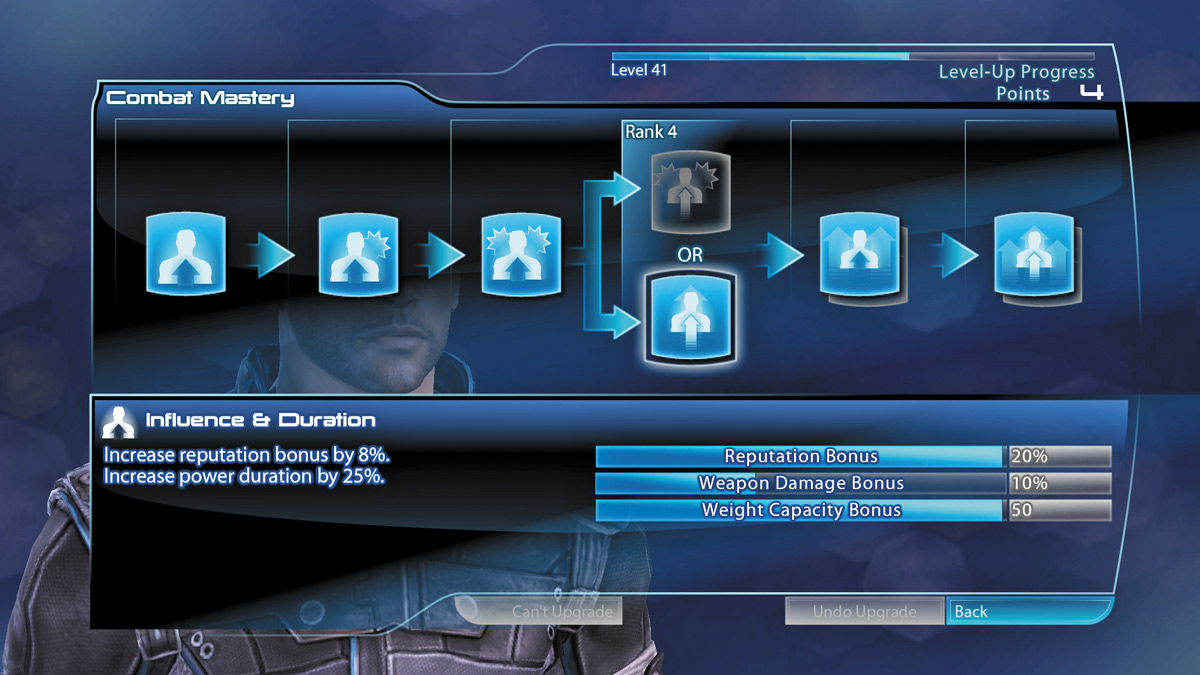
The other part of character development in Mass Effect 3 comes from the more traditional method of earning experience points, gaining levels, and distributing the points earned with every level into the powers you prefer the most.
Shepard and his/her squadmates all gain experience at the same rates, even if not deployed in actual combat. Leveling your powers requires more points the higher you go in their respective trees, but the benefits are worth it.
In addition to the active combat powers, every class includes a set of passive skills that boost damage from weapons, Biotics, Tech powers, and melee strikes.
They also include stacking Reputation and alignment bonuses, which can help boost those levels to where they need to be to grant access to certain dialogue options.
For complete listings of all the powers across each class, check out “The Squad chapter.” (see The Squad section).