
Mass Effect 3 Guide Extras Collectors Edition
Cinematic Storytelling in Mass Effect
Camera as Character
Back in 2001, when the concept for Mass Effect 1 was first being developed, the cinematics team considered ways through which they could make the cinematic scenes more authentic and realistic.
Use of lenses and camera techniques was quite forward-thinking for the time, as was the notion of communicating the presence of a cameraman (i.e., using cinematic camera techniques to provide proper framing and scene editing, thus imbuing the interactive scenes with a sense of drama).
Players could feel not only that they were participating in highly dynamic story moments, but also that those moments were presented in a beautifully authored way that channeled techniques we had all come to recognize from our favorite film directors.
The camera itself has become a character.
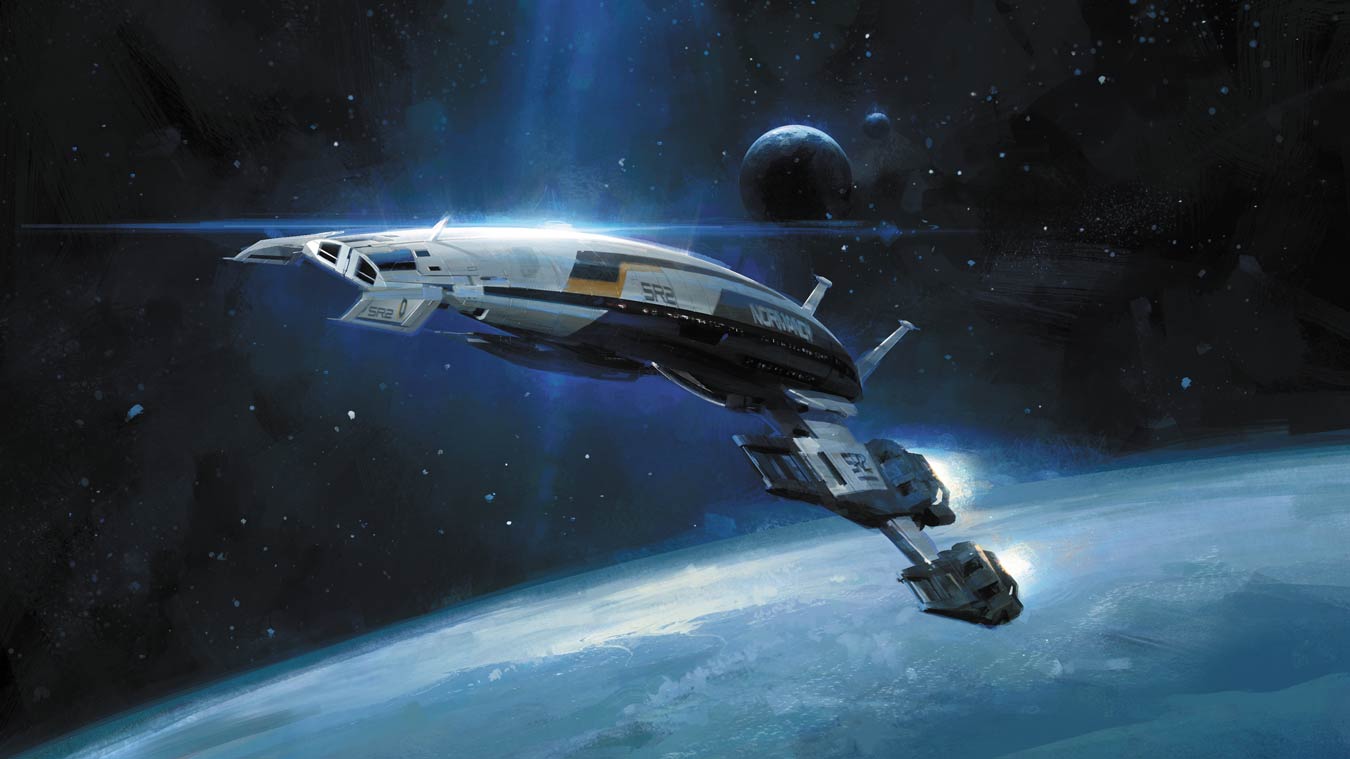
Adding Personality to Spacecraft
In Mass Effect 2, the cinematics team invested in additional tools and processes in order to deliver even more cinematic moments, in particular scenes involving the various spacecraft.
The memorable scene in which the player comes face-to-face with the new Normandy—after having experienced its destruction firsthand in the game’s opening sequence—utilizes the full spectrum of cinematic storytelling techniques such as camera, lighting, and music.
This helps the player fall in love with the new ship. Indeed, the scene plays out like meeting an old love, one you never thought you would see again.
All of these techniques come together in Mass Effect 3.
The cinematics team had to find a way to communicate story and character through each of the ships in the game—the Normandy, the Reaper ships, and others—and in the battles between them.
Using Lenses
The team developed a standardized lens language for the game, including how lenses were used to portray specific ships, locations, and characters to help capture iconic silhouettes for each.
For example, female characters would be viewed through longer lenses to avoid distorting their proportions, whereas aliens tended to look better through wider lenses, the distortion adding to their sense of “otherworldliness.”
Smoother Editing
Improving the editing of scenes and narrative delivery was also a big focus for Mass Effect 3. Transitions into and out of gameplay sequences were made smoother, delivery of story information was tightened, and the overall presentation of cinematic story flowed much more naturally and with stronger forward momentum than ever before.
Connecting to Shepard
In all the Mass Effect games, the cinematics team paid particular attention to how Shepard would be introduced to players at the beginning of the game and how he would appear throughout the entire experience.
This meant creating specific shots, some of which were used in all three games.
For example, the shots where the camera tracks Shepard’s movement as he travels through the Normandy (in Mass Effect 1 and 2) or in the trial scene (in Mass Effect 3), and the slow pan around to reveal his face.
This is particularly important, as players can customize their own Shepard, and this reveal is hugely validating as a cinematic introduction to their personal character.
Another subtle cinematic technique the team has used to create a stronger bond between the player and their Shepard is the subjective camera used in all three games when Shepard is coming to after having been unconscious.
In Mass Effect 1, this occurred after Shepard’s first visions of the Reapers.
In Mass Effect 2, it was when he woke up on the operating table in the Cerberus reconstruction facility. In Mass Effect 3, it was after the explosion in the trial that launches Shepard across the room.
These scenes not only provide a highly cinematic moment for players, but they also allow them to feel that they are experiencing what Shepard is experiencing: Their vision is blurry and then resolves to clarity. And once they can see clearly, they feel they are Shepard.
Inspirations
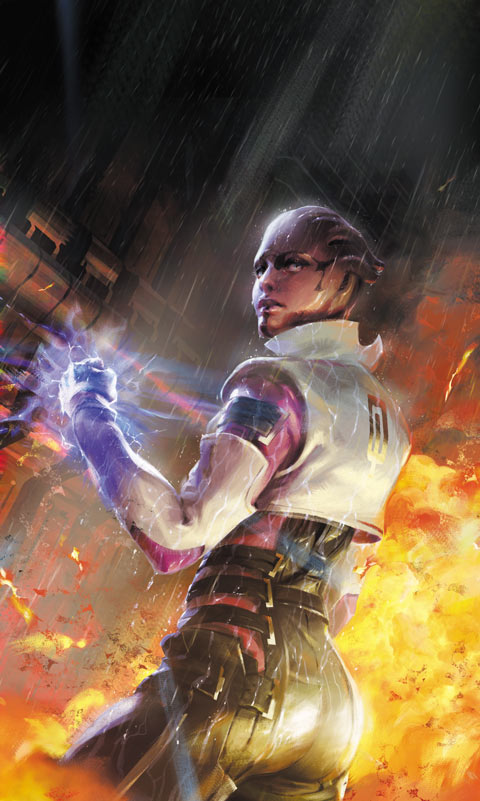
For real-world film inspiration, the team looked at films from several directors. A few stood out: the films of Ridley Scott; the Oscar-nominated Afghanistan war documentary Restrepo, which portrayed the gritty, dirty life of soldiers in that conflict; scenes from Akira Kurosawa films, in particular the burning of the third castle in the film Ran.
Within specific battles, the team tried to capture the spirit of warfare throughout history—shots of soldiers lined up and firing down a line recall rows of riflemen with muskets, the smoke and sound of fire “hitting” the camera.
There is also a shot the team referred to as a “thousand ships,” which was inspired by the Trojan War.
These inspirations added an air of authenticity to the cinematic experience of combat and helped deliver a sense of the game being in a “timeless war.”
Cinematics Production Process
For Mass Effect 3, cinematics production was a complex, multistaged process involving several departments, continuous iteration, and an incredible attention to detail.
Unifying techniques and processes from video games and film production, the team at BioWare have evolved a workflow over the creation of three Mass Effect games to boast one of the most mature cinematics production methodologies in the industry:
1. Cinematics team will get a script for a scene or even just a short description from the writing team.
2. The team will do a storyboard pass, brainstorming various ways to set up shots and move the camera before bringing it back down to the basics.
The team asks the question, “Are the shots in the storyboard sufficient for communicating the story in the scene?” If the answer is yes, they are ready for the next step.
3. The team will create a scene using “previz animatics” (rough animation that shows the intention of a scene and helps work out specifics around camera position, timing, cuts, etc.) based on the storyboard.
The previz sequences are built within a gray-boxed space with static characters, using animatics for basic action and cameras.
All geometry is placeholder at this point, and there is little thought paid to the finer points of lighting and whatnot.
The scene will often be previz’d to a temp audio or music track that is intended to help communicate the overall mood of the scene.
4. The previz sequences will be put together, creating the “narrative playable.” This playable allows for iteration to happen until the basic flow, pacing, camera position, and editing cuts are in place.
The playable may be shared with music composers at this time so that they can begin making plans for how to score the scene.
5. The team then reviews the density of narrative content when playables are stacked together.
This can reveal areas where there are too many cinematic story moments occurring in sequence without sufficient interactive moments or breathing room in between.
The team can then take a step back and evaluate, with the writing and level design teams, how to reorder the moments so that pacing feels more natural.
6. Once the pacing and location of individual narrative playables are in place and considered locked, the cinematics team proceeds to animation and motion-capture to create the character movement, body language, and facial expressions that will bring the characters and story to life.
7. The team takes their previz animation to the motion-capture studio.
Each character does not have a single actor assigned to it; rather, there are certain actors who help set the style of body movement for a particular character, which the team then utilizes utilizes depending on the needs of the scene.
Hand animation is used to smooth out any slight variations in the performance for a certain character that has been played by multiple actors.
This ensures that a particular performance matches the original reference established for that particular character.
8. For characters who have specific voice actors, like the Illusive Man, played by Martin Sheen, the team will screen the previz, and the actor will deliver a voice performance based on the previz scene.
Often the actor will add so much to the scene through their voice performance that the animation team will revisit a scene and reanimate to capture the magic of the actor’s performance.
9. Once all this work is done, the cinematics team begins collaborating with the level-design team to integrate the cinematic sequence into the game.
The lighting team will get involved to help ensure the scene looks as good as possible, and the visual effects and audio teams will add the final layer of integral polish to the scene.
Music will then be integrated integrated, and the scene will be complete.