Mass Effect 3 Guide Extras Collectors Edition
Creature Design
A successful combat system depends on a clear and compelling relationship between the tools the player is given and interesting opportunities to use—and master—those tools.
With all the enhancements to Mass Effect 3’s combat experience—through stronger level design, greater breadth in the weapon modification systems, improved weapon feedback, and so on—the biggest change came in the form of the enemies themselves.
As with other areas of the game, what players experience in Mass Effect 3 is the result of an evolution through the previous two games and accompanying downloadable content (DLC).
With Mass Effect 1, players were fighting what essentially amounted to sci-fi skins on common Dungeons & Dragons–type enemies.
With a stronger core of shooter gameplay, Mass Effect 2 introduced additional enemy types, yet most were variants on standard bipedal humanoids, all toting guns, and combat occasionally suffered from a feeling of “sameness”.
All enemies fell into three categories of behavior: enemies that would use cover, enemies that closed distance and used melee attacks, and enemies that ran at the player, shooting.
On top of this, the enemy profiles—the shape and color of enemies, which is how players identify the different threats they face onscreen—tended to blend together.
For Mass Effect 3, the team knew they needed to up the ante with creature design. This increased focus was formalized through assigning a full-time designer solely to creatures for the duration of the project.
The new approach identified clear and distinct roles for each enemy type. Roles defined clear goals for the creatures, with unique behaviors (gameplay actions driven by AI) created to support these goals.
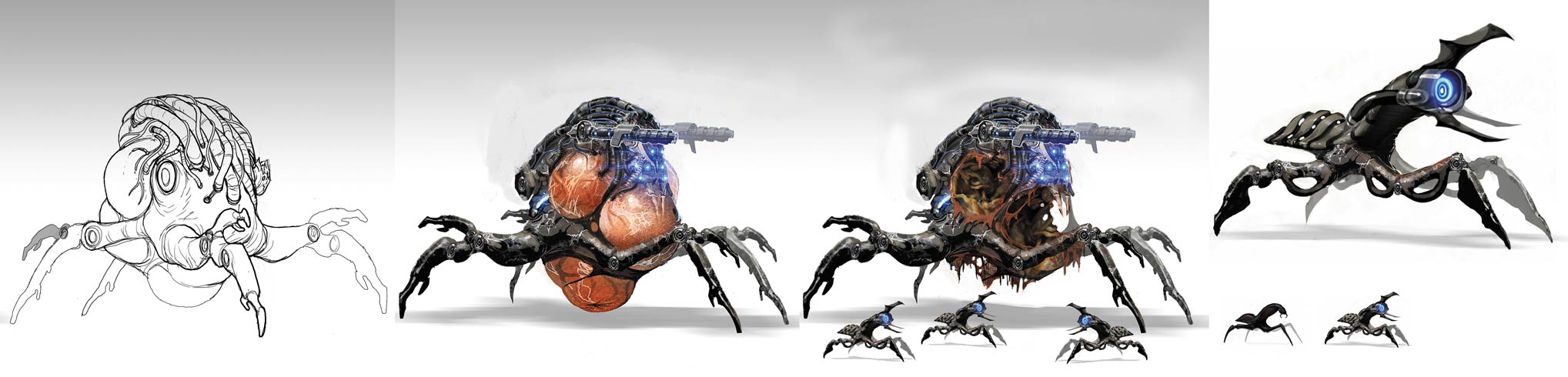
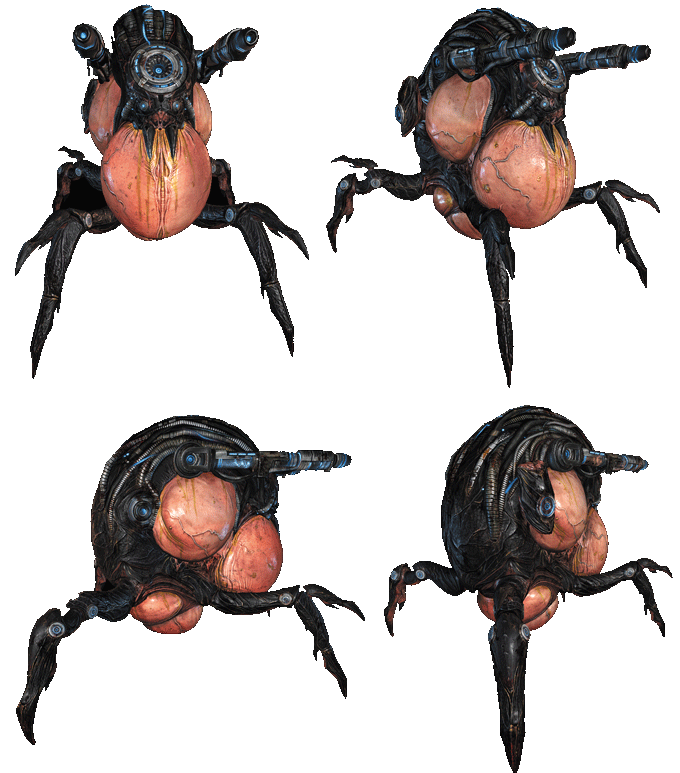
Beyond this, many creatures were also given discreet weaknesses—for example, the Guardian’s shield can be knocked away, and destroying the Ravager’s “sacks” prevents them from spawning new enemies.
This gives players opportunities to develop new tactics and discover the optimal ways to overcome the various enemies.
Through roles, each enemy would introduce a new power into the combat dialogue. For example, some would push the player into cover; others would force them out. Some would approach slowly, soaking up damage and presenting a great threat if they made it up close.
This allowed the designers to play with parameters like time and distance when building encounters; some enemies would become more dangerous the closer they came to you, others would become more dangerous the longer they were left alone, and so on.
Presenting these enemies together in interesting combinations would form the basis of the improved encounter design in Mass Effect 3. Players would be given a true combat puzzle to solve.
Enemies were also given a variety of ways to move and approach the player—for example, rocket boots allowing them to fly up or down, leaping, climbing walls, and so on—adding dynamism to the combat and making them look interesting while simultaneously keeping players on their toes.
Many of them would have a way to force themselves into the player’s combat space, a custom “entrance” that would surprise the player and challenge them to engage and use all their own skills—as well as the Shepard’s abilities and arsenal—to fight, and win.
Combat Example from Biotic Student Rescue Mission
At position A, a fixed turret cannot move but is highly dangerous if you are exposed to its fire. You enter the space, coming under fire from the turret, and take cover in position B.
Mobile enemies attempt to flank your position, forcing you to engage and exit your protective cover. You are again vulnerable to the turret.
Your task is to find the best way to exploit the environment, the weapons in your arsenal, and your abilities and those of your allies to destroy the enemies you face.
Animating Combat and Creatures
One of the great improvements to the creature animation process in Mass Effect 3 was the ability for the gameplay design team to iterate on creature behaviors almost immediately, whereas they historically had to wait for animations to be created before they could test creature behavior out.
The ability to test quickly allowed for more and faster iteration, working toward a good result before committing costly animation resources.
The combat designers start with a “box creature,” which essentially is a series of different sized boxes joined together to create the sense of a head, torso, limbs, and so on.
Using this simplistic creature, designers could experiment with timing of movement and attacks, pacing, and speed.
In parallel, the animators build an animation tree, a kind of blueprint that outlines the various movement capabilities of a character and the relationship between the various subanimations that comprise the action.
Once the combat designers understand, in rough terms, what the combat gameplay requires a particular character or creature to be able to do, the animation team works closely with them to find ways to visualize this through movement.
This is a close collaboration that involves both artistry and highly technical skills.
It is a constant balancing act between what looks natural and effective versus how quickly a certain move needs to be carried out in order to satisfy the gameplay requirements.
An incredible amount of tuning is involved with finding this often nuanced “sweet spot.”
The process unfolds in phases. Phase one involves animators putting rough posing and timing into place, the idea being to establish a basic set of motions so that the designers can tweak and tune as quickly as possible.
At this point, the character is simply a set of boxes.
The designers are able to integrate and tweak these animations quickly to bring the character to a baseline functionality and understand the scope and type of motion that the character requires.
Once the designer and animator are satisfied with the basic motion, the animator can move to the next phase, which involves adding layers to the existing animation, secondary movement that will help smooth out the actions and make them flow more naturally and seamlessly from one to the other.
At this point, timing has been locked down and the combat designers can tune, provided the animation does not get broken.
The third and final phase involves animators going in and polishing the final animations to ensure they achieve a shippable quality.
Animators often work from reference material. Sometimes this includes films and sometimes they will act out certain motions and record them for future reference.
For Mass Effect 3’s combat animation, the team reviewed footage of soldiers moving.
Shepard’s movement befits a soldier—a confident stride, quick movement when he needs to get into or out of cover, and dexterous reactions without being too agile (he’s not a ninja, after all).
With his expanded movement set in Mass Effect 3 (e.g., being able to slide into cover), the team added some parkour influences to his movement set.
For some of Shepard’s melee actions, the team referred to footage of Krav Maga, the martial art developed by the Israeli Defense Forces.
Weapon reloads in games need to be very fast, as your character will suffer if the process takes too long, leading to player frustration; however, there is also an expectation that the animations will make the character look compelling and will telegraph status without the player really needing to pay close attention.
In other words, players want to feel cool when they are reloading, but they want it to happen quickly so they can get back into the fight. They don’t want to have to wonder if the movement is finished or not.
The weapon reload animations in Mass Effect 3 enjoyed a major overhaul.
The team referred to footage of “speed-loading” competitions—an actual competitive sport where firearms enthusiasts attempt to load various weapons as quickly as possible in a kind of timed race.