
Gears of War 3 Guide Basic Training
Navigating the Battlefield
Utilizing Cover
Gameplay in the Gears of War series is based on using cover. Though you can achieve a fair amount of success on lower difficulties (and in multiplayer) by running and gunning, this simply does work on harder difficulties. Presenting your enemies as small a target as possible is imperative. Do this by standing or crouching behind solid objects such as walls, cars, sandbags, and other bulletproof barriers. Essentially, there are two types of cover: low and high.
Low Cover
Most cover falls into this category. As its name implies, low cover is any solid object behind which the player can take refuge, but is low enough to mantle over (i.e. hurdle). Low cover is generally waist-high and forces the character to crouch behind it for maximum protection. A small amount of the player is often exposed to standard enemies, but he or she can blind fire over the top of the object and even manually lean over the cover and aim, still concealing most of his or her body. It’s also possible to move left and right along low cover and attack from different positions. Grenades can be blind tossed over the top of low cover.
Low cover is the most flexible cover to use, but it does leave the player vulnerable in several ways unique to Gears of War 3. For starters, enemies can now perform a mantle kick. It used to be impossible to mantle over a piece of cover if an enemy was on the other side. The same scenario now gives the aggressor a huge advantage! The mantle kick knocks the foe in cover backward into a stagger, giving the player mantling over the cover a perfect opportunity for a pointblank shotgun blast!
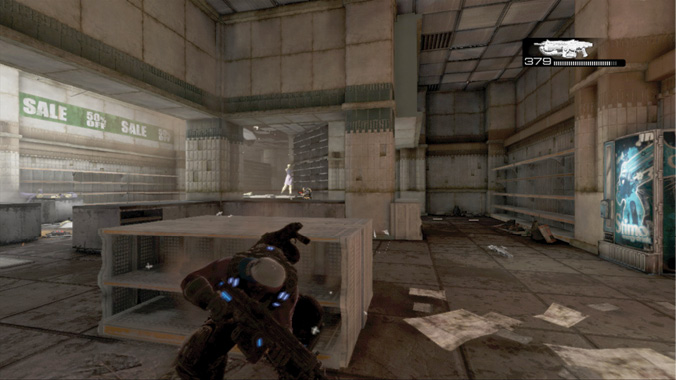
Low cover is also ineffective against certain types of Lambent. Gunkers can easily lob their Imulsion bombs over the top of low cover for a direct hit. Similarly, Drudges that undergo a leg or head mutation grow tall enough to attack directly over the top of the low cover. Enemies of normal humanoid height cannot angle their shots enough to hit enemies behind low cover, but taller enemies can quite easily.
High Cover
High cover refers to any solid object that’s tall enough to provide complete coverage to a player standing behind it. As a rule, high cover offers more protection than low cover, but at the cost of maneuverability. High cover tends to be a solid wall or column, in which case the only areas from which to lean out and fire are the structure’s obvious ends, such as at a doorway or on the left and right sides of a column.
Though the player can click the Left Thumbstick to manually crouch and keep his opponents guessing in that regard, he cannot blind fire over the top of the cover.
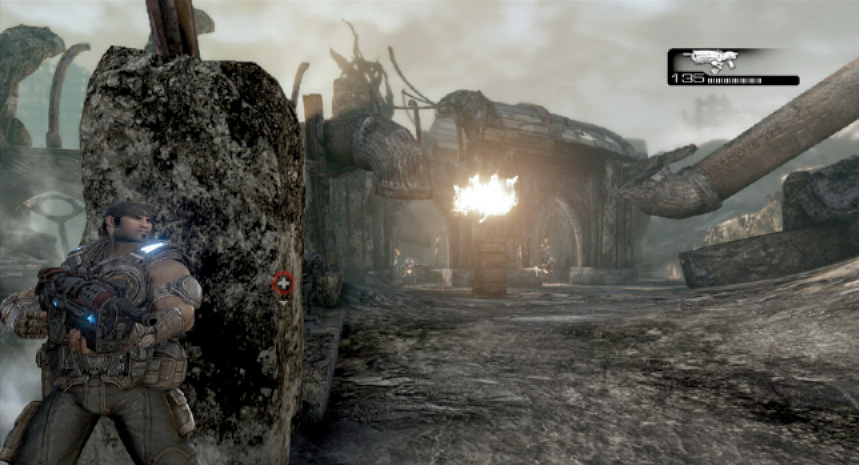
Players can blind fire from the sides of high cover and even cover swap between two adjacent pieces of tall cover. That said, high cover does somewhat limit your field of view and can make it difficult to spot an enemy moving along your flank. Nevertheless, high cover does provide near-absolute protection from taller enemies such as a mutated Drudge or the Gunker’s lobbed Imulsion bombs.
Enemies in Cover
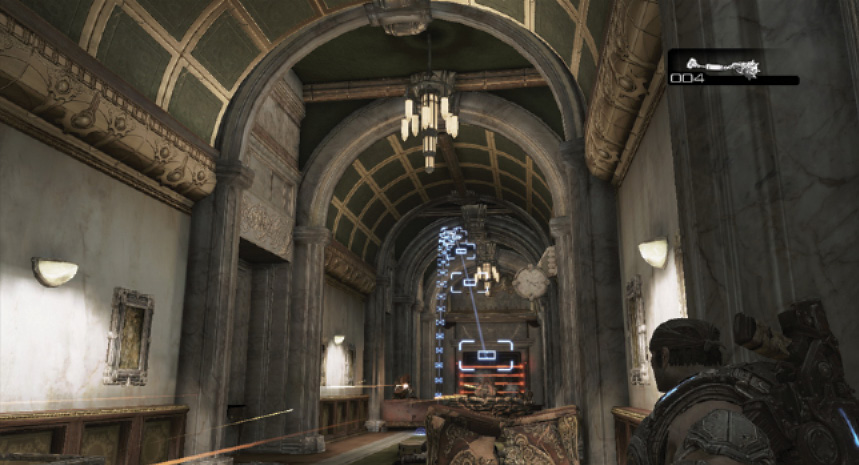
The Gears aren’t the only ones who know how to use cover; the Locust are more than capable of employing many of the same techniques described above. Grenadiers and Palace Guards are particularly savvy when it comes to using cover. The campaign walkthrough includes case-by-case tips for flushing enemies from cover, but you can employ a few general-purpose strategies throughout the game.
- Depending on the weapons in your possession, it sometimes makes sense to keep your distance and target an enemy while it’s in cover. Wait for it to expose itself during an attack, and quickly counterattack. This works best with a precise weapon, such as the Hammerburst or Longshot. Enemies often reveal a small portion of themselves when they crouch behind low cover—take the shot!
- An ideal way to expel an enemy from behind cover is by spotting and flanking. Spot the enemy to focus your squad’s fire on the foe. This will likely keep the enemy pinned down and may even soften him up. This gives you time to flank the enemy safely. Use cover to move up alongside the enemy to get a clean shot at it from a lateral position. You can do this without spotting the enemy, provided the area is large and the enemy is distracted. Otherwise, he might see you coming.
- Explosives provide another excellent way to force an enemy out of cover. Lobbing an Incendiary Grenade, Frag Grenade, or dropping a Mortar shell onto the enemy’s area almost certainly sends him fleeing if it doesn’t kill him outright. Take care when you do this to avoid wasting the grenade. Try to bounce the grenade off cover behind the enemy or to his side. Pay attention to the trajectory indicator, which shows where the grenade will ricochet.
| Casual | Normal | Hardcore | Insane | |
|---|---|---|---|---|
| Player HP | 1410 | 900 | 420 | 210 |
| Player DMG | x2 | x1.6 | x1.3 | x1 |
Gears on the Run
Movement is yet another aspect that sets the Gears of War series apart from others. Players can make their characters sprint, otherwise known as Roadie Run, but they can also use the cover system to wall bounce, cover slip, and slam into cover faster than the character can run. These techniques are actually far more important in Multiplayer mode than they are in the campaign. While you may have to run for your life occasionally in the campaign, these moments are few and far between. It’s often much safer to take a slower, more methodical approach to combat in the campaign. Keep your enemies at a distance, and sweep across the battlefield to play the angles before you advance. While staying in cover for too long in multiplayer will likely get you killed, leaving cover too soon in the campaign yields a similar result.
Mastering the art of steering your character in a Roadie Run serves you well during the campaign. Practice 90-degree and 180-degreen Roadie Run turns, and always tap the A Button when you approach cover to slide into it from several steps away. Though staying in cover and picking off enemies from the safety it affords serves you well, it’s important to move with urgency when you’re outside of cover.
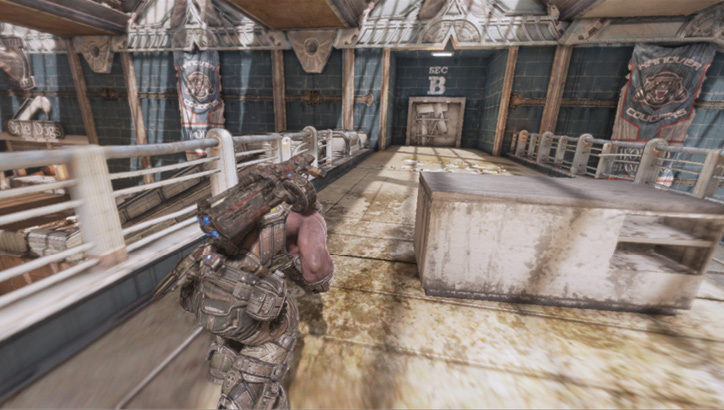
For a more advanced discussion of movement’s intricacies in Gears of War 3, please consult the Multiplayer Introduction chapter later in this book. It contains an expertly detailed breakdown of the numerous ways to move across the landscape using the cover system to your advantage.