
The Witcher 3: Wild Hunt Guide Appendices and Compendiums The Bestiary
Beasts
Not every danger that stalks the land is an otherworldly nightmare. Beasts from a time when fiends or royal griffins were not the apex predators have carved out their own niche, and are still a major threat.
Bears
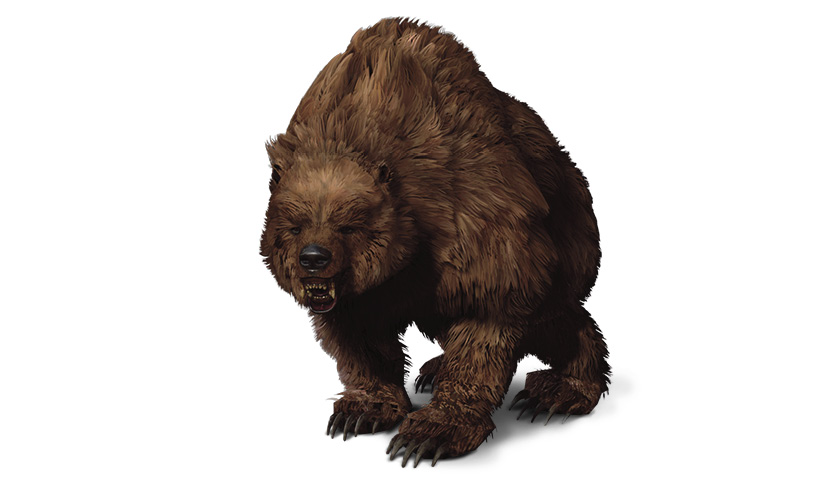
| Loot: Bear Fat, Bear Pelt, White Bear Pelt, Raw Meat |
| Sub-Species/Named Variants: Brown Bear, Black Bear, Polar Bear, Cave Bear |
| Environments: Found in every major wilderness region of the world, with some sub-species unique to certain regions. Polar Bears, for example, favor colder regions, and are found more commonly in Skellige. |
| Vulnerabilities: Beast Oil, Quen, Igni, Yrden |
Know that ditty about the bear “climbing the mountain, to see what he could see?” Biggest load of rubbish I’ve ever heard. When a bear climbs a mountain, it’s not to see. It’s to hunt. To kill. —Jahne Oldak, Royal Huntsman
Bears are omnivores—meaning men find a place in their diet beside berries, roots and salmon. When they snack on humans, they most frequently partake of the meat of travelers unwittingly trespassing on their territory, or else that of hunters for whom besting such a creature is a lifelong ambition.
There are several subspecies of bears—black bears, polar bears and cave bears—which differ from one another in coloring as well as in size and strength. All share one trait in common, however: a near-unmatched ability to kill.
Bears are found far from human habitation, in high mountains or deep woods. They are solitary creatures—and a good thing they are, for defeating a single bear is challenge to anyone, experienced witchers included. Fighting a bear should be avoided, but if it cannot, one should not try to run away—these seemingly clumsy animals can run at an astonishingly high speed, especially if angered.
Combat Tactics
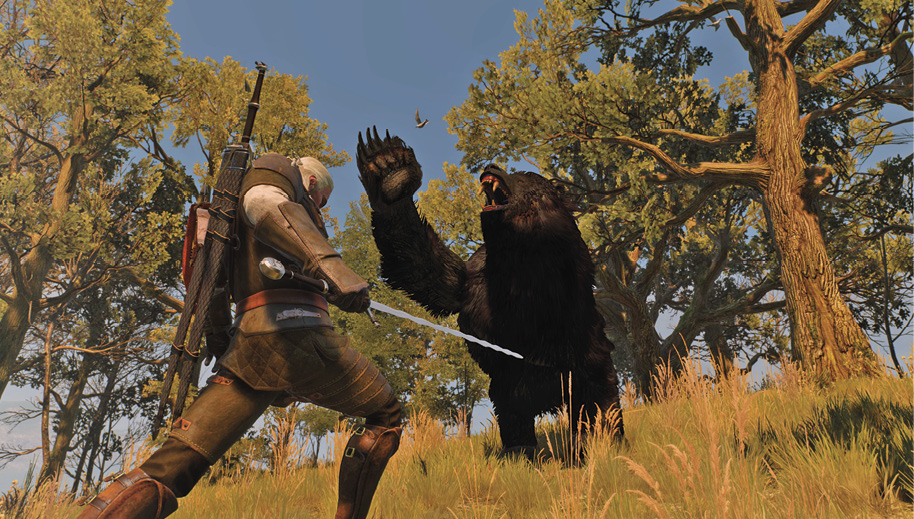
Bears of any kind are sturdy foes possessing great Vitality, and terrible strength. Do not try to exchange blows with a bear. Dodge their claw swipes and try to cut at their flanks.
Igni and Yrden are not explicitly weaknesses suffered by bears, but both have their uses. Igni can set a bear aflame, temporarily stunning it and allowing for flanking strikes. Yrden slows these beasts down enough to make evading their paws much easier.
When a bear stands on its hind legs, it is preparing to smash the ground with its forepaws. They can do this with such force that even a veteran witcher can be knocked prone.
Bears are territorial. Stepping into their domain can incite aggression, but it can be surprisingly easy to avoid a bear if you spot one early enough and move around it.
Dogs
.jpg)
A wild dog is seldom alone. Packs of three or more are common.
| Loot: Dog Tallow, Raw Meat |
| Environments: Found across Velen, Novigrad, and Skellige |
| Vulnerabilities: Beast Oil |
“They say a dog’s a man’s best friend… But in these foul times one best be wary, even of his friends”—Alfred Pankratz, beggar from Novigrad
Some claim dogs are reflections of their masters. A well-treated pet repays his owner with loyalty and trust, whereas an ill-treated one repays this treatment in kind as well, meeting yells with barks and kicks with bites. Since there is an abundance of bad men, so, too, is there an abundance of bad dogs. Most dangerous of all are the vagrant mutts who have lost all respect for men and developed a taste for blood and carrion.
Dogs usually attack in packs, choosing isolated victims, especially ones in whom they sense some kind of weakness. Packs of rabid dogs usually only dare attack children, drunkards, the elderly and cripples. Yet when backed into a corner, they will defend themselves with frothing bites and sharp claws against all and sundry.
Combat Tactics
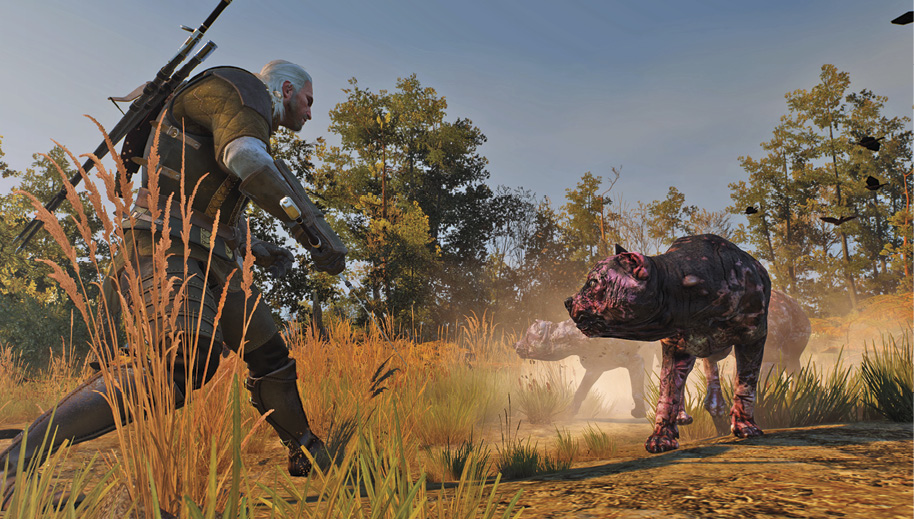
Aard is good for pushing back a pack of dogs, compared to other beasts of the world, the dog is lightweight.
Do not underestimate the speed of dogs. While not particularly strong, they are fast, and packs of dogs can easily pick apart a careless witcher through sheer numbers, and constant attacks.
Wolves
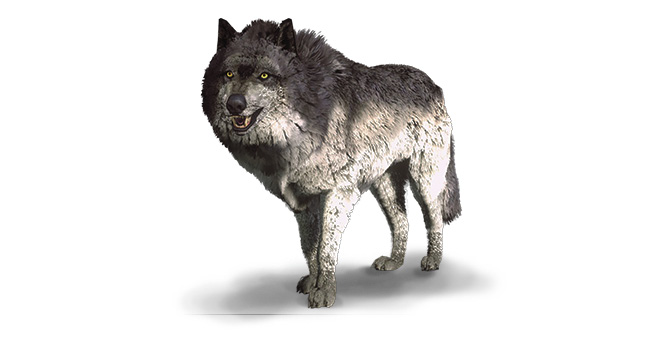
| Loot: Wolf Pelt, White Wolf Pelt, Wolf Liver, Dog Tallow, Raw Meat, |
| Sub-Species/Named Variants: Wargs, White Wolves, Dog Tallow |
| Environments: Found in Skellige and Velen |
| Vulnerabilities: Beast Oil |
“Friend of mine used to say that with all these griffins and basilisks and whatnot, good old fashioned wolves weren’t nothing to worry about… Then the damned beasts devoured half his flock.”—Yngvar, shepherd
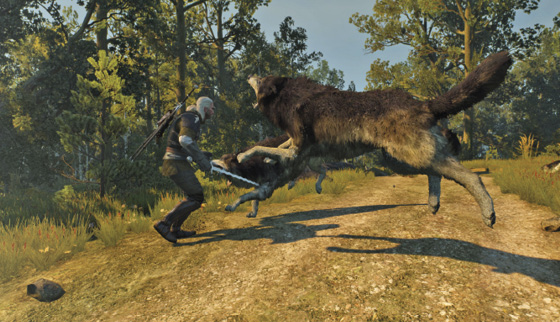
Once upon a time wolves were the absolute rulers of the forest. Men used them to frighten children, while adults, too, trembled at the sound of their howling. Post-Conjunction monsters not only pushed wolves into the deepest wilds but also took over their place in human nightmares. Yet this does not mean the old predators ceased to be a danger. Wolves do not have a drop of magic within them, breathe no fire and spit no acid, but that in no way stops them from killing unwary travelers and hunters.
Particularly dangerous are wargs, a nasty and ferocious subspecies of wolf, and the snow-white wolves which today can only be found in the wild highlands of the Skellige archipelago.
Wolves usually feed in packs counting from a handful to over a dozen members, though some particularly strong males hunt alone. Though wolves are weaker than many post-Conjunction monsters, they make up for any lack of strength with their intelligence. When fighting them one must be especially careful not to become surrounded. The presence of wolves can also signal more serious trouble—these predators often share their hunting grounds with werewolves and leshens.
Combat Tactics
Wolves are pack predators. They coordinate with each other to surround their chosen prey. Beyond the coordination, wolves are similar to dogs in how they attack.
Pack leaders are typically the highest level wolf in a given pack, and are occasionally a warg as opposed to a regular wolf.
If surrounded, Igni and Aard can drive off a pack, if just for a moment, allowing a witcher some time to recover their Stamina or regain control of the fight.
Leshens are able to command wolf packs to aid them. Wolves summoned by leshens must still be fought with silver swords.