
World of Warcraft: Warlords of Draenor Signature Series Strategy Guide Introduction
Advanced Group Play
Grouping changes the nature of World of Warcraft play considerably. Players are no longer focused on doing everything for themselves. Instead of acting as tank, healer, and damage dealer all at once, you get to focus on whatever you do best, while others in your group do the same.
Groups can carry up to five members, and that is what’s needed to complete most dungeon runs. This section explains more about roles in a group and dungeon running.
World Dungeons
World dungeons are large places designed for more intensive play than standard areas in World of Warcraft. Some world dungeons are bigger than others, but they all have instanced zones. An instance is a specific copy of the dungeon that is for your group only. In the same way that your server is a copy of World of Warcraft, your instance is a copy of a dungeon. You can only enter the same copy of the dungeon if you are in a party with your friends.
Level 15 is the minimum character level to enter the lowest-level World Dungeons. You aren’t required to take five characters into a dungeon. An overleveled character can solo things to farm for low-level materials. You won’t be getting in anyone’s way because you’ll be in your own copy of the dungeon.
However, taking on any dungeon of appropriate level should be done with all five character slots filled. Everyone should also meet the level requirements of the dungeon and be geared adequately. Even if someone’s gear seems a bit low, don’t immediately assume they’re no good for the dungeon. Give that player a chance before making a snap decision based solely on gear. Poor player skill is far more of a liability than weak gear!
What to Expect in World Dungeons
Group Preparation
When you’re in a group that is considering a dungeon run, make sure that you know the answers to the following questions.
Who is the main tank? This is the person who initiates fights, holds aggro, and protects the group. You want to ensure that their job is as easy as possible because your character’s life depends on it.
Who is the main healer? Almost any group is going to need one healer, and some are going to need more than one to get through a dungeon. The main healer should be saving all resources for healing. They only try to add damage to a fight when things are going especially well.
Who is dealing damage (DPS)? Everyone who is going to focus on damage is included in the group’s DPS (damage per second, but it’s often used as a way to say damage). Damage dealers should have /assist macros to ensure that they are all hitting the same targets. The most experienced DPS member should be the one that everyone assists.
Who will do the pulling? Some main tanks like to have another person bring monsters back to the group. A puller is a character who goes ahead of the group and then lures enemies back to a safer position, where they can be ambushed and killed without the danger of additional targets joining the encounter. If the main tank isn’t a puller, this task often falls to a ranged character or someone with stealth.
Who is the group leader? Someone needs to lead, and the others must follow. A tradition is to have the main tank lead—but they should know the dungeon well. A good leader should know an area ahead of time and be a skilled player!
Does everyone have all the dungeon quests? Look in the quest log to make sure everyone has pertinent quests. Share everything possible so everyone gets the most gold and experience from their dungeon run.
How long will it take? Confirm whether anyone has to leave early. Some dungeons are much longer than others, and having someone leave in the middle is a major hassle.
What are the loot rules? Every group must decide on loot rules before starting their fights. You don’t want a good item to appear and get snatched away because you didn’t decide on this ahead of time.
Has everyone shared their class buffs? Use class buffs, food, and any other bonus-producing goodies before starting a challenging quest or dungeon run.
Are Hunters and Warlocks managing their pets? Pets should be set to assist. For specific encounters where precision is key, people may even ask that pets be dismissed.
Level Requirements
Because the content in dungeons is difficult, each dungeon has a recommended level range that all members in your party should meet. Taking someone who is below that level requirement is problematic, because enemies can aggro on that lower-level character from farther away. This makes it much harder to manage fights or sneak through specific areas (even in more cautious groups it can lead to problems). Also, higher-level monsters are hard to hit; a character below the minimum isn’t going to contribute much toward a group’s success.
The best way to find level-appropriate dungeons is to use the Dungeon Finder tool and see what’s available. Once you hit level 15, there will be at least one instanced dungeon available, although you may need to discover its entrance first.
Dungeon Preparation
Here are a few more things to do before starting a group for a dungeon run.
Wipeouts
Wiping occurs when all members of your group die and they have no way to resurrect where they died. If this happens, you must run back from a graveyard and return to your corpse. When this happens inside a dungeon, you must go back into the dungeon’s entrance before your body respawns.
Depending on the timing, all the monsters you killed may still be dead; or they may have respawned, which means they’ve reset, and you have to fight them again. This only happens when a group takes a long time to complete a dungeon. This is sometimes a sign that things aren’t going well and people might want to try again another time.
Understandably, groups want to avoid a wipe at all costs, so it’s wise to try to save a party member who can resurrect everyone else later. However, if your group does wipe, don’t get too upset about it. Wipeouts happen, especially when people are learning new dungeons/encounters.
Your gear suffers a durability hit when your character dies, but the cost isn’t that severe. It’s easy to make money with questing, selling things on the Auction House, and by general fighting. You aren’t going to end up poor because of a few lousy dungeon runs.
Pick Up Groups (PUGs)
In this case, PUGs aren’t cute little dogs. This refers to groups that are formed by strangers, often using the Group Finder’s Dungeon Finder tool. These are the hardest groups to win with, but that doesn’t mean that they’ll always be of low quality. Indeed, you might end up with several people who know a dungeon already or have impressive gear, and the dungeon will be a walk in the park because of it.
The reality of PUGs is that you won’t know what to expect. Their quality has such wide variance that you might have a perfect run and follow it up with a nail-biting, hair-pulling attempt that falls flat after an hour.
To limit your time with random groups, remember to /friend people who impress you. Good players make groups a great deal more enjoyable. If you can fill two or three slots with players of known skill, you won’t have nearly as much uncertainty in your dungeon delving.
Eventually, you might find a group or guild to adventure with regularly. This leads to considerable advances in tactics and playstyle. It’s also a great way to make friends.
Tactics
Take a look at which abilities you use while soloing. Some of them make perfect sense when you don’t have anyone watching your back. However, in a group environment, some of these become a waste of time and resources. If you’re not taking aggro from monsters, why use something that raises your survivability by a substantial measure (especially if it takes away from your damage output)?
 Figure out how to best contribute within your role. If you’re a tank, learn how to mitigate as much damage as possible. Use abilities that get attention from multiple monsters. Try to keep yourself from going low on health, and learn how to control monsters’ positions so the damage dealers know where to stand in each encounter.
 Healers should spend a huge amount of time looking at everyone’s health and saving the group from harm. Find ways to do this efficiently during long fights as well as methods to maximize your healing output and mana during tense boss fights. Consider who the most important people are to keep healed (e.g., a tank or another healer), move as necessary to keep things from pounding on you, and take enemies over to someone else if you do get attention. Being an effective healer isn’t only about managing bars, it’s also about good communication.
 Damage dealers should lay on as much damage as possible without stealing aggro from the main tank. As long as they assist each other to stay on one target at a time, this is not terribly difficult. They’ll rip down individual enemies while the tank holds onto everything else (and preferably the single target as well)!
Don’t be afraid to ask questions before a fight. Ask about your role or your abilities. Some people will be annoyed by this. The majority won’t, because they know that you’re trying to learn. They also know that your questions might save the group in the pull ahead. If one person didn’t know what to do, maybe there were a couple more people who didn’t know but were afraid to ask!
Also, use available resources to find out more about your targets. The Dungeon Journal is an in-game tool that lists all the abilities and available loot within World Dungeons.
Have Fun
This section might make dungeons seem awfully intimidating and tough. They can be, but they can also be very satisfying to complete. Dungeons reveal more about the Azeroth storyline, and they hold the most exotic, sometimes amusing, and powerful enemies in the game. For success, enter a dungeon, listen to your leader, and pay close attention, but also have fun!
Dungeon Finder Tool
If you want to run a dungeon, whether you’re part of a full five-player group or joining on your own, the Dungeon Finder tool is a valuable resource. Using the Dungeon Finder to run dungeons has many advantages, but the biggest one is arguably the fact that you are transported directly to the dungeon interior instead of spending the time traveling.
What About the Other Options?
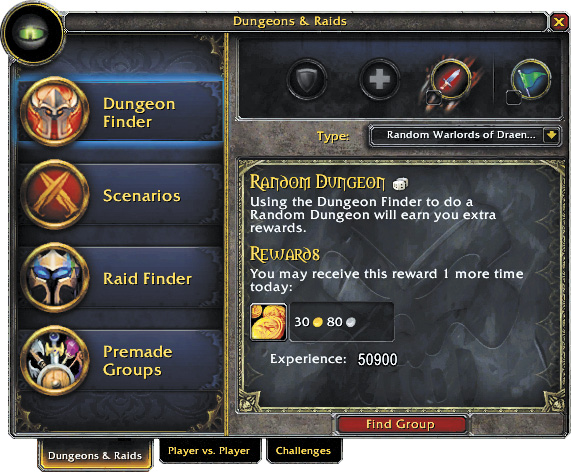
Using the Dungeon Finder
The Dungeon Finder tool first becomes available at level 15. To access the Dungeon Finder tool, click on the appropriate icon in your interface bar, or press I on your keyboard. First, you can select a specific dungeon, or set the system to randomly assign a dungeon. Next, select a role appropriate for your class and spec (Tank, Healer, Damage dealer).
The Dungeon Finder places you in the queue, and the Dungeon Finder tool icon appears near your minimap. Mousing over the Dungeon Finder icon provides the average wait time for players using the system. Tanks and healers generally have much shorter wait times than players who choose a damage role.
Use the drop-down “Type:” menu to choose to run a random dungeon, or a specific dungeon from a listing appropriate for your party’s level range. While it might be tempting to stick with familiar dungeons, there are advantages to running random dungeons (more on that soon).
The Dungeon Finder always places you in dungeons appropriate to your character’s level and equipment. At higher levels, you may need to meet certain requirements, such as completing a quest or discovering a dungeon’s entrance, to access the dungeons through the Dungeon Finder tool.
Queuing in a Group
Groups, whether full or in need of a few roster spots, can still use the Dungeon Finder. The group leader queues the entire group, but individual players must choose their role (or roles—with dual specs, most classes can select more than one role). If your group has fewer than five players, it is placed into the queue and other players already in the queue are added when a dungeon is selected.
If your group already has five characters, then you are sent to a dungeon immediately after everyone has selected a role. Keep in mind that at least one player must select Tank and another Healer in order for the Dungeon Finder to place your group.
Inside the Dungeon
After entering the dungeon, you can use the Dungeon Finder icon near your minimap to teleport out. Doing so sends you back to the spot from which you were teleported into the dungeon. Walking out of the portal at the dungeon’s start does the same thing. To find the option to return to the dungeon, right-click on the Dungeon Finder icon.
Random Dungeon Bonuses
Completing a random dungeon provides extra rewards. Most often the rewards are extra money, experience, and even items at lower levels. Another advantage to selecting a random dungeon is that everyone in a group with at least one random member receives a Luck of the Draw buff. Luck of the Draw increases damage done by 5%, healing done by 5%, and health by 5%. This number increases in 5% increments for each random party member included in the group, although the maximum benefit given by Luck of the Draw is 15%.