Red Faction: Armageddon Guide Essentials Universe
Science, Technology, and Culture in Red Faction
Nanotech and the Red Planet
Traditionally crafted out of metal, carbon filaments, or plant fiber, nanites have been used since the end of the twentieth century, to fortify sunscreen, brighten clothing, and aid in fuel catalyzation.
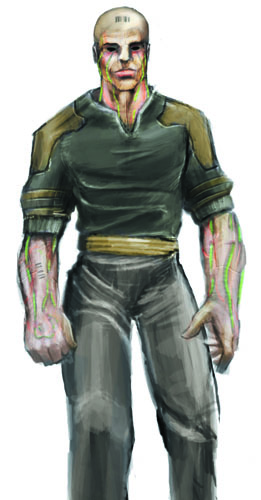
Unfortunately, they also have their darker uses, and as the Earth slowly descended into chaos, it is these uses which became more and more common. Nanite production began to focus on creating genetically modified humans to fight on the battlefields of the future. Axel Capek was there in these early days, and contributed to the large amount of crude, deformed super soldiers, who were mercilessly euthanized when they didn't prove viable.
When Capek's work was uncovered, the starving denizens of Earth were horrified. He was forced to flee to Mars under the cover of Ultor's army of lawyers, and there his research continued. This ultimately led to the creation of the Plague, a nano-borne disease with a mortality rate of one hundred percent--and a mutation rate nearly as high. For years, many would consider this the peak of the Doctor's mad genius.
Then, the Nano Forge was discovered.
Capable of creating nanites from ambient material, and disassembling molecules down to their component parts, the Nano Forge is one of the most powerful devices in existence--more than one war has been fought to possess it, and more than one war has been won by applying it. During the 22nd century, Samanya weaponized the Forge, mounting it to a rifle. With it, her future husband, Alec Mason, was able to destroy entire buildings in one shot . . . and ultimately . . . win the war for Mars.
Since then, the Nano Forge has been handed down through the Mason lineage, each generation tweaking it for their own purpose. Even now, in the hands of Alec Mason's grandson, Darius, the workings of the Nano Forge are only vaguely understood; too much use could potentially overheat the device, warp its constituent organelles, or completely destroy it, rendering the last producer of nanites on Mars inoperable.
But with it, Darius is a peerless warrior. For that reason, and many others he'd prefer not to think of, he shoulders the hopes of Mars.
The Universe of Red Faction is filled with complex organisms that test the classic perception of what is a living being and what is a mechanical one.
Mars isn't exactly the Wild West, but it does feature many of the same trappings. Chief among these is the idea of the "pioneer spirit," the idea being that if you pull yourself up by your bootstraps, all the charlatans, bandits, and flash floods can't pull you down.
Reduce, Reuse, Recycle
During its colonized history, Mars had not been a production-heavy planet. Pre-fabricated units were constructed on Earth, broken down, and shipped to Mars for construction. It made sense financially, but it had the added benefit of allowing the Ultor Corporation to keep its miners buying from the company store rather than engaging in capitalist supply and demand.
The EDF, too, saw no reason to discontinue the practice, particularly because production lines of any kind had the ability to produce weapons and tanks for Red Faction guerillas.
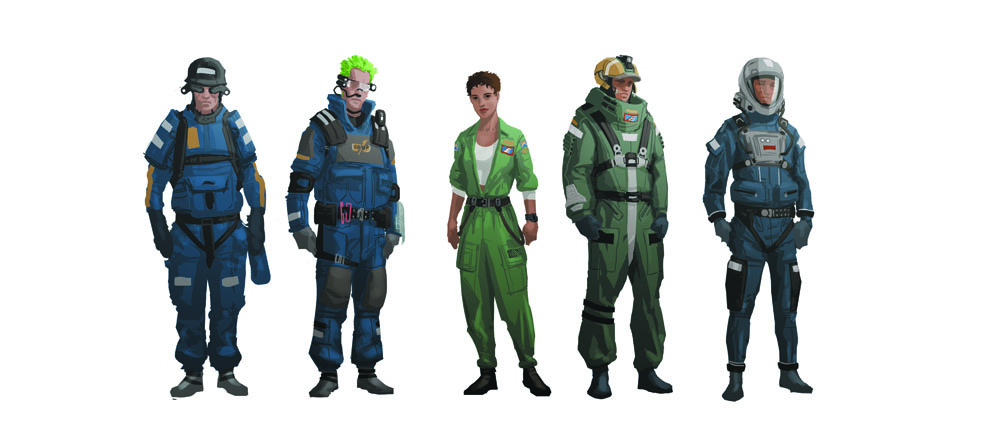
From its inception, Mars has been in a perpetual state of reconstruction. Storms ravage the surface, bandits destroy lines of transport, cities are founded and then abandoned. It is the nature of a boom-bust world where violence is a constant.
As a result, Martians have turned recycling, salvaging, and smuggling into art forms. Old ruins are habitually raided for materials. Worn out vehicles stripped of any usable piece of metal. What's left is melted into slag and then reconstituted into something new and usable. Nothing goes to waste. With Earth no longer sending regular supplies, what's left on Mars is going to stay on Mars.
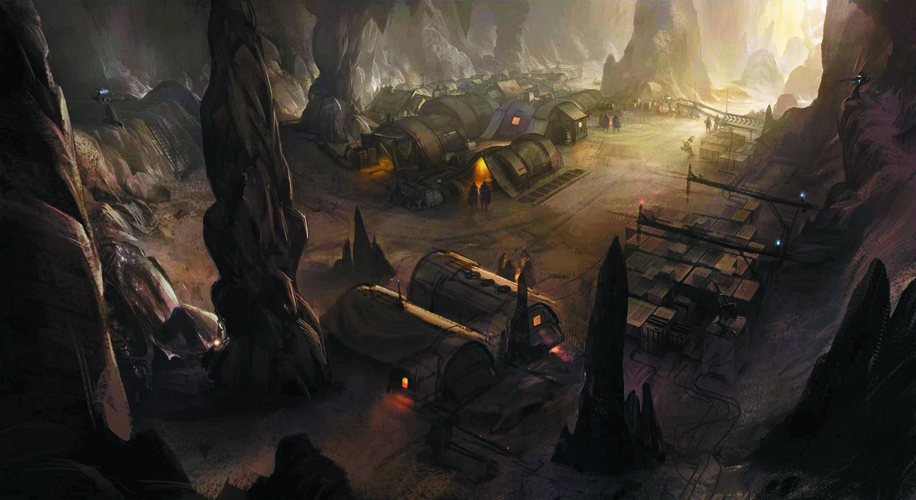
The population of the Red Planet by 2220 was almost entirely born on Mars, but few thought of themselves as Martians. By Red Faction: Guerilla, Martians are Martians and proud of it, having had to fight for their self-determination.
Martian communities are based around protection and survival rather than communal growth or personal advancement. You won't find a lot of public schools or humanitarian hospitals on Mars.
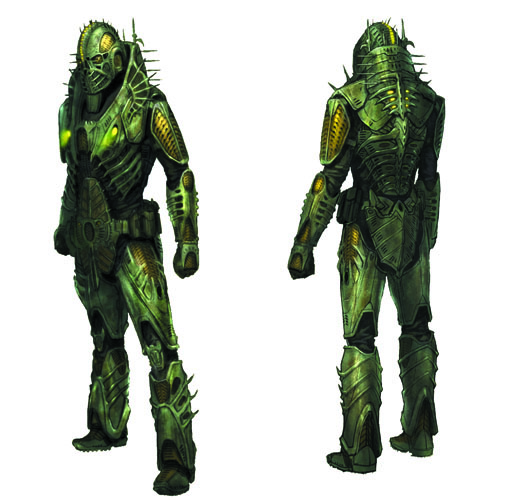
Marauders: The "Other" Mars
Once an elite group of scientists handpicked by Axel Capek to advance biochemical, genetic, and nanotechnological research, the Marauders were both born and made. After Parker's Rebellion, a small group of these scientists stayed behind on Mars, their research not yet complete.
Marauder society is just as vibrant and interesting as that of the Colonists and, in some ways, more interesting because it is more exotic to traditional human experience. To the Colonists, the Marauders are terrifying, brutal barbarians, roaming the surface of Mars, but there is more to the Marauders than just their militaristic hierarchies and often ghoulish appearance.
The Marauders venerate science; their spiritual beliefs are wholly tied to the original work of Capek's scientists. Because of their genetic and biological research, the early Marauders rapidly grew from fewer than fifty scientists to several hundred in a single generation, and exponentially onward. Their rigid hierarchies and dogmas grew originally from the way this second generation of the group was brought up. With only a few "parents," the "children" were educated in a highly disciplined tribal society that emphasized specific vocations, which turned into rigid caste hierarchies in the subsequent generations of Marauders.
This population explosion also forced the group to split into roaming communities, forced to search Mars for the resources they needed to sustain their growth and the relics and points of scientific inquiry to feed their ravenous scientific pursuits.
In the third and fourth generations of Marauders, the scientific precepts of their forefathers evolved into a form of mysticism that was more in tune with the requirements of their roving tribal culture. To survive as groups they became hard and their social ethics conflicted with some aspects of Earth's traditional methods of scientific research.
Science became a religion, with dogma that was often bent to the needs of a rule-or-be-ruled society. It was not "might made right," but it was close enough for the differences to be indistinguishable to an outsider. They became extremely militaristic in response to the conditions on Mars, both environmental and social, often augmenting their physical bodies to provide advantages.
Within their groups they maintained close control of their breeding populations, adopting an attitude more in keeping with the genetic and eugenic research of their progenitors. They also were ruthless in their culling of members of their groups deemed weak, intransigent, or a drain on resources.
Even when the terraforming of Mars began under the EDF, the Marauders preferred the channels and caverns of Mars to the surface. It was easier to hide, easier to ambush, and easier to escape than while out in the open. At the same time, the discoveries of mysterious runes and alien technologies drew the Marauders further beneath the surface. The numerous "gifts" of the "usurpers" were always viewed with mistrust. This idea was reinforced when the Marauders first met EDF forces; the ensuing massacre stained the relationship between the two sides for decades to come.
A Chancellor-General, elected from all Marauders, interpreted their laws and kept the peace amongst the roving communities. Mostly, the Marauders did what they pleased so long as they did not bring stress upon others. Problems were handled by families and tribes, while nearly all of the intra-Marauder antagonism came from the tolerant vs. hard-line denizens: the former more willing to accept the "other" Martians, and the latter desirous of violence or extreme segregation.
The animosity between the two groups affected more than just Marauder society. Technological growth stagnated greatly during the initial implementation of the law, before the uneasy peace of Marauder-Martian relations normalized after the destruction of the Hydra. The First Law commanded Marauders to evolve and develop, but with survival at a premium, the easiest, and most prestigious, avenues of scientific exploration were those that kept Marauders safe, secure, and hidden.
From this grew an economy based upon trade and salvage. Marauder weapons and items never just served a single purpose: a soldering gun was a weapon as well as a mining implement. Like the American Indians, they used every part of every piece of salvage they found, never wasting energy or material that could be used later. This often gave their artifacts a rough, steampunk-like quality to them, as they had very little need for aesthetics above functionality, but the durability of their products made them highly desired on the streets of Bastion.
Even through their differences, the two groups of Martians were remarkably similar. Distrustful of authority, insular, worn, capable, and loyal, all Martians seemed to be made from the same psychological molding.
From Ultor to the EDF to White Faction to the Cultists to the Plague, there has always been someone trying to oppress those who wanted a better life on the Red Planet. Some people acquiesced and lived lives of quiet desperation. Others rebelled, creating a planet of freedom and hope for the future.