
Mass Effect 2 Guide Essentials TRAINING
Character Management
Experience and Level Progression
As you cross the galaxy, defeat enemies, and complete both missions and assignments, you earn experience points. Experience points accumulate over time.
When your experience points reach specific thresholds, you earn a new level. Each new level awards you talent points, which you can spend on developing powers for both yourself and the other members of your squad.
You do not earn talent points at the same rate for yourself and your squad, though. Squad points for the team lag behind points earned for yourself.
With each new level, you are awarded two squad points for yourself. You can immediately assign these points to powers, or you can hold on to them and use them later.
When you develop powers to their third level, you need more than two squad points to move to the fourth level.
Use this level chart to see how many experience points are required for each level as well as the awarded points for yourself and the squad.
| Level | Experience Points | Talent Points | Squad Talent Points |
|---|---|---|---|
| 1 | 0 | 2 | 1 |
| 2 | 1,000 | 4 | 3 |
| 3 | 2,000 | 6 | 5 |
| 4 | 3,000 | 8 | 7 |
| 5 | 4,000 | 10 | 9 |
| 6 | 5,000 | 12 | 9 |
| 7 | 6,000 | 14 | 11 |
| 8 | 7,000 | 16 | 11 |
| 9 | 8,000 | 18 | 13 |
| 10 | 9,000 | 20 | 13 |
| 11 | 10,000 | 22 | 15 |
| 12 | 11,000 | 24 | 15 |
| 13 | 12,000 | 26 | 17 |
| 14 | 13,000 | 28 | 17 |
| 15 | 14,000 | 30 | 19 |
| 16 | 15,000 | 32 | 19 |
| 17 | 16,000 | 34 | 21 |
| 18 | 17,000 | 36 | 21 |
| 19 | 18,000 | 38 | 23 |
| 20 | 19,000 | 40 | 23 |
| 21 | 20,000 | 41 | 24 |
| 22 | 21,000 | 42 | 24 |
| 23 | 22,000 | 43 | 25 |
| 24 | 23,000 | 44 | 25 |
| 25 | 24,000 | 45 | 26 |
| 26 | 25,000 | 46 | 26 |
| 27 | 26,000 | 47 | 27 |
| 28 | 27,000 | 48 | 27 |
| 29 | 28,000 | 49 | 28 |
| 30 | 29,000 | 50 | 29 |
Morality
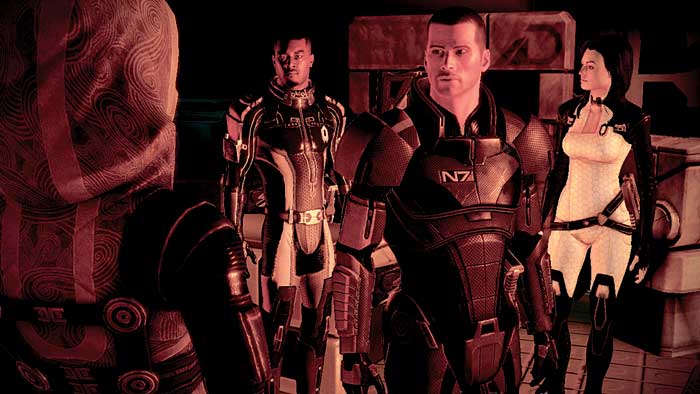
Your hero has a sense of morality that follows them through the adventure.
How you choose to interact with squad members, enemies, and even complete strangers affects your hero’s morality, which in turn defines their personality in a more active manner than their backstory (which does affect morality).
Morality is expressed in two forms: Paragon and Renegade.
Paragon and Renegade sound like absolutes, but as you know, life is never quite that black and white. So many choices deal in the gray area between the absolutes.
Paragons charm. They flatter. They may not choose the most expedient way to complete a task if the alternative is ethically questionable.
Renegades are not wicked, but they could be considered intimidating or selfish.
Renegades look out for themselves and are not always considerate of the feelings of other people, especially when such consideration stands between them and getting the job done.
When you choose a Paragon action or conversation topic, you earn Paragon points. Conversely, choosing a Renegade action results in Renegade points.
Over time, these points accumulate. Having more points on either end of the morality scale affects choices you have during your adventure.
If you are trending toward Paragon, you will have more Paragon conversation choices, such as the ability to charm people into doing what’s right or agreeing with you.
So, does it pay then to walk the line between Paragon and Renegade? Not necessarily. Although there will be times when a Paragon wants to take a Renegade action (Renegade actions sometimes shorten battles thanks to underhanded moves) and vice versa, it pays to trend toward one or the other over the course of the adventure.
The higher your rating in either Paragon or Renegade, the more options you will have. If morality points are spread across both evenly, you will miss out on some of the more extreme morality options.
Furthermore, a high Paragon or Renegade rating may also affect which allies you can recruit.
Your Paragon or Renegade rating also affects your appearance: as you earn more Renegade points, your facial scars worsen; scars improve as you earn more Paragon points.
Interrupts
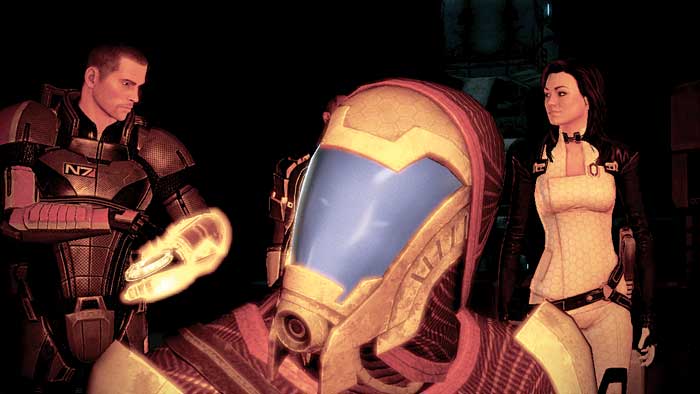
During conversations, you may see a Paragon or Renegade symbol appear onscreen. The Paragon symbol always appears on the left side of the screen. The Renegade symbol always appears on the right side.
This signals an opportunity for an interrupt that results in morality points. When you see the symbol, press the associated button to take the interrupt.
Interrupts let you take charge of a situation. For example, let’s say a krogan warrior is rambling on and on about his master plan to make his clan the most powerful in the galaxy.
While talking, the krogan does not realize he’s standing on an explosive tank. The Renegade interrupt appears. If you act fast and take it, you shoot the tank under the krogan’s feet. The tank explodes, killing the krogan warrior.
The battle that would have taken place after the conversation happens anyway, but thanks to your move, the krogan warrior is already out of the equation.
Now, killing the krogan while he’s just talking isn’t exactly the honorable thing to do, so you take on Renegade points for doing so.
Dialog
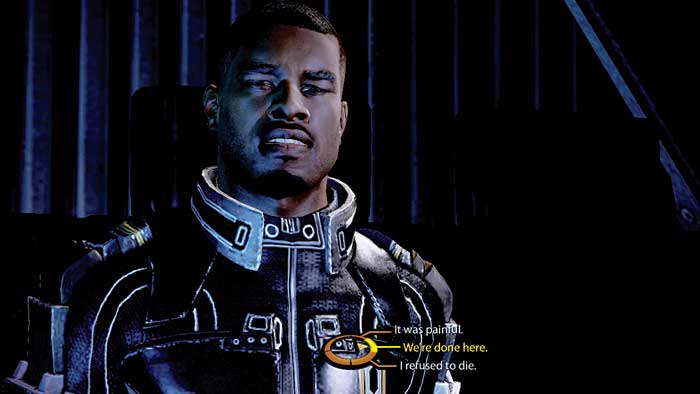
While a gun is an extremely effective communication tool, it’s not the only one at your disposal. You will talk to friends, enemies, and strangers while traveling the galaxy.
When you enter into a conversation, you direct your responses or line of questioning with the dialog wheel located on the bottom of the screen.
Move the arrow in the center of the wheel to the desired conversation option and select it to speak or end a conversation
(sometimes you end conversations wordlessly—nothing says goodbye like a bullet).
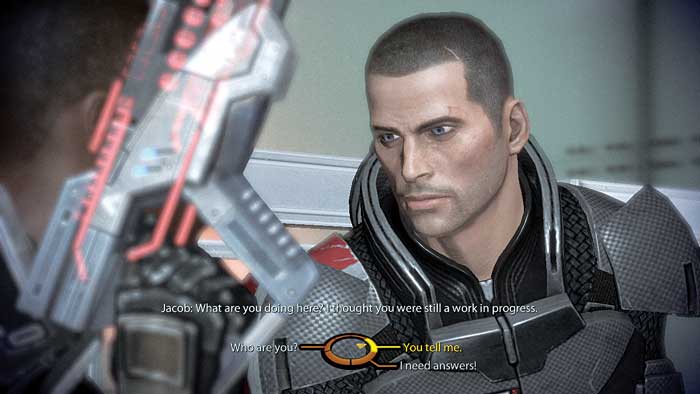
The dialog wheel always has different options on it, but the structure of the wheel itself is universal. Options on the left side of the wheel draw out a conversation—these are investigative topics.
Options on the right side of the wheel steer a conversation toward its conclusion.
The position of an option on either side of the wheel is also important—these are tonal. Options in the upper corner of the wheel are largely considered friendly or positive. An option in a lower corner is hostile or dismissive.
Guiding a conversation through positive or negative channels can result in Paragon or Renegade points, so if you are playing to a particular morality end, keep these positions in mind when using the dialog wheel.
As mentioned in the “Morality” section, if you have a high enough Paragon or Renegade ranking, you unlock additional conversation options.
Just as there are different degrees of Paragon and Renegade, there are conversation options that do not open until you are high enough in either morality category.
If you are merely trending toward Paragon, for example, you will easily be able to charm shopkeepers into giving you a discount.
You need to be quite the Paragon, though, to talk a disgruntled crew member into rejoining the social structure of the team. Without a high enough Paragon or Renegade ranking, some dialog avenues will just never be open for you.
Fraternization and Loyalty

When a crew goes through extreme situations together, it is impossible not to feel great bonds with each other. Nothing sparks and eventually solidifies a relationship quite like staring death in the face.
While Cerberus does not exactly condone relationships between team members, the Illusive Man is not about to board the ship and tell two team members to take a cold shower.
And so you can pursue deep friendships with members of the team, including romantic relationships.
Not every relationship with a team member has the potential to turn romantic. Some relationships will always remain just friendships—perhaps even close ones.
To develop a relationship, you need to talk to team members—and then keep talking to them. Check in with team members between missions. Kindle relationships by choosing positive dialog. Show compassion.
Don’t be afraid to be tender or even flirt a little. However, there are always risks involved when building relationships.
Say the wrong thing to the wrong person and you will turn someone off. Some will be turned off permanently. They won’t bail out the nearest air lock, but they will keep things strictly business from then on out.
Gaining the loyalty of your crew is important to your overall mission, so it’s a good idea to keep everyone happy.
Developing relationships is exciting. It adds a personal level to an adventure that’s bigger than life. You may not want to spoil how relationships unfold if you prefer to tackle them organically and let the chips fall where they may.
Relationships with team members all start out the same. You have generic questions you ask them once they are aboard the ship to get a little backstory on them and establish a baseline friendship.
However, team members hold a lot back in the very beginning of their service on your ship. To draw them out and build the relationship, you must keep talking to them.
Over time, you will nurture a relationship unless you say something absolutely terrible. That shuts down a relationship, and it’s very difficult to recover from it without a high Paragon or Renegade rank.
Some relationship killers can never be overcome, so consider the potential effects of your dialog before opening your mouth.
All members of the crew have personal situations that they need help dealing with—these are called loyalty missions because once you complete one, that team member is considered loyal to you, which unlocks not only relationship potential, but also a special power.
The loyalty mission is a pivotal moment in a relationship and is crucial to completing the main story line of the game. Prior to the loyalty missions, you can speak to team members once or twice to get a little conversation out of them.
You must let a little time pass between conversations to keep building the relationships. Passing time is equivalent to going on a mission.
However, once a loyalty mission has been successfully completed (you can fail three of the loyalty missions, which also shuts down a potential relationship), the relationship enters its next phase.
Speak to the team member following the loyalty mission and be positive. At this point, a friend is turning into either a romantic interest or a trusted ally.
After undertaking another mission following the completion of the loyalty mission, return to the team member and talk again.
If this conversation is positive and successful (meaning, you don’t say anything rude or untoward), the relationship reaches its highest level. If the relationship is a romance, then you will see a special scene between you and the team member prior to going on the final mission. And by special, we mean…well, you know what we mean.
Now, because you can nurture relationships with all team members, you need to realize you cannot carry every relationship to the penultimate scene. You must choose which team member you want to be exclusive with.
If you try to be romantic with another team member, they will let you know that they wish to be exclusive. You now have the option to go to the team member you have set up for the special moment and let them down either easy or hard.