
Mass Effect 2 Guide Essentials PLANETARY DATABASE
Cluster: Minos Wasteland
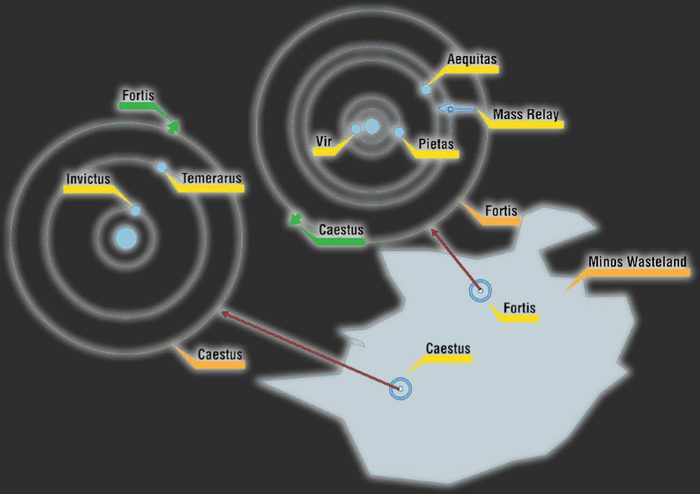
| System | Planets, Planetoids, and Other Galactic Flotsam |
|---|---|
| Caestus | Invictus, Temerarus |
| Fortis | Vir, Pietas, Aequitas, Mass Relay |
| Related Mission | System | Planet |
|---|---|---|
| Special Assignment > N7: Abandoned Mine | Fortis | Aequitas |
System: Caestus
Invictus
World Type: Garden
Richness: Rich
Element Zero: Moderate
Iridium: Moderate
Platinum: Rich
Palladium: Moderate
Colony Founded: 1939 CE; Population: 320,535,000 (est. 640,000,000 with illegals); Capital: Shastinasio; Orbital Distance: 1.3 AU; Orbital Period: 1.5 Earth Years; Radius: 7,260 Km; Day Length: 31.6 Earth Hours; Atmospheric Pressure: 1.15 Earth Atmospheres; Surface Temperature: 30 Celsius; Surface Gravity: 1.5 G.
Description: Home to dextro-amino-acid-based life, Invictus has temperate zones that were settled by a turian population that initially fell prey to a bewildering number of diseases.
Two decades after its first colony was founded its population had been reduced by half due to fatalities and a large colonist exodus.
But when the Primarchs considered ceding the planet to robo-mining interests, the turian statesman Shastina Emperus ambitiously declared that she would start her own colony and double its population within five years.
This effort succeeded, largely due to the colonies’ location in deserts with a minimal number of pest species.
The image of Shastina’s triumph in the frontier made for good political theater, and the turian population poured in. The planet’s tropical belt still remains largely unexplored as its aggressive organic life still wreaks havoc on turian biology.
A “house in an Invictus jungle” is a modern turian phrase for an idea that seems like a good idea but only to the one who came up with it.
Invictus’s atmosphere is primarily nitrogen and oxygen, and its surface crust varies but has high concentrations of alumina and silver.
Because it can support life easily, criminals from throughout the Terminus Systems hide out on Invictus. Its official population is estimated to be half the number of sapiens that are actually on the planet.
Temerarus
World Type: Rock
Richness: Rich
Element Zero: None
Iridium: Rich
Platinum: Poor
Palladium: Moderate
Orbital Distance: 3.4 AU; Orbital Period: 6.3 Earth Years; Radius: 3,321 Km; Day Length: 66.4 Earth Hours; Atmospheric Pressure: 15.86 Earth Atmospheres; Surface Temperature: 131 Celsius; Surface Gravity: 0.2 G.
Description: Visible in Invictus’s night sky is Temerarus, a planet named for the turian spirit said to have inspired the crew of their first manned moon launch.
A boiling hot rock planet, Temerarus is much hotter than its temperate neighbor due to a thick atmosphere rich in carbon dioxide and helium.
Its hot surface is largely composed of boron. Surrounded by a thick dust cloud, Temerarus is often struck by small meteors, making exploration dangerous.
System: Fortis
Aequitas
World Type: Desert
Richness: Rich
Element Zero: None
Iridium: Moderate
Platinum: Moderate
Palladium: Rich
Orbital Distance: 4.0 AU; Orbital Period: 8.0 Earth Years; Radius: 7,437 Km; Day Length: 51.6 Earth Hours; Atmospheric Pressure: 0.49 Earth Atmospheres; Surface Temperature: -85 Celsius; Surface Gravity: 1.6 G.
Description: Home to the famous Iron Canyons, Aequitas has reddish iron oxide dust (hematite) covering much of its surface and significant blue cobalt deposits that freckle the terrain.
Turian explorers have discovered hot springs in the polar ice caps, heated by magma in the planet’s crust.
In a strange combination of science and hucksterism a small facility exports water from these springs, which is bottled and sold as having medicinal properties.
The funds are then used to maintain a research station, which has discovered some fossil evidence that Aequitas once harbored microscopic life, based on deoxyribonucleic acids in these springs.
Pietas
World Type: Desert
Richness: Rich
Element Zero: None
Iridium: Moderate
Platinum: Moderate
Palladium: Rich
Orbital Distance: 1.8 AU; Orbital Period: 2.4 Earth Years; Radius: 5,430 Km; Day Length: 26.5 Earth Hours; Atmospheric Pressure: 1.26 Earth Atmospheres; Surface Temperature: 21 Celsius; Surface Gravity: 0.7 G.
Description: Though Pietas has a combination of features that make terraforming a possibility, the rights to the planet have been tied up in Citadel Council courts for the past eight years.
The running joke is that by the time the Council finally gives the go-ahead to colonize the planet, Pietas will have evolved life of its own.
Home to comfortable temperatures and a mild atmosphere of mostly nitrogen and argon, Pietas could be habitable with the addition of oxygen-producing cyanobacteria.
Its crust is high in silicates and carbon, allowing for easy fabrication of construction materials. Smugglers, pirates, and other unregistered starships sometimes touch down on Pietas to lay low or make repairs.
Civilian travel is not advised.
Vir
World Type: Desert
Richness: Good
Element Zero: None
Iridium: Moderate
Platinum: Moderate
Palladium: Rich
Orbital Distance: 0.6 AU; Orbital Period: 0.5 Earth Years; Radius: 8,162 Km; Day Length: 44.4 Earth Hours; Atmospheric Pressure: 106.22 Earth Atmospheres; Surface Temperature: 778 Celsius; Surface Gravity: 2.1 G.
Description: A pressure-cooker planet with a thick, nitrogen-heavy atmosphere, Vir is largely ignored by the galactic community.
Probes have revealed a crust of nickel and scorched carbon, both of which can be found in abundance elsewhere at far lower temperatures.