
Mass Effect 2 Guide Essentials PLANETARY DATABASE
Cluster: Omega Nebula
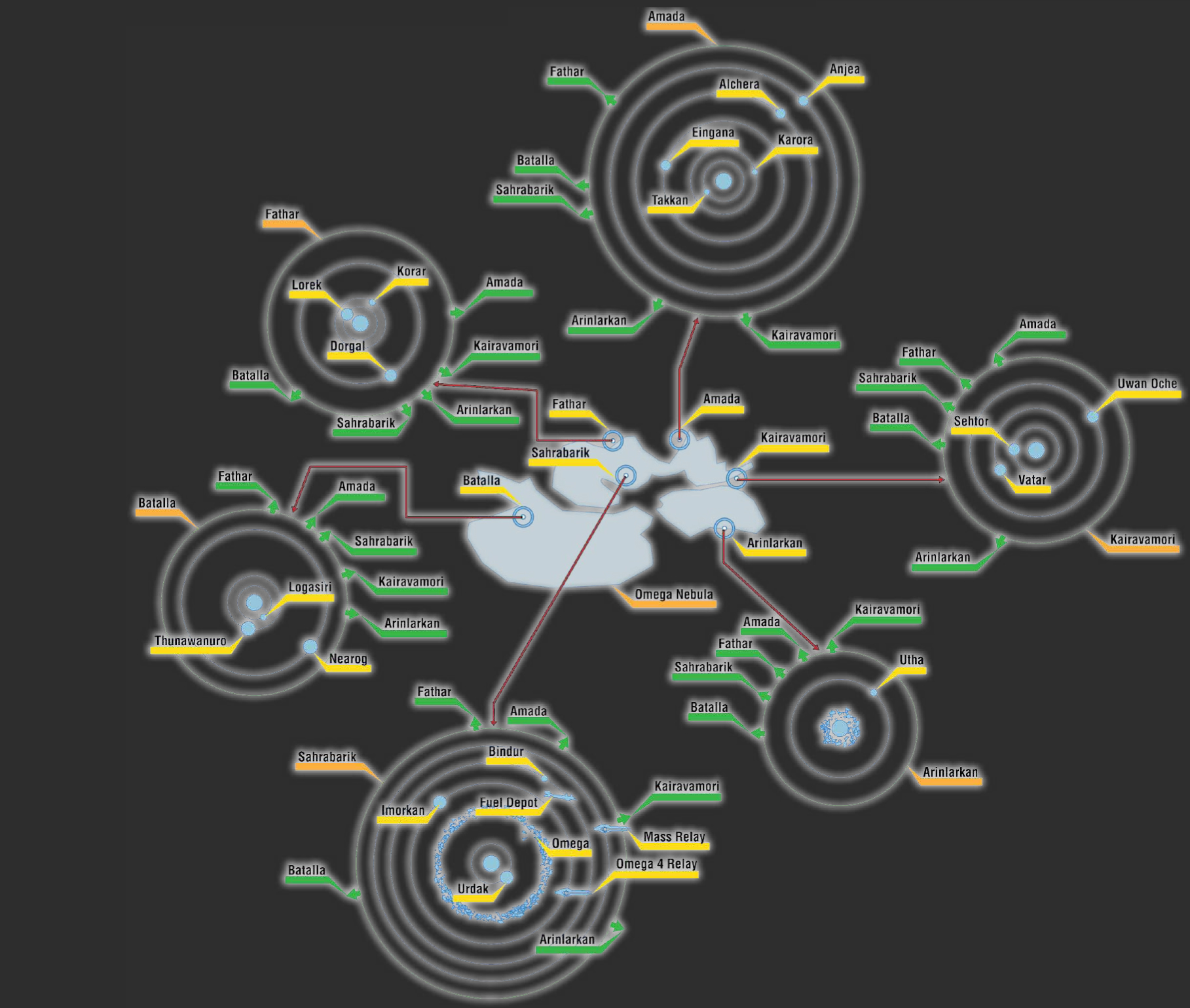
| System | Planets, Planetoids, and Other Galactic Flotsam |
|---|---|
| Amada | Takkan, Karora, Eingana, Alchera, Anjea |
| Arinlarkan | Asteroid Belt, MSV Strontium Mule , Utha |
| Batalla | Logasiri, Thunawanuro, Nearog |
| Fathar | Lorek, Korar, Dorgal |
| Kairavamori | Sehtor, Vatar, Uwan Oche |
| Sahrabarik | Urdak, Asteroid Belt, Omega, Imorkan, Fuel Depot, Omega 4 Relay, Bindur, Mass Relay |
| Related Mission | System | Planet |
|---|---|---|
| Walkthrough Mission > Dossier: Archangel | Sahrabarik | Omega |
| Walkthrough Mission > Dossier: The Professor | Sahrabarik | Omega |
| Walkthrough Mission > Dossier: The Veteran | Sahrabarik | Omega |
| Special Assignment > N7: Lost Operative | Fathar | Lorek |
| Special Assignment > N7: Blue Suns > MSV Strontium Mule | Arinlarkan | MSV Strontium Mule |
| Special Assignment > N7: Normandy Crash Site | Amada | Alchera |
| Special Assignment > Omega > Batarian Bartender | Sahrabarik | Omega |
| Special Assignment > Omega > Datapad Recovered (Dossier: Archangel) | Sahrabarik | Omega |
| Special Assignment > Omega > Missing Assistant (Dossier: The Professor) | Sahrabarik | Omega |
| Special Assignment > Omega > Packages for Ish | Sahrabarik | Omega |
| Special Assignment > Omega > Struggling Quarian | Sahrabarik | Omega |
| Special Assignment > Omega > The Patriarch | Sahrabarik | Omega |
System: Amada
Alchera
World Type: Ocean/Ice
Richness: Rich
Element Zero: None
Iridium: Moderate
Platinum: Moderate
Palladium: Rich
Orbital Distance: 9.5 AU; Orbital Period: 29.4 Earth Years; Radius: 9,229 Km; Day Length: 59.2 Earth Hours.
Description: Alchera’s crust is composed of carbon and water-ice. While low in density, its large size allows it to retain a thick atmosphere of methane and ammonia.
It is believed that if Alchera had acquired a bit more mass when the Amada star system formed, it would have formed the core of a second outer-system gas giant. Alchera has three moons: Uluru, Wandjina, and Baiame.
Anjea
World Type: Ice Giant
Richness: Moderate
Element Zero: None
Iridium: Moderate
Platinum: Moderate
Palladium: Moderate
Orbital Distance: 15.3 AU; Orbital Period: 60 Earth Years; Radius: 23,120 Km; Day Length: 17.4 Earth Hours.
Description: Anjea is a typical ammonia-methane ice giant. Traces of chlorine in the atmosphere give it a distinct green tint.
Penetrating scans have revealed large numbers of hollow, unpowered objects with dimensions of 3.14 by 12.56 by 28.26 circulating in the equatorial cloud bands.
These objects appear to have sails or wings attached, allowing them to be borne aloft by Anjea’s winds.
While they are too deep to be reached for study, popular conjecture in zenoarchaeological circles holds that they are “coffins” of an ancient race who laid their dead to rest in the gas giant.
Eingana
World Type: Desert
Richness: Rich
Element Zero: Moderate
Iridium: Moderate
Platinum: Rich
Palladium: Moderate
Orbital Distance: 5.3 AU; Orbital Period: 12.2 Earth Years; Radius: 5,733 Km; Day Length: 20.8 Earth Hours; Atmospheric Pressure: 0.84 Earth Atmospheres; Surface Temperature: 36 Celsius; Surface Gravity: 0.86 G.
Description: Eingana is a hot, beautiful, and deadly world, covered with the debris of ancient starships. Approximately 127,000 years ago, a series of battles were fought over it by two organic species, the thoi’han and the inusannon.
Although no records of the conflict remain, most historians agree that both races wanted to colonise Eingana, and neither was willing to share.
The two lost hundreds of ships in a series of battles over Eingana and its moon, Barraiya; many of these were eventually pulled in by the planet’s gravity well.
The mass effect drive cores of these ships broke apart, dumping refined element zero over large stretches of the landscape. This poisoned the environment and a wave of extinctions followed.
Many of the animal species that remained showed a tendency to develop biotic powers. As the ecology of Eingana is energetic and aggressive, this makes colonization a deadly peril.
Karora
World Type: Rock
Richness: Moderate
Element Zero: None
Iridium: Moderate
Platinum: Moderate
Palladium: Poor
Orbital Distance: 2.4 AU; Orbital Period: 2.9 Earth Years; Radius: 2,446 Km; Day Length: 63.6 Earth Hours; Atmospheric Pressure: 0.14 Earth Atmospheres; Surface Temperature: 99 Celsius; Surface Gravity: 0.28 G.
Description: Karora is essentially a great rock in space, tidally locked to Amada. Its only notable feature is a chain of craters sticking across the Northern Hemisphere, thought to be the result of impacts by a swarm of meteors.
Karora’s low density suggests it contains no mineral wealth beyond common light metals. It maintains a tenuous atmosphere of krypton and xenon.
Takkan
World Type: Desert
Richness: Moderate
Element Zero: None
Iridium: Moderate
Platinum: Moderate
Palladium: Moderate
Orbital Distance: 1.2 AU; Orbital Period: 1 Earth Years; Radius: 4,312 Km; Day Length: 45.8 Earth Hours; Atmospheric Pressure: 0.49 Earth Atmospheres; Surface Temperature: 286 Celsius; Surface Gravity: 0.5 G.
Description: Orbiting closest to the F-class star Amada, Takkan is a blistering, sun-blasted hell. Neither its carbon dioxide nor its weak magnetic field provides any protection from the star’s harsh radiation.
Fortunately, Takkan has few significant resources, and is notable only for an unusual purple desert in the Southern Hemisphere, thought to be the result of eroded spessartite.
System: Arinlarkan
MSV Strontium Mule
World Type: Cargo Freighter
Richness: Not Minable
Element Zero: Not Minable
Iridium: Not Minable
Platinum: Not Minable
Palladium: Not Minable
Description: Detecting a derelict freighter that has sustained heavy damage. Blue Suns communications detected aboard the ship.
Utha
World Type: Ocean/Ice
Richness: Rich
Element Zero: None
Iridium: Poor
Platinum: Rich
Palladium: Moderate
Orbital Distance: 4.0 AU; Orbital Period: 6.1 Earth Years; Radius: 6,050 Km; Day Length: 49.4 Earth Hours; Atmospheric Pressure: 1.2 Earth Atmospheres; Surface Temperature: 40 Celsius. Surface Gravity: 0.8 G.
Description: Punished with UV and gamma radiation from the Class F star it orbits, Utha is no one’s first choice for a planet to land on.
Covered in seawater, Utha has a hydrosphere and ozone layer similar to Earth’s, but that simply isn’t enough to ward off the life-killing radiation.
Its nitrogen-rich oxygen-poor atmosphere goes unchanged by the few proteins that have managed to form in the ocean depths. Utha, however, has served as a way station for slaves escaping their batarian masters.
What little land it has is tectonically stable, and its considerable radiation belt and electrical storms grant cover from many common types of sensors.
Fleeing ships typically hide on Utha long enough to discharge their drive cores and stock up on deuterium before trying to make it to the cluster’s mass relay.
System: Batalla
Logasiri
World Type: Desert
Richness: Moderate
Element Zero: None
Iridium: Poor
Platinum: Poor
Palladium: Rich
Orbital Distance: 0.6 AU; Orbital Period: 0.5 Earth Years; Radius: 5,017 Km; Day Length: 49.7 Earth Hours; Atmospheric Pressure: Trace; Surface Temperature: 56 Celsius; Surface Gravity: 0.5 G.
Description: A step above a carbonaceous asteroid, Logasiri is a planet with a carbon-heavy crust and a trace atmosphere of CO2 and helium.
Its surface is cool enough to have liquid water, but it is rapidly drying out as it has lost the critical mass to have a self-sustaining hydrologic cycle.
Nevertheless, the batarians have colonized the world, forcing slaves to work in their mines and agri-habitats. The labor is hot, endless, and backbreaking, even in the low-G environment.
Every horror story told by slaves elsewhere in the cluster seems to be topped by one from Logasiri.
The most famous is that of the slaver Silparon, who worked to death 420 slaves over the course of a galactic standard year and ground up their bodies for compost in his greenhouses.
He was eventually poisoned by his wife, but his shadow—and his business model—still hangs over the miserable planet.
Nearog
World Type: Giant Ice
Richness: Moderate
Element Zero: Moderate
Iridium: Poor
Platinum: Moderate
Palladium: Poor
Orbital Distance: 4.8 AU; Orbital Period: 11.8 Earth Years; Radius: 19,976 Km; Day Length: 16.5 Earth Hours.
Description: Nearog is a hydrogen-methane gas giant whose moons were once home to Essul, a batarian warlord who terrorized the Terminus Systems.
Attempting to unite a pirate army under his banner, he successfully conducted a rapid blitz against 11 habitable planets.
Fortunately for the rest of the galaxy, Essul’s crimes caught the attention of the Spectres, who deduced his hidden location and assassinated him. Essul’s empire, built on a hyperextended army, soon came crashing down.
His lost stockpiles of element zero have become something of a legend, and foolish spacers have spent countless amounts of time and money searching the Batalla system, convinced they will be the ones that finally strike it rich.
Thunawanuro
World Type: Garden
Richness: Good
Element Zero: Rich
Iridium: Poor
Platinum: Rich
Palladium: Moderate
Population: 3,769,400; Colony Founded: 2035 CE; Capital: Nurhemathun; Orbital Distance: 1.1 AU; Orbital Period: 1.3 Earth Years; Radius: 11,993 Km; Day Length: 51.7 Earth Hours; Atmospheric Pressure: 2.86 Earth Atmospheres; Surface Temperature: 32 Celsius; Surface Gravity: 6.7 G.
Description: A strange island of peace in the lawless Terminus Systems, Thunawanuro is a planet of crushing gravity but abundant life.
As its ponderous name indicates, it was colonized by the elcor, who have several booming industries on the planet.
Hydroelectric dams and biofuels from tough woody algae provide much of the planet’s energy. Mines export uranium, thorium, and gold taken to space with generous use of mass effect fields.
Of course, pirates target the elcor’s shipping as soon as it leaves orbit, but the elcor’s deals with mercenary companies keep away all but the most foolhardy of attackers.
System: Fathar
Dorgal
World Type: Ocean/ice
Richness: Rich
Element Zero: None
Iridium: Poor
Platinum: Rich
Palladium: Moderate
Orbital Distance: 0.54 AU; Orbital Period: 0.7 Earth Years; Radius: 3,521 Km; Day Length: 51.4 Earth Hours; Atmospheric Pressure: 0.43 Earth Atmospheres; Surface Temperature: -88 Celsius; Surface Gravity: 0.44 G.
Description: The surface of Dorgal is an ethane-soaked mush. The planet hovers near the boiling point of the hydrocarbon and supports a diverse if simple and slow-moving carbon-based ecology.
The planet’s gravity is strong enough to retain an atmosphere of molecular nitrogen and carbon monoxide, but the methane that dominated billions of years ago has long since been lost.
Korar
World Type: Rock
Richness: Good
Element Zero: None
Iridium: Rich
Platinum: Moderate
Palladium: Moderate
Population: 2,400; Orbital Distance: 0.32 AU; Orbital Period: 0.3 Earth Years; Radius: 1,919 Km; Atmospheric Pressure: Trace; Surface Temperature: -40 Celsius; Surface Gravity: 0.19 G.
Description: Korar is a small, lifeless rock blessed with significant deposits of thorium, which is used in radiation shielding and the manufacture of spaceframe alloys.
A few miners eke out an existence on the surface, selling their ore at Lorek and praying that the intermittent raids by the Terminus pirate clans will pass their homestead by.
There have been no children born on Korar since the infamous pirate raid of 2047, when every child on the planet was rounded up and taken as a slave. Any couple finding themselves pregnant preemptively moves offworld.
Lorek
World Type: Ocean/Ice
Richness: Rich
Element Zero: None
Iridium: Moderate
Platinum: Rich
Palladium: Moderate
Colony Founded: 1,764; Population: 4,700,000; Capital: Jalnor; Orbital Distance: 0.2 AU; Orbital Period: 59.6 Earth Days; Radius: 6,754 Km; Atmospheric Pressure: 0.4 Earth Atmospheres; Surface Temperature: 40 Celsius; Surface Gravity: 0.6 G.
Description: Lorek is an extremely rare example of a habitable world circling a red dwarf star. Originally an independent asari colony named Esan, it was annexed by the Batarian Hegemony in 1913, causing a minor galactic incident.
Despite several attempts, the local Terminus warlords have never been able to take Lorek for themselves. Lorek is a low-density world composed of rock, light metals, and a water-based crust.
It is tidally locked to Fathar with a sunward “hot pole” and shadowed “cold pole.”
Water on the sunward side evaporates quickly, traveling over the islands of the habitable terminator zone in the form of massive fast-moving thunderstorms and finally settling as snow on the frozen dark side.
There are fears that the buildup of ice cap mass on the far side may cause axial reorientation over the course of several million years, but batarian officials dismiss the idea as an irresponsible theory disseminated by counter-hegemonist subversives.
System: Kairavamori
Sehtor
World Type: Rock
Richness: Rich
Element Zero: None
Iridium: Rich
Platinum: Moderate
Palladium: Moderate
Orbital Distance: 0.7 AU; Orbital Period: 0.7 Earth Years; Radius: 5,810 Km; Day Length: 47.8 Earth Hours; Atmospheric Pressure: 47.73 Earth Atmospheres; Surface Temperature: 470 Celsius; Surface Gravity: 0.8 G.
Description: A rocky planet with a crushing atmosphere, Sehtor has been scanned from orbit but largely left unexplored due to its sweltering conditions.
Its atmosphere contains nitrogen but also an unusually high percentage of ethane, which can coalesce in pockets near the surface.
The alumina-heavy crust of the planet can reach glowing-hot temperatures during the daytime, reaching the ethane’s auto-ignition temperature and creating pockets of flame across the landscape.
For this reason extra-vehicular activities are discouraged on Sehtor, and no company has been willing to invest in exploration.
Uwan Oche
World Type: Rock
Richness: Rich
Element Zero: None
Iridium: Rich
Platinum: Moderate
Palladium: Moderate
Orbital Distance: 2.7 AU; Orbital Period: 5.0 Earth Years; Radius: 6,529 Km; Day Length: 57.5 Earth Hours; Atmospheric Pressure: Trace; Surface Temperature: -126 Celsius; Surface Gravity: 1.1 G.
Description: Uwan Oche (“Uwan Prime”) is a stony planet encased in ice under a methane-heavy sky.
Named for the Uwan Consortium, the batarian manufacturing firm that financed its exploration, Uwan Oche’s crust provides much of the boron allotropes used in omni-gel throughout the Terminus Systems.
The area has naturally become a haven for pirates, who attempt to steal the refined gel or its ingredients as soon as the cargo ships leave the atmosphere.
Vatar
World Type: Rock
Richness: Rich
Element Zero: None
Iridium: Rich
Platinum: Moderate
Palladium: Moderate
Orbital Distance: 1.4 AU; Orbital Period: 1.9 Earth Years; Radius: 6,352 Km; Day Length: 18.0 Earth Hours; Atmospheric Pressure: 0.77 Earth Atmospheres; Surface Temperature: -35 Celsius; Surface Gravity: 1.0 G.
Description: Located within the life zone of a dimming orange sun, Vatar would be habitable except for its carbon-dioxide atmosphere and an icy surface that kills most oxygen-producing bacteria.
Nonetheless, mercenary companies and slavers have numerous strongholds on the planet, out of reach of any galactic authority.
TRAVEL ADVISORY: A statistically significant number of distress signals have originated within the 1-million-kilometer mark of Vatar. Civilian travel is not advised.
System: Sahrabarik †
Bindur
World Type: Ocean/Ice
Richness: Rich
Element Zero: None
Iridium: Poor
Platinum: Rich
Palladium: Moderate
Orbital Distance: 6.12 AU; Orbital Period: 27.7 Earth Years; Radius: 4,907 Km; Day Length: 53.3 Earth Hours; Atmospheric Pressure: Trace; Surface Temperature: -224 Celsius; Surface Gravity: 0.55 G.
Description: If it were closer to Sahrabarik, Bindur would have an atmosphere of carbon dioxide and ethane. In the deep cold of the outer solar system, however, both elements have long since frozen to the ground.
Imorkan
World Type: Giant Ice
Richness: Moderate
Element Zero: None
Iridium: Poor
Platinum: Moderate
Palladium: Poor
Orbital Distance: 3.4 AU; Orbital Period: 11.5 Earth Years; Radius: 53,491 Km; Day Length: 18.7 Earth Hours.
Description: A standard methane-ammonia gas giant, Imorkan is the main source of helium-3 fuel for ships coming to or from Omega. Most of its fueling stations are run by criminal cartels that engage in cutthroat (sometimes literally) pricing wars.
Imorkan is also widely known for its layover stations, where pirates in a hurry can find fuel, ammunition, intoxicants, gambling, and sexual companionship at any hour.
Omega
World Type: Asteroid Husk (Space Station)
Richness: Not Minable
Element Zero: Not Minable
Iridium: Not Minable
Platinum: Not Minable
Palladium: Not Minable Population: 7.8 million; Orbital Distance: 2.43 AU; Orbital Period: 6.9 Earth Years; Total Length: 44.7 Km.
Description: Built in the mined-out husk of a metallic asteroid, Omega has been a haven for criminals, terrorists, and malcontents for thousands of years.
At times the station has lain idle and abandoned for centuries, only to be reactivated by a new group of outlaws seeking a fresh start.
The space station’s original elegant design has given way to haphazard expansion by scrabbling factions of every species.
There is no central government or unifying authority on Omega, and nobody can recall a time there ever was one.
Omega 4 Relay
World Type: Mass Relay
Richness: Not Minable
Element Zero: Not Minable
Iridium: Not Minable
Platinum: Not Minable
Palladium: Not Minable
Description: The Omega 4 relay is surrounded by hazard beacons and automated warnings. Over the last thousand years many ships have attempted to pass through it, but none have returned.
The only ones to pass freely back and forth through the relay are the mysterious Collectors. There are many theories as to why ships never return from Omega 4.
Some say there is a black hole at the far end; others (mostly the impoverished underclass of Omega) believe there is some form of earthly paradise.
Most, however, simply think that the Collectors capture or destroy those passing through the relay.
Urdak
World Type: Brown Dwarf
Richness: Moderate
Element Zero: None
Iridium: Poor
Platinum: Moderate
Palladium: Moderate
Orbital Distance: 0.8 AU; Orbital Period: 1.3 Earth Years; Radius: 72,512 Km; Day Length: 19.2 Earth Hours.
Description: Urdak is a close-orbiting brown dwarf; most red-brown dwarf binary systems have an average separation of 8 AU.
The Sahrabarik system is about 12 billion years old, and it has long since used up the deuterium used to fuel fusion, so Urdak is not luminous like some brown dwarfs are.
Urdak is a class L brown dwarf with a relatively low temperature of 1,300 degrees Celsius, but its heat and gravity have made it unpopular for development.
There are rumors that the heads of several of Omega’s crime syndicates maintain private residences on various moons.
Whatever the truth of the matter, battles between syndicate vessels are often observed around the ring plane.
News outlets on Omega maintain satellites at Urdak’s Lagrange points for real-time coverage of these battles, which garner high viewer ratings.