
Mass Effect 2 Guide Essentials PLANETARY DATABASE
Cluster: The Phoenix Massing
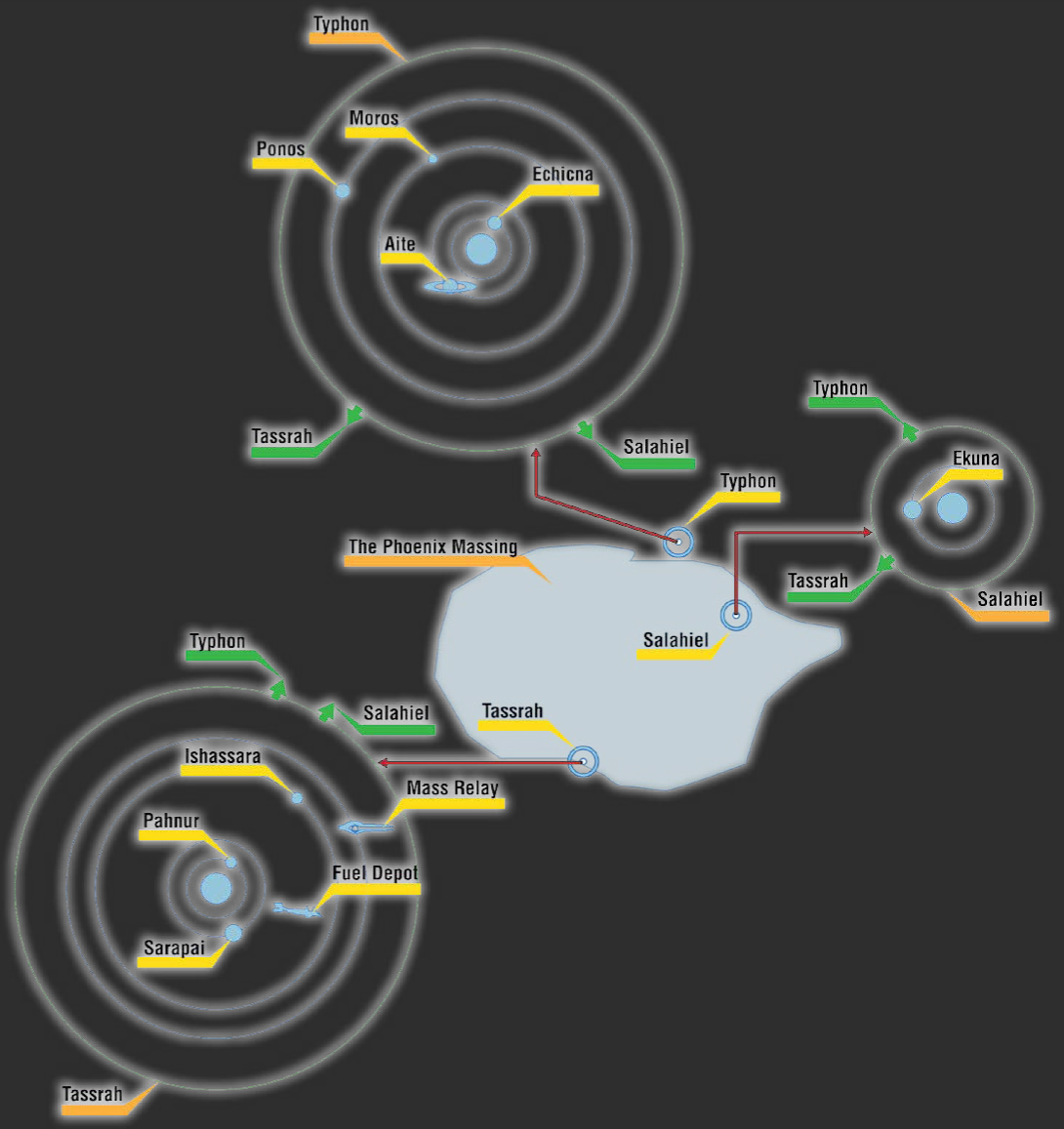
| System | Planets, Planetoids, and Other Galactic Flotsam |
|---|---|
| Chomos | Trigestis, Lattesh |
| Salahiel | Ekuna |
| The Sea of Storms | Heretic Station |
| Tassrah | Pahhur, Sarapai, Fuel Depot, Ishassara, Mass Relay |
| Typhon | Echidna, Aite, Moros, Ponos |
| Related Mission | System | Planet |
|---|---|---|
| Special Assignment > Firewalker > Geth Incursion | The Sea of Storms | Heretic Station |
| Special Assignment > N7: Endangered Research Station | Typhon | Aite |
| Special Assignment > Overlord > Hermes Station | Typhon | Aite |
| Special Assignment > Overlord > Prometheus Station | Typhon | Aite |
| Special Assignment > Overlord > Vulcan Station | Typhon | Aite |
System: Chomos
Lattesh
World Type: Desert
Richness: Moderate
Element Zero: None
Iridium: Poor
Platinum: Moderate
Palladium: Poor
Orbital Distance: 2.2 AU; Orbital Period: 5.2 Earth Years; Radius: 5,500 Km; Day Length: 35.7 Earth Hours; Atmospheric Pressure: 1.3 Earth Atmospheres; Surface Temp: -35 (mean), -53 (with shroud) Celsius; Surface Gravity: 0.7 G.
Description: Lattesh (translated from a salarian dialect as “it’s a still winter”) has an almost habitable temperature and abundant water but shows no signs of life.
Regular supervolcanic eruptions in the southern hemisphere have shrouded the sun and led to a climate even more bone-chilling than usual.
Trigestis
World Type: Ice Giant
Richness: Moderate
Element Zero: None
Iridium: Moderate
Platinum: Poor
Palladium: Poor
Orbital Distance: 0.9 AU; Orbital Period: 0.9 Earth Years; Radius: 59,051 Km; Day Length: 16.0 Earth Hours.
Description: Trigestis is a gas giant, named for the first salarian astronomer to predict planets’ occumences mathematically rather than through direct observation. It has a faint ring system and three moons: Sidacha, Norem, and Bestia.
High-altitude clouds can be seen casting shadows on Trigestis’s lower atmosphere, and ammonia gives it an azure color. The planet is believed to be an extrasolar capture.
System: Salahiel
Ekuna
World Type: Rock
Richness: Rich
Element Zero: Moderate
Iridium: Rich
Platinum: Moderate
Palladium: Moderate
Colony Founded: 2103 CE; Population: 221,256,200; Capital: Bel Shadii (elcor: Durawunafon); Orbital Distance: 1.6 AU; Orbital Period: 2.3 Earth Years; Radius: 10,206 Km; Day Length: 36.4 Earth Hours; Atmospheric Pressure: 1.4 Earth Atmospheres; Surface Temperature: -37 Celsius (equator mean temperature 15 Celsius); Surface Gravity: 4.1 G.
Description: First discovered by the quarians at the turn of the century, Ekuna is habitable but a second-tier choice for most species.
Circling an orange sun, Ekuna averages below freezing temperatures.This led development firms to colonize at the planet’s equator, where the climate is tolerable for agriculture.
The quarians, seeking a homeworld of their own, petitioned the Citadel Council for the right to take over Ekuna, but they had already settled a few hundred thousand quarians on the planet before approaching the Council.
Seeing this occupation as an illegal act, the Council turned a deaf ear to quarian pleas and gave the world to the elcor, who could withstand the high gravity of the world far better.
The quarians squatting on the planet were given one galactic standard month to leave, at which point their colonies would be bombarded. The junk left behind by the fleeing quarians clogs up portions of the landscape to this day.
Non-elcor visitors to Ekuna are advised to use personal or vehicular mass effect fields to lighten the pressure, as the surface gravity will otherwise cause health and mechanical problems.
System: The Sea of Storms
Heretic Station
World Type: Space Station
Richness: Not Minable
Element Zero: Not Minable
Iridium: Not Minable
Platinum: Not Minable
Palladium: Not Minable
Approximately 6.6 million copies of geth software are stored in the station, the majority of which are kept bodiless in servers and downloaded to legged platforms when needed.
The station’s “population” of legged platforms is approximately 2.4 million.
Total Length: 20.5 Km; Total Width: 11.3 Km; Total Height: 11.3 Km; Exterior Armor Thickness: 8 M; Gross Weight: 1.55 Billion Metric Tons; Population: 6.6 Million Copies; 2.4 Million Platforms (1 million of which are in storage).
Description: Once called Haratar by the quarians, this space station was stripped of its useful technology by the fleeing Migrant Fleet when they left the Perseus Veil 300 years ago.
Little more than a cold metal superstructure floating in the void, the station was removed from star charts by 2050 CE.
cans indicate the station was reconstructed and upgraded in a massive effort that must have taken at least 10 years, implying that there may have been some geth outside the Veil before their infamous attack on Eden Prime.
Needing little but a fuel source it could have been hidden here for much longer without attracting attention from the barren worlds around Tassrah or the clueless elcor in the Salahiel system.
Heretic Station, as Legion refers to it, is home to a geth data core capable of broadcasting vast distances through tightbeam projection.
System: Tassrah †
Ishassara
World Type: Giant Jovian
Richness: Poor
Element Zero: None
Iridium: Poor
Platinum: Poor
Palladium: Moderate
Orbital Distance: 3.8 AU; Orbital Period: 5.7 Earth Years; Radius: 22,769 Km; Day Length: 14.0 Earth Hours.
Description: A gas giant, Ishassara is composed mostly of hydrogen and nitrogen. Its orbit in recent years has taken it close to the mass relay in this system, making it a popular stop for “scoop ships” to refuel the hydrogen in their thrusters before moving on.
Pahhur
World Type: Rock
Richness: Rich
Element Zero: None
Iridium: Rich
Platinum: Moderate
Palladium: Moderate
Orbital Distance: 0.6 AU; Orbital Period: 0.4 Earth Years; Radius: 10,560 Km; Day Length: 46.0 Earth Hours; Atmospheric Pressure: 90.59 Earth Atmospheres; Surface Temperature: 1,445 Celsius; Surface Gravity: 4.6 G.
Description: By normal standards a large rock planet, Pahhur (which means “fiery”) is constantly scorched by the white bright giant it orbits.
A dense atmosphere featuring hydrogen, helium, and clouds of vaporized magnesium floats over its iron-rich core, making for a truly hellish landscape. Its spectacular temperature prevents any practical exploitation.
Sarapai
World Type: Desert
Richness: Rich
Element Zero: None
Iridium: Poor
Platinum: Moderate
Palladium: Rich
Orbital Distance: 1.7 AU; Orbital Period: 1.7 Earth Years; Radius: 6,016 Km; Day Length: 60.8 Earth Hours; Atmospheric Pressure: 118.08 Earth Atmospheres; Surface Temperature: 1,271 Celsius; Surface Gravity: 0.9 G.
Description: Sarapai (which means “ever upward”) is the second planet orbiting the white star Tassrah. Sarapai’s pressure-cooker atmosphere of carbon dioxide and ethane serves as a greenhouse to an already boiling-hot surface.
Cobalt compounds are frequently found on its crust, giving spectacular blue tinges to its land. Scans from orbital probes indicate its crust contains deposits of platinum likely to be as unexploited as those on its sister planet Pahhur.
System: Typhon
Aite
World Type: Garden
Richness: Not Minable
Element Zero: Not Minable
Iridium: Not Minable
Platinum: Not Minable
Palladium: Not Minable
Colony Founded: 2104; Population: 1,540,000; Capital: Adrasteia (disputed); Orbital Distance: 1.4 AU; Orbital Period: 1.7 Earth Years; Radius: 5,941 Km; Day Length: 24.9 Earth Hours; Atmospheric Pressure: 0.6 Earth Atmospheres; Surface Temp: 20 Celsius; Surface Gravity: 0.88 G.
Description: Aite is an Earth-like world with a variety of habitable land ranging from deserts to jungles to tundra. It also possesses faint rings, an unusual feature for a non-giant planet.
The rings contain rocks up to a meter in length and a wide dust cloud that stretches nearly 23,000 kilometers from the center of the planet.
This impressive celestial phenomenon, however, is dwarfed by the fact that Aite’s largest moon, Litae, is in an unstable orbit and is predicted to impact the planet within the next two centuries.
Knowing that any Aitean venture is living on borrowed time, colonial population and investment have been orders of magnitude less than other garden worlds.
Echidna
World Type: Pegasid
Richness: Good
Element Zero: Moderate
Iridium: Moderate
Platinum: Moderate
Palladium: Moderate
Orbital Distance: 0.2 AU; Orbital Period: 0.1 Earth Years; Radius: 23,307 Km; Day Length: 14.7 Earth Hours.
Description: A so-called “hot Neptune” planet, Echidna rapidly orbits the star Typhon at a nose-to-nose distance, much like a Pegasid, or “hot Jupiter.”
Also like the Pegasids, it is believed to have formed farther out and gradually migrated to its present position.
Its core is higher in rock content than Sol’s Neptune, the consequence of attracting asteroids and other debris as it journeyed through its solar system.
Moros
World Type: Rock
Richness: Rich
Element Zero: Poor
Iridium: Moderate
Platinum: Moderate
Palladium: Rich
Colony Founded: 2150; Population: 27,800; Orbital Distance: 2.9 AU; Orbital Period: 4.9 Earth Years; Radius: 4,025 Km; Day Length: 60.7 Earth Hours; Atmospheric Pressure: 0.16 Earth Atmospheres; Surface Temp: −73 Celsius; Surface Gravity: 0.35 G.
Description: Moros is a small rock planet with a thin nitrogen and carbon monoxide atmosphere.
Each city-state of Aite claims the rights to exploit the planet for its heavy metal deposits; individual city-state governments maintain three small habitats on Moros, as far away from one another as possible.
Nevertheless, the planet’s wars have extended here, and the habitats infrequently send commando teams to assault each other in small-unit actions.
TRAVEL ADVISORY: The inhabitants of Moros have set large numbers of antipersonnel and antivehicular mines at common choke points across the planet. Records of the mines’ locations are extremely unreliable. Civilian travel is not advised.
Ponos
World Type: Jovian Giant
Richness: Good
Element Zero: None
Iridium: Moderate
Platinum: Moderate
Palladium: Moderate
Orbital Distance: 5.8 AU; Orbital Period: 14.0 Earth Years; Radius: 69,740 Km; Day Length: 14.4 Earth Hours.
Description: Ponos is a typical hydrogen-helium gas giant. Its once-vital helium-3 refining machinery in orbit around the planet was destroyed in one of Aite’s many wars, and Aite’s extraplanetary trade suffered severely as a result.
The dictators of Aite are not pleased with this situation, but they consider it a bad strategic move to be the first to start work on a refinery before eliminating any chance of other nations (or planets) seizing it.