
Mass Effect 2 Guide Essentials PLANETARY DATABASE
Cluster: Pylos Nebula
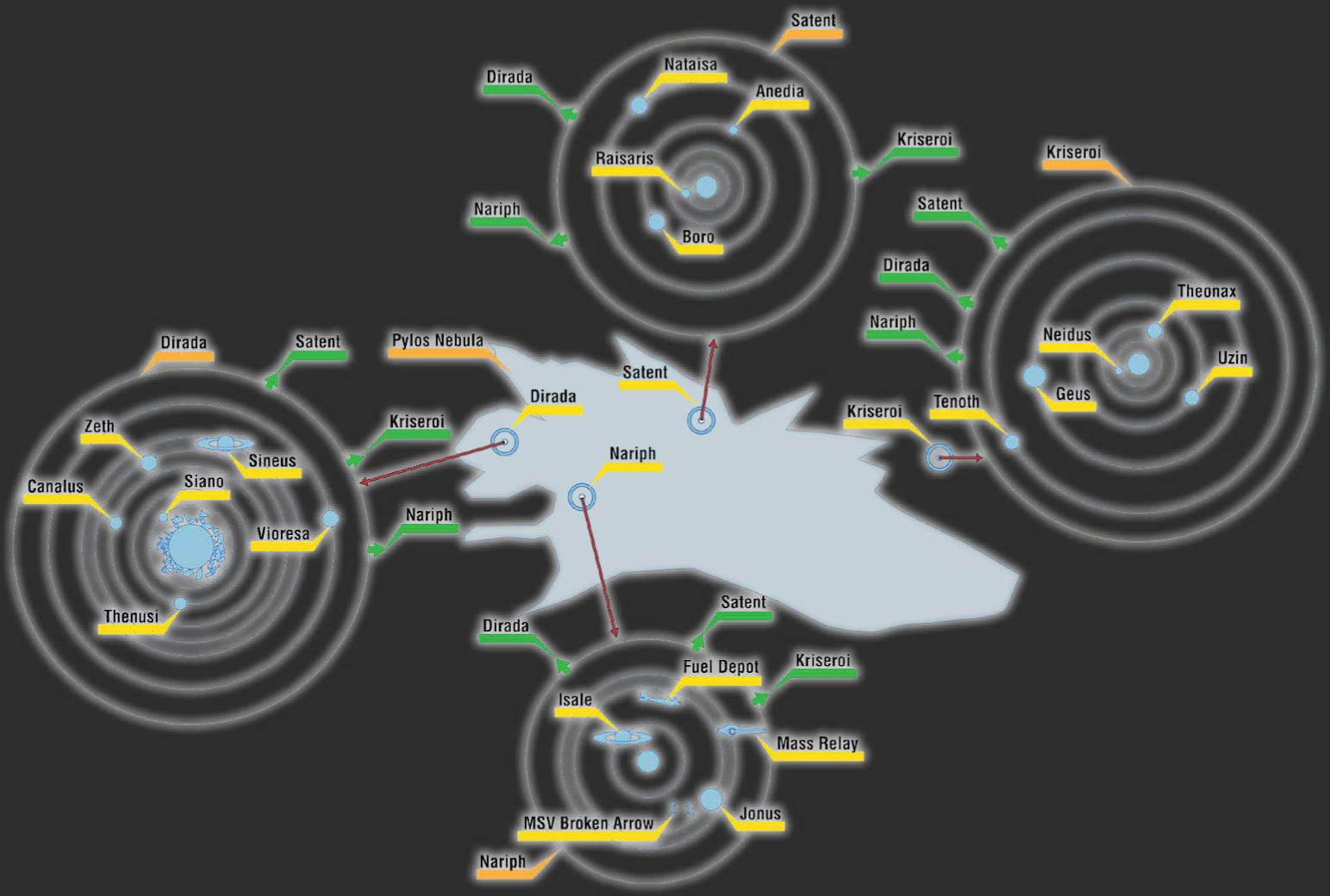
| System | Planets, Planetoids, and Other Galactic Flotsam |
|---|---|
| Dirada | Asteroid Belt, Siano, Thenusi, Canalus, Zeth, Sineus, Vioresa |
| Kriseroi | Neidus, Theonax, Uzin, Geus, Tenoth |
| Nariph | Isale, Fuel Depot, MSV Broken Arrow , Jonus, Mass Relay |
| Satent | Rescel, Raisaris, Anedia, Boro, Nataisa |
| Related Mission | System | Planet |
|---|---|---|
| Special Assignment > N7: Anomalous Weather Detected | - | - |
| Special Assignment > N7: Imminent Ship Crash | - | - |
System: Dirada
Canalus
World Type: Desert
Richness: Rich
Element Zero: None
Iridium: Moderate
Platinum: Moderate
Palladium: Rich
Orbital Distance: 46.3 AU; Orbital Period: 176.8 Earth Years; Radius: 4,618 Km; Day Length: 9.8 Earth Hours; Atmospheric Pressure: 0.83 Earth Atmospheres; Surface Temperature: 99 Celsius; Surface Gravity: 0.85 G.
Description: Canalus is smaller than Earth but has unusually high density. The high level of tectonic activity indicates that the density is caused by an abundance of radioactive materials in the core.
These, combined with the planet’s unusually high rate of spin, raise the planet’s internal temperature and cause volcanism.
While several companies performed mineral assays in the late 2170s, the world’s geological instability precluded development.
Siano
World Type: Rock
Richness: Rich
Element Zero: Moderate
Iridium: Rich
Platinum: Moderate
Palladium: Moderate
Orbital Distance: 12.9 AU; Orbital Period: 26 Earth Years; Radius: 4,925 Km; Day Length: 26 Earth Years; Atmospheric Pressure: Trace; Surface Temperature: 79 Celsius; Surface Gravity: 0.47 G.
Description: Siano, named for an ancient asari philosopher known for being a contrarian, orbits Dirada at a retrograde. It is believed to be an object that fell into the system millions of years ago from parts unknown.
The outermost of Dirada’s two inner Asteroid Belts is thought to have been a small planetoid that was broken up by Siano’s passage into the system.
Siano is formed of low-density rock and is tidally locked to Dirada; the same hemisphere always faces the star.
There is evidence that a complex of artificial structures once existed in the north of the sunward-facing hemisphere, but they have been badly degraded by millennia of heat and radiation.
Several bunkers of radioactive waste, apparently by-products of primitive fission plants, have been discovered on the far side.
Sineus
World Type: Giant Jovian
Richness: Poor
Element Zero: None
Iridium: Poor
Platinum: Poor
Palladium: Poor
Orbital Distance: 138.9 AU; Orbital Period: 919.2 Earth Years; Radius: 63,748 Km; Day Length: 16.4 Earth Hours.
Description: A standard hydrogen-helium gas giant, Sineus has more than 80 moons.
Thenusi
World Type: Rock
Richness: Rich
Element Zero: None
Iridium: Rich
Platinum: Poor
Palladium: Moderate
Orbital Distance: 25.7 AU; Orbital Period: 73.1 Earth Years; Radius: 3,602 Km; Day Length: 73.1 Earth Years; Atmospheric Pressure: Trace; Surface Temperature: -10 Celsius; Surface Gravity: 0.33 G.
Description: Thenusi is a small barren rock. Though there is evidence that it once had an atmosphere of carbon dioxide, only trace amounts of krypton and xenon remain. Like Siano it is tidally locked to Dirada.
Vioresa
World Type: Giant Ice
Richness: Poor
Element Zero: None
Iridium: Poor
Platinum: Moderate
Palladium: Poor
Orbital Distance: 222.2 AU; Orbital Period: 1,860.4 Earth Years; Radius: 26,566 Km; Day Length: 12.7 Earth Hours.
Description: With an orbital period nearly two millennia long, the cold and distant Vioresa was actually missed in the initial asari survey of the system.
Only a follow-up mineral assay sent to Canalus by a volus mining concern noticed its subtle movement across the stars. Vioresa is a methane-ammonia ice giant circled by a retinue of deep-frozen moons.
Its remoteness makes it a popular drive discharge point for pirates working the Pylos Nebula cluster. In the last two years several dozen ships have disappeared while passing through the Dirada system.
As Pylos is currently unclaimed by any sovereign power, Council naval patrols are few and far between. Thus far none of the pirates responsible have been apprehended.
Zeth
World Type: Giant Jovian
Richness: Moderate
Element Zero: None
Iridium: Poor
Platinum: Poor
Palladium: Poor
Orbital Distance: 69.5 AU; Orbital Period: 325.2 Earth Years; Radius: 60,327 Km; Day Length: 14.8 Earth Hours.
Description: Zeth is a common hydrogen-helium gas giant. An abundance of sulfur in the upper atmosphere gives it a distinct yellow color.
System: Kriseroi
Geus
World Type: Giant Ice
Richness: Moderate
Element Zero: None
Iridium: Poor
Platinum: Moderate
Palladium: Poor
Orbital Distance: 0.64 AU; Orbital Period: 0.9 Earth Years; Radius: 33,036 Km; Day Length: 9.9 Earth Hours.
Description: Geus is a methane-ammonia gas giant very similar to its near-twin, Uzin. It presents a nearly featureless robin’s-egg-blue face to the universe.
Neidus
World Type: Post-Garden
Richness: Moderate
Element Zero: None
Iridium: Moderate
Platinum: Moderate
Palladium: Moderate
Orbital Distance: 0.1 AU; Orbital Period: 0.1 Earth Years; Radius: 4,875 Km; Day Length: 0.1 Earth Years; Atmospheric Pressure: 0.84 Earth Atmospheres; Surface Temperature: 2 Celsius; Surface Gravity: 0.87 G.
Description: Neidus lies improbably close to the red dwarf Kriseroi. This allows it to approach habitability though it is quite frigid.
It is tidally locked, with a “hot pole” and a “cold pole.” Along the terminator the temperature averages just above freezing.
On the lee side the temperatures are well below freezing. Neidus has developed a limited native ecology. Much of it clusters permanently attached around geothermal vents. There are, however, more advanced forms of life.
Several arthropodal herbivore species wander back and forth across the terminator because they require nutrients available in both environments for sustenance.
More dangerous are the omnivorous predator species that devour the arthropods. Most animal life on Neidus has limited vision but a finely developed thermal sense.
Tenoth
World Type: Giant Ice
Richness: Moderate
Element Zero: None
Iridium: Poor
Platinum: Moderate
Palladium: Poor
Orbital Distance: 1.86 AU; Orbital Period: 2.6 Earth Years; Radius: 1,411 Km; Day Length: 17.9 Earth Hours; Atmospheric Pressure: Trace; Surface Temperature: -220 Celsius; Surface Gravity: .09 G.
Description: Tenoth is little more than a glorified “ice dwarf” that has drifted inwards from Kriseroi’s Oort Cloud over the millennia.
Its extremely elliptical orbit is ultimately unstable. Computer projections suggest it will impact the atmosphere of Geus in a few billion years.
Theonax
World Type: Ocean/Ice
Richness: Rich
Element Zero: None
Iridium: Moderate
Platinum: Rich
Palladium: Moderate
Orbital Distance: 0.18 AU; Orbital Period: 0.1 Earth Years; Radius: 10,442 Km; Day Length: 69.9 Earth Hours; Atmospheric Pressure: 1.3 Earth Atmospheres; Surface Temperature: -70 Celsius; Surface Gravity: 1.3 G.
Description: Theonax’s surface is covered by water and ammonia-hydrate ices, which are constantly repaved by cryovolcanic processes.
The world’s size and density suggest the core contains heavier elements and retains much of the heat of the system’s formation.
Uzin
World Type: Giant Ice
Richness: Moderate
Element Zero: None
Iridium: Poor
Platinum: Moderate
Palladium: Poor
Orbital Distance: 0.31 AU; Orbital Period: 0.3 Earth Years; Radius: 31,982 Km; Day Length: 15.2 Earth Hours.
Description: A typical methane-ammonia ice giant, Uzin has 37 moons of various sizes. Chithess, one of the largest, orbits at a retrograde, suggesting it was a planetesimal that was captured by the gas giant gravity well.
The planet itself is believed to be an extrasolar capture as well, though millions of years before Chithess came on the scene.
Evidence collected by planetary geologists suggest that Chithess was for many centuries a water-world heated by tidal flexing as its orbit circularized around Uzin.
The planetary ocean, once hundreds of kilometers deep, must now be frozen solid. Some have recommended drilling test bores to see if life ever developed in Uzin’s seas, but the question is considered academic.
System: Nariph †
Isale
World Type: Giant Jovian
Richness: Moderate
Element Zero: None
Iridium: Poor
Platinum: Poor
Palladium: Poor
Orbital Distance: 0.5 AU; Orbital Period: 0.6 Earth Years; Radius: 64,005 Km; Day Length: 17.7 Earth Hours.
Description: Isale is a standard hydrogen-helium gas giant. Though gas giants are known for their powerful magnetic fields, Isale’s field is stronger than current models predict.
Within the “frost line” of its solar system, where gas giants do not usually form, Isale is believed to have once been extrasolar.
Jonus
World Type: Giant Ice
Richness: Moderate
Element Zero: None
Iridium: Poor
Platinum: Poor
Palladium: Poor
Orbital Distance: 0.65 AU; Orbital Period: 1 Earth Year; Radius: 20,312 Km; Day Length: 15.1 Earth Hours.
Description: Jonus, a methane-ammonia ice giant, is being developed as a Fuel Depot serving the Pylos Cluster.
Eldfell-Ashland Energy has established a base on one of its moons to crack ice into hydrogen and oxygen and skim helium-3 from its atmosphere.
Jonus is also believed to be an extrasolar planet captured by its star. From orbit, Normandy’s sensors can pick out a hand-painted sign some waggish employee has left outside the complex: “Last chance fuel for 100 light years.”
MSV Broken Arrow
World Type: Cruiser
Richness: Not Minable
Element Zero: Not Minable
Iridium: Not Minable
Platinum: Not Minable
Palladium: Not Minable
Description: This cruiser is barreling at high speed across the solar system. Its trajectory will take it directly to the fuel infrastructure on Jonus.
System: Satent
Anedia
World Type: Ocean/Ice
Richness: Rich
Element Zero: None
Iridium: Moderate
Platinum: Rich
Palladium: Moderate
Orbital Distance: 1.14 AU; Orbital Period: 1.4 Earth Years; Radius: 2,949 Km; Day Length: 38.6 Earth Hours; Atmospheric Pressure: Trace; Surface Temperature: -41 Celsius; Surface Gravity: 0.19 G.
Description: Anedia is a small ice body with very low density; its mass is only 4 percent that of Earth. It appears to be composed mainly of carbon and water ice, but over the millennia it has accrued a trace atmosphere of krypton and xenon.
While Anedia’s gravity is weak enough that a cruiser could land on it safely, there is no particular reason one would want to. Pirates have been known to land to recover ice for cracking into hydrogen and oxygen.
One area in the southern hemisphere, the so-called “Anedian Scrapes,” is so frequently used for this purpose that higher-albedo raw ice can be easily seen from orbit.
Boro
World Type: Ocean/Ice
Richness: Rich
Element Zero: Rich
Iridium: Moderate
Platinum: Rich
Palladium: Moderate
Colony Founded: 2180; Population: 1,617; Capital: Yila; Orbital Distance: 2.1 AU; Orbital Period: 3.4 Earth Years; Radius: 10,573 Km; Day Length: 31.0 Earth Hours; Atmospheric Pressure: 1.6 Earth Atmospheres; Surface Temperature: -57 Celsius; Surface Gravity: 1.66 G.
Description: Boro is a young volus colony world settled in defiance of a threat by Terminus pirate groups. The pirates, who can’t use the world themselves, have “suggested” that the volus “hire” them to protect the colony.
The volus responded by requesting military protection from their turian allies. Although uncomfortably hot by volus standards, Boro has the rare combination of high pressure and ammonia, an ecology the volus require. Development of the colony is proceeding rapidly.
Nataisa
World Type: Giant Ice
Richness: Moderate
Element Zero: None
Iridium: Poor
Platinum: Moderate
Palladium: Poor
Orbital Distance: 4.1 AU; Orbital Period: 8.3 Earth Years; Radius: 23,623 Km; Day Length: 8.9 Earth Hours.
Description: An unremarkable methane-ammonia gas giant, Nataisa would be of no consequence if it weren’t the only approachable gas giant in the Satent system.
Boro’s volus colony has set up a few automated ice cracking stations around the planet, and Narhu Combine has been contracted to set up a helium-3 extraction facility.
Construction has lagged due to the CEO’s arrest in a kickback scandal that reaches to the highest levels of the Vol Ministry of the Frontier.
Raisaris
World Type: Rock
Richness: Rich
Element Zero: Rich
Iridium: Rich
Platinum: Moderate
Palladium: Moderate
Orbital Distance: 0.6 AU; Orbital Period: 0.5 Earth Years; Radius: 3,790 Km; Day Length: 66.3 Earth Hours; Atmospheric Pressure: Trace; Surface Temperature: 56 Celsius; Surface Gravity: 0.24 G.
Description: An airless rock of mixed light ores, Raisaris is only of note for the Teryinu impact crater. It was a relatively recent asteroid strike (within the last million years), and the core of the object was partly composed of element zero.
It struck at a low enough velocity that the eezo remained near the surface. Over the years many pirates and “wildcat” miners have attempted to extract the ore.
It is believed that the Teryinu debris originated in the pulsar system AAP34211+19. The supernova that formed the pulsar also created the red emission nebula that human spacers have unofficially named the Sakura Nebula.
Rescel
World Type: Giant Pegasid
Richness: Moderate
Element Zero: None
Iridium: Poor
Platinum: Poor
Palladium: Moderate
Orbital Distance: 0.02 AU; Orbital Period: 4.56 Earth Days; Radius: 69,155 Km; Day Length: 4.56 Earth Days.
Description: Rescel is a massive “hot Jupiter” gas giant that whips around the star Satent once every four and a half days. Like most planets of its type it migrated inwards from its initial position in the system (thought to be around 0.3 AU).
Rescel is one of the few close-orbiting gas giants to show a marked temperature difference in its sun-facing and dark-side hemispheres.
The atmosphere absorbs and re-radiates Satent’s heat too quickly for winds to carry the heat to the dark side. There is a temperature difference of over 1,000 degrees between the gas giant’s “hot” and “cold” poles.