
Mass Effect 2 Guide Essentials PLANETARY DATABASE
Cluster: Caleston Rift
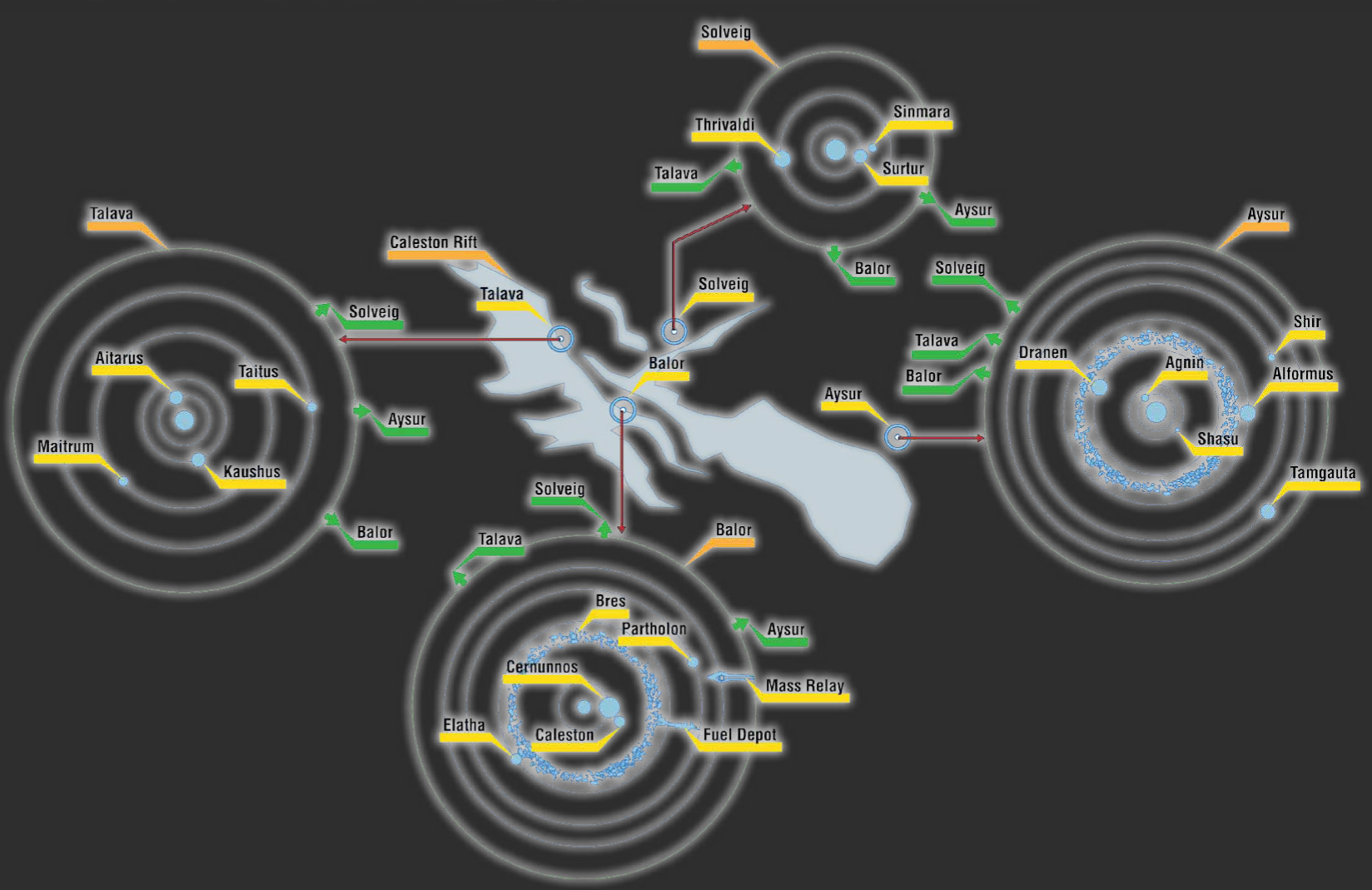
| System | Planets, Planetoids, and Other Galactic Flotsam |
|---|---|
| Aysur | Agnin, Shasu, Dranen (Arvuna), Asteroid Belt, Alformus, Shir, Tamgauta |
| Balor | Cernunnos (Caleston), Fuel Depot, Asteroid Belt, Bres, Elatha, Partholon, Mass Relay |
| Solveig | Surtur (Sinmara), Thrivaldi |
| Talava | Aitarus, Kaushus, Maitrum, Taitus |
| Yakawa | Sakata, Nambu, Maskawa, Karumto, Kobayashi |
| Related Mission | System | Planet |
|---|---|---|
| Additional Mission > Firewalker > Volcano Station | Yakawa | Karumto |
| Special Assignment > N7: Endangered Research Station | Solveig | Sinmara (Moon) |
| Special Assignment > N7: Mining the Canyon | Talava | Taitus |
System: Aysur
Agnin
World Type: Rock
Richness: Rich
Element Zero: None
Iridium: Rich
Platinum: Rich
Palladium: Moderate
Orbital Distance: 0.7 AU; Orbital Period: 0.6 Earth Years; Radius: 4,834 Km; Day Length: 61.1 Earth Hours; Atmospheric Pressure: 86.87 Earth Atmospheres; Surface Temperature: 684 Celsius; Surface Gravity: 0.5 G.
Description: A hothouse planet, Agnin has scorching clouds of methane and sulfur dioxide that give the planet a pale green color in visible light.
The SO2 from volcanic activity rains down as sulfuric acid in the upper atmosphere, but this is boiled away before the liquid ever reaches the surface. Agnin’s harsh environment has prevented exploration by anything except probes.
Alformus
World Type: Giant Jovian
Richness: Moderate
Element Zero: None
Iridium: Poor
Platinum: Moderate
Palladium: Moderate
Orbital Distance: 10.1 AU; Orbital Period: 32.2 Earth Years; Radius: 67,626 Km; Day Length: 8.8 Earth Hours; Atmospheric Pressure: 1.81 Earth Atmospheres.
Description: A hydrogen-helium gas giant, Alformus had its helium-3 refueling stations destroyed in an attack by Grow Zero, an anti-population terrorist group that wanted no more immigration to Arvuna. A consortium of Arvuna-based corporations is currently rebuilding the stations.
ALLIANCE ADVISORY: Alformus is not considered vital to the stability of the Aysur system. Civilians working on the helium-3 platforms should not expect Alliance military intervention in case of kidnapping or other violence.
Arvuna
World Type: Ocean/Ice
Richness: Rich
Element Zero: Moderate
Iridium: Poor
Platinum: Rich
Palladium: Moderate
Population: 348,785,500; Colony Founded: 2160 CE; Capital: Asa; Orbital Distance: 2.5 AU; Orbital Period: 4.0 Earth Years (Aysur) 66 days (Dranen); Radius: 6,448 Km; Day Length: 29.2 Earth Hours; Atmospheric Pressure: 1.45 Earth Atmospheres; Surface Temperature: -11 Celsius (mean), 25 Celsius (equator); Surface Gravity: 1.1 G.
Description: With oceans covering 90 percent of Arvuna’s surface, this moon of Dranen is classified as a water world. Besides its prodigious sea life, Arvuna is also home to avian and mammal-like life forms on its islands. None are currently considered sapient.
Arvuna is home to thriving human colonies, though indigenous diseases and venomous pests similar to a horsefly cause high mortality rates.
TRAVEL ADVISORY: Kidnapping for ransom is the number one violent crime on this planet. Please use all available security options when traveling to Arvuna.
Dranen
World Type: Giant Jovian
Richness: Moderate
Element Zero: None
Iridium: Poor
Platinum: Poor
Palladium: Poor
Orbital Distance: 2.5 AU; Orbital Period: 4.0 Earth Years; Radius: 72,021 Km; Day Length: 17.1 Earth Hours; Atmospheric Pressure: 1.94 Earth Atmospheres.
Description: A sizable hydrogen-nitrogen gas giant just on the far side of its pale yellow star’s “frost line,” Dranen is known for its spectacular storms.
At least three persistent observable “spots”—actually cyclonic and anticyclonic storms—have lasted for over 544 years, significantly longer than Jupiter’s Great Red Spot.
The largest of these spots, the Ishna, has consistently held a diameter over three times that of Earth. Dranen has 44 moons.
Two of them are of special interest to the Citadel Committee on Habitable Worlds.The first, Arvuna, is a life-bearing world that has already been colonized.
The second, Alahya, is slowly being terraformed into an ammonia-based world for volus populations.
Shasu
World Type: Rock
Richness: Rich
Element Zero: None
Iridium: Rich
Platinum: Moderate
Palladium: Moderate
Orbital Distance: 1.4 AU; Orbital Period: 1.7 Earth Years; Radius: 1,454 Km; Day Length: 37.4 Earth Hours; Atmospheric Pressure: 0.34 Earth Atmospheres; Surface Temperature: 23 Celsius; Surface Gravity: 0.1 G.
Description: Shasu is a dwarf planet that is believed to have been ejected from Agnin during a giant impact with another planet-sized body.
At the time, Agnin had a magma ocean covering much of its surface, and the liquid rock sprayed into space, where it coalesced and cooled over millions of years.
The theory is that during this cooling Shasu first orbited Agnin but was eventually pulled from that orbit by the gravity wells of other planets, primarily Dranen.
Today Shasu is relatively temperate, with a light hydrogen-helium atmosphere attracting spacers who use its atmosphere to refuel. Its crust composition is similar to that of Agnin, as is evident in its high sulfur content.
Shir
World Type: Rock
Richness: Rich
Element Zero: None
Iridium: Rich
Platinum: Moderate
Palladium: Rich
Orbital Distance: 20.0 AU; Orbital Period: 89.7 Earth Years; Radius: 4,900 Km; Day Length: 31.0 Earth Hours; Atmospheric Pressure: Trace; Surface Temperature: -185 Celsius; Surface Gravity: 0.7 G.
Description: A remote rock planet capped in ice, Shir has been exploited by Arvunan corporations for its minerals.
Home to gold ore, which is used in spaceship shielding as well as jewelry, and to cobalt deposits used in high-tensile alloys, Shir shows no signs of being exhausted anytime soon.
A light gravity helps keep the planetary exportation process cheap.
Tamgauta
World Type: Desert
Richness: Good
Element Zero: None
Iridium: Poor
Platinum: Moderate
Palladium: Rich
Orbital Distance: 42.2 AU; Orbital Period: 275.1 Earth Years; Radius: 3,354 Km; Day Length: 64.8 Earth Hours; Atmospheric Pressure: Trace; Surface Temperature: -216 Celsius; Surface Gravity: 0.2 G.
Description: The outermost planet of the Aysur system, Tamgauta is remote and largely unexplored. Its carbon dioxide atmosphere has long since frozen into fields of dry ice.
System: Balor †
Bres
World Type: Rock
Richness: Rich
Element Zero: None
Iridium: Poor
Platinum: Rich
Palladium: Moderate
Orbital Distance: 2.9 AU; Orbital Period: 4.9 Earth Years; Radius: 975 Km; Day Length: 23.3 Earth Hours; Atmospheric Pressure: None; Surface Temperature: -146 Celsius.
Description: A member of the Fomor Belt, Bres is a dwarf planet with no atmosphere. It is, however, rich in lithium, which is integral to the heat sinks of starships and hand-held weapons.
A large robo-mining operation from Caleston can be found here.
Caleston
World Type: Desert
Richness: Rich
Element Zero: Moderate
Iridium: Poor
Platinum: Rich
Palladium: Moderate
Population: 1,802,705,000; Colony Founded: 1975 CE; Capital: Syneu; Orbital Distance: 0.07 AU (orbits Cernunnos); Orbital Period: 21.5 Earth Hours (around Cernunnos); Radius: 6,600 Km; Day Length: 21.5 Earth Hours; Atmospheric Pres-sure: 0.9 Earth Atmospheres; Surface Temperature: 30 Celsius; Surface Gravity: 1.2 G.
Description: The hostile moon Caleston is the largest satellite of the gas giant Cernunnos. An ancient asteroid strike deposited major loads of element zero within the molten sulfur mantle.
Eldfell-Ashland Energy’s mining operations have made it the largest source of starship drive core material in the Attican Traverse. Caleston is wracked with volcanism due to tidal stresses from Cernunnos.
Because of the weak solar output, plant-like life on Caleston is not carbon-based and photo-synthetic but silicon-based and thermosynthetic, requiring heat rather than sunlight to power its chemical reactions.
These organisms flourish in volcanic vents and during solar flares when Balor can double or triple in luminosity. Sadly, sapient habitation is not possible here and Caleston’s biodiversity is considered “threatened” by the Citadel Council Committee on Habitable Worlds.
Cernunnos
World Type: Giant Jovian
Richness: Moderate
Element Zero: None
Iridium: Poor
Platinum: Rich
Palladium: Moderate
Orbital Distance: 0.07 AU; Orbital Period: 31 Earth Days; Radius: 49,231 Km; Day Length: 17.0 Earth Hours; Atmospheric Pressure: 0.86 Earth Atmospheres.
Description: Cernunnos is a sizable gas giant with a hydrogen-nitrogen atmosphere. It is believed to be an extrasolar capture due to its close stellar location
In a rare phenomenon it is near enough to its red dwarf star to be within the life zone, though its massive size prevents the tidal lock that usually occurs at such a range.
While nothing could survive on the surface of a planet with such crushing gravity, Cernunnos’s moon, Caleston, is habitable.
Cernunnos is skimmed for its abundant hydrogen, and refineries on Caleston process it into a metastable metallic form for use as starship fuel.
Elatha
World Type: Rock
Richness: Rich
Element Zero: None
Iridium: Poor
Platinum: Rich
Palladium: Moderate
Orbital Distance: 5.5 AU; Orbital Period: 23.6 Earth Years; Radius: 1,812 Km; Day Length: 57.3 Earth Hours; Atmospheric Pressure: 43.34 Earth Atmospheres; Surface Temperature: -72 Celsius; Surface Gravity: 0.1 G.
Description: A tiny rock planet, Elatha is noted for its frigid temperatures and crushing nitrogen and krypton atmosphere. Lying out beyond the Fomor Belt, it has little to recommend it.
Partholon
World Type: Ocean/Ice
Richness: Rich
Element Zero: None
Iridium: Poor
Platinum: Rich
Palladium: Moderate
Orbital Distance: 11.2 AU; Orbital Period: 68.6 Earth Years; Radius: 11,921 Km; Day Length: 28.2 Earth Hours; Atmospheric Pressure: Trace; Surface Temperature: -236 Celsius; Surface Gravity: 6.6 G.
Description: A large planet composed of ice surrounding a rocky core, Partholon retains trace gases of nitrogen and carbon monoxide. Its crushing gravity makes for an inhospitable stay and makes most mining unfeasible.
However, its orbit’s proximity to the mass relay in the system means space travelers will for the next few years use it for a gravitational slingshot to add speed on their way to and from Caleston.
System: Solveig
Sinmara
World Type: Rock
Richness: Good
Element Zero: None
Iridium: Rich
Platinum: Moderate
Palladium: Moderate
Colony Founded: 2044 CE; Population: 135; Largest Habitat: Trundholm.
Description: Surtur’s moon Sinmara has been used for many generations to monitor its parent star Solveig.
It has no atmosphere to interfere with solar observational equipment, which is critical at this juncture; the star recently showed signs of erupting prematurely into a red giant.
In preparation for the day when the critical warning goes out the extranet channel from Sinmara’s research station is given top priority throughout the comm buoys in the system.
The chances of such a signal being received over the sun’s magnetic interference at that time is low, but relegating it to a lower channel proved politically untenable.
Surtur
World Type: Desert
Richness: Rich
Element Zero: None
Iridium: Poor
Platinum: Poor
Palladium: Rich
Orbital Distance: 0.7 AU; Orbital Period: 0.6 Earth Years; Radius: 4,433 Km; Day Length: 65.0 Earth Hours; Atmospheric Pressure: Trace; Surface Temperature: 126 Celsius; Surface Gravity: 0.8 G.
Description: Surtur is a small but dense desert planet close to its parent star. All but traces of its nitrogen-carbon monoxide atmosphere have burned away, leaving it cooler than similar planets in other systems.
Robo-mining has proved lucrative as it has developed significant deposits of beryllium and palladium.
Thrivaldi
World Type: Giant Jovian
Richness: Poor
Element Zero: None
Iridium: Poor
Platinum: Moderate
Palladium: Poor
Orbital Distance: 1.5 AU; Orbital Period: 1.8 Earth Years; Radius: 35,957 Km; Day Length: 11.0 Earth Hours.
Description: The refueling stations of hydrogen-helium gas giant Thrivaldi provide helium-3 for commercial spacecraft visiting the system. It has nine known moons and many smaller bodies in its rings.
TRAVEL ADVISORY: Recent attacks by pirates have targeted Thrivaldi’s refueling stations. Authorities list the perpetrators as “at large.” Travel is not recommended.
System: Talava
Aitarus
World Type: Rock
Richness: Moderate
Element Zero: None
Iridium: Rich
Platinum: Poor
Palladium: Poor
Orbital Distance: 0.5 AU; Orbital Period: 0.3 Earth Years; Radius: 8,945 Km; Day Length: 65.1 Earth Hours; Atmospheric Pressure: Trace Surface Temperature: 549 Celsius; Surface Gravity: 2.8 G.
Description: A large rock planet orbiting an F-class star, Aitarus is pummeled by radiation, heavy gravity, and tectonic activity. Its crust is mostly silicates and of little value. Travel is not advised.
Kaushus
World Type: Rock
Richness: Good
Element Zero: None
Iridium: Rich
Platinum: Moderate
Palladium: Moderate
Orbital Distance: 1.2 AU; Orbital Period: 1.0 Earth Years; Radius: 6,212 Km; Day Length: 42.6 Earth Hours; Atmospheric Pressure: Trace; Surface Temperature: 249 Celsius; Surface Gravity: 1.0.
Description: Home to the spectacular Infinity Caldera, Kaushus is a young planet with extreme tectonic and volcanic activity.
It has nine super-volcanoes that can throw out at least 1,000 cubic kilometers of dense rock equivalents each, and Kaushus’s activity has put its atmosphere in a state of shroud. It will likely suffer from global dimming for at least the next 10 years.
Though much of the surface is no more dangerous than many other inner-ring planets, this extreme tectonic activity has given Kaushus a bad reputation and discouraged all resource exploitation.
Maitrum
World Type: Rock
Richness: Rich
Element Zero: None
Iridium: Rich
Platinum: Poor
Palladium: Poor
Orbital Distance: 2.8 AU; Orbital Period: 3.6 Earth Years; Radius: 4,642 Km; Atmospheric Pressure: Trace; Surface Temperature: 74 Celsius; Surface Gravity: 0.4 G.
Description: A small hot rock with few resources, Maitrum is used by the turian armed forces for its maximum security prison and interrogation centers.
The temperatures are high enough to prevent any escape without an environmental suit but low enough that construction of additional buildings will not be hindered.
Over 500,000 prisoners are detained on Maitrum, only a handful of which have ever managed even a temporary escape.
A small supply economy and prefab habitats support the prison staff who usually work only for two-year tours of duty before they are rotated out to less stressful positions.
Taitus
World Type: Desert
Richness: Rich
Element Zero: None
Iridium: Poor
Platinum: Moderate
Palladium: Rich
Orbital Distance: 4.0 AU; Orbital Period: 6.1 Earth Years; Radius: 6,045 Km; Day Length: 22.2 Earth Hours; Atmospheric Pressure: Trace; Surface Temperature: -1 Celsius; Surface Gravity: 0.9 G.
Description: A desert of whitish potassium salts and reddish iron oxides, Taitus is far enough away from its parent star to have a tolerable surface temperature.
Though it has only a trace atmosphere of carbon dioxide and oxygen it is still hospitable enough for criminals in the Terminus Systems to use it as a staging base.
Turian patrols sometimes fly through the area looking to preempt jailbreak attempts on Maitrum’s prisons.
TRAVEL ADVISORY: Unregistered starships have been spotted in the vicinity of Taitus. Civilian travel is not recommended.
System: Yakawa
Karumto
World Type: Rock
Richness: Good
Element Zero: None
Iridium: Moderate
Platinum: Moderate
Palladium: Rich
Orbital Distance: 2.3 AU; Orbital Period: 3.8 Earth Years; Radius: 6,529 Km; Day Length: 33.4 Earth Hours; Atmospheric Pressure: 33.72 Earth Atmospheres; Surface Temp: 150 Celsius; Surface Gravity: 1.1 G.
Description: An Earth-sized planet wrapped in an impermeable haze of carbon dioxide and ash, Karumto is an unforgiving place. Earthquakes, volcanic gases, and shrouds of dust have prevented any major settlements. Its sulfurous crust has yet to produce resources of interest.
Kobayashi
World Type: Jovian Giant
Richness: Moderate
Element Zero: None
Iridium: Poor
Platinum: Moderate
Palladium: Moderate
Orbital Distance: 3.9 AU; Orbital Period: 7.7 Earth Years; Radius: 30,698 Km; Day Length: 11.3 Earth Hours.
Description: A hydrogen-helium gas giant, Kobayashi has a faint ring system. A “rust belt” of decrepit refueling stations and abandoned habitats on its moons have attracted vorcha, krogan, and other ne’er-do-wells.
Living a hand-to-mouth existence with no garden planet supplying them, they trade helium-3 fuel and recycled waste products to survive.
Kidnappees from Maskawa are typically brought to Kobayashi to be released or sold as chattel to out-of-system slavers.
TRAVEL ADVISORY: Law enforcement authorities of Maskawa categorically state that their effective range does not extend as far as Kobayashi.
A statistically significant number of distress signals have been broadcast from within the one-million-kilometer mark of Kobayashi. Civilian traffic is not advised.
Maskawa
World Type: Rock
Richness: Rich
Element Zero: None
Iridium: Rich
Platinum: Moderate
Palladium: Moderate
Orbital Distance: 2.0 AU; Orbital Period: 2.8 Earth Years; Radius: 7,105 Km; Day Length: 37.6 Earth Hours; Atmospheric Pressure: 3.35 Earth Atmospheres; Surface Temp: 52 Celsius; Surface Gravity: 1.4 G.
Description: A dense rock planet, Maskawa has a thick methane-ammonia atmosphere.
Because of its similar conditions to the volus homeworld Irune billions of years ago when it first formed life, a large volus university, the Ten-Clan Academy, hosts symposia on the planet’s surface.
Unfortunately, despite their security precautions, pirates, organ-leggers, and slavers throughout the Terminus Systems have learned that kidnapped students and professors are a source of easy money.
This only adds to the university’s reputation, as a visit to or tenure at the academy is a clear mark of commitment on any scientific résumé.
Nambu
World Type: Jovian Giant
Richness: Moderate Element
Zero: None
Iridium: Moderate
Platinum: Moderate
Palladium: Poor
Orbital Distance: 1.1 AU; Orbital Period: 1.2 Earth Years; Radius: 47,852 Km; Day Length: 15.5 Earth Hours.
Description: A hydrogen-helium gas giant, Nambu has an extensive ring system but only 20 moons—comparatively few.
Its moon Sumiko is the smallest moon known to be tectonically active in the Milky Way, and it is covered by bright factures. Visitors to Maskawa often take advantage of Nambu’s refueling platforms.
Sakata
World Type: Post-Garden
Richness: Rich
Element Zero: None
Iridium: Rich
Platinum: Moderate
Palladium: Rich
Orbital Distance: 0.6 AU; Orbital Period: 0.5 Earth Years; Radius: 11,672 Km; Day Length: 35.8 Earth Hours; Atmospheric Pressure: 13.68 Earth Atmospheres; Surface Temp: 374 Celsius; Surface Gravity: 3.5 G.
Description: A large Venusian hothouse, Sakata’s rough weather and active magnetosphere has a reputation for confounding or destroying space probes launched to investigate it.
What has been discovered is that its dense atmosphere is largely carbon dioxide and sodium and its surface, lime. Its magnetosphere suggests an iron-rich core, but its heavy gravity precludes most development.