
Mass Effect 2 Guide Essentials PLANETARY DATABASE
Cluster: Eagle Nebula
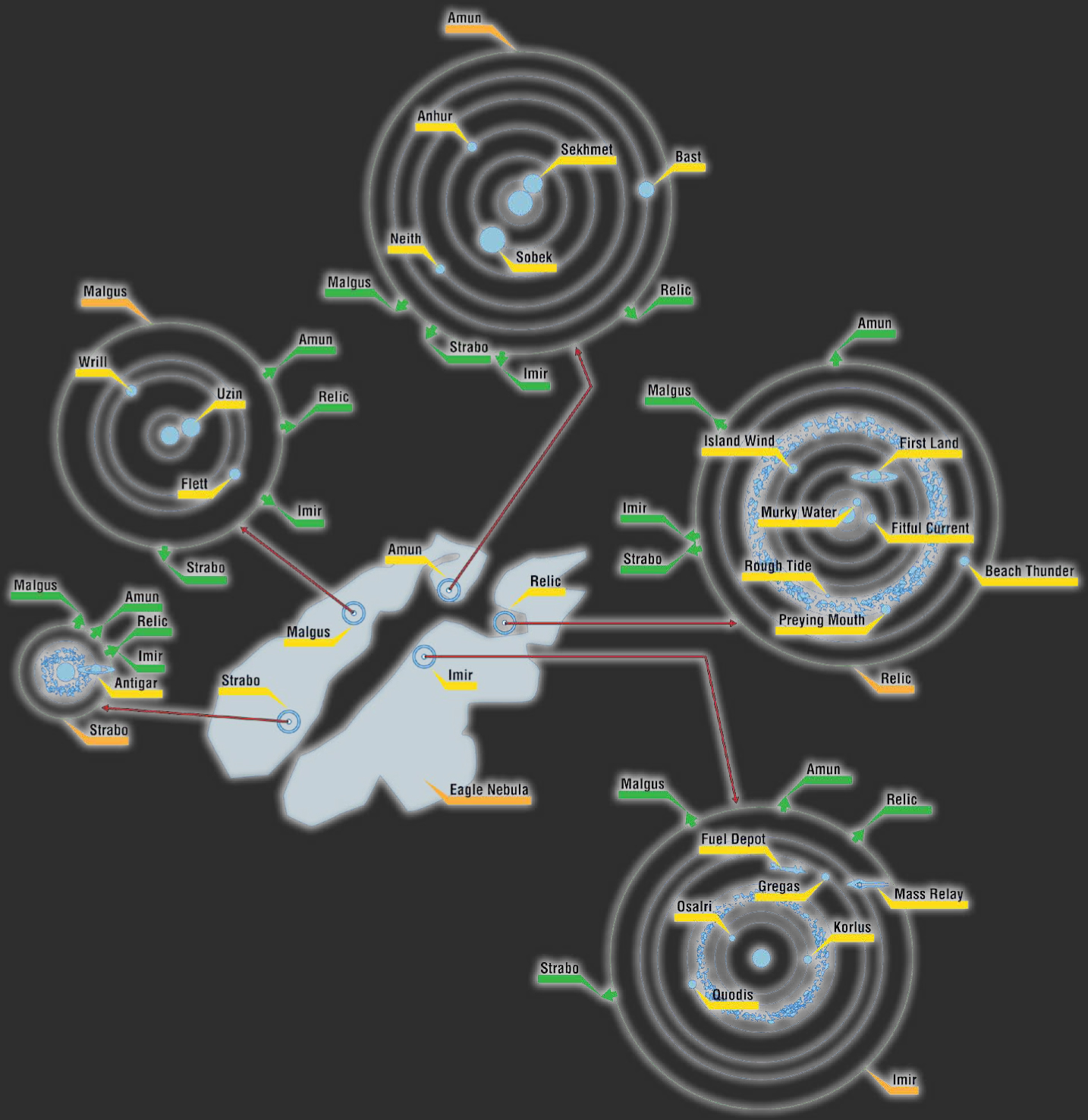
| System | Planets, Planetoids, and Other Galactic Flotsam |
|---|---|
| Amun | Sekhmet, Sobek, Anhur, Neith, Bast |
| Imir | Osalri, Korlus, Asteroid Belt, Quodis, Fuel Depot, Gregas, Mass Relay |
| Malgus | Uzin, Wrill, Flett |
| Relic | Murky Water, Fitful Current, First Land, Island Wind, Rough Tide, Asteroid Belt, Preying Mouth, Beach Thunder |
| Strabo | Asteroid Belt, Antigar, Jarrahe Station |
| Related Mission | System | Planet |
|---|---|---|
| Special Assignment > N7: Hahne-Kedar Mechs > Abandoned Research Station | Strabo | Jarrahe Station |
| Special Assignment > N7: Hahne-Kedar Mechs > Wrecked Merchant Freighter | Amun | Neith |
System: Amun
Anhur
World Type: Garden
Richness: Rich
Element Zero: Rich
Iridium: Poor
Platinum: Rich
Palladium: Moderate
Population: 208,587,000; Colony Founded: 2165; Capital: New Thebes; Orbital Distance: 1.7 AU; Orbital Period: 2.2 Earth Years; Radius: 6,829 Km; Day Length: 18.0 Earth Hours; Atmospheric Pressure: 0.6 Earth Atmospheres; Surface Temperature: 7 Celsius; Surface Gravity: 1.3 G.
Description: A garden world with heavy populations of humans and batarians, Anhur was home to one of the ugliest violations of sapient rights in modern human history.
A consortium of corporations and corrupt politicians, fearing batarian economic competition due to their custom of legal slavery, passed a resolution that abolished the minimum wage—effectively relegalizing slavery on a human-dominated world.
Opponents of the motion quickly turned to activism and violence. A civil war erupted as one side sought to end slavery throughout the system and the other, primarily a batarian faction called the Na’hesit, sought to keep the slaves they had. The Anhur Rebellions raged from 2176 to 2178.
The Na’hesit had a significant advantage in ships, labor, and weapons, forcing the Anhur militias to hire mercenary companies to even the odds.
In the end the abolitionists won out, though at the cost of much of their infrastructure. Though Anhur today still has significant natural wealth, it is economically depressed save for the reconstruction industry.
Bast
World Type: Giant Jovian
Richness: Poor
Element Zero: None
Iridium: Poor
Platinum: Poor
Palladium: Poor
Orbital Distance: 7.0 AU; Orbital Period: 18.6 Earth Years; Radius: 18,557 Km; Day Length: 13.6 Earth Hours.
Description: A small hydrogen-nitrogen gas giant, Bast and its moons served as the Eclipse mercenary company’s fallback position after their defeat on Neith.
Once they had gathered their strength they leaked a false position to the Na’hesit consortium to lure them into a trap, which devolved into a pitched battle.
Both sides claimed victory. Na’hesit lost more ships but could afford the setback in a way Eclipse could not.
Neith
World Type: Desert
Richness: Rich
Element Zero: None
Iridium: Moderate
Platinum: Moderate
Palladium: Rich
Orbital Distance: 3.4; AU Orbital Period: 6.3 Earth Years; Radius: 7,008 Km; Day Length: 54.7 Earth Hours; Atmospheric Pressure: 0.7 Earth Atmospheres; Surface Temperature: -25 Celsius; Surface Gravity: 1.4 G.
Description: Cold and dry, Neith has a thin nitrogen atmosphere and vast salt flats at its equator, which is warm enough for liquid water to pool during the summer period.
The revealed salt is collected and sold to sodium-poor planets for agricultural purposes.
During the Anhur Rebellions, Neith was a staging ground for Eclipse ships and was the site of their first defeat when enemy Na’hesit surprised and routed them with a superior force.
Some wreckage from the battle can still be found on the planet today.
Sekhmet
World Type: Giant Jovian
Richness: Moderate
Element Zero: Moderate
Iridium: Poor
Platinum: Moderate
Palladium: Poor
Orbital Distance: 0.4 AU; Orbital Period: 0.3 Earth Years; Radius: 38,347 Km; Day Length: 9.0 Earth Hours.
Description: A hydrogen-helium gas giant believed to have entered Amun’s system within the last billion years, Sekhmet was the site of an important battle in the Anhur Rebellions.
When the Eclipse mercenary company sought to capture the refueling stations to deny the rebels supplies, a fighter wing hiding in Sekhmet’s rings ambushed them.
Eclipse suffered heavy initial losses but destroyed two rebel carriers and forced them to retreat into FTL.
This was considered the “high water mark” of the rebellion: At no point after the battle of Sekhmet did the rebels have a victory. Today Sekhmet is home to refueling stations and a small war memorial in orbit at the planet’s L5 Lagrange point.
Sobek
World Type: Giant Jovian
Richness: Moderate
Element Zero: None
Iridium: Poor
Platinum: Moderate
Palladium: Poor
Orbital Distance: 0.8 AU; Orbital Period: 0.7 Earth Years; Radius: 72,530 Km; Day Length: 12.4 Earth Hours.
Description: Sobek is a hydrogen-nitrogen gas giant believed to be an extrasolar capture. Its low-G moons were the sites of many batarian labor camps during the Anhur Rebellions, generating raw materials for the war.
When the slaves were finally liberated by Eclipse the mercenaries found abysmal conditions, including whole camps that lacked mass effect fields to keep the gravity at habitable levels.
The widespread bone loss among the slaves was part of their masters’ final degradation—it would cripple them if they ever left for a standard-gravity world.
The plight of the slaves soon garnered galactic media attention, and several charities sprang up to pay for their physical therapy and find them gainful employment.
Eclipse mercenaries, normally reviled for their cutthroat tactics and criminal employees, found themselves painted as heroes. The mercenary company still retains an office on Sobek’s moon Heqet, out of nostalgia as much as a business strategy.
System: Imir †
Gregas
World Type: Rock
Richness: Rich
Element Zero: None
Iridium: Rich
Platinum: Moderate
Palladium: Moderate
Orbital Distance: 10.0 AU; Orbital Period: 31.7 Earth Years; Radius: 5,240 Km; Day Length: 69.9 Earth Hours; Atmospheric Pressure: Trace; Surface Temperature: -170 Celsius; Surface Gravity: 0.7 G.
Description: Cold and distant, Gregas is currently 65 percent rock by mass and 35 percent frozen methane and nitrogen ices. In the planet’s “summer years” these percentages change as the sun heats its ice and it evaporates into a thin atmosphere.
Its calcium-heavy crust has been scouted by countless Korlus surveying teams, most of whom came back empty-handed.
Korlus
World Type: Rock
Richness: Not Minable
Element Zero: Not Minable
Iridium: Not Minable
Platinum: Not Minable
Palladium: Not Minable
Population: 3,800,000,000 (est.); Colony Founded: 1781 CE; Capital: Choquo (disputed); Orbital Distance: 1.3 AU; Orbital Period: 1.5 Earth Years; Radius: 6,850 Km; Day Length: 28.9 Earth Hours; Atmospheric Pressure: 1.5 Earth Atmospheres; Surface Temperature: 28 Celsius; Surface Gravity: 1.3 G.
Description: A garbage scow with a climate was how one Citadel Council member described Korlus at the turn of the century, and ever since then the Korlus Tourist Bureau has been attempting to re-brand their planet.
It hasn’t worked—though they have tried calling it “the recycling center of the galaxy,” corruption scandals and a staggering murder rate ensure that Korlus’s image is permanently stained.
Korlus’s biggest business is the recycling of decommissioned or junked spacecraft into their component parts.
While the invention of omni-gel has made this process significantly cleaner it is still a dirty business that chokes Korlus’s sky with smog and fills its ports with megatons of scrap.
A shady hospitality industry and a scavenger underclass round out the spectacle of urban decay.
TRAVEL ADVISORY: Korlus ranks second in murder per capita in the Terminus Systems and first in offworlder murder. Civilian traffic is encouraged to employ security professionals when visiting.
Osalri
World Type: Brown Dwarf
Richness: Moderate
Element Zero: None
Iridium: Poor
Platinum: Moderate
Palladium: Moderate
Orbital Distance: 0.6 AU; Orbital Period: 0.5 Earth Years; Radius: 2,622 Km; Day Length: 33.4 Earth Hours; Atmospheric Pressure: 1.86 Earth Atmospheres; Surface Temperature: 229 Celsius; Surface Gravity: 0.1 G.
Description: Osalri (which means “fire maiden”) is a boiling hot dwarf planet close to the G-class star Imir. Too hot for lucrative exploitation, its only satellites are defunct solar arrays destroyed by pirates long ago.
Quodis
World Type: Giant Jovian
Richness: Moderate
Element Zero: None
Iridium: Poor
Platinum: Moderate
Palladium: Poor
Orbital Distance: 5.0 AU; Orbital Period: 11.2 Earth Years; Radius: 48,918 Km; Day Length: 13.3 Earth Hours.
Description: A hydrogen-helium gas giant, Quodis is used by countless spaceships to discharge their drive cores after coming into the system. Commercial vessels restock on their supplies of helium-3 from one of its many orbital platforms.
TRAVEL ADVISORY: Piracy at helium-3 refueling stations is common in the Imir system. Visitors are encouraged to use the escorts provided by the Korlus Security Fleet to and from the system’s mass relay.
To prevent escort fraud always ask for identification from the escort ships and compare them to those found on the Korlus Security Fleet’s extranet sites.
System: Malgus
Flett
World Type: Desert
Richness: Rich
Element Zero: None
Iridium: Moderate
Platinum: Moderate
Palladium: Rich
Orbital Distance: 1.2 AU; Orbital Period: 1.5 Earth Years; Radius: 5,623 Km; Day Length: 48.2 Earth Hours; Atmospheric Pressure: 2.49 Earth Atmospheres; Surface Temperature: 16 Celsius; Surface Gravity: 0.7 G.
Description: Uninhabitable by most species, Flett is home to the Blood Pack’s vorcha training and breeding grounds. The thick atmosphere is nearly all nitrogen and lacks oxygen, which poses no hazard to the vorcha.
Needing little but imports of food and water, vorcha mercenaries and mercenaries-to-be train religiously to overpower and kill whoever the company is at war with this time.
TRAVEL ADVISORY: Flett’s spaceports are wholly owned subsidiaries of the Blood Pack mercenary company, a corporation undergoing numerous criminal investigations for capital crimes. Civilian traffic to Flett is strongly discouraged.
Uzin
World Type: Giant Pegasid
Richness: Moderate
Element Zero: None
Iridium: Poor
Platinum: Moderate
Palladium: Moderate
Orbital Distance: 0.3 AU; Orbital Period: 0.2 Earth Years; Radius: 74,137 Km; Day Length: 12.4 Earth Hours.
Description: Named for one of many krogan gods of vengeance, Uzin is a gas giant close enough to its orange sun that none of its moons are considered habitable.
Its composition is largely hydrogen and methane, with traces of xenon that the krogan collect for use in ion drives.
Uzin is well within the “frost line” where gas giants usually do not form, leading astronomers to believe that its orbit used to be farther from the star.
If so this would indicate a seriously unstable orbit, and the planet may plunge into its star within a few million years.
Wrill
World Type: Desert
Richness: Rich
Element Zero: None
Iridium: Poor
Platinum: Moderate
Palladium: Rich
Orbital Distance: 0.6 AU; Orbital Period: 0.5 Earth Years; Radius: 5,999 Km; Day Length: 30.1 Earth Hours; Atmospheric Pressure: Trace; Surface Temperature: 56 Celsius; Surface Gravity: 0.9 G.
Description: A planet only a vorcha could love, Wrill is notable for its “near miss” climate: punishing heat and a thin toxic methane-ethane atmosphere. I
ts surface is dotted with krogan and vorcha habitats eking out a meager living off the planet’s tin and copper deposits and killing anyone who cuts into their profits.
TRAVEL ADVISORY: Krogan can survive in the heat with the use of a breathing mask. All other species require environmental suits to avoid heat exhaustion and burns.
Liquid water can be found in large lakes on the surface. This can be used for thermoregulation, but it is not potable without processing.
ALLIANCE BULLETIN: Large-scale gang warfare is a regular occurrence on Wrill. Civilian travel is not advised.
System: Relic
Beach Thunder
World Type: Rock
Richness: Rich
Element Zero: None
Iridium: Rich
Platinum: Moderate
Palladium: Poor
Orbital Distance: 33.0 AU; Orbital Period: 190.2 Earth Years; Radius: 8,058 Km; Day Length: 54.1 Earth Hours; Atmospheric Pressure: 1.25 Earth Atmospheres; Surface Temperature: -157 Celsius; Surface Gravity: 2.1 G.
Description: Beach Thunder lives and dies on the price of titanium—the metal being the only reason to come to this frozen rock. A best-selling e-novel, The Hard Stuff, has popularized the story of the miners on the planet.
It follows the hanar and drell robo-miners competing with krogan and vorcha, who simply put on environmental suits and lase the titanium out more or less by hand.
As the novel’s promotional screed says “accidents are frequent, rivalry is fierce, and vengeance served up fast.”
First Land
World Type: Giant Jovian
Richness: Moderate
Element Zero: None
Iridium: Poor
Platinum: Moderate
Palladium: Poor
Orbital Distance: 2.1 AU; Orbital Period: 3.4 Earth Years; Radius: 53,826 Km; Day Length: 10.9 Earth Hours.
Description: A hydrogen-helium gas giant believed to be an extrasolar capture, First Land is home to many space stations supporting the ubiquitous refueling platforms.
A thriving community of drell and hanar make their homes in orbit here, giving the solar system’s robo-miners somewhere to go when the 50-hour days and nights are driving them mad.
Fitful Current
World Type: Rock
Richness: Rich
Element Zero: None
Iridium: Rich
Platinum: Poor
Palladium: Poor
Orbital Distance: 1.2 AU; Orbital Period: 1.5 Earth Years; Radius: 9,260 Km; Day Length: 41.9 Earth Hours; Atmospheric Pressure: Trace; Surface Temperature: -47 Celsius; Surface Gravity: 3.1 G.
Description: Fitful Current was so named because it orbits in retrograde, indicating that it may have been an extrasolar planet that was captured by the Relic System’s gravity well.
Large for a rock planet, Fitful Current has only traces of hydrogen in its extremely thin atmosphere. Hanar robo-miners have recovered some uranium and thorium deposits from its depths.
Island Wind
World Type: Giant Jovian
Richness: Moderate
Element Zero: None
Iridium: Poor
Platinum: Moderate
Palladium: Poor
Orbital Distance: 3.9 AU Orbital Period: 7.7 Earth Years; Radius: 73,088 Km; Day Length: 17.0 Earth Hours.
Description: A large hydrogen-nitrogen gas giant, Island Wind is named for the sweet-smelling land breezes that come off of the archipelagos of Kahje in the evening.
As tumultuous as any other Jovian giant, Island Wind has cyclones that span tens of thousands of kilometers.
Murky Water
World Type: Desert
Richness: Rich
Element Zero: None
Iridium: Moderate
Platinum: Moderate
Palladium: Rich
Orbital Distance: 0.7 AU; Orbital Period: 0.7 Earth Years; Radius: 10,551 Km; Day Length: 53.9 Earth Hours; Atmospheric Pressure: 19.46 Earth Atmospheres; Surface Temperature: 225 Celsius; Surface Gravity: 4.6 G.
Description: Despite the name, Murky Water has yet to show any signs of having any water whatsoever. Its name is a literal translation from the original hanar, who consider murky water a sign of danger.
Murky Water has a hazy crushing atmosphere of carbon dioxide and methane that brings the surface heat to boiling levels. It remains unexploited—its gravity and temperature are too high to bother.
Preying Mouth
World Type: Giant Jovian
Richness: Moderate
Element Zero: Rich
Iridium: Poor
Platinum: Poor
Palladium: Poor
Orbital Distance: 16.0 AU; Orbital Period: 64.2 Earth Years; Radius: 40,775 Km; Day Length: 11.7 Earth Hours.
Description: A hydrogen-helium gas giant, Preying Mouth is a ship-killing enigma—the Bermuda Triangle of the Terminus Systems.
There are many theories why ships never return from there: undetectable space debris; old disruptor torpedoes and magnetic mines from a long-forgotten war; even miniature black holes.
But what is clear is that too many ships have been lost there for it to be happenstance.
TRAVEL ADVISORY: Due to the large number of ships lost when attempting to discharge their drive cores in Preying Mouth, the Relic system highly recommends using First Land’s complimentary discharge stations instead.
Rough Tide
World Type: Rock
Richness: Rich
Element Zero: None
Iridium: Poor
Platinum: Rich
Palladium: Rich
Orbital Distance: 7.8 AU; Orbital Period: 21.8 Earth Years; Radius: 2,125 Km; Day Length: 67.7 Earth Hours; Atmospheric Pressure: 7.89 Earth Atmospheres; Surface Temperature: 1 Celsius; Surface Gravity: 0.1 G.
Description: A dwarf planet with a shroud of carbon monoxide and dioxide that keeps it warm, Rough Tide was so named when large veins of platinum and palladium were struck and miners from all over the cluster came in to stake their claims.
Hanar police and their drell enforcers clashed with krogan and vorcha in an ugly series of race riots in the late 2170s, and the planet has only grudgingly kept a shaky peace since then.
System: Strabo
Antigar
World Type: Giant Jovian
Richness: Moderate
Element Zero: None
Iridium: Poor
Platinum: Moderate
Palladium: Poor
Orbital Distance: 4.0 AU; Orbital Period: 8.0 Earth Years; Radius: 24,193 Km; Day Length: 11.2 Earth Hours.
Description: Charted by a salarian mining expedition that went off course due to computer error, Antigar is a hydrogen and helium gas giant with 11 known moons and dusty rings.
Jarrahe Station
World Type: Space Station
Richness: Not Minable
Element Zero: Not Minable
Iridium: Not Minable
Platinum: Not Minable
Palladium: Not Minable
Orbital Distance: 2.02 AU; Orbital Period: 2.2 Earth Years; Length: 1.5 Km; Population: 33; Gross Weight: 385 metric tons.
Description: There is little public information to be had about this station. It has a salarian name and orbits Antigar at its second Lagrange point. It is not listed in the Alliance directory of helium-3 refueling stations.