
Mass Effect 2 Guide Essentials PLANETARY DATABASE
Cluster: Sigurd's Cradle
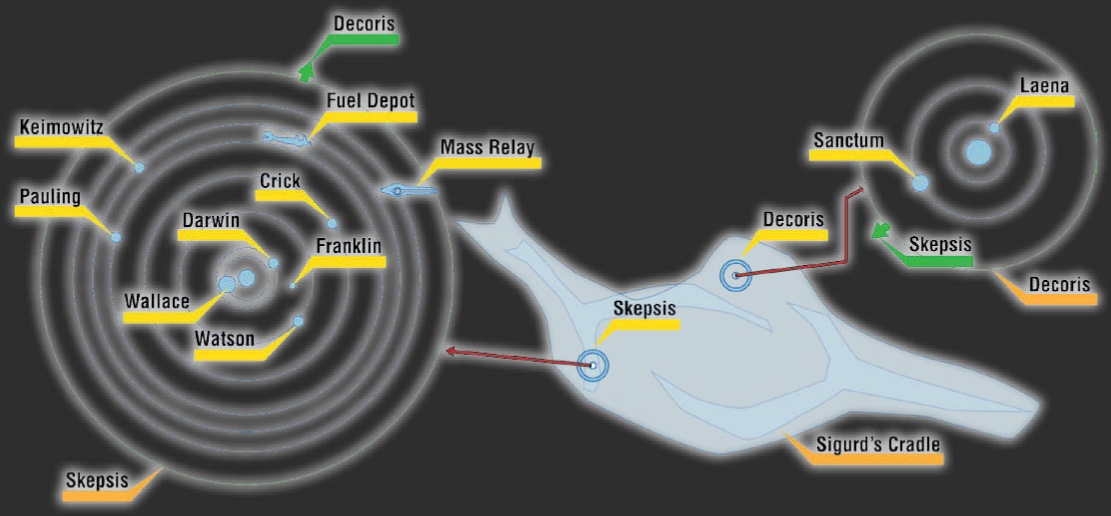
| System | Planets, Planetoids, and Other Galactic Flotsam |
|---|---|
| Decoris | Laena, Sanctum |
| Skepsis | Wallace, Darwin, Watson (Franklin), Crick, Pauling, Fuel Depot, Keimowitz, Mass Relay |
| Related Mission | System | Planet |
|---|---|---|
| Special Assignment > N7: Blue Suns > Blue Suns Base | Decoris | Sanctum |
System: Decoris
Laena
World Type: Desert
Richness: Rich
Element Zero: None
Iridium: Poor
Platinum: Moderate
Palladium: Rich
Orbital Distance: 1.4 AU; Orbital Period: 1.7 Earth Years; Radius: 6,197 Km; Day Length: 36.2 Earth Hours; Atmospheric Pressure: 37.64 Earth Atmospheres; Surface Temperature: 365 Celsius; Surface Gravity: 1.0 G.
Description: Laena (which means “cloaked”) is a methane-clouded hothouse planet. Its lack of a metal-rich core and significant magnetosphere allows for an easy scan, which reveals mining equipment on its surface.
It can be deduced that this mining occurred within the last five years—any longer and the machines would have been worn down to nothing by the excessive heat and dust storms of hot iron oxide.
Sanctum
World Type: Garden
Richness: Good
Element Zero: Moderate
Iridium: Poor
Platinum: Rich
Palladium: Moderate
Population: 257,300; Colony Founded: 2169; Capital: Vulpes; Orbital Distance: 2.6 AU; Orbital Period: 4.2 Earth Years; Radius: 6,651 Km; Day Length: 69.4 Earth Hours; Atmospheric Pressure: 0.4 Earth Atmospheres; Surface Temperature: -50 Celsius (mean), 4 Celsius (equator). Surface Gravity: 1.2 G.
Description: Sanctum is proof of the old spacer adage “just because it’s called a garden world doesn’t mean it’s a picnic.”
Freezing ice storms cover the poles and temperate zones, leaving a narrow strip of habitable land at the equator. Dry but windy, this area is home to Sanctum’s minimal terrestrial plant life.
The planet has yet to develop land-based animals, though invertebrates grow quite large in its pelagic seas. Mining referred to as “ice cracking” at anywhere but the equator is a common employment on Sanctum.
The planet is rich in platinum and palladium deposits as well as boron, which is locally used in semiconductor doping.
TRAVEL ADVISORY: Carbon dioxide levels on Sanctum can reach 5,000 parts per million during thermal inversions. Travelers should carry a breath mask at all times and consult the Sanctum World Weather Service for warnings.
TRAVEL ADVISORY: Piracy is at a 14-year global high on Sanctum. Visitors should take appropriate security precautions.
System: Skepsis †
Crick
World Type: Rock
Richness: Rich
Element Zero: None
Iridium: Rich
Platinum: Moderate
Palladium: Moderate
Orbital Distance: 4.3 AU; Orbital Period: 8.9 Earth Years; Radius: 4,738 Km; Day Length: 60.7 Earth Hours; Atmospheric Pressure: 2.77 Earth Atmospheres; Surface Temperature: -32 Celsius; Surface Gravity: 0.6 G.
Description: Known for its spectacular geysers that can be seen from orbit, Crick is a rock planet with expansive frozen oceans.
Though it is within the temperature and pressure range for human habitation, its thick atmosphere is largely carbon dioxide and monoxide, making breath masks or environmental suits mandatory.
The most abundant resources for exploitation are the potassium salts found in its seabeds, which fetch good prices on terraforming worlds.
Darwin
World Type: Rock
Richness: Good
Element Zero: None
Iridium: Rich
Platinum: Moderate
Palladium: Moderate
Orbital Distance: 0.9 AU; Orbital Period: 0.9 Earth Years; Radius: 6,771 Km; Day Length: 37.3 Earth Hours; Atmospheric Pressure: 112.06 Earth Atmospheres; Surface Temperature: 710 Celsius; Surface Gravity: 1.2 G.
Description: A mid-sized rock planet, Darwin is ironically named, being one of the worst places for life in the galaxy. Its atmosphere is punishing, its temperature boiling, its chemical makeup toxic.
Carbon monoxide and methane wrap the planet in an unyielding haze, and scans of its surface show only silicates and molten tin.
Its daily thermal fluctuations lead to hurricane-level vortices, two at each pole, forming “eyes” that can be seen from orbit.
Despite all this Darwin is still used by spacers as a drive core discharge point—hydrogen pierces the clouds in the upper atmosphere, making for a relatively benign approach.
Franklin
World Type: Rock
Richness: Rich
Element Zero: None
Iridium: Rich
Platinum: Moderate
Palladium: Poor
Orbital Distance: 2.1 AU; Orbital Period: 33 Earth Days (around Watson), 3.0 Earth Years (around Skepsis); Radius: 2,405 Km; Day Length: 33 Earth Days; Atmospheric Pressure: Trace; Surface Temperature: -116 Celsius; Surface Gravity: 0.1 G.
Description: A large moon, Franklin retains a trace atmosphere of carbon dioxide, but its desolate surface holds no signs of water or life.
In order to defend Watson from the pirates of the Terminus Systems, Franklin is home to two Alliance spaceports and naval bases capable of fielding six fighter squadrons each and a classified number of interplanetary ballistic missiles.
Mass effect fields keep the gravity in its installations at a comfortable level for long-term living.
Keimowitz
World Type: Ocean/ice
Richness: Rich
Element Zero: None
Iridium: Poor
Platinum: Rich
Palladium: Poor
Orbital Distance: 16.8 AU; Orbital Period: 69.1 Earth Years; Radius: 9,586 Km; Day Length: 29.7 Earth Hours; Atmospheric Pressure: Trace; Surface Temperature: -190 Celsius; Surface Gravity: 3.4 G.
Description: Named for the 21st century pioneer of groundwater remediation techniques, Keimowitz is an impressive layer of ice over a stony metallic core.
Despite its size it has only one moon, Noa, which shares its carbonaceous composition, leading astronomers to believe it formed following a giant impact.
Iridium deposits have attracted miners to the planet; they must work through robots and telepresence because of the planet’s strong gravity.
Pauling
World Type: Giant Ice
Richness: Poor
Element Zero: None
Iridium: Poor
Platinum: Moderate
Palladium: Poor
Orbital Distance: 4.3 AU; Orbital Period: 8.9 Earth Years; Radius: 4,738 Km; Day Length: 60.7 Earth Hours; Atmospheric Pressure: 2.77 Earth Atmospheres; Surface Temperature: -32 Celsius; Surface Gravity: 0.6 G.
Description: A hydrogen-methane gas giant, Pauling’s gravitational field is believed to have cleared most of what would otherwise have been a sizable Asteroid Belt.
The 2163 mission of the space probe Ultimate gave the inhabitants of Watson reams of data reinforcing this theory, giving the colonists an accurate count of its moons (66), rings, moonlike ring objects, and more than 200 visible impact craters on its pockmarked surface.
Ultimate has since been retrieved for re-use on subsequent missions within the solar system.
Wallace
World Type: Giant Pegasid
Richness: Moderate
Element Zero: None
Iridium: Poor
Platinum: Moderate
Palladium: Moderate
Orbital Distance: 0.04 AU; Orbital Period: 11 Earth Days; Radius: 39,459 Km; Day Length: 11 Earth Days.
Description: An unusually small Pegasid or “hot Jupiter,” Wallace was originally an extrasolar planet that entered this system and was captured by the gravity well of the G-class star Skepsis.
Tidally locked, Wallace’s “hot side” reaches temperatures over 2,500 degrees Celsius. While not large enough proportionate to the star to cause eclipses visible from Watson, it is easily seen at dawn or dusk as one of the brightest objects in the sky.
Watson
World Type: Garden
Richness: Good
Element Zero: Rich
Iridium: Poor
Platinum: Rich
Palladium: Moderate
Orbital Distance: 2.1 AU; Orbital Period: 3.0 Earth Years; Radius: 6,733 Km; Day Length: 37.8 Earth Hours; Atmospheric Pressure: 0.6 Earth Atmospheres; Surface Temperature: -18 Celsius (mean), 25 Celsius (habitable zone); Surface Gravity: 1.2 G.
Description: Watson is known in human media for two things—its spectacular tides brought on by a large moon and the bureaucratic snafu over which Earth nations got to settle there first.
Watson is a garden world first discovered in 2165 CE with credit claimed by the Chinese People’s Federation, the United North American States, and the European Union.
The Systems Alliance brokered the infamous “Reykjavik Compromise,” allowing limited colonization from each coalition in cities comprised of populations from each nation.
Watson itself trends colder than Earth, with a temperate zone measuring about 30 degrees latitude in either direction from the equator.
Its life does not easily map to Earth’s evolutionary eras—some islands have species that resemble terrestrial placental mammals, while others are overrun by arthropods.
It is estimated that at least two more generations of xenozoologists will be needed to properly classify all the species of the planet.