
Mass Effect 2 Guide Essentials PLANETARY DATABASE
Cluster: Serpent Nebula
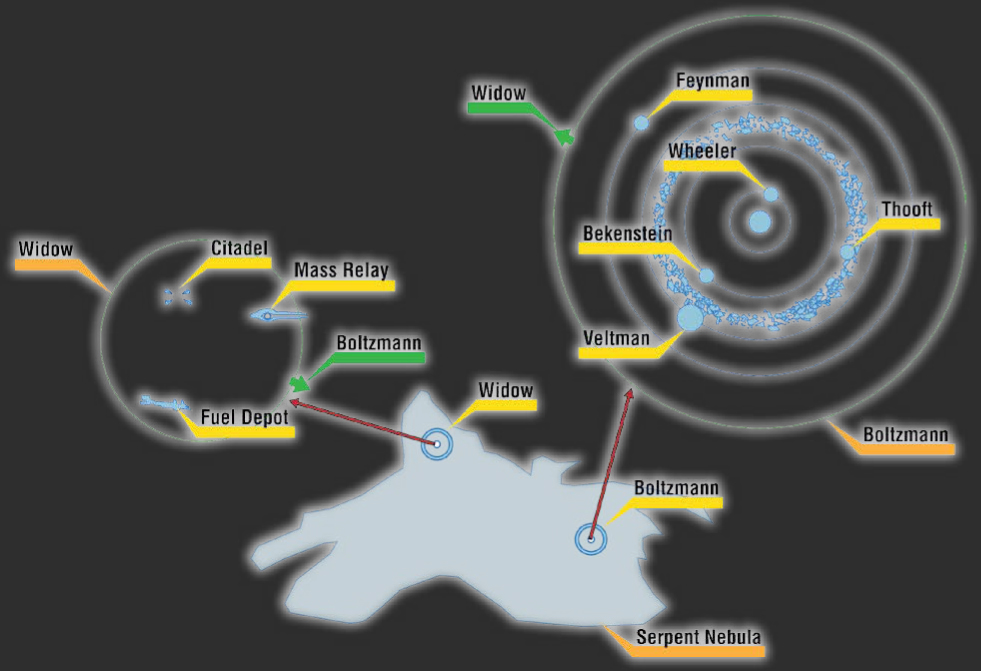
| System | Planets, Planetoids, and Other Galactic Flotsam |
|---|---|
| Boltzmann | Wheeler, Bekenstein, Asteroid Belt, Thooft, Veltman, Feynman |
| Widow | Citadel, Fuel Depot, Mass Relay |
| Related Mission | System | Planet |
|---|---|---|
| Walkthrough Mission > Dossier: The Master Thief | Widow | Citadel |
| Walkthrough Mission > Loyalty Mission: Garrus: Eye for an Eye | Widow | Citadel |
| Walkthrough Mission > Loyalty Mission: Thane: Sins of the Father | Widow | Citadel |
| Special Assignment > Citadel > Captain Bailey | Widow | Citadel |
| Special Assignment > Citadel > The Council | Widow | Citadel |
| Special Assignment > Citadel > Crime in Progress | Widow | Citadel |
| Special Assignment > Citadel > Found Forged ID (Garrus: Eye for an Eye) | Widow | Citadel |
| Special Assignment > Citadel > False Positives (Thane: Sins of the Father) | Widow | Citadel |
| Special Assignment > Citadel > Krogan Sushi | Widow | Citadel |
System: Boltzmann
Bekenstein
World Type: Garden
Richness: Depleted
Element Zero: None
Iridium: Poor
Platinum: Poor
Palladium: Poor
Orbital Distance: 1.8 AU; Orbital Period: 2.4 Earth Years; Radius: 6,050 Km; Day Length: 21.3 Earth Hours; Atmospheric Pressure: 1.17 Earth Atmospheres; Surface Temp: 43 (mean) 25 (habitable zone) Celsius; Surface Gravity: 0.9 G.
Description: Bekenstein was the recipient of the first wave of Earth’s colonization efforts. Its founders had a decidedly less agrarian plan than Eden Prime.
The mission of Bekenstein’s first colony was to become Earth’s first off-planet manufacturing base, ingratiating humanity into galactic culture by producing needed goods.
Meeting with mixed success for the first generation, Bekenstein then leapfrogged its competition by producing high-grade luxury goods that were sent straight to nearby markets via the Citadel.
Today, Bekenstein is known as “the humans’ Illium”—a place where new-money tycoons flaunt their wealth and the have-nots are rarely spoken of.
Feynman
World Type: Jovian Giant
Richness: Poor
Element Zero: None
Iridium: Moderate
Platinum: Poor
Palladium: Poor
Colony Founded: 2158; Population: 5,425,000; Capital: Milgrom; Orbital Distance: 15.2 AU; Orbital Period: 59.4 Earth Years; Radius: 40,196 Km; Day Length: 16.9 Earth Hours.
Description: A hydrogen-methane gas giant, Feynman is of far less interest to the colonists of Bekenstein than its moons.
All 24 are under heavy development by three rival firms: Hoshichiri Heavy Industries, Guanghui Solutions, and the Dynamis Corporation.
These three firms are under ironclad contracts to sell their raw materials exclusively to corporations based on or orbiting around Bekenstein, a situation which has led to heavy investment on Bekenstein from manufacturing corporations looking to get a piece of the action.
Feynman itself has been relatively untouched by the mining concerns as its strong magnetosphere and great dark storm cells create a barrier to all but the newest generation of scanners.
Thooft
World Type: Rock
Richness: Moderate
Element Zero: None
Iridium: Moderate
Platinum: Poor
Palladium: Poor
Orbital Distance: 3.6 AU; Orbital Period: 6.8 Earth Years; Radius: 3,247 Km; Day Length: 34.2 Earth Hours; Atmospheric Pressure: 1.88 Earth Atmospheres; Surface Temp: −5 Celsius; Surface Gravity: 0.2 G.
Description: Technically named T’hooft (Dutch for “the head”), Thooft is a dwarf planet with a moderate carbon dioxide atmosphere and rich deposits of periclase.
Originally put on the star charts when a human scout ship needed to discharge its drive core and wasn’t able to reach the system’s gas giants in time, Thooft has seen some development by Hoshichiri Heavy Industries.
Periclase from the asteroid can be found in common industrial products, such as industrial cable insulation and fire-resistant prefab housing walls.
Veltman
World Type: Jovian Giant
Richness: Poor
Element Zero: None
Iridium: Moderate
Platinum: Poor
Palladium: Poor
Orbital Distance: 7.1 AU; Orbital Period: 19.0 Earth Years; Radius: 61,755 Km; Day Length: 14.0 Earth Hours.
Description: A hydrogen-helium gas giant, Veltman is home to the koshiroten, enormous storm cells that appear as whitish spots and are visible as far away as Bekenstein.
As with most other colonized gas giants, Veltman’s orbital space sports a variety of helium-3 refueling stations for merchant vessels.
Of particular note among the orbital stations is the Dynamis Corporation’s facility for manufacturing metastable metallic hydrogen, despite the risks involved in manipulating the powerful mass effect fields needed to do so.
Citadel warships, which use the substance in their thrusters, can frequently be seen docking at Veltman as a result. This makes the Boltzmann system one of the most heavily patrolled in Citadel space.
Wheeler
World Type: Rock
Richness: Moderate
Element Zero: None
Iridium: Rich
Platinum: Poor
Palladium: Poor
Orbital Distance: 0.85 AU; Orbital Period: 0.8 Earth Years; Radius: 7,894 Km; Day Length: 60.5 Earth Hours; Atmospheric Pressure: 2.35 Earth Atmospheres; Surface Temp: 165 Celsius; Surface Gravity: 1.9 G.
Description: Wheeler is a sizable rock planet. Its atmosphere is a hostile mix of hydrogen and carbon monoxide, which poses little hazard to remote robo-mining.
Modern equipment can easily tolerate the planet’s temperatures and gravity. Wheeler’s crust is rich in bauxite and other light metals used in fabricators the galaxy over.
System: Widow
Citadel
World Type: Space Station
Richness: Not Minable
Element Zero: Not Minable
Iridium: Not Minable
Platinum: Not Minable
Palladium: Not Minable
Total Length (Open): 44.7 Km; Diameter (Open): 12.8 Km; Population: 13.2 million (not including keepers); Gross weight: 7.11 billion metric tons.
Description: Supposedly constructed by the long-extinct Protheans, this colossal deep-space station serves as the capital of the Citadel Council.
Gravity is simulated through rotation, and is a comfortable 1.02 standard Gs on the wards and a light 0.3 standard Gs on the Presidium Ring.