
Mass Effect 2 Guide Essentials PLANETARY DATABASE
Cluster: Hawking Eta
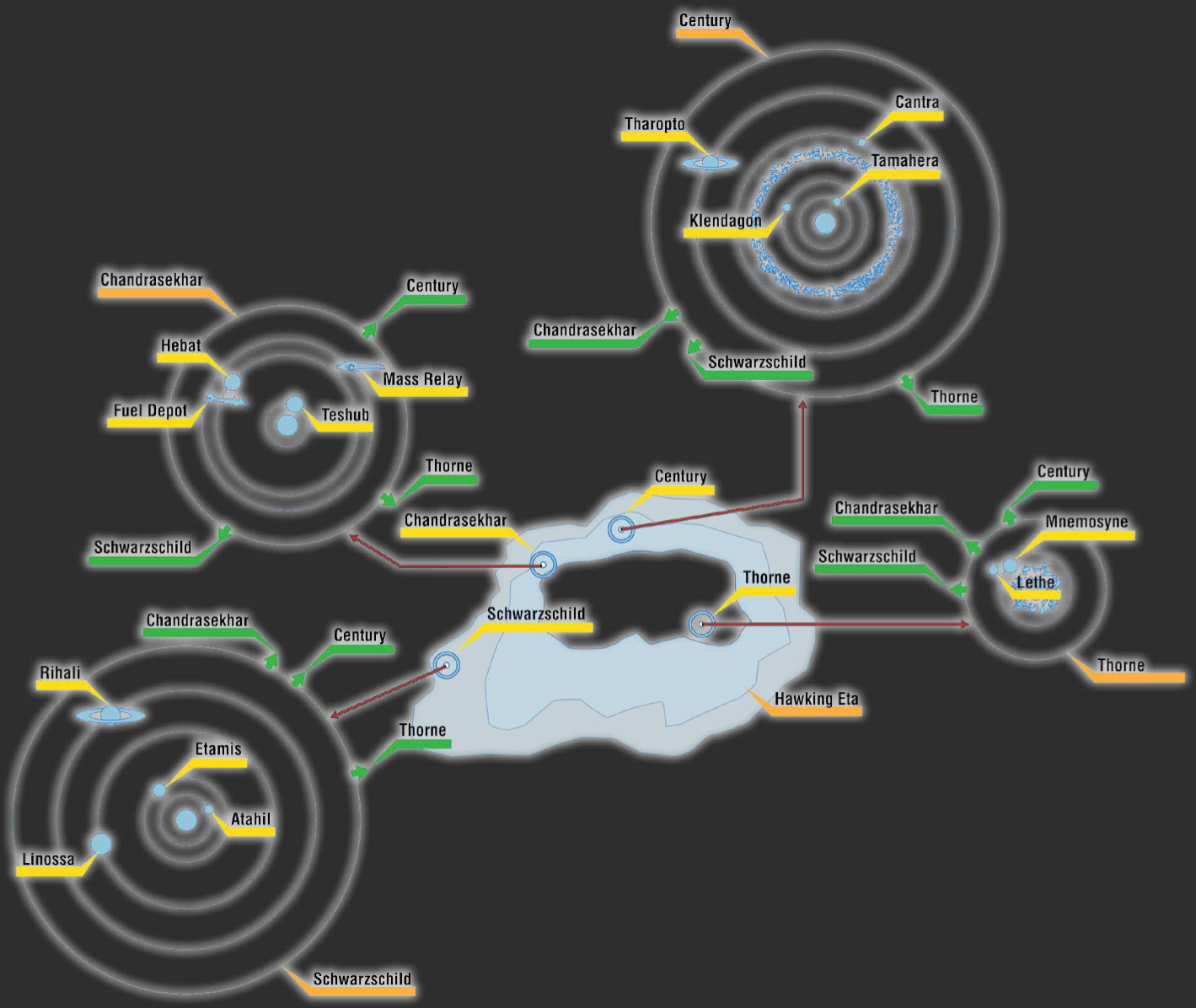
| System | Planets, Planetoids, and Other Galactic Flotsam |
|---|---|
| Century | Tamahera, Klendagon (Presrop), Asteroid Belt, Canctra, Tharopto |
| Chandrasekhar | Teshub, Fuel Depot, Hebat, Mass Relay |
| Schwarzschild | Atahil, Etamis, Linossa, Rihali |
| Thorne | Mnemosyne (Lethe), Derelict Reaper |
| Verr | Corang, Allusah, Serao |
| Related Mission | System | Planet |
|---|---|---|
| Additional Mission > Firewalker > Recover Artifact Collection | Verr | Corang |
System: Century
Canctra
World Type: Desert
Richness: Rich
Element Zero: None
Iridium: Moderate
Platinum: Poor
Palladium: Rich
Orbital Distance: 14.3 AU; Orbital Period: 60.6 Earth Years; Radius: 5,471 Km; Day Length: 66.7 Earth Hours; Atmospheric Pressure: 0.83 Earth Atmospheres; Surface Temperature: -175 Celsius; Surface Gravity: 0.7 G.
Description: A terrestrial world of average size, Canctra has an atmosphere composed of nitrogen and argon. Its frozen surface is mainly composed of tin with deposits of calcium.
Aside from some spectacular formations of ice at the poles the planet has little to recommend it.
Klendagon
World Type: Desert
Richness: Rich
Element Zero: None
Iridium: Moderate
Platinum: Moderate
Palladium: Rich
Orbital Period: 2.3 Earth Years; Radius: 7,377 Km; Day Length: 53.6 Earth Hours; Atmospheric Pressure: 0.64 Earth Atmospheres; Surface Temperature: -53 Celsius; Surface Gravity: 0.88 G.
Description: Klendagon is an arid terrestrial planet slightly larger than Earth but with a lower density that reflects its relative lack of heavier elements.
The crust is composed of tin and aluminum with wide deserts of dust-fine sand that are easily stirred by the wind.
Klendagon’s most striking feature is the Great Rift valley, which stretches across the southern hemisphere. What is most fascinating about the Rift is that it does not appear to be natural.
The geological record suggests it is the result of a “glancing blow” by a mass accelerator round of unimaginable destructive power. This occurred some 37 million years ago.
Tamahera
World Type: Desert
Richness: Rich
Element Zero: None
Iridium: Moderate
Platinum: Moderate
Palladium: Rich
Orbital Period: 1.4 Earth Years; Radius: 6,302 Km; Day Length: 40.1 Earth Hours; Atmospheric Pressure: 0.34 Earth Atmospheres; Surface Temperature: -30 Celsius; Surface Gravity: 0.66 G.
Description: Tamahera has a thin atmosphere of carbon dioxide and xenon. The surface is icy and composed of sodium oxide with deposits of calcium. It contains a few unremarkable metals but mainly consists of rock.
The presence of canyons and flood plains indicates that liquid water once existed, suggesting Tamahera had a thicker insulating atmosphere in the past.
Tharopto
World Type: Giant Ice
Richness: Moderate
Element Zero: None
Iridium: Poor
Platinum: Moderate
Palladium: Poor
Orbital Distance: 29.4 AU; Orbital Period: 128.2 Earth Years; Radius: 68,714 Km; Day Length: 17.5 Earth Hours.
Description: Tharopto is a typical ice gas giant with traces of chlorine and sulphur in its atmosphere. It has over 100 moons and an extensive ring system composed of pulverized rock, presumably the debris from shattered moons.
System: Chandrasekhar †
Hebat
World Type: Giant Ice
Richness: Moderate
Element Zero: None
Iridium: Poor
Platinum: Moderate
Palladium: Moderate
Orbital Distance: 1.35 AU; Orbital Period: 2.9 Earth Years; Radius: 36,257 Km; Day Length: 17.1 Earth Hours.
Description: Hebat is a methane-ammonia ice giant. When Heavy Metals Exomining of China won the bidding rights to develop the moon of Presrop in the Century system it began by establishing a helium-3 refueling facility on Hebat.
The station completed this year is considered a model facility by the executives of the state-run company.
Though the station produces more than enough fuel to supply the HMEC ships running to and from Century, it has a crew of only a dozen for maintenance and oversight. Nearly all the day-to-day operations are automated.
Teshub
World Type: Giant Jovian
Richness: Moderate
Element Zero: None
Iridium: Poor
Platinum: Moderate
Palladium: Poor
Orbital Distance: 0.9 AU; Orbital Period: 1.6 Earth Years; Radius: 63,568 Km; Day Length: 16.6 Earth Hours.
Description: The first and larger of the two gas giants in the Hawking Eta gateway system, Teshub is composed mainly of hydrogen and helium.
The brown and orange coloration in its upper cloud decks is caused by the upwelling of sulfur from lower levels of the atmosphere.
System: Schwarzschild
Atahil
World Type: Rock
Richness: Rich
Element Zero: None
Iridium: Rich
Platinum: Moderate
Palladium: Moderate
Orbital Distance: 0.9 AU; Orbital Period: 1 Earth Year; Radius: 5,230 Km; Day Length: 28.8 Earth Hours; Atmospheric Pressure: 62 Earth Atmospheres; Surface Temperature: 348 Celsius; Surface Gravity: 0.79 G.
Description: A typical Venusian “greenhouse” world, Atahil is only of note for a few scattered craters. Though flattened by millions of years of high pressure the marks of orbital bombardment strikes are unmistakable.
It is generally accepted among academics that whoever hailed from or settled Schwarzschild’s second planet, Etamis, must have had outposts on Atahil as well.
Etamis
World Type: Post-Garden
Richness: Good
Element Zero: Rich
Iridium: Moderate
Platinum: Rich
Palladium: Moderate
Orbital Distance: 1.35 AU; Orbital Period: 1.6 Earth Years; Radius: 9,577 Km; Day Length: 51.6 Earth Hours; Atmospheric Pressure: 0.2 Earth Atmospheres; Surface Temperature: -49.6 Celsius; Surface Gravity: 3.4 G.
Description: Etamis is a superterrestrial world a third larger than Earth. It is in a “post-garden” state that clearly shows evidence of attack from space.
While it’s now waterless, the shores of former oceans show patterns of cratering too regular to be anything but saturation bombardment by dreadnought-class kinetic weapons, although it is unclear how most of the atmosphere has been lost.
Archaeologists have found little of note. It appears that all settled regions were touched by the global bombardment.
The few relics found suggest an advanced spacefaring culture thrived on the world from approximately 20 to 40 million years ago.
The level of antiquity makes it impossible to estimate the world’s former population or guess whether it was the race’s homeworld or a colony.
Linossa
World Type: Giant Ice
Richness: Moderate
Element Zero: None
Iridium: Poor
Platinum: Moderate
Palladium: Poor
Orbital Distance: 3.34 AU; Orbital Period: 6.8 Earth Years; Radius: 55,806 Km; Day Length: 17.8 Earth Hours.
Description: Linossa is a hydrogen-helium gas giant. It is surrounded by several thin rings of debris.
Analysis of this debris has been difficult due to its extreme age and fragility, but several apparently nano-manufactured materials have been identified.
The leading theory is that the inhabitants of Etamis mined the atmosphere for helium-3.
Rihali
World Type: Giant Jovian
Richness: Moderate
Element Zero: None
Iridium: Poor
Platinum: Moderate
Palladium: Poor
Orbital Distance: 6.34 AU; Orbital Period: 17.9 Earth Years; Radius: 70,778 Km; Day Length: 15.4 Earth Hours.
Description: Rihali is a typical hydrogen-helium gas giant. It is notable because none of its moons is larger than 12 kilometers in diameter, a rare trait among the charted gas giants of the galaxy.
System: Thorne
Derelict Reaper
World Type: Derelict Craft
Richness: Not Minable
Element Zero: Not Minable
Iridium: Not Minable
Platinum: Not Minable
Palladium: Not Minable
Description: Orbiting Mnemosyne is a two-kilometer-long ship with the unmistakable profile of a Reaper. It is giving off power signatures in localized areas, but they are far weaker than a ship this size would indicate.
The Reaper seems to maintain a mass effect field that has kept it from falling into the failed star, but massive holes have been blasted and melted into parts of the hull and remain unrepaired.
The only logical conclusion is that the Reaper “died” or was at least reduced to minimal functioning a long time ago.
Lethe
World Type: Desert
Richness: Rich
Element Zero: None
Iridium: Poor
Platinum: Moderate
Palladium: Rich
Orbital Distance: 2,323,500 Km (from Mnemosyne); Orbital Period: 16.4 Earth Days; Radius: 5,663 Km; Day Length: 16.4 Earth Days; Atmospheric Pressure: 0.58 Earth Atmospheres; Surface Temperature: 31 Celsius; Surface Gravity: 0.59 G.
Description: Lethe is the largest moon of Mnemosyne, massive enough to retain its own thin atmosphere of methane and nitrogen and heated by the brown dwarf to relatively moderate temperatures.
While nearly the size of Earth, its overall density is low, suggesting a paucity of valuable heavy metals. It is tidally locked to Mnemosyne, with one hemisphere always bathed in the brown dwarf’s heat and dim red light.
The moon experiences constant weak tectonic activity, driven by the tidal fluxes of Mnemosyne’s gravity rather than Lethe’s own internal heat. Several large ancient volcanoes release wide-ranging flows of molten silicate.
Mnemosyne
World Type: Brown Dwarf
Richness: Moderate
Element Zero: None
Iridium: Poor
Platinum: Moderate
Palladium: Moderate
Orbital Distance: 0.81 AU; Orbital Period: 0.8 Earth Years; Radius: 72,541 Km; Day Length: 18.7 Earth Hours.
Description: Mnemosyne is a brown dwarf of approximately 37 Jupiter-masses. It is young enough that some nuclear fusion still occurs within its depths.
It is luminous and radiates more heat than it receives from the star, Thorne, with an atmospheric temperature in excess of 1,800 degrees Kelvin (1,500 degrees Celsius).
Early probes of Thorne showed evidence of a minor gravitic anomaly in the northern hemisphere. This area of unexpectedly low mass did not move with the prevailing wind patterns.
While an investigation was planned by the Besaral Institute of Planetary Science, the school ultimately sent an expedition to study the famed “deep anomalies” of the gas giant Ploba instead.
System: Verr
Allusah
World Type: Ice Giant
Richness: Moderate
Element Zero: None
Iridium: Moderate
Platinum: Poor
Palladium: Poor
Orbital Distance: 1.19 AU; Orbital Period: 2.4 Earth Years; Radius: 25,652 Km; Day Length: 18.1 Earth Hours.
Description: Allusah is a small, dense ice giant with high concentrations of water, ammonia, and methane. A few automated helium-3 fuel stations have been established to refuel the ore freighters shuttling to and from Corang.
Corang
World Type: Rock
Richness: Rich
Element Zero: None
Iridium: Rich
Platinum: Poor
Palladium: Poor
Orbital Distance: 0.7 AU; Orbital Period: 0.9 Earth Years; Radius: 4,911 Km; Day Length: 53.2 Earth Hours; Atmospheric Pressure: 0.73 Earth Atmospheres; Surface Temp: 58 Celsius.
Description: Initial surveys of Corang noted its high density and active plate tectonics, suggesting a high internal heat fueled by a greater-than-normal concentration of heavy elements and radioactive elements.
Early test cores proved the mineral richness of the world, but distance from the mass relay in the Century system made it unprofitable to develop until late 2183.
The atmosphere is a smog of methane, ammonia, and water vapor, a so-called “primordial soup” similar to the conditions of early Earth.
However, there is no evidence of life developing on Corang’s surface beyond the level of simple dextro-amino acids.
The minimal energy input of the red dwarf Verr has created an energy-starved surface environment, though the planet’s volcanism does hold open some possibility for subterranean development.
Serao
World Type: Jovian Giant
Richness: Poor
Element Zero: None
Iridium: Poor
Platinum: Moderate
Palladium: Poor
Orbital Distance: 2.14 AU; Orbital Period: 5.7 Earth Years; Radius: 70,881 Km; Day Length: 9.7 Earth Hours.
Description: Serao is a standard hydrogen-helium gas giant. Its more obvious features are a pair of gigantic storm cells, one in the northern hemisphere, and one in the south.
While it’s richer in helium-3 than Allusah, the difficulties of extraction from Serao’s gravity well and stormy atmosphere led to the other gas giant’s development. Serao has over 80 moons, ranging from a radius of 50 to 2,000 kilometers.
The asari Tersicor Council has established an observation post on one of the larger moons to study the planet’s twin storm systems.