
Mass Effect 2 Guide Essentials PLANETARY DATABASE
Cluster: Hourglass Nebula
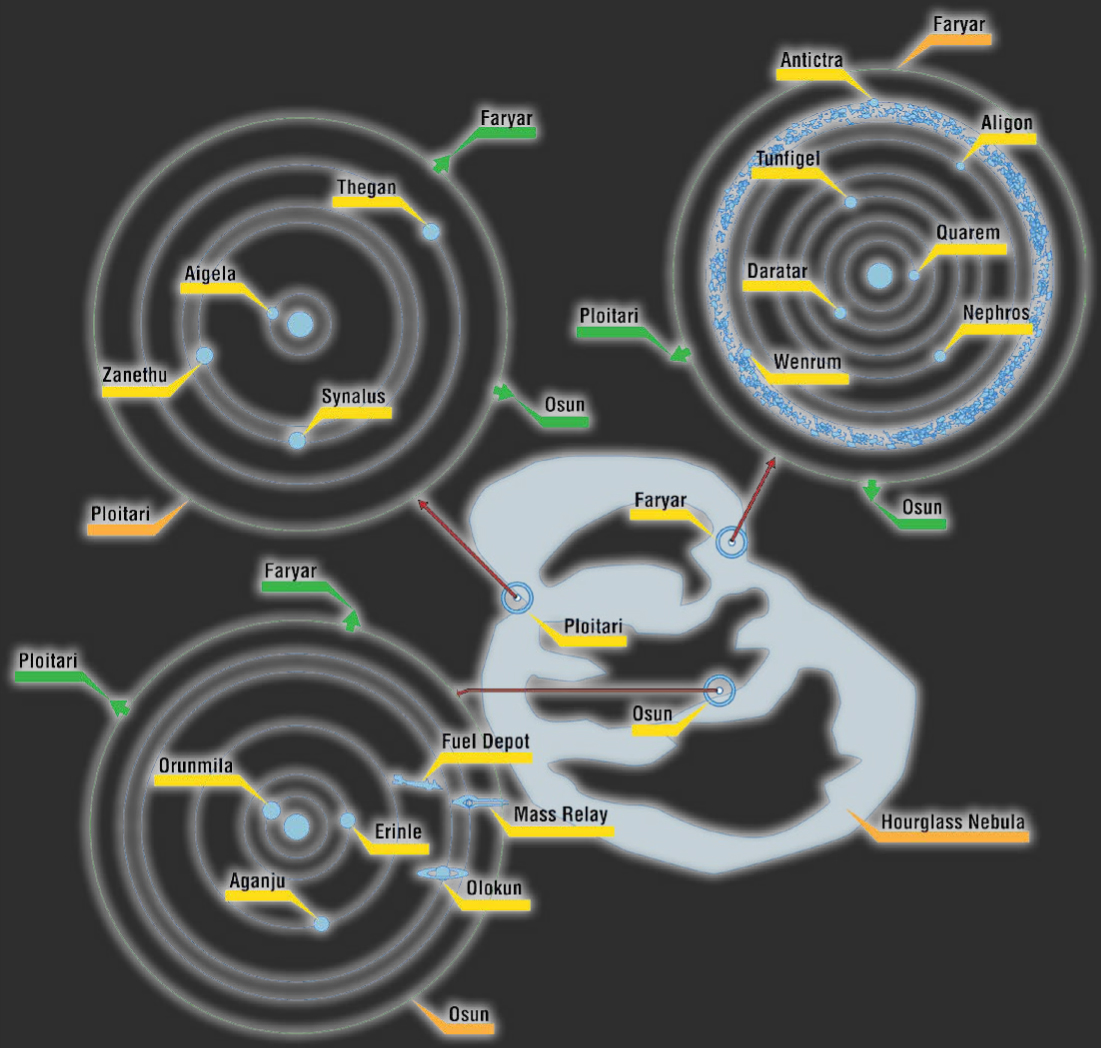
| System | Planets, Planetoids, and Other Galactic Flotsam |
|---|---|
| Faryar | Quarem, Daratar, Tunfigel, Nephros, Alingon, Wenrum, Asteroid Belt, Antictra |
| Osun | Orunmila, Purgatory, Erinle, Aganju, Fuel Depot, Olokun, Mass Relay |
| Ploitari | Aigela, Zanethu, Synalus, Thegan |
| Sowilo | Uruz, Kenaz, Hagalaz, Ansuz, Thurisaz, Isa |
| Related Mission | System | Planet |
|---|---|---|
| Walkthrough Mission > Dossier: The Convict | Osun | Purgatory |
| Additional Mission > Lair of the Shadow Broker | Sowilo | Hagalaz |
| Special Assignment > Illium > N7: Eclipse > Eclipse Smuggling Depot | Faryar | Daratar |
| Special Assignment > Illium > N7: MSV Estevanico | Ploitari | Zanethu |
System: Faryar
Alingon
World Type: Desert
Richness: Rich
Element Zero: None
Iridium: Moderate
Platinum: Moderate
Palladium: Rich
Orbital Distance: 10.1 AU; Orbital Period: 31.7 Earth Years; Radius: 3,085 Km; Day Length: 56.3 Earth Hours; Atmospheric Pressure: 0.04 Earth Atmospheres; Surface Temperature: -166 Celsius; Surface Gravity: 0.5 G.
Description: Alingon (which means “deceptive”) was so named by salarian scouts because as their probes landed on the planet their instruments started going awry.
This turned out to be due to the high concentration of magnetically active periclase (magnesia) in the core and crust of the planet.
This interferes with scans and broadcasts, which has given rise to countless spacer stories of pirates lying in wait in Alingon’s magnetosphere or crashed ships with untold fortunes stranded on the surface.
In reality, any pirates would have a hard time locating prey amid all the interference and would live lives cut off from the rest of the galaxy because the magnetosphere kills extraplanetary communication.
Alingon’s other natural features are a thin atmosphere of carbon dioxide, spectacular dry ice formations, and xenon gas, which can be skimmed from the upper atmosphere and used in ion thrusters.
Antictra
World Type: Rock
Richness: Rich
Element Zero: None
Iridium: Rich
Platinum: Poor
Palladium: Moderate
Orbital Distance: 12.3 AU; Orbital Period: 43.3 Earth Years; Radius: 5,658 Km; Day Length: 21.1 Earth Hours; Atmospheric Pressure: 0 Earth Atmospheres; Surface Temperature: -180 Celsius; Surface Gravity: 0.8 G.
Description: Antictra (which means “fused metal”) is so named because of its spectacular craters.
A planet high in various grades of iron oxide, Antictra is regularly pummeled by loose asteroids in the nearby belt between it and Wenrum.
The iron melted and fused by the incoming meteors makes for spectacular landscape shots that look alien no matter what part of the galaxy you may be from.
However, due to frequent meteor impacts exploration is considered highly dangerous even to those with advanced kinetic barriers.
Daratar
World Type: Post-Garden
Richness: Good
Element Zero: Rich
Iridium: Moderate
Platinum: Rich
Palladium: Moderate
Orbital Distance: 0.9 AU; Orbital Period: 0.9 Earth Years; Radius: 3,937 Km; Day Length: 62.8 Earth Hours; Atmospheric Pressure: 0.49 Earth Atmospheres; Surface Temperature: -66 Celsius; Surface Gravity: 0.5 G.
Description: Though ancient riverbeds crisscross the plains of Daratar, photodissociation has long since dried up the world.
There are indications of ancient mining operations, but any structures have long since been buried or worn away by the planet’s seasonal dust storms.
Nephros
World Type: Giant Jovian
Richness: Moderate
Element Zero: None
Iridium: Moderate
Platinum: Poor
Palladium: Poor
Orbital Distance: 7.5 AU; Orbital Period: 20.6 Earth Years; Radius: 44,750 Km; Day Length: 11.9 Earth Hours.
Description: Nephros (which means “restless sleep”) is a relatively small hydrogen-nitrogen gas giant.
Its atmosphere is home to spectacular winds of up to 350 kilometers/hour and electrical storms up to 700 times the power of those on Earth, which indicate that its hydrogen clouds contain moderate amounts of water vapor.
Quarem
World Type: Rock
Richness: Rich
Element Zero: None
Iridium: Rich
Platinum: Moderate
Palladium: Poor
Orbital Distance: 0.2 AU; Orbital Period: 0.1 Earth Years; Radius: 3,137 Km; Day Length: 53.1 Earth Hours; Atmospheric Pressure: 2.22 Earth Atmospheres; Surface Temperature: 558 Celsius; Surface Gravity: 3.5 G.
Description: A scorchingly hot planet close to its parent star, Quarem was bombarded by comets and asteroids during its earliest geological periods.
As the solar system stabilized, these occurrences leveled off until the planet became geologically inactive.
Its nitrogen and helium atmosphere is extremely thick due to heavy metals making the planet’s core very dense. Unfortunately, these metals are deep below the crust making mining impractical.
Tunfigel
World Type: Desert
Richness: Rich
Element Zero: None
Iridium: Moderate
Platinum: Moderate
Palladium: Rich
Orbital Distance: 1.8 AU; Orbital Period: 2.4 Earth Years; Radius: 10,772 Km; Day Length: 35.5 Earth Hours; Atmospheric Pressure: 0.03 Earth Atmospheres; Surface Temperature: -31 Celsius; Surface Gravity: 5.1 G.
Description: First charted by the salarians, Tunfigel (which means “hard heart”) is noted for its platinum and uranium deposits, making robo-mining a lucrative activity.
While the surface temperature is well within the range of a comfortable EVA excursion, the extremely dense Tunfigel generates a dangerous gravitational pull five times that of Earth.
The salarian miners exploiting the planet derisively nickname planets such as these “elcor tourist traps.”
Wenrum
World Type: Desert
Richness: Rich
Element Zero: None
Iridium: Moderate
Platinum: Moderate
Palladium: Rich
Orbital Distance: 11.8 AU; Orbital Period: 40.6 Earth Years; Radius: 1,574 Km; Day Length: 59.3 Earth Hours; Atmospheric Pressure: 0 Earth Atmospheres; Surface Temperature: -178 Celsius; Surface Gravity: 0.1 G.
Description: Wenrum (“white knight”) takes its name from a salarian story in the Romantic period of a knight who refused all temptation to riches, carnality, and even flavorful food until justice was served to the poor and oppressed.
The planet is so named because of its white, highly reflective surface, composed mainly of titanium dioxide and ice and no atmosphere to speak of to dim its albedo.
System: Osun †
Aganju
World Type: Desert
Richness: Good
Element Zero: None
Iridium: Moderate
Platinum: Moderate
Palladium: Rich
Orbital Distance: 3.2 AU; Orbital Period: 5.7 Earth Years; Radius: 10,008 Km; Day Length: 23.3 Earth Hours; Atmospheric Pressure: 0.02 Earth Atmospheres; Surface Temperature: -93 Celsius; Surface Gravity: 5.3 G.
Description: Aganju is an extremely large rock planet with a thin atmosphere of hydrogen and carbon monoxide.
Abundant in both copper and platinum, the crust has been scanned by mining bots from Erinle, but the specialized equipment to work in Aganju’s heavy gravity (more than 5 Gs) has created prohibitive costs, and so Aganju is largely unexploited.
Erinle
World Type: Garden
Richness: Good
Element Zero: Rich
Iridium: Poor
Platinum: Rich
Palladium: Moderate
Orbital Distance: 0.95 AU; Orbital Period: 0.9 Earth Years; Radius: 6,711 Km; Day Length: 32.4 Earth Hours; Atmospheric Pressure: 1.1 Earth Atmospheres; Surface Temperature: 32 Celsius; Surface Gravity: 1.1 G.
Description: Erinle is a garden world in its last stages of habitability. While its soil still supports agriculture, its animal biodiversity has fallen to record lows, and the most successful remaining life forms are toxic blue-green algae and insect-like pest species.
A large salarian colony is trying to restore biodiversity to the planet, but setbacks are a fact of life.
Mineral and fuel mining remains lucrative, however, and Erinle has a thriving spaceport that refuels many ships passing into the Terminus Systems.
Olokun
World Type: Giant Jovian
Richness: Moderate
Element Zero: None
Iridium: Poor
Platinum: Poor
Palladium: Moderate
Orbital Distance: 6.0 AU; Orbital Period: 14.7 Earth Years; Radius: 64,718 Km; Day Length: 11.9 Earth Hours.
Description: Olokun (which means “sky harvest”) is a standard gas giant composed of hydrogen and helium.
The spacefarers from Erinle gather helium-3 from here rather than Orunmila because its atmosphere is much more predictable.
Orunmila
World Type: Giant Jovian
Richness: Moderate
Element Zero: None
Iridium: Poor
Platinum: Poor
Palladium: Poor
Orbital Distance: 0.5 AU; Orbital Period: 0.3 Earth Years; Radius: 34,653 Km; Day Length: 13.7 Earth Hours.
Description: A medium-sized gas giant, Orunmila is close enough to its parent star to suffer massive changes in temperature during its day and night periods.
This leads to powerful convection currents and storms throughout its hydrogen/helium atmosphere.
Gathering helium-3 to refuel is possible for the hardiest of exploration craft, but lesser ships are nearly always lost in the attempt.
Orunmila is within the “frost line” of its solar system, where icy-cored gas giants do not usually form. For this reason it is believed to be an extrasolar planet captured by its star’s gravity.
Prison Ship Purgatory
World Type: Prison Ship
Richness: Not Minable
Element Zero: Not Minable
Iridium: Not Minable
Platinum: Not Minable
Palladium: Not Minable
Description: Owned by the notorious Blue Suns mercenary company, the Purgatory was once an “ark ship” used to hold agricultural animals.
Now it is used to hold prisoners, whether taken in battle or sold by unscrupulous politicians under the name of subcontracting and outsourcing.
Rumors abound that the Blue Suns turn skilled or fit prisoners over to batarian slavers, but few have ever seen the transactions and lived to tell about it.
Its population is listed at 4,350 but independent journalists estimate it is nearly three times that in periods of overcrowding.
System: Ploitari
Aigela
World Type: Rock
Richness: Rich
Element Zero: None
Iridium: Rich
Platinum: Moderate
Palladium: Moderate
Orbital Distance: 0.7 AU; Orbital Period: 0.6 Earth Years; Radius: 1,511 Km; Day Length: 19.3 Earth Hours; Atmospheric Pressure: 0.03 Earth Atmospheres; Surface Temperature: 125 Celsius; Surface Gravity: 0.1 G.
Description: Only known from scan data picked up by space probes, Aigela is currently classified as a dwarf planet. A warm barren rock, its thin atmosphere is composed of carbon dioxide and oxygen.
Significant alumina deposits in its crust make its density and gravity very low indeed.
Synalus
World Type: Desert
Richness: Rich
Element Zero: None
Iridium: Moderate
Platinum: Moderate
Palladium: Rich
Orbital Distance: 2.2 AU; Orbital Period: 3.3 Earth Years; Radius: 5,391 Km; Day Length: 66.8 Earth Hours; Atmospheric Pressure: 1.23 Earth Atmospheres; Surface Temperature: -3 Celsius; Surface Gravity: 0.84 G.
Description: Space probes indicate that Synalus is nowhere near as hospitable as its neighbor, Zanethu.
Synalus’s hydrogen-argon atmosphere is thought to be anathema to life, but the presence of borax on the surface, spawned by a boron-heavy core, indicates the planet may once have had water.
Thegan
World Type: Desert
Richness: Rich
Element Zero: Moderate
Iridium: Moderate
Platinum: Moderate
Palladium: Rich
Orbital Distance: 4.1 AU; Orbital Period: 8.3 Earth Years; Radius: 3,581 Km; Day Length: 28.5 Earth Hours; Atmospheric Pressure: 0.05 Earth Atmospheres; Surface Temperature: -116 Celsius; Surface Gravity: 0.56 G.
Description: Thegan rounds out the trio of planets scouted only by space probe in this backwater solar system.
A frozen ball with significant amounts of tin in its crust, Thegan has a fractional atmosphere with trace amounts of carbon dioxide and carbon monoxide.
Strange radiation emissions have been charted coming off of Thegan, but it is unknown if these are from radioactive elements or merely a star’s radiation reflected by a high-albedo surface.
Zanethu
World Type: Rock
Richness: Good
Element Zero: None
Iridium: Rich
Platinum: Moderate
Palladium: Moderate
Orbital Distance: 1.9 AU; Orbital Period: 2.6 Earth Years; Radius: 6,619 Km; Day Length: 53.6 Earth Hours; Atmospheric Pressure: 0.38 Earth Atmospheres; Surface Temperature: -16 Celsius; Surface Gravity: 1.2 G.
Description: Believed to be a post-garden world, Zanethu has large deposits of calcium carbonate in its sedimentary rocks, indicating it may have once had plate tectonics and even plant life.
Its swirling clouds of dust and snow may have occurred more recently and blocked the sun, creating a mass-extinction event. Its surface gravity is comfortable and its temperature tolerable by most sapient species.
System: Sowilo
Ansuz
World Type: Rock
Richness: Rich
Element Zero: Low
Iridium: Moderate
Platinum: Moderate
Palladium: Rich
Orbital Distance: 1.6 AU; Orbital Period: 2.0 Earth Years; Radius: 8,795 Km; Day Length: 26.4 Earth Hours; Atmospheric Pressure: 0.14 Earth Atmospheres; Surface Temp: -7 Celsius; Surface Gravity: 2.7 G.
Description: A large rock planet, Ansuz was once under development by a consortium of robo-mining interests, but an epidemic of accidents and sabotage cost the lives of hundreds of workers and eventually drove them off the world.
Despite numerous accusations among the mining corporations and a dozen or more trials, popular opinion holds that the real saboteurs were never found.
Hagalaz
World Type: Garden
Richness: Moderate
Element Zero: None
Iridium: Low
Platinum: Moderate
Palladium: Moderate
Orbital Distance: 0.95 AU; Orbital Period: 1.0 Earth Year; Radius: 6,309 Km; Day Length: 98.3 Earth Hours; Atmospheric Pressure: 0.83 Earth Atmospheres; Surface Temp: 72 (day)/-64 (night) Celsius; Surface Gravity: 0.69 G.
Description: Hagalaz is a second-tier garden world that receives little attention from the galactic community.
A salarian mining expedition initially discovered the planet, which was promptly strong-armed away from them by organized crime figures.
Hagalaz’s exploration rights were then sold to the highest bidder, which led to a brief burst of mining colonies in the 2000s, but most of those were abandoned when other planets were found with more accessible resources.
Though Hagalaz has a nitrogen-oxygen atmosphere capable of supporting life, its rotational period is slower than Earth’s, making its day and night 98 Earth hours long.
The intense heat on one side of the planet and the extreme cold on the other make for violent storm cells wherever the sun is rising or setting.
As a result, the flora and fauna of Hagalaz have developed the capability to live in cycles of ice, flooding, baking heat, and dramatic air pressure changes.
The biota of the planet has been largely unexploited by the exotic pet and gardening trades, since simulating their natural conditions is problematic for the average consumer.
Isa
World Type: Rock
Richness: Depleted
Element Zero: None
Iridium: Poor
Platinum: None
Palladium: Poor
Orbital Distance: 5.4 AU; Orbital Period: 12.6 Earth Years; Radius: 7,219 Km; Day Length: 66.5 Earth Hours; Atmospheric Pressure: Trace; Surface Temp: -135 Celsius; Surface Gravity: 1.5 G.
Description: A rock and ice planet, Isa has a thin atmosphere of methane and ethane.
Its borax deposits, largely trapped beneath the ice, were never considered valuable enough to mine since synthetic substitutes and alternative sources became widely available.
Kenaz
World Type: Rock
Richness: Rich
Element Zero: None
Iridium: Rich
Platinum: Poor
Palladium: Rich
Orbital Distance: 0.55 AU; Orbital Period: 0.5 Earth Years; Radius: 5,501 Km; Day Length: 68.3 Earth Hours; Atmospheric Pressure: Trace; Surface Temp: 72 Celsius; Surface Gravity: 0.69 G.
Description: Kenaz’s extremely thin atmosphere is mostly methane and helium. The salarian explorers who named the system set up a small mining presence for recovering nickel and chromium, used in making stainless steel.
Thurisaz
World Type: Jovian Giant
Richness: Poor
Element Zero: None
Iridium: Poor
Platinum: Poor
Palladium: Poor
Orbital Distance: 3.0 AU; Orbital Period: 5.2 Earth Years; Radius: 57,287 Km; Day Length: 18.8 Earth Hours.
Description: A hydrogen-helium gas giant, Thurisaz has a decrepit automated infrastructure for refueling merchant vessels with helium-3. Painted onto the metal in a salarian dialect are the words “Self Serve.”
Uruz
World Type: Rock
Richness: Rich
Element Zero: None
Iridium: Rich
Platinum: Poor
Palladium: Moderate
Orbital Distance: 0.25 AU; Orbital Period: 0.1 Earth Years; Radius: 9,266 Km; Day Length: 51.0 Earth Hours; Atmospheric Pressure: 78.58 Earth Atmospheres; Surface Temp: 635 Celsius; Surface Gravity: 2.1 G.
Description: Uruz is a large rock planet with a pressure-cooker atmosphere of nitrogen and argon. Its silicate-rich crust is relatively low-density.
It was largely ignored by the salarian explorers who first charted the system.